Auction 113 gave SpaceX two licenses, but that result alone does not establish a nationwide terrestrial mobile-network plan. For carriers and consumers, the result changes who holds some AWS-3 spectrum, not how mobile service works today. The licenses cover a limited part of the auction’s offerings. They do not prove a planned nationwide terrestrial network.
An unpaired uplink is a frequency block used for transmissions from a mobile device toward a network, without a paired downlink block in that license. That distinction matters because the auction’s 1695-1710 MHz block serves a specific role. The wider debate involves satellite access to other carrier bands. Those are separate questions, even when the same companies appear in both.
Key Takeaways
- SpaceX won two Auction 113 licenses, including one B1 license.
- Blue Ridge Wireless II won the single A1 license.
- Verizon had the largest gross bid total among bidders.
- CTIA’s request concerns a separate satellite-sharing proposal.
- FCC decisions and deployment milestones will shape possible service changes.
Why Did AWS-3 Spectrum Return to Auction?
Congress set the original AWS-3 reallocation process in motion in 2012, before the licenses were first auctioned. The shift began with a plan to move federal spectrum into commercial use. Congress later required a new auction and directed where its proceeds must go.
AWS-3 auction proceeds must first repay Treasury borrowing for a communications reimbursement program. That requirement shaped Auction 113 beyond its role in assigning spectrum. The Federal Communications Commission (FCC) also had to wait for new legal authority after licenses returned.
Federal spectrum became commercial spectrum
The 2012 Middle Class Tax Relief and Job Creation Act identified spectrum for reallocation from federal to nonfederal use. Federal agencies had used those frequencies, including for weather data. The process opened a path for commercial licenses.
In the 2015 AWS-3 auction, 70 bidders qualified, and the FCC awarded 1,611 licenses. Later, 197 licenses returned to the agency. Those returned licenses became part of the next sale.
Returned licenses waited for new auction authority
The FCC’s auction authority expired on March 9, 2023. Congress restored the path in the FY2025 National Defense Authorization Act, enacted December 23, 2024. The law told the FCC to begin the auction by June 23, 2026.
The act authorized $3.08 billion in borrowing for the Secure and Trusted Communications Networks Reimbursement Program. AWS-3 proceeds must repay the Treasury first. Any remaining funds may support regional technology hubs, up to $280 million, then reduce the deficit.
The FCC proposed auction rules on February 27, 2025, and adopted final rules on July 24, 2025. Its rules did not include a tribal licensing window. The FCC’s AWS-3 auction rules also set updated bidding terms.
- 2012: Congress directed federal spectrum reallocation for nonfederal use.
- 2015: The FCC auctioned AWS-3 licenses; 197 later returned.
- 2024: Congress set an auction deadline and Treasury repayment purpose.
The statutory repayment requirement made proceeds a central part of the auction’s purpose, not just a measure of bidding demand.
After repayment, the law limits technology-hub support to $280 million before directing remaining funds to deficit reduction.
What Did Auction 113 Offer?
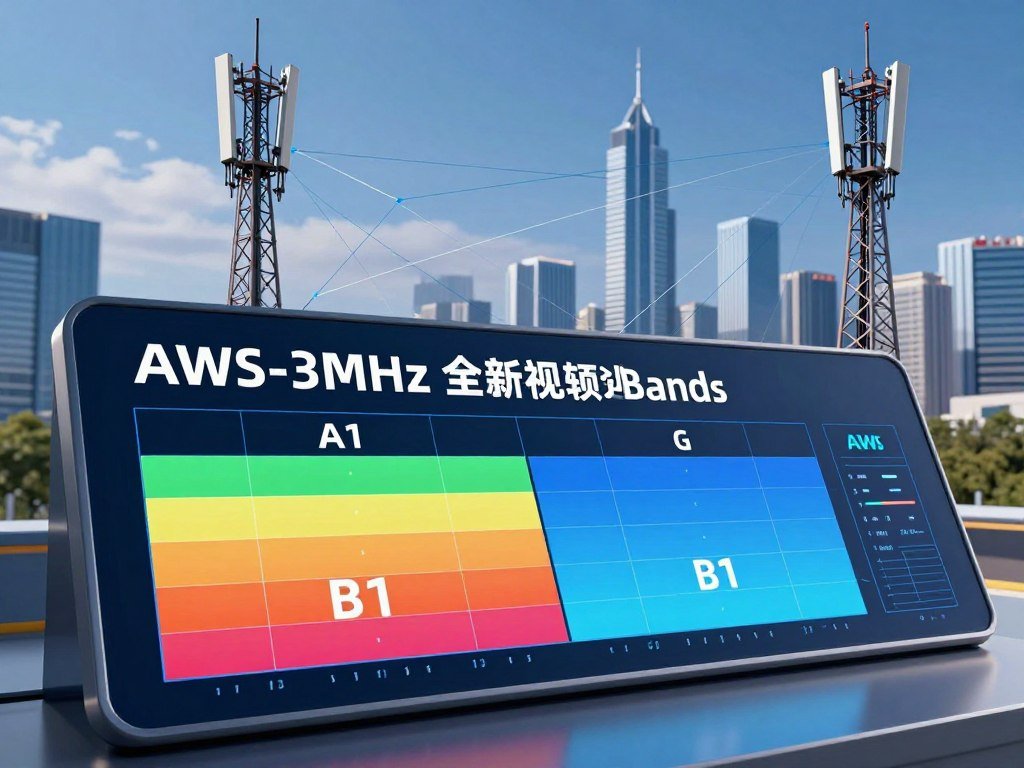
The 1695-1710 MHz portion was unpaired uplink spectrum, not a paired set of frequencies for two-way traffic. Auction 113 offered 200 licenses across three ranges: 1695-1710 MHz, 1755-1780 MHz, and 2155-2180 MHz. The first range has a special sharing rule.
Users of 1695-1710 MHz must share the band with federal meteorological-satellite data users. The A1 and B1 blocks split that range into different license slices. The FCC’s meteorological-satellite sharing rule applies across 1695-1710 MHz.
| Block | Auction scope | License-area basis |
|---|---|---|
| A1 | One 5 MHz license | Economic Area |
| B1 | One 10 MHz license | Economic Area |
| G block | 152 licenses | Cellular Market Area |
A1 covered 1695-1700 MHz and allowed low-power mobile transmissions. B1 covered 1700-1710 MHz and also allowed low-power mobile transmissions. Both were unpaired, but their bandwidth and frequencies differed.
The auction used two kinds of license areas. Forty-eight licenses in A1, B1, H, I, and J blocks used Economic Areas. The 152 G-block licenses used Cellular Market Areas.
Those areas covered markets in 48 states and two U.S. territories, home to more than 100 million consumers. The broad reach of the markets did not make each license nationwide. Readers should check the block label as well as the MHz range, since A1 and B1 cover different slices.
Who Won the Auction, and What Did They Spend?
Verizon spent the most, while T-Mobile won the greatest number of licenses among the three national carriers. The results differ: T-Mobile took 102 licenses, while Verizon secured 82. Verizon’s gross winning bids reached $3,162,445,000.
SpaceX won a B1 license, not the A1 block. Its two licenses cost $8,490,200 in combined gross bids. The final results assigned all 200 licenses after 72 rounds.

The three national carriers took most of the licenses
The three national carriers won 194 licenses between them. T-Mobile License LLC won the most licenses, but its gross bids totaled less than Verizon’s. The difference shows that license counts alone do not reveal total spending.
AT&T Spectrum Holdings II, LLC won 10 licenses for $120,774,000 in gross bids. Auction 113 ran from June 2 through June 23, 2026. Gross proceeds reached $3.573 billion, while net proceeds after applicable bidding credits were $3.572 billion.
| Bidder | Licenses won | Gross winning bids |
|---|---|---|
| Verizon, through Cellco Partnership | 82 | $3,162,445,000 |
| T-Mobile License LLC | 102 | $277,787,000 |
| AT&T Spectrum Holdings II, LLC | 10 | $120,774,000 |
| Space Exploration Holdings, LLC | 2 | $8,490,200 |
| Total auction | 200 | $3.573 billion |
SpaceX won a B1 license, not the A1 block
Space Exploration Holdings, LLC, SpaceX’s bidding entity, won one B1 license covering 1700-1710 MHz. It also won one paired G-block license. The two wins together accounted for its $8,490,200 gross bid total.
Blue Ridge Wireless II won the only A1 license. Its gross bid was $2.09 million, reduced to a net bid of $1.5675 million after a 25% small-business bidding credit. The FCC’s final Auction 113 results show that the A1 result belongs to Blue Ridge Wireless II, not SpaceX.
Carriers CTIA Real Consequences SpaceX AWS 3 1695 1700 MHz 2026: What Changed?
SpaceX’s small Auction 113 win and its much larger EchoStar spectrum transaction are separate regulatory developments. The auction gave the company two licenses. The FCC separately approved an assignment of about 65 MHz of EchoStar spectrum, in a transaction described as worth $17 billion.
CTIA’s spectrum-sharing request does not challenge SpaceX’s 1695-1710 MHz auction licenses. It concerns different bands and a separate FCC proposal. The distinction matters because the proceedings address different frequencies and actions.

The auction win and EchoStar transaction are separate
The approved EchoStar assignment covers AWS-4, AWS-H Block, and unpaired AWS-3 spectrum. The AWS-3 portion covers 5-15 MHz in Economic Areas, except Puerto Rico and the U.S. Virgin Islands. Final closing was expected on or about November 30, 2027.
Those terms do not expand the two Auction 113 licenses. The two-license win and the EchoStar assignment have separate approval paths. Their overlap in company and spectrum policy does not make them one transaction.
CTIA’s 290 MHz request concerns a different sharing debate
The FCC’s proposed Supplemental Coverage from Space (SCS) framework would make 482 MHz available for satellite-to-phone links. CTIA filed a 10-page request asking the FCC to remove 290 MHz tied to the 2.5 GHz and 3.45 GHz bands. Its filing concerns the SCS proposal, not Auction 113’s 1695-1710 MHz block.
The FCC planned to vote on the SCS proposal on October 29, 2026. Its proposed SCS framework would expand eligible bands from five to 13. The proposal remains a proposal, not a final rule.
The same vote package includes a separate proposed auction of 25 MHz for direct-to-device (D2D) satellite services. The FCC’s separate 25 MHz auction proposal covers different spectrum. T-Mobile argued that satellite use of the same spectrum could degrade its 5G service.
These are related spectrum-policy debates, not one filing or one set of frequencies. A carrier objection to satellite sharing in 2.5 GHz or 3.45 GHz should not be described as an objection to SpaceX’s B1 auction license.
What Could the Spectrum Mean for Networks and Consumers?
A satellite link can extend a carrier’s reach beyond tower coverage, but that does not make every phone connection a satellite connection. Terrestrial networks remain central to mobile service, while satellites may help connect devices outside a tower’s reach.
The FCC describes D2D as a link from next-generation satellites to a smartphone or other device, sometimes with a mobile operator’s help. The agency says assigned spectrum could support a move from text service toward voice and data. Those are possible benefits, not a guarantee or confirmed service launch.

Satellite links can extend coverage, while terrestrial networks remain central
D2D could let a phone reach a satellite where a terrestrial cell signal is unavailable. That would add another connection option, rather than replace towers across a carrier’s network. The FCC has framed voice and data as possible next steps from text-based service.
The FCC also proposed a separate auction of 25 MHz for flexible terrestrial and D2D use. A separate Starlink license order, adopted October 21, 2026, approved three unpaired AWS-3 licenses from Tristar. Those licenses cover parts of eight states and about 4% of the U.S. population.
Buildout conditions determine what SpaceX must deliver
The FCC’s order waives several rules for the assigned spectrum, while setting deployment milestones. The changes affect how the spectrum may be used and how SpaceX must show progress.
- Flexible use allows terrestrial service or D2D satellite service.
- The order waives terrestrial construction requirements and the discontinuance rule.
- SpaceX must meet milestones on par with a similarly situated terrestrial network.
The order also waives the usual 180-day consummation requirement. That change gives the transaction a different timeline from ordinary license transfers, without removing deployment duties.
Consumers may see broader coverage or more capacity if the service works as proposed. Carriers may gain a way to extend service, but satellite use could also affect shared spectrum. Readers should look for verified deployment milestones before treating expected capacity improvements as available service.
What Could Auction 113 Signal for Future Spectrum Sales?
Auction 113 is part of a larger debate over who sets the terms for future spectrum sales. Congress can set rules such as bidding credits and proceeds allocation, or leave those choices to the FCC. Those choices can change who bids and how much money an auction raises.
Auctions authorized under the FY2025 reconciliation act are expected to generate $85 billion in offsetting receipts. That figure is a policy target, not money already collected. Auction design also affects how spectrum reaches carriers and other users.
Congress can set specific conditions or give the FCC more discretion over license rules. Bidding credits may affect smaller firms’ ability to compete. Proceeds rules can decide whether funds support a named program, reduce the deficit, or serve another purpose.
The projected $85 billion is not revenue in hand; it depends on future auctions and the terms lawmakers set.
Readers tracking wireless policy can choose the topics they want through the Occcy newsletter. Watch whether Congress writes detailed auction conditions or leaves more discretion with the FCC.
Conclusion
Auction 113 confirms that SpaceX has entered the AWS-3 license picture, but it does not settle how satellite and terrestrial networks will share spectrum. The auction shows a limited license win, not proof of a nationwide mobile-network plan.
The separate EchoStar assignment and the FCC’s proposed SCS framework may shape future service, but their outcomes remain distinct. Consumers should watch for actual deployment milestones before treating possible voice, data, or coverage gains as delivered.
Follow FCC decisions on satellite sharing and SpaceX’s deployment milestones. Readers who want more technology and product news can choose topics in the newsletter?
FAQ
Did SpaceX win the 1695-1700 MHz A1 license?
No, Blue Ridge Wireless II won the single A1 license. SpaceX won a B1 license covering 1700-1710 MHz and a paired G-block license. A1 and B1 sit beside each other in frequency, but they are different licenses. The result means SpaceX’s auction win did not include the 1695-1700 MHz A1 block.
What is the difference between the A1 and B1 AWS-3 blocks?
A1 is a 5 MHz license covering 1695-1700 MHz, while B1 is a 10 MHz license covering 1700-1710 MHz. Both are unpaired low-power mobile licenses. The frequencies also sit within the band shared with federal meteorological-satellite data users. The block name matters because the MHz ranges do not identify the same license.
Did SpaceX’s Auction 113 win give it the EchoStar spectrum?
No, SpaceX’s two auction licenses and the separately approved EchoStar assignment are distinct transactions. Auction 113 awarded the B1 license and a G-block license through competitive bidding. The FCC’s approval of the EchoStar assignment covered other spectrum and followed a separate regulatory process. One approval did not transfer the other licenses.
Which carrier won the most Auction 113 licenses?
T-Mobile won 102 licenses, more than Verizon’s 82. Verizon still had the largest gross bid total, at $3,162,445,000. AT&T won 10 licenses. These results show why license count and spending are different ways to compare auction outcomes. A bidder can win more licenses without spending the most.
Is CTIA asking the FCC to remove 1695-1710 MHz from the satellite-sharing proposal?
No, CTIA’s 290 MHz request concerns the 2.5 GHz and 3.45 GHz bands in a separate SCS proceeding. It is not a request to remove 1695-1710 MHz from that proposal. The FCC’s planned vote also includes a separate proposed auction for D2D satellite services. These proceedings address different spectrum and regulatory questions.
Where will AWS-3 auction proceeds go?
AWS-3 proceeds must first repay the Treasury for funds borrowed for the Secure and Trusted Communications Networks Reimbursement Program. If money remains, the law allows up to $280 million for regional technology hubs. Any remaining funds after that support deficit reduction. The order of those uses comes from the law governing the auction proceeds.