
A chatbot drafting a reply or an image tool turning a prompt into a picture shows how generative AI has become familiar to beginners. You may use these tools without knowing what makes them work. Their reach now extends across text, images, audio and video. That range can make it hard to know what a tool can do well, or where it might fall short.
This guide explains the reusable models behind many generative AI tools in plain language. You will learn what they do, how people adapt them for tasks, and why their answers can still go wrong. You do not need a background in artificial intelligence or machine learning to follow along. Understanding the model behind a tool makes it easier to judge what the tool can and cannot do.
Key Takeaways
- Foundation models learn broad patterns and can support many tasks.
- Large language models focus on language, while other models handle different data.
- Generative AI makes new content, but predictive AI estimates likely outcomes.
- Prompting, fine-tuning and retrieval can shape a model’s responses.
- Generated answers need checks, especially when the stakes are high.
What Are Foundation Models in Generative AI?
A foundation model learns broad patterns from data, then provides a reusable starting point for different tasks. Its foundation is not one answer or a fixed set of rules. Rather, it is a base that can be adapted for jobs its creators did not build one by one.
During pretraining, a model learns patterns across a broad collection of data. That broad preparation lets one model support more than one application. Generative AI often begins with a foundation model that uses a prompt to produce an output that seems statistically likely.

The idea is different from training a system for one narrow job, such as sorting a small set of forms. A broadly trained model can be adapted for writing, summarizing, or other work. Stanford researchers popularized the term “foundation model” in 2021. The term describes a role in today’s AI systems, not the start date of the methods behind them.
A downstream task is a specific task an adapted pretrained model is used to perform. For example, a team might adapt a model to classify customer messages or help answer questions about a set of documents. The original base supplies learned patterns, while the adapted system aims at a more focused job.
Treat “foundation” as a reusable base, not a promise that one model is equally good at every job.
Broad training gives a model a useful starting point, but the data and design still shape its strengths. Some models work better with certain inputs or tasks than others. An application may also add instructions, tools or outside information. Those choices affect the response you see, even when two products use related models.
Think of the base as a starting place rather than a finished expert. Its performance depends on what it learned and how people adapt it. A model trained on broad data may handle many tasks, but it can still miss details or make mistakes on a narrow one.
How Do Foundation Models Differ From Large Language Models?
An LLM is one kind of foundation model, while generative AI describes the ability to create content. These terms are related, but they do not mean the same thing. The table shows how each term describes a different part of the picture.
Large language models are the language-focused subset of foundation models. They are common in tools that generate or work with text. Other foundation models may focus on images, sound or other data instead.

| Term | What it describes | Relationship |
|---|---|---|
| Foundation model | A reusable model trained on broad data | Can support many downstream tasks |
| Large language model | A model focused on language tasks | A subset of foundation models |
| Generative AI | Systems that create new content | A capability, not one model type |
Generative AI describes what a system can do: create new content from learned patterns. It may use a foundation model, but the term does not name one specific model type. Some generative systems are built for a narrow task, such as making images from text.
Natural language processing, or NLP, is a broader field that studies how computers work with human language. It includes the development and use of LLMs, as well as other language tools. An LLM is one kind of model used within that larger field.
The terms can appear together in a product description, but each points to a different idea. “Foundation model” names a reusable base; “large language” describes a language-focused model; “generative AI” describes a content-making ability. Check whether a tool’s name refers to its model type or to what the tool can do.
How Does a Foundation Model Work?
A foundation model’s work begins before a user types a prompt, with patterns learned during pretraining. The process moves from preparing data to adapting and deploying a model. Each stage can affect how the model responds later.
Pretraining teaches patterns; later steps shape how the model is used. Here are the four main stages in a simple model lifecycle:
- Data preparation: gather and organize material for training.
- Pretraining: learn patterns from that material.
- Adaptation: guide the model toward a specific task.
- Deployment: connect the model to an application people can use.
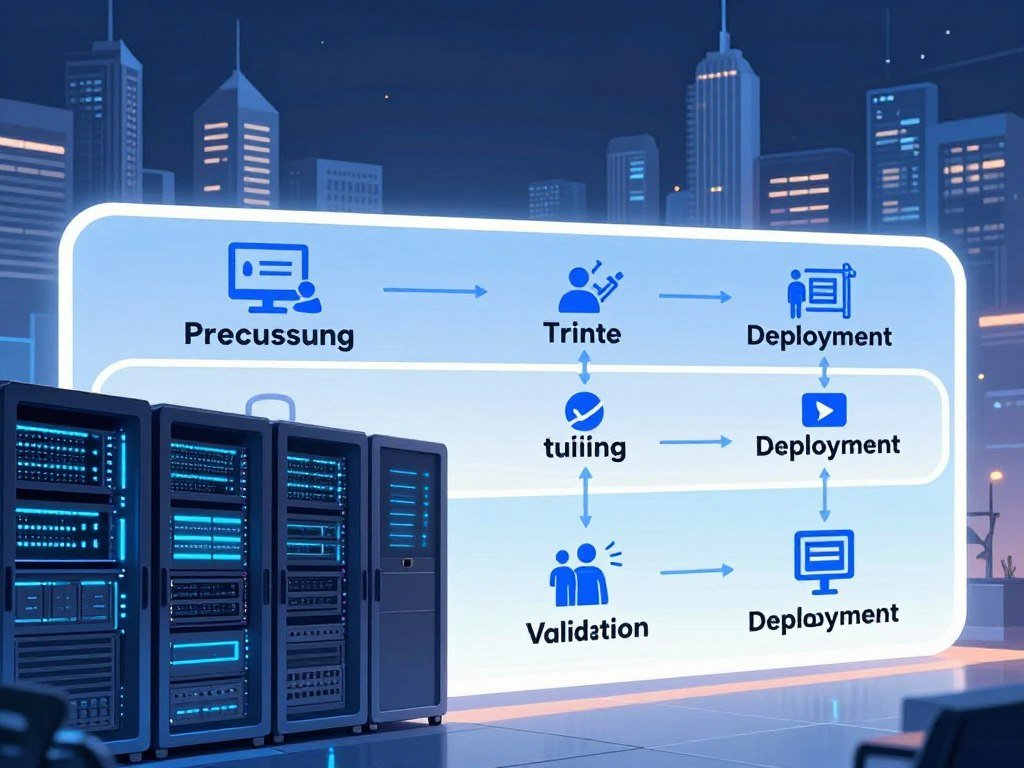
How pretraining learns patterns
Data preparation may include filtering, formatting and removing material that should not enter training. The exact process depends on the data and the model. During pretraining, machine learning methods adjust the model as it learns patterns across its training material.
Language models commonly learn by predicting the next token, a small unit of text. In simple terms, the model guesses what text is likely to come next. Image, audio and video generators learn patterns in pixels or waveforms instead.
How a model is adapted
Prompting adds instructions or examples that guide a response without changing the model’s learned parameters. A prompt might ask for a short answer, provide a tone, or show a sample format. This can guide the model toward a task while leaving its base unchanged.
Fine-tuning takes a different path: it updates a model using task-specific data. A team might use examples of a desired response style or task. The model’s architecture, data and adaptation method all affect the result.
What happens at deployment
At deployment, an application sends a prompt to the model and presents its response. The application may also apply rules or connect to other services. A user usually sees the final answer, not the many processes that led to it.
Prompt wording can change the output, but it does not make a model understand a request as a person would. A model uses patterns learned through training to form a response. A model that responds fluently at deployment is still generating a statistically likely output, not retrieving certainty by default.
What Types of Foundation Models Are There?
The clearest way to sort foundation models is by the data they handle, then by the tasks they perform. Modality means the kind of information a model takes in or produces. Architecture describes how a model is built.
Language models work with text, while vision models work with images or video. A model may analyze an image without creating one, so a modality alone does not tell you whether it is generative. Generative models produce new content from patterns they learned.

Language and vision models
A language model can process or generate text. A vision model may identify objects, describe a scene, or create an image. These are broad groups based on the data a model handles, not fixed lists of model designs.
Some systems combine language and vision. They might accept a written question and an image, then produce a text answer. A model that handles multiple kinds of data is called multimodal.
Multimodal models and generative architectures
Diffusion models, generative adversarial networks (GANs), transformer models and variational autoencoders (VAEs) are architectures used in generative AI. Each has a different design and common uses. The table gives a few concrete examples.
| Architecture | Common role | Example output or task |
|---|---|---|
| Diffusion | Generate or edit images | Turn a text prompt into an image |
| GAN | Generate data through two competing networks | Create a synthetic face image |
| Transformer | Process sequences and related context | Predict the next word in a text response |
| VAE | Learn compressed data patterns | Generate a new sample image |
These categories can overlap. A transformer might work with text, while a diffusion model might generate images. A single system may use more than one design or handle more than one kind of data.
There is no one official set of foundation model types. The answer to “Which of the following is not a valid set of foundation models?” depends on how the set groups architectures, data types and tasks. Treat modality and architecture as two different classification questions, since one model can fit both.
For a closer look at text-to-image tools and diffusion, see this guide to AI image generator tools. It helps to keep the model’s input and output in view when comparing systems.
Which Familiar Generative AI Models Power Common Tools?
ChatGPT is a generative AI chatbot: it uses large language models, including GPT, to respond to prompts. The product and the model are not the same thing. A product gives you an interface, while a model helps power the work behind it.
OpenAI develops GPT, DALL-E, Whisper and Codex. GPT is its text-and-reasoning family; DALL-E focuses on image generation; Whisper supports speech-to-text; and Codex supports coding work. A model’s name does not guarantee a particular result.
OpenAI’s lineup includes GPT-5.5, o-series, GPT-4o and GPT-4o Mini. Product names and model family labels can refer to different things, even when they appear together. A chatbot may use one or more models to answer prompts.
Claude Opus, Sonnet and Haiku are Anthropic model family names. Opus targets frontier reasoning, Sonnet aims for balanced performance, and Haiku supports fast, lightweight use. These labels describe intended roles, not a promise that every response will suit your needs.
Amazon Nova Micro, Nova Lite and Nova Pro accept text, image and video inputs and generate text. Nova Canvas accepts text and image inputs and generates images. Nova Reel accepts text and image inputs and generates video. The input and output types differ across the group.
Two earlier examples show how model types and dates can add context. BERT was released in 2018 and trained on plain text and Wikipedia, using 3.3 billion tokens and 340 million parameters. OpenAI developed GPT in 2018. Stable Diffusion, released in 2022, is a text-to-image model that uses diffusion.
ChatGPT is a product, while GPT is a model family used by that product. Similar names can make product and model relationships hard to spot. Match a model’s documented input and output types to the task instead of choosing by name alone.
For a product-level comparison, you can explore popular AI chatbots and their uses. That distinction matters when a product offers more than one model or service.
What Can Foundation Models Do?
A foundation model can turn a prompt into a first draft, a summary, a translation or another kind of content. Creating new content is a key feature and the main goal of generative AI. It does more than sort information already in a file.
Generative systems can support different applications when people adapt them to a downstream task. The model’s central job is to create an output from an input. Here are five common tasks:
- Drafting and summarizing text, such as an email or a long report.
- Translation between languages for written messages.
- Image generation from a written description.
- Speech transcription that turns spoken words into text.
- Question answering based on a prompt or supplied information.
Tools apply these capabilities in different ways. Bing Chat can answer questions and summarize information. Duolingo Max offers language-learning features. These products show how a shared kind of technology can support distinct tasks.
Be My Eyes Virtual Volunteer provides virtual assistance to people who are blind or have low vision. Khanmigo offers tutoring-style support. These examples do not mean a model replaces a teacher, a sighted helper or a person’s judgment.
Generative AI can also support healthcare work, including patient education, translation and summaries. A nursing-focused overview discusses those uses alongside concerns about privacy, bias and accountability. For that setting, read this overview of generative AI in nursing.
The output may be useful even when it needs editing. A draft can give you a place to begin, while a summary can help you find the main points in a long text. Use generated work as a starting point when the task requires a person to verify meaning or context.
For images, the prompt guides the result but may not control every detail. You can compare tools with the same request in this guide to AI image generators and platforms. Each service may offer different editing features and outputs.
Generative AI vs. Predictive AI: What’s the Difference?
Generative AI makes a new output, while predictive AI estimates what is likely to happen next. The main difference is the result each system aims to produce. One creates content; the other estimates a likely outcome.
Generative systems use learned patterns to produce new text, images or other outputs. Predictive systems use historical data to estimate future events, results or trends. A GPT-style generator produces content, while an ARIMA model can forecast a time series.
| Type | Main job | Typical input | Output |
|---|---|---|---|
| Generative AI | Create new content | Prompt or example | Text, image or other content |
| Predictive AI | Estimate a likely outcome | Historical data | Forecast or probability |
| Combined workflow | Explain a forecast | Forecast and related facts | Generated explanation |
An ARIMA model is commonly used for time-series forecasting. A time series is a set of measurements recorded over time, such as monthly sales. The model uses past values to estimate future ones.
A combined workflow can pair a forecast with a generated explanation. For example, a predictive model could estimate a trend, then a language model could turn that result into plain text. This is a way to combine systems, not a separate AI category.
The two approaches can support different needs, even when they use related data. A forecast is an estimate, while a generated explanation is new text. Choose by the result needed: a new draft calls for generation, while a future estimate calls for prediction.
What Are the Benefits of Foundation Models?
Reusing a pretrained base can let a team focus on its specific application instead of starting with a separate model for every task. Reuse can save time during development. It also gives teams a base they can adapt for more than one application.
Pretrained models already contain patterns learned from broad data. A developer may not need to label new data for every task before testing an idea. One reusable base can support several applications, though each still needs to fit its purpose.
That shared starting point can make experimentation faster. A team can test a prompt or adaptation on a small set of examples before building a full service. The same base may support a writing tool, a support assistant or a document search feature.
Reusing models can also change the resources a team needs. A group may spend less time building a model from scratch, yet still need skilled people, suitable data and a platform for deployment. Machine learning work depends on the model and task, not just the base.
Running a model after development has its own cost, often called inference cost. Between November 2022 and October 2024, inference costs for GPT-3.5-level performance fell over 280-fold. That comparison applies to a particular performance level, not every model or deployment.
Lower costs for that level of performance can make some uses more accessible. A deployed service may still need computing power, monitoring and ongoing support. A larger model or a high volume of requests can require substantial resources.
The practical benefit depends on how well the base fits the work. A model that needs too much repair may not save time overall. Evaluate the cost of running the model in the intended application, not only the cost of developing it.
What Are the Limits and Risks of Foundation Models?
A confident-sounding response can still be wrong, biased or difficult to explain. Fluent text can hide gaps in a model’s knowledge. A model may also produce an answer without making its reasoning clear.
Black-box behavior makes it hard to understand why a model produced a certain output. Training data can shape what it says, including data that is incomplete, biased or sensitive. Data can contain gaps, bias, private information or copyrighted material, and a model may reproduce examples from it.
Generative AI can produce plausible but false information, often called a hallucination. Developers can reduce such errors, but no safeguard fully removes them. Models can also sometimes reproduce text or images from training data, including examples word for word.
The U.S. Copyright Office’s May 2025 report examines copyrighted works used to develop generative AI systems. It also considers legal questions about consent and compensation. Those questions matter to creators and the people who build AI services.
- Inaccurate outputs can mislead a reader or decision-maker.
- Bias in data can lead to unfair or uneven results.
- Privacy exposure can occur when sensitive information appears in outputs.
- Copyright concerns can arise when a model uses protected works.
Ethical AI development aims to make systems beneficial while prioritizing fairness, safety and accountability. A nursing-focused review also covers transparency and responsibility in clinical uses of generative AI. Verify high-stakes outputs with an accountable person and trusted evidence before acting on them.
How Do Grounding and RAG Improve Responses?
Grounding gives a model relevant outside information to use when forming a response. Trusted context can help connect an answer to information beyond the model’s training. It can also make the answer easier to check.
Grounding connects a language model’s response to external information, such as trusted data held by an organization. Grounding can reduce hallucinations, but it cannot guarantee a correct answer. The quality of the outside information still matters.
Retrieval-augmented generation, or RAG, retrieves relevant material before the model generates a response. It can bring both structured and unstructured organizational data into the answer as context. Structured data may sit in tables, while unstructured data may include documents or text.
RAG can use that material without retraining the model. The system finds information related to a prompt and supplies it as context. The model then uses that material when forming a response.
This approach can help a model answer questions about current or private organizational information. Yet the answer may still fail if retrieved material is old, incomplete or unrelated to the question. A source that looks relevant may not support every detail in the response.
Grounding is most useful when the external information is reliable and suited to the task. The model still creates the response, so the supporting material needs to match what the answer says. Keep the retrieved documents current and check that they support the answer being used.
How Can You Adapt or Choose a Foundation Model?
Start with the least involved adaptation method that can meet the task’s requirements. Prompting can guide a model without changing it. Fine-tuning and parameter-efficient methods change some of the model itself.
Transfer learning applies patterns learned in one task to another. Prompting, fine-tuning and parameter-efficient fine-tuning (PEFT) offer different ways to adapt a model. Choose based on the task, the data you can use and the resources you can support.
Prompting for quick task guidance
Prompting adds instructions or examples without updating model parameters. It can be a useful first test when you want a certain style, format or type of answer. You can change the prompt and compare the results.
Fine-tuning for specialized behavior
Fine-tuning updates model parameters with task-specific data. It may fit a repeated task that needs a consistent response pattern. The team needs suitable examples and a way to test how the changes affect results.
Parameter-efficient adaptation
PEFT updates a smaller portion of model parameters rather than changing the full model. It can be an option when full fine-tuning is not a good fit for the team’s available resources. The table compares the three approaches.
| Method | What changes | When it can fit |
|---|---|---|
| Prompting | Instructions or examples only | Quick guidance without parameter updates |
| Fine-tuning | Model parameters updated with task data | A repeated task needs specialized behavior |
| PEFT | A smaller portion of parameters | Adaptation with fewer parameter changes |
Before choosing a model, check the task and the system around it. The same base may be useful for one workflow but unsuitable for another. Use this five-part checklist:
- Task fit: does the model suit the work you need done?
- Input and output modality: can it handle the needed data types?
- Data access and privacy: can it use the data safely?
- Performance testing: does it work on representative examples?
- Deployment resources: can your team run and support it?
GPUs support AI training and inference, and infrastructure can affect what a developer can run. NVIDIA offers GPUs, CUDA-X libraries, NIM inference microservices, Dynamo and the NGC catalog. These are examples of tools and services, not endorsements of a specific setup.
Pick a model that matches the workflow rather than the most familiar name. Test the adapted model on representative examples before connecting it to a live workflow.
How Is the AI Model Landscape Changing?
A useful snapshot is that U.S.-based institutions produced 40 notable AI models in 2024. That count has a defined scope: it covers notable models from U.S.-based institutions, not every foundation model worldwide.
Industry produced nearly 90% of notable AI models in 2024, up from 60% in 2023. The share shows that industry has become a larger source of notable model development. The figures describe notable models, not all AI models in use.
The word “notable” matters because it sets a boundary around what gets counted. Different lists may use different rules for deciding which models qualify. A count based on one definition will not match a count using another.
The total number of foundation models worldwide is not a stable figure. It changes as new models appear, and it depends on what people count as a foundation model or as notable. The 40-model figure is not a global total.
AI development also comes from different kinds of groups. Universities, companies and other institutions can build or release models. The rising industry share points to a change in who produces the notable models included in this snapshot.
A number can help describe growth, but it needs a date and a clear definition. Without both, two model counts may appear to disagree when they measure different groups. Treat any model count as a dated snapshot with a stated definition, not a permanent inventory.
A model count is useful only when you know which models, institutions and year it covers.
Scale alone does not tell you whether a model suits a particular task. A small group of models can still differ in data, performance and intended use. The count is a point in time, not a measure of quality.
Conclusion
A foundation model is best understood as a flexible starting point whose usefulness depends on the task and the checks around it. It can support many applications, but it does not guarantee correct answers or a perfect fit. How you adapt and test it matters.
Choose one small, low-risk task and try a model on examples that reflect the work. Check whether the outputs are clear and useful before relying on them. Begin with one manageable task, verify the results and expand only when the model performs well enough for the real need.
FAQ
How many foundational AI models are there?
There is no stable global count of foundational AI models. New models appear, and people use different rules to decide which ones count as foundation or notable models. U.S.-based institutions produced 40 notable AI models in 2024, but that figure covers a defined group. It is not a count of all foundation models worldwide.
Is ChatGPT a generative model?
Yes, ChatGPT is a generative AI chatbot developed by OpenAI. It uses large language models, including GPT, to respond to prompts with generated content. The chatbot is the product people use, while GPT is a model family that can help power it. Its responses can still contain mistakes, so check important details.
Are large language models a subset of foundation models?
Yes, large language models are the language-focused subset of foundation models. They work mainly with language tasks, including text generation and other text-based work. Foundation models also cover other data types and tasks, such as image generation or vision. The terms describe related ideas, but they are not interchangeable.
What are the 7 main areas of AI?
There is no universally fixed list of seven main AI areas. A practical grouping includes machine learning, natural language processing, computer vision, robotics, expert systems, planning and speech recognition. These areas can overlap: machine learning methods may support vision, language or speech systems. The right grouping depends on whether you sort by task, method or field.
What are the 5 main AI models?
There is no official list of five main AI models. A practical grouping includes language models, vision models, multimodal models, generative systems and predictive systems. These groups overlap because some models handle more than one data type or task. The grouping describes what systems work with or do, rather than five distinct model designs.