A buyer can receive a useful answer from an AI platform without ever seeing a page of search results. That shift is why AI visibility matters when you want your brand to reach people during research. ChatGPT, Perplexity, Google AI Overviews, Gemini, Claude, and Copilot can all shape how buyers learn about products and services.
Unlike traditional search, these platforms can combine information from several places into one response. Your brand might appear as a mention, earn a citation with a link, or receive a recommendation. Those forms of presence mean different things, and none alone proves that buyers will visit your website or choose your product.
You will learn how to measure these appearances, compare platforms, choose useful tools, and improve the information that systems can find. The goal is a clear process, not a single score that hides what happened. Treat AI presence as a separate measurement task alongside, not instead of, search performance.
Key Takeaways
- Answer appearances differ from traditional search rankings.
- A mention, citation, and recommendation are separate signals.
- Results can change across prompts, platforms, and dates.
- Track a fixed set of buyer questions for fair comparisons.
- Use results to guide focused changes, then measure again.
What Is AI Visibility?
AI visibility describes whether an AI answer includes a brand, its content, or a source from its website. The presence can take the form of a mention, a citation, or a recommendation, and each form signals something different.
Entity resolution is the process of distinguishing a brand from similarly named people, products, or organizations and connecting it to the right facts. A brand can appear without a link, while a citation points to a page. A recommendation goes further by presenting the brand as a choice.
An appearance does not prove positive sentiment, accuracy, or business impact. Record what the answer actually says before treating presence as success.
ChatGPT, Perplexity, Google AI Overviews, Gemini, Claude, and Copilot are platforms you can monitor. They may describe the same brand in different ways, or leave it out of a response altogether.
That makes the surrounding answer useful evidence. Note whether the system names a product, describes a use case, compares competitors, or gives a reason for its choice.
Also keep the exact wording and any links with your record. Record the exact answer context, since an unlinked mention and a linked citation indicate different kinds of presence.
How Does AI Visibility Differ from Traditional Search?
A page can rank well in Google and still fail to appear in an AI answer about the same topic. Rank position measures a page’s place in results, while answer presence measures whether a brand appears in a generated response.
SEO and AI visibility overlap, but they are not interchangeable. Google Search and Bing are traditional search indexes that can also inform AI-powered experiences. Yet a strong ranking alone does not ensure that an AI platform selects or cites your page.
| Dimension | Traditional search | AI visibility | Practical implication |
|---|---|---|---|
| Primary measure | Page position | Answer presence | Track rankings and appearances separately |
| User experience | Link selection | In-platform reading | Some buyers may not visit a site |
| Success signal | Rankings and clicks | Mentions and citations | Use measures that match the result |
| Competitive comparison | A results page | An answer response | Compare brands within the same response |
Traditional search often gives people a list of pages to choose from. An AI answer may instead summarize several sources, name a few brands, and omit others.
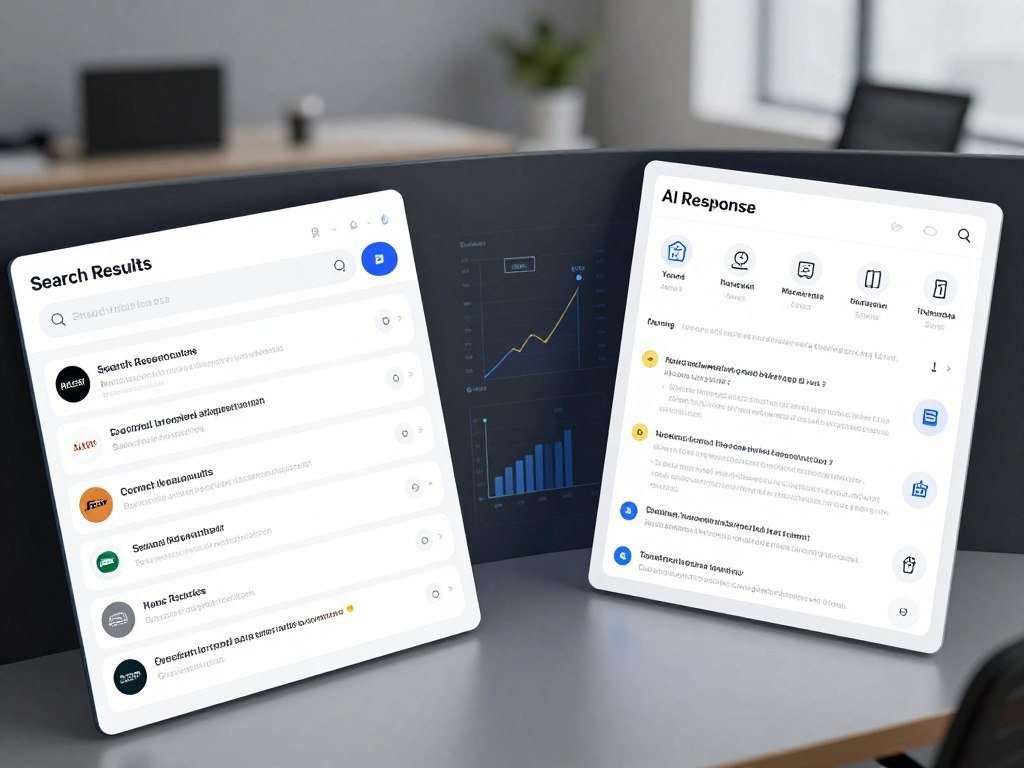
That change affects reporting. A rise in traffic can come with flat answer presence, while more mentions may not bring more visits.
Google rankings can affect eligibility for its generative AI features, but they do not guarantee selection or display. Keep rankings and answer presence in separate reporting columns so strength in one does not conceal a gap in the other.
Which Types of AI Presence Should You Track?
A mention rate can look healthy even when an AI platform rarely recommends the brand. Separate signals show whether the brand appears, how it appears, and whether the appearance helps buyers.
Report each measure on its own before combining results into a summary score. A mention is an unlinked brand reference; a citation is an attributed link to a brand-owned page or another source.
Mention rate measures how often a brand appears across sampled answers. Citation rate measures how often an answer links to a source, while recommendation rate tracks answers that favor the brand as a choice.
Entity resolution checks whether the system identifies the correct brand. Source role records whether a page serves as evidence, a product source, or a general reference. Sentiment captures the answer’s tone, and stability checks whether results hold across engines and repeated runs.
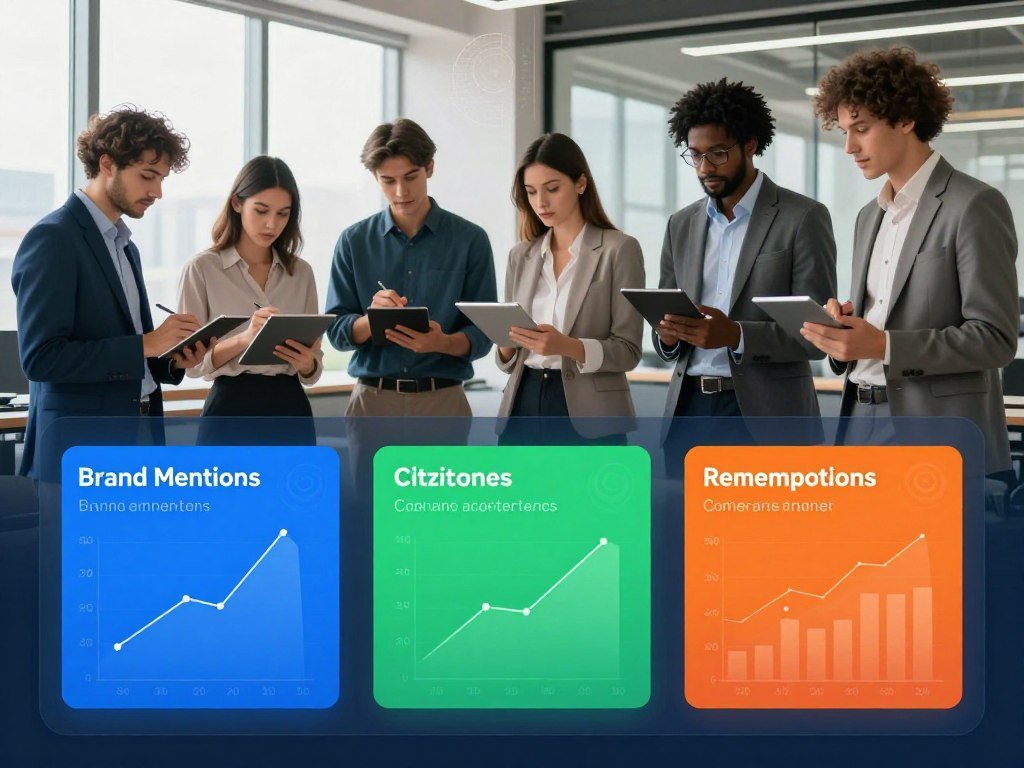
These measures can diverge sharply. In a 2026 sample of 60 brands, the median brand appeared in 19.8% of AI answers but received recommendations over alternatives in just 0.2%. Fifteen brands received no recommendations during the measured month.
A strong appearance rate, then, does not mean buyers hear a clear endorsement. A source role can also matter: a brand might be named in passing while a competitor supplies the answer’s main evidence.
For a useful report, show each rate with its platform, prompt panel, and date window. Report each metric separately before combining any of them into a summary score.
Why Can AI Visibility Change Between Checks?
The same prompt can produce different AI answers on separate runs, even when the brand and platform have not changed. One response is an observation, not a dependable trend.
A practical floor for a stable segment rate is 10 observations across at least 7 distinct run dates. AI generation is not fully predictable, so repeated sampling helps show whether a result persists.
Wording can change which information a platform retrieves. The platform, date, and repeat run can also affect which brands appear, which sources get cited, and how the answer is framed.
Keep the observation count and date window beside every reported rate. For example, a rate from 10 answers over seven dates should not be presented as if it came from hundreds of checks.

Small panels can still help you learn, as long as you label them clearly. A single missed mention may reflect one answer, not a lasting loss of visibility.
When results shift, inspect the saved answers before drawing a business conclusion. Avoid calling a one-run fluctuation a trend.
What Is a Good AI Visibility Score?
A score of 49/100 and a score of 55.8/100 cannot be compared as if both came from one universal scale. Same-method progress is a better test: compare a brand with its own results from the same provider and setup.
A good score improves under the same method while meeting your brand’s goals. Provider scores may use different prompts, platforms, weights, date windows, and rules for missing data.
How Composite Scores Are Built
A composite score combines several measures into one number. One proposed model assigns 25% to entity resolution, 20% to mention rate, 20% to citation rate, 20% to source-role evidence coverage, and 15% to consistency across engines.
Those weights are an example, not a tested universal standard. Presenc AI uses a different six-factor model: Knowledge Presence at 20%, Semantic Authority at 18%, Citation Frequency at 18%, Contextual Integrity at 16%, Share of Voice at 14%, and Recommendation Rate at 14%.
What Benchmarks Can and Cannot Tell You
Presenc AI’s Q1 2026 benchmark covers 2,847 brands across 15 industries. Brands were monitored for at least 90 days across ChatGPT, Claude, Gemini, Perplexity, and Copilot. Its cross-industry median was 49/100.
| Benchmark | Value | Scope |
|---|---|---|
| Presenc AI cross-industry median | 49/100 | Q1 2026, six-factor composite |
| Presenc AI industry examples | SaaS/Technology 63; Construction/Real Estate 31 | Q1 2026 industry medians |
| AuthorityTech mean | 55.8/100 | Its 200-brand index |
| Proposed AuthorityTech weighting model | Entity 25%; mentions 20%; citations 20%; source role 20%; consistency 15% | Illustrative model, not universal |
Other Presenc AI industry medians were Financial Services 56, Healthcare/Pharma 49, E-commerce/Retail 52, Professional Services 45, and Manufacturing/Industrial 37. Those numbers describe one index and its method.
AuthorityTech’s mean describes a separate index, so its value cannot be read as a higher result on Presenc AI’s scale. A benchmark can help you see category patterns, but it cannot set a universal target.
Before you compare providers, check their components, prompt panels, engines, dates, missing-data rules, and weights. Keep the scoring formula and benchmark conditions beside the number whenever you share it.
How Do You Build a Reliable Prompt Set?
Start with the questions a buyer would ask while deciding what belongs on a shortlist. Buyer intent gives a prompt panel more value than a random list of popular keywords.
A practical starter panel can contain 10-20 buyer questions. Include a category, a use case, and a comparison so you can see more than one kind of answer.
Group Prompts by Buyer Decision
Map each prompt group to a real decision. A buyer choosing software may first learn what the category means, then look for tools that fit a task, and finally compare vendors.
Cover Different Question Types
- Category and definition questions: What does the product category include?
- Use-case questions: Which options fit a named job or team?
- Comparison questions: How do two relevant competitors differ?
- Buying or evaluation questions: What should a buyer check before choosing?
Buyer roles can shape wording. A small-business owner may ask about setup, while a technical lead may focus on integration and control.
Use cases should reflect your real market, not every task anyone could imagine. Add competitors buyers actually consider, rather than turning the panel into a broad catalog of names.
Expand the set when distinct audiences or markets ask different questions. Keep those groups separate so a shift in one audience does not distort another audience’s results.
Save prompt wording exactly so a later run can be compared fairly. A small set that reflects actual choices is more useful than a large panel of loosely related queries.
How Do You Check AI Visibility Across Platforms?
A spreadsheet and a small, consistent prompt panel are enough to establish a first baseline. Record the platform because ChatGPT, Perplexity, and Google AI Overviews can give different answer experiences.
A saved answer records one run, not a permanent ranking. The response may include linked citations, unlinked mentions, or neither.
- Run the same prompt on each selected platform.
- Save the full answer and the date of the check.
- Log mentions, citations, recommendations, and sentiment separately.
- Note the source URLs that appear in the response.
Use the same wording for each platform when you compare results. For a comparison of assistant workflows, see this guide to ChatGPT, Claude, and Gemini.
Keep the whole answer, not only a count. The surrounding language can reveal whether a system recommends a brand, mentions a limitation, or simply lists it.
Store the answer text with its date, since a count alone cannot show how the AI framed the brand. A saved response also makes it easier to review a change later.
Which AI Visibility Tools Fit Different Teams?
An SEO team that wants source and URL analysis can start by comparing SE Ranking, while a team that needs broad prompt coverage can examine Ahrefs. The right fit depends on coverage, competitor limits, history, update pace, and useful analysis.
SE Ranking suits teams that want AI tracking alongside SEO work, while Ahrefs offers broad prompt coverage and custom prompt tracking. Compare what each tool counts before treating scores as equivalent.
Best AI Visibility Tools by Use Case
OtterlyAI fits teams looking for a lower starting price, while Peec AI offers smart suggestions. ZipTie focuses on analysis and reporting, and Similarweb combines SEO and GEO tracking.
Petra Labs targets enterprise needs. Semrush and Ahrefs may suit existing users, Clearscope serves content creators, and Yext Scout focuses on local tracking.
| Tool | Starting price | Distinguishing fit |
|---|---|---|
| OtterlyAI | $29/month | Lower-cost starting option |
| Peec AI | $95/month | Smart suggestions |
| ZipTie | $35.63/month | Analysis and reporting |
| Ahrefs Brand Radar | $199/month | Broad prompt coverage |
| SE Ranking AI Search add-on | $71.20/month | SEO workflow with AI tracking |
Ahrefs Brand Radar for Broad Monitoring
Brand Radar measures mentions, citations, AI Share of Voice, and estimated impressions weighted by real search volume behind prompts. Its index covers more than 509 million prompts across AI Overviews, AI Mode, ChatGPT, Perplexity, Gemini, and Copilot.
Ahrefs builds prompts from its keyword database and Google’s People Also Ask corpus. Prompt-based question sets are retested monthly on a 90-day reporting window, while search-based AI Overviews and AI Mode indexes update continuously.
Its AI Visibility Index starts at $199 per month, and Custom Prompts start at $50 per month. Custom Prompts can run daily, weekly, or monthly; daily tracking checks each prompt daily on each selected platform.
SE Ranking AI Visibility Tracker for SEO Teams
SE Ranking tracks Google AI Overviews, Google AI Mode, ChatGPT, and Gemini. It supports up to five competitors and offers source and URL analysis, history, saved answer copies, and competitor comparisons.
Its source page lists seven markets and five languages. The tracker offers a free check with up to five attempts per day, plus a 14-day trial for ongoing tracking. The AI Search add-on starts at $71.20 monthly, while its Core SEO plan starts at $103.20.
SE Visible covers five major AI engines and reports mentions, sentiment, share of voice, competitors, prompts, and sources. Frase covers ChatGPT, Perplexity, Claude, Gemini, and Google AI, joining monitoring with research, writing, optimization, and publishing.
For other options, a 2026 tool comparison pairs Similarweb with combined SEO and GEO tracking, Petra Labs with enterprise needs, Clearscope with content teams, and Yext Scout with local tracking.
Ahrefs supports historical AI responses back to 2025, while Custom Prompts begin collecting data after setup. Compare what each tool counts and how often it updates before treating its scores as equivalent.
What Do AI Platforms Use to Find and Cite Content?
Many AI search experiences first find candidate information and then synthesize an answer from it. Retrieval is the step that gathers material before a system writes its response.
Retrieval-Augmented Generation combines retrieved material with generated answers. Some platforms may use training data, real-time retrieval, or a hybrid of both, and they do not all work the same way.
Retrieval Happens Before Answer Generation
A platform with web retrieval can look across an index or other accessible sources. It then selects information that may help answer the prompt and creates a response from that material.
Training data is information a model learned during training. Real-time retrieval can bring in newer pages, while a hybrid system may use both learned information and retrieved sources.
One Prompt Can Trigger Several Related Searches
Query fan-out means a system splits one question into related searches. A prompt about project software might trigger searches about product features, team use cases, and vendor comparisons.
Google says AI Overviews and AI Mode rely on core Search ranking and quality systems, retrieval-augmented generation, and query fan-out. That approach can surface several kinds of evidence for one response.
The final answer may combine details from different pages, even if the user submitted one short question. A cited source may support only one part of the response.
For support with drafting and research workflows, AI writing tools for content creators can help organize work, while people still need to check facts and add expertise.
Treat each platform’s retrieval behavior as its own measurement context. A citation pattern on one engine does not guarantee the same pattern elsewhere.
How Can You Make Your Brand Easier for AI to Recognize?
Clear identity signals help reduce confusion between a brand and similarly named entities. Consistent details make it easier for systems and readers to connect a name with the right product and facts.
Keep the brand name, category, and product details aligned across your own pages and public profiles. Small differences in naming or descriptions can muddy the picture.
- Use one consistent brand name across the website and profiles.
- State the category and intended audience in plain language.
- Keep organization and product details aligned across profiles.
- Use relevant structured data, such as Organization or Product.
Structured data is a standard way to label information on a web page. Schema.org includes types such as Organization and Product, which can describe a business or an item.
These labels help describe a page, but they do not guarantee an AI mention. Clear facts still need to match what people can read on the page.
A company profile might call a product one thing while a product page uses a different name. Check the same brand description on the website, company profile, and product pages for contradictions.
How Do You Make Website Content Easier to Cite?
A useful page makes its main answer clear without requiring an AI system to infer it from several unrelated paragraphs. Direct answers and clear page structure help readers find the point quickly.
Answer the page’s central question plainly, then support it with useful facts. Descriptive headings, self-contained sections, and comparison tables can make a real answer easier to identify.
Write Self-Contained Answers
Give each section enough context to make sense on its own. Define unfamiliar terms, name the subject clearly, and avoid relying on a paragraph several screens above.
Use comparison tables when the products or choices have real differences. Clearly attribute original data, and separate verified facts from your views or recommendations.
- Answer the page’s central question plainly.
- Make sections understandable without nearby paragraphs.
- Distinguish verified facts from opinion.
- Add useful images or video when they clarify the topic.
Add Distinctive Evidence and Useful Media
Original measurements, examples, and expert insight can give a page more value than a reworded summary. A 2024 GEO research study found that tested optimization strategies raised visibility by up to 40% in its benchmark, with results varying by domain.
Google recommends useful content with a distinct point of view, clear organization, and relevant, high-quality images or video for its generative AI search features. Its guidance on helpful, reliable, people-first content also stresses value for readers.
For a visual that explains a process, compare free AI image generator tools before choosing one. If motion adds clarity, review free AI video generator options and their use terms.
Useful, distinctive material is better than many pages written for minor query variations. Google warns that making pages mainly to target every query variation or fan-out search can violate its scaled content abuse policy.
Publish a page only when it adds useful detail beyond a reworded version of an existing answer. A page with a clear purpose gives people a reason to trust and use it.
How Does Google AI Search Affect Visibility?
A page needs to be indexed and eligible for a Search snippet before it can be eligible for Google’s generative AI features. Eligibility is the starting point, not a promise that the page will appear.
Google Search eligibility does not guarantee crawling, indexing, selection, or display in AI Overviews or AI Mode. A page can meet the basic rule and still be left out of a particular answer.
Google’s AI Overviews and AI Mode draw on its Search systems. The page must be available in Search and eligible to appear with a snippet before those features can consider it.
Check the indexability and snippet eligibility of pages that matter to buyers. If a useful page cannot appear in Search, it cannot qualify for Google’s generative AI features.
Do not create a separate page for every possible wording of a buyer question. Focus on a useful page that serves the subject well, then check whether it is eligible.
Eligibility answers whether a page can be considered; measurement shows whether it appears in an answer. Verify the page’s search eligibility first, then measure whether it appears in an AI answer.
How Do Third-Party Sources Shape AI Answers?
AI answers can cite third-party pages more often than a brand’s own website. Outside coverage includes publishers, community discussions, social platforms, and competitor pages.
Your website is only one part of the source landscape. In a 2026 sample of 100 brands and 5.9 million citations, the median brand’s site made up 6.8% of cited sources in its category.
Competitors’ websites were cited more often than a brand’s own website for 41 of those brands. The pattern shows why a strong owned site may not control the answer’s evidence.
| Source type | Example | What to inspect |
|---|---|---|
| Publisher coverage | Reviews and industry guides | Accuracy, date, and brand details |
| Community discussions | Reddit threads | Recurring questions and user concerns |
| Video or social platforms | YouTube and Facebook | Useful explanations and public profiles |
| Competitor pages | Product comparisons | Claims, features, and missing facts |
In Ahrefs’ September 2026 US index, YouTube appeared in 13.74 million AI responses, Reddit in 9.21 million, and Facebook in 5.50 million. The index lists youtube.com in 24.43 million cited AI responses, reddit.com in 19.40 million, and google.com in 14.89 million.
Source concentration also varies. In an AuthorityTech buyer-question segment, the most-cited domain appeared in one-sixth to one-quarter of answers, while the hundredth-ranked domain appeared in 1%-2.5%.
Review the URLs that appear repeatedly and decide which gaps can be addressed through useful, accurate information. A missing fact in a trusted comparison may matter more than another page on your own site.
How Do You Increase AI Visibility Over Time?
A useful improvement cycle changes one meaningful factor and then checks the same prompt panel again. Consistent checks help you see whether a change lines up with a different result.
Use the same prompts and platforms for before-and-after comparisons. That reduces noise and makes a change easier to interpret.
- Establish a baseline for the prompts and platforms that matter.
- Identify a repeatable gap in mentions, citations, or recommendations.
- Make one high-value content or entity change.
- Recheck under the same conditions and compare results.
Compare competitor presence in the same answers, not just across separate reports. A competitor may appear as the cited source while your brand receives only a brief mention.
Keep a change log with the date, affected page or profile, and reason for the edit. Then you can connect later shifts to a specific action instead of guessing.
Visibility outcomes are not the same as referral traffic or conversions. A brand can appear more often without a matching rise in site visits or sales.
The 2024 GEO study found that tested strategies increased visibility by up to 40% in its benchmark, though results varied by domain. That supports testing changes in your own category rather than assuming one tactic works everywhere.
Keep a dated record of each change so a movement in the results can be interpreted in context. A clear record also helps your team avoid repeating changes that did not help.
What Should You Fix First After an AI Visibility Diagnosis?
A low overall score is more useful when you can identify which driver is holding it down. Find the weak point by comparing mentions, citations, entity resolution, source role, and stability.
Choose a remedy that matches the measured weakness, not the score alone. Different gaps point to different causes, so a broad site overhaul may waste time.
Identify the Weakest Visibility Driver
Weak crawl access suggests that important pages may be hard to reach or index. Unclear brand identity points to conflicting names, product facts, or descriptions across public pages.
Limited authoritative coverage suggests that outside sources rarely support the brand’s claims. Poor content extractability means useful facts may be buried, unclear, or hard to quote.
Prioritize the Fix That Matches the Evidence
Check whether the issue repeats across prompts and platforms. A missing citation on one answer may be a narrow result, while weak source roles across a whole panel suggest a broader gap.
A 2026 diagnostic sample of 54 brands measured across five drivers found authority or content quality weakest for 42 brands. Crawlability was the weakest driver for none of them.
Start with the weakness that appears repeatedly in the data. Changing every part of a site at once makes it harder to learn which fix helped.
That sample does not make crawlability unimportant for every site. It shows why teams should diagnose the specific cause rather than assume technical access is always the main barrier.
Match the remedy to the measured weakness rather than changing every part of the site at once. Record the evidence that led to the choice, so the next review can test it.
Conclusion
Better AI visibility work starts with a dependable baseline, not a guess based on one answer. Consistent prompts and repeated observations give you a fair way to judge change.
Keep comparisons tied to the same platforms, prompt panel, and method. That way, a movement in mentions or citations is easier to read alongside your search results and business goals.
Choose a small panel of buyer questions and record your brand’s current mentions, citations, and recommendations. Choose your first buyer-question panel and record the next run with its platform and date.
FAQ
What is a good AI visibility score?
A good score improves against the same provider, prompts, engines, and method while supporting your brand’s goals. There is no universal scale shared by all tools. Check the components, date range, missing-data rules, and weights before comparing scores. If those conditions differ, use each result as a separate measure rather than treating one number as higher performance.
What does visibility mean?
In AI search, visibility means a brand appears in an AI-generated answer through a mention, citation, or recommendation. A mention names the brand without linking to it. A citation attributes a link to a source, while a recommendation presents the brand as a choice. Track the answer’s wording because presence alone does not show accuracy, sentiment, or business results.
What is AI visibility diagnosis?
AI visibility diagnosis compares measures such as mentions, citations, entity resolution, source role, and stability to find the weakest driver. For example, strong mentions with few citations may point to a different issue than a brand name that platforms confuse. Use repeated results to separate a real pattern from a single answer that happened to omit the brand.
How do I check my AI visibility?
Run the same prompt panel across chosen platforms, save each answer with its date, and record mentions, citations, recommendations, and sentiment separately. For a stable segment rate, use at least 10 observations across 7 distinct run dates. A saved answer captures one run, so keep the full response and source URLs rather than only counting brand appearances.
How to increase your AI visibility?
Establish a baseline, find a repeatable gap, make a targeted change, and recheck the same prompts under the same conditions. Compare your brand with competitors in the same answers, and keep a dated change log. A visibility increase may not lead to more referral visits or sales, so track those business outcomes separately.
How to write for AI visibility?
Use direct answers, clear headings, self-contained sections, and distinctive information you can verify. Give readers enough context to understand each section on its own, and label facts separately from opinion. Avoid producing many pages for minor query variations. A useful page should add facts, examples, or expertise that a reworded version of an existing answer cannot provide.
What’s the best AI optimization tool for visibility?
SE Ranking fits SEO teams that want source and URL analysis alongside their usual work, while Ahrefs suits teams seeking broad prompt coverage or custom prompt tracking. Compare platform coverage, competitor limits, history, update pace, and the metrics each tool counts. A tool that fits your workflow is more useful than one with a larger score or feature list alone.