A buyer can get a short list of recommendations from an AI answer without ever seeing a search-results page. If your business is missing, that buyer may never know you were an option. Traditional rankings cannot show the full picture, so you need a repeatable way to check buyer questions in conversational answer engines.
This process helps you record whether your brand appears, how the engine describes it, which sources it cites, and which competitors show up. You will compare the same prompts over time, rather than trying to read meaning into one answer. The goal is a clear record your team can use to spot changes and choose what to check next.
Key Takeaways
- Use buyer questions, not rankings alone, to check AI search visibility.
- Record brand mentions, citations, recommendations, and competitors separately.
- Keep the same prompt set for fair comparisons over time.
- Save full answers and cited URLs, not just a score.
- Review repeated results before changing your content or strategy.
A consistent record of the same buyer questions makes visibility changes easier to interpret.
What Counts as an AI Brand Mention?
Count a brand name in the answer separately from a link to a source, because those are different outcomes. An AI brand mention is a business name in the answer text. Separate outcomes show whether the engine knows your brand, points to evidence, or tells buyers to choose it.
A citation is a linked source in an AI answer. An owned-domain citation links to your brand’s website. A citation can appear without a brand name, and a brand name can appear without a citation. Record the two independently, even when one answer includes both.
| Outcome | What appears | What to record |
|---|---|---|
| AI brand mention | Business name in answer text | Brand name and context |
| Citation | Linked source in the answer | URL and source name |
| Owned-domain citation | Link to the brand’s site | Owned page URL |
| Recommendation | Direct suggestion to choose a brand | Brand, reason, and wording |
A recommendation is stronger than an incidental name-check. “Acme sells project software” names a business, while “Acme is a good fit for small teams” recommends it. Note the surrounding sentence, since answer wording can make a mention sound positive, neutral, or critical.
Keep an explicit recommendation separate from a passing name-check when you compare results.
These labels also help you review search results from different engines without treating every brand appearance as equal. An engine might cite a review page that names your company, yet never name your company in its own answer. In that case, you have a citation and a source-based mention, but not an answer-text brand mention.
In December 2025, the presence of a Google AI Overview correlated with a 58% lower clickthrough rate for the top-ranking result. That makes visibility in answers worth tracking alongside search rankings, without assuming one measure explains the other. A careful record helps you see whether an answer named your brand, cited a page, and made a clear recommendation.
Use the same labels each time you review an answer, so your team compares like with like.
Why Does AI Mention Tracking Need a Baseline?
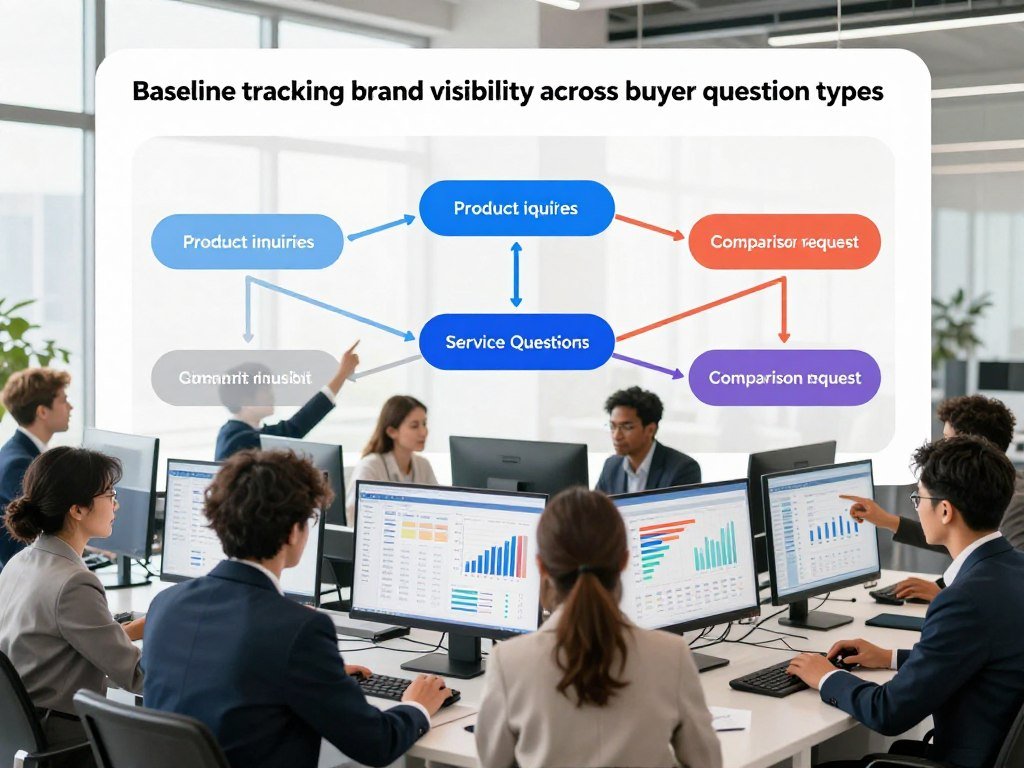
A brand can be easy for an AI to describe and still be absent when a buyer asks which option to choose. A useful baseline checks direct brand questions, category research, and problem questions. All three intents show whether an engine knows your name and whether it brings you into discovery.
Direct brand checks alone can hide a category-level visibility gap. A 2026 study tested 175 brands across legal, healthcare, SaaS, financial services, and ecommerce and retail. AI platforms accurately described 96% of tested brands when asked about them directly, yet 89% never appeared in category-research answers.
Brand questions and category questions reveal different things
A question such as “What does Northstar Analytics do?” tests recognition of a known name. A category prompt, such as “Which analytics tools work for a small retailer?”, tests whether the brand appears beside competitors. Both checks matter because buyers may know a product already or may be choosing among options.
Include competitor names in category prompts when buyers compare them directly. If an engine accurately describes your business but names three competitors in a shortlist, it knows your brand without treating it as a likely choice. That difference is easy to miss if you only test branded queries.
Problem questions can hide a visibility gap
Problem-awareness questions test an earlier stage, before a buyer knows which product or service can help. In the same 2026 study, brands appeared in just 0.10% of answers to problem-awareness prompts. A customer asking how to cut invoice errors may receive advice without seeing any software brands.
Those results explain why a strong direct answer does not prove broad brand visibility. A model can describe your product accurately when a buyer names it, yet omit it from category and problem answers. Include competitors in the baseline to see who takes the space you hoped to occupy.
Keep brand-specific checks in the baseline, but do not mistake them for category visibility.
Which Buyer Questions Belong in Your Prompt Set?
Choose buyer questions that make an answer engine name, compare, or rule out options, rather than a list of isolated keywords. Start with 20 to 50 questions that reflect how customers describe needs and choices. Run that same list monthly so changes in brand visibility are easier to spot.
Build the prompt set from real conversations, not only from a keyword tool. Ask sales and support teams what customers compare, where they get stuck, and which product facts they ask you to confirm. Review keyword questions, Reddit, Quora, relevant forums, and Google’s People Also Ask results for natural wording.

- Discovery: “What tools help a small clinic manage appointment reminders?”
- Comparison: “Compare [brand] and [competitor] for a five-person design team.”
- Problem-awareness: “How can a shop reduce abandoned online orders?”
- Direct brand: “What does [brand] offer, and who is it best for?”
Keep use cases in the questions, since buyers often care more about fit than a short feature list. Ask about team size, budget needs, location, or a specific task when those details shape the buying choice. Include competitor comparisons as well as prompts that mention your own business.
A prompt set made only of “What is [brand]?” questions will miss category-level omissions. It can show that engines recognize your name, but not whether they mention you when someone asks for a solution. The mix of question types lets you see where a competitor appears instead.
Keep the original 20 to 50 questions unchanged for the monthly comparison, and add new questions as a separate set.
How to Track Brand Mentions in AI Search Step by Step
A useful baseline starts with the exact same prompt wording in each engine you intend to compare. Run the questions in ChatGPT, Claude, Gemini, Perplexity, Grok, Copilot, Google AI Overviews, or Google AI Mode, based on your audience. Exact wording gives you a fairer comparison across engines and dates.
Use a consistent account and the same settings where possible. Personalization, location, and account history can shape responses. Manual monitoring is a practical starting point, though it becomes burdensome as your prompt set or engine count grows.

Run a controlled manual baseline
Start with a small batch of prompts and record what each engine returns. Treat each answer as a snapshot, not a trend. A single response can help you see how the engine handles a question, but it cannot show whether a change lasts.
Use this five-step checklist for each run:
- Enter the exact prompt from your set.
- Record the engine and date.
- Capture the complete answer.
- Mark mention, citation, and recommendation separately.
- Note competitors and cited URLs.
Schedule the same prompts across answer engines
Once the manual process works, run the same prompts on a schedule. Keep the engine list focused on the services your customers use. If one engine does not serve your audience, adding it can create more work without improving your view of buyer discovery.
Use a spreadsheet for a small baseline, with one row per prompt and engine. Add a new dated result rather than overwriting the last one. That history makes it possible to compare wording and sources across repeated runs.
Save the answer and its context
Store the prompt, answer, date, engine, and any cited pages together. Add a short note if the answer used a specific product name, described a feature, or left out a competitor. This keeps your data useful when a teammate reviews the result later.
Record the full URL for each citation, not just the domain. A review page and a company profile on the same site can give different facts. The exact page also helps you investigate why an answer used one source instead of another.
Save the full response beside the prompt, since a score alone cannot show how the engine described the brand.
Which Metrics Should You Record Separately?
Start with separate counts for brand names, citations, and recommendations, then compare the brand’s share of answers with competitors. Mention rate is the percentage of tracked AI responses that include a specific brand name. AI share of voice is the brand’s relative frequency among competitors in the same prompt set.
Keep the prompt set and competitor group fixed when you compare share. A changing group can make a brand appear to gain or lose visibility even when its own results stay the same. Track each measure with its denominator visible.
| Metric | What it measures | What to log |
|---|---|---|
| Mention rate | Responses naming the brand | Named responses / total responses |
| Citation rate | Responses with any citation | Cited responses / total responses |
| Owned-domain citation rate | Responses linking to the brand site | Owned citations / total responses |
| AI share of voice | Brand mentions relative to competitors | Brand and competitor mentions |
The table separates answer text from linked sources. A citation rate can rise while mention rate stays flat, such as when engines link to your site without naming the business. Record both outcomes to avoid calling that change a gain in named brand visibility.
Then annotate each answer for recommendation and sentiment. Recommendation records whether the engine suggests a brand, while sentiment captures whether the surrounding wording is positive, neutral, or negative. Keep these as answer-level notes rather than blending them into one score.
Write the total number of responses beside every rate. If the prompt set has 40 questions and you track three engines, the full run contains 120 responses. A missing engine or a changed list shifts the denominator, even if the brand’s answer-level results do not change.
Keep the denominator visible in every report so a change in prompt coverage does not look like a change in performance.
Which Tracking Method and Tools Fit Your Team?
A spreadsheet is enough to establish a small baseline, while scheduled multi-engine tracking becomes useful as prompt volume grows. Start with the simplest fit for your team’s workload and reporting needs. Choose a tracker for its engine coverage and prompt capacity, not price alone.
Use manual checks or free previews to establish a baseline
Manual checks can show how an engine answers a small set of questions. Ahrefs offers a free AI Overviews Tracker preview with brand mentions, month-over-month mentions, top topics, cited domains, and cited pages. Its AI Overviews index refreshes with keyword-database update cycles.
Google Alerts tracks newly indexed web pages that mention a name; it does not show whether an AI answer names a brand. Workflow tools can help automate other tasks, but they are not substitutes for checking AI answers. Search and retrieval APIs return page results or passages, not a measure of whether an answer names or recommends your business.
Compare paid trackers by coverage and prompt limits
Paid trackers differ in price, prompt limits, and refresh timing. The entry plans below give you a starting comparison, but check how their engine coverage matches the prompts you need to run.
| Tool | Entry price | Prompt limit | Refresh or coverage |
|---|---|---|---|
| Otterly.AI | $29/month | 15 prompts | Daily refresh |
| Peec AI | $95/month (€85) | 50 prompts | Daily refresh |
| Orchly | $49/month | 25 prompts | Daily refresh |
| Semrush AI Visibility Toolkit | $99/month per domain, billed yearly | 25 prompts | Daily refresh |
| Ahrefs Brand Radar | $199/month per platform; $699/month for all six | Not stated | Six listed platforms |
Search and page-extraction API options can help teams build retrieval workflows, but their outputs differ from dedicated AI answer tracking. Compare the data they return before deciding whether they fit another part of your process.
Gumloop Pro starts at $37/month and includes 20,000 credits per month, unlimited agents and seats, and more than 35 models. Gumloop Enterprise has custom pricing, SCIM/SAML, an admin dashboard, and audit logs. These are general workflow options, not dedicated brand-mention trackers.
Alertmouse has a free plan, with paid plans starting at $10/month. It is an alert automation option, not a replacement for direct AI answer checks. Select a tracker based on engine coverage, access to full answers, history, prompt capacity, and export or reporting needs.
Compare the engines and prompt limits you will actually use before judging a plan by its monthly price.
How Do You Turn Missing Mentions Into Improvements?
For a prompt where competitors appear and your brand does not, inspect the cited pages before drafting another article. Compare the URLs behind competitor answers with the pages that mention your business. Source patterns can reveal which facts or trusted voices shape the answer.
Third-party pages dominate category-research citations. In a 2026 study, 99.99% of 49,391 citations in category-research prompts pointed to third-party websites, not brand-owned domains. Only four of the 150 brands in the study’s mention-rate group received a citation to their own website.
Find the third-party sources behind competitor answers
Check roundups, review sites, publisher coverage, forums, and creator material for clear, accurate information about competitors and your own brand. Note which pages repeat product facts, name a use case, or compare options. Those patterns help you see what answer engines can draw on.
Look for outreach opportunities where a trusted source already covers your category. If a publisher compares several products but omits yours, share accurate details that help its readers make a fair comparison. Avoid asking for a mention without offering specific information.
In a 2026 study, referring-domain counts had a 0.49 correlation with AI mentions, while third-party web mentions had a 0.45 correlation. An Ahrefs study of 75,000 brands found branded web mentions had the strongest link to AI visibility. These relationships do not prove that one mention will cause an answer to change.
Fix the information gaps those sources expose
Check product facts across your owned pages and third-party pages before producing more content. Correct inconsistent names, prices, features, and use claims where you can. Conflicting facts can make it harder for an engine, or a buyer, to understand which details are current.
Update owned pages with clear answers, useful headings, and relevant schema, which labels page details for search systems. Pages with clean organization and schema earned 2.8 times more AI citations than poorly formatted pages. Still, owned-page updates cannot replace the third-party sources that dominate category research.
Brands with fewer than 2,000 indexed web pages mentioning them appeared in AI answers 3% of the time. This is a study result, not a target to chase by publishing pages in bulk. Focus on accurate, useful information and timely updates; 40% of pages that lost AI visibility resurfaced after updates.
Brands earning both citations and mentions were 40% more likely to resurface across multiple AI answers than brands earning citations alone. Prioritize a source that already shapes the answer and can accurately add useful, specific information.
How Much Can AI Answers Change Between Checks?
Two answers to the same recommendation question can name different brands or rank them in a different order. Wording, model changes, retrieval, and answer order can all shift results. One response is a snapshot, not proof of a lasting rise or loss.
Compare repeated runs before acting on a missing mention. In tests, ChatGPT or Google AI returned the same brand list in fewer than one in 100 responses. Claude was slightly more likely to repeat a list, while recommendation lists appeared in the same order about once in 1,000 runs.
One prompt can behave more consistently than a broad average. Google AI recommended Smartsites in 85 of 95 responses to a question about digital marketing consultants with ecommerce expertise. That result shows what happened for one brand and prompt, not a guarantee for other companies.
Across AI answers, 30% of brands remained visible from one response to the next, and 20% remained visible across five consecutive runs. A brand’s place in an answer can shift even when the prompt stays fixed. More frequent checks reveal movement, but do not make any single response definitive.
Google AI Overviews had a 70% chance of changing between observations. Cited content lasted about 2.15 days, and 45.5% of cited sources were entirely new each time. In December 2025, Google AI Overview presence correlated with a 58% lower clickthrough rate for the top-ranking result.
Use repeated observations to compare direction over time, rather than treating each new answer as a verdict. A short run of checks may show a change worth investigating, especially when a key competitor starts appearing more often. Keep the prompt and engine details beside the response so you can tell a changed answer from a changed test.
Treat an isolated change as a signal to verify, not as a reason to rewrite your strategy.
How Should You Review and Report the Results?
A useful report puts the tracked answers beside the actions your team took and the outcome you observed. Review the unchanged prompt set monthly, and check sooner when an answer contains urgent misinformation. Keep visibility separate from traffic and business results, since they measure different things.
Google Search Console’s generative AI performance reports completed their rollout to all websites on August 31, 2026. Treat those reports as a separate input, not a replacement for reading answer text and checking whether it names your brand.
Use a short reporting checklist to keep the review focused:
- Prompt coverage: which prompts and engines ran, and which did not.
- Answer changes: shifts in mentions, citations, and recommendations.
- Competitors: brands that gained or lost visible answer space.
- Actions: changes made and the follow-up result.
AI referrals and business outcomes belong beside visibility measures, not inside them. Use available analytics to assess traffic or leads from AI referrals. A brand can gain mentions without seeing a near-term rise in visits, because many buyers read an answer and do not click through.
Check the timing before linking a traffic change to AI visibility. A campaign, season, site change, or ranking shift may have happened at the same time. Note those changes in the report so the team does not credit an AI answer for a result with another likely cause.
Keep the prompt set and reporting definitions stable long enough to distinguish a trend from a measurement change.
A report should help a teammate decide what to inspect next, not just show a number. When mention rate changes, include examples of the answers behind the shift. When a citation changes, keep the URL and the related prompt together so the next review can trace the difference.
Record the owner and date for each follow-up action, then check the same prompt again during the next review. That gives your team a simple way to connect a change in content or outreach with later answer patterns, without claiming the action caused every change.
Conclusion
Reliable AI visibility tracking starts with a fixed set of buyer questions and a record of what each answer actually says. Keep prompts steady, and record mentions, citations, and recommendations as separate outcomes. Repeated results give you a stronger basis for decisions than one striking answer.
You do not need a large tracking setup to begin. Pick questions buyers use when they compare solutions, choose the engines that matter to your customers, and save a first run. Later, you can compare new answers against that baseline and decide which gaps deserve attention.
Choose your first buyer questions today and save the initial answers as the baseline for your next review.
FAQ
Can my website be cited in an AI answer without my brand being named?
Yes, an AI answer can cite your website without naming your brand in its text. A citation links to a source, while a mention is a brand name in the answer itself. Record both outcomes separately. For example, an answer might link to a product page as support while describing the product without using your company name.
How many AI engines should I track at the start?
Start with the engines your customers use, then add others when you can compare the same prompt set consistently. Tracking too many engines at once can make a small team’s records hard to maintain. A focused set gives you room to save complete answers and review changes. Expand when you have a clear reason, such as a new audience or market.
Should I use the same prompts every time I check?
Yes, use the same prompts for trend comparisons. Stable wording helps you see whether answers changed, rather than whether your test changed. Add new questions in a separate set so they do not alter the baseline. If you revise a prompt for clarity, keep the old version in your history and mark the new one clearly.
Can Google Alerts tell me when ChatGPT recommends my business?
No, Google Alerts does not report what ChatGPT says in its answers. It monitors newly indexed web pages that mention a name, which can help you find public web coverage. To see whether ChatGPT recommends your business, you need to check the answer itself or use a tracker that records AI responses and their context.
What should I do if an AI answer gives incorrect information about my company?
Save the full answer and cited URLs, verify the error, correct the underlying information, and retest the prompt. Check your own pages first, then review third-party pages that repeat the wrong detail. Keep a note of the exact claim and the correction you made. That record helps your team see whether later answers use the updated facts.
Does a mention in an AI answer always mean the brand is recommended?
No, a brand mention does not always mean the engine recommends that business. A name may appear in a neutral description, a comparison, or a warning. Record whether the answer clearly suggests choosing the brand, then note the wording and sentiment. This keeps an incidental name-check from being counted as a recommendation in your report.
Should I change my content after one missed mention?
No, do not change your content based on one missed mention. Repeat the same prompt and review the cited sources before deciding what to do. An answer can shift between runs, and a competitor’s appearance may depend on the sources used that day. Save the full response, compare later results, and make changes when a repeated gap points to a clear issue.