
The case centers on an attack on a Tesla repair facility in Las Vegas and the federal court’s response to it. Paul Hyon Kim admitted to conduct that damaged the Tesla Collision Center Las Vegas. The case also raised a separate question: what evidence proved about motive.
That distinction matters because a slogan at a crime scene does not, by itself, prove why someone acted. The court’s findings about proven conduct and intent must be read separately. Supervised release is court-ordered supervision in the community after a federal prison term, subject to court-set conditions.
The las vegas tesla arson 5 year sentence 2026 drew attention because readers want a clear account of the plea, the court’s ruling, and the sentence. The key question is how the proven conduct and the court’s ruling fit together.
Key Takeaways
- The case involved the Tesla Collision Center Las Vegas.
- Kim admitted to federal offenses in February 2026.
- The court considered whether the evidence proved intent.
- A prosecutor’s recommendation and a judge’s sentence are different.
- Supervised release follows prison and carries court-set conditions.
What Happened in the Las Vegas Tesla Arson 5 Year Sentence 2026 Case?
The attack unfolded in the early morning hours at the facility on Badura Avenue near Jones Boulevard. Kim targeted the Tesla Collision Center Las Vegas on March 18, 2025. The documented actions show how the attack happened, while the spray-painted word alone does not establish motive.
The Department of Justice released photographs of the scene and attack. Its release contains still images, not an asserted video of the attack. Those images show parts of the incident and its aftermath.
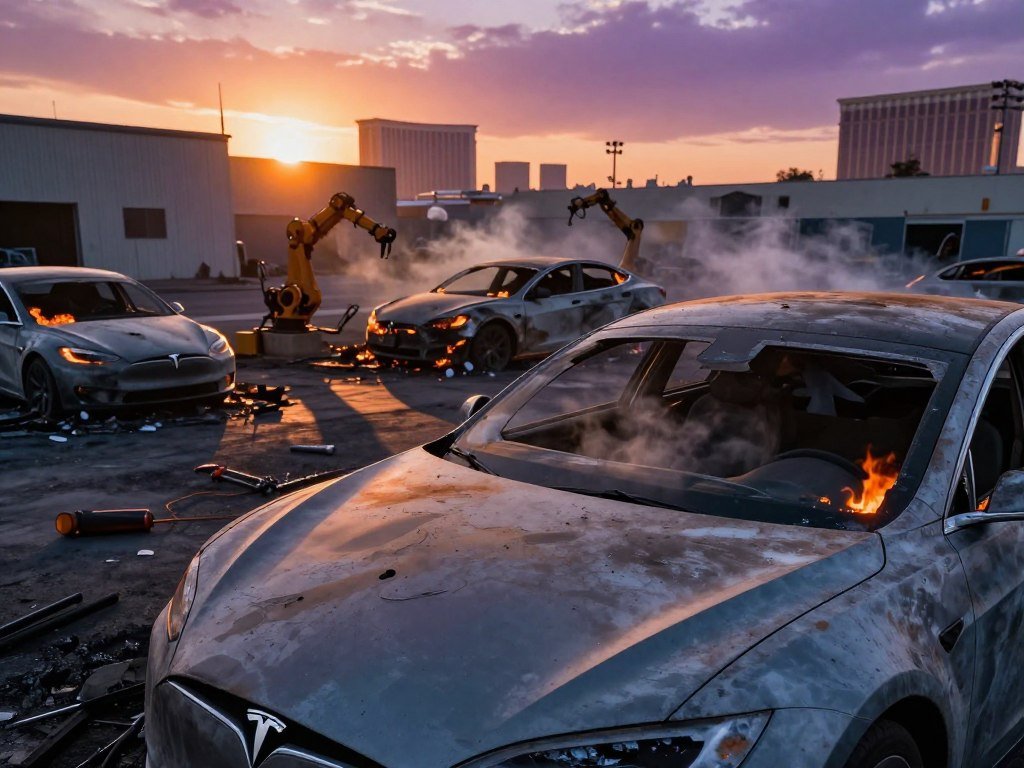
The attack at Badura Avenue
The reported sequence at the facility was:
- Kim used a .300 Blackout AR-platform semiautomatic rifle to shoot out two exterior security cameras.
- He spray-painted “RESIST” in large capital letters on the double entrance doors.
- He fired several shots into parked Tesla vehicles.
- He threw three Molotov cocktails into three vehicles. Two exploded and started fires; the third did not detonate.
The DOJ release shows still photographs, not a video of the attack.
The distinction matters for anyone looking for a video of the 2026 five-year sentence in the Las Vegas Tesla arson case. The release includes images of Kim spray-painting the doors, a Molotov cocktail inside a damaged vehicle, and two Teslas ablaze.
Damage, escape and released images
After the attack, Kim fled on foot to his car and drove away. The photographs help show both the scene and the damage, but they remain still images rather than moving footage.
Five vehicles were destroyed beyond repair, giving readers a clear measure of the property damage.
What Federal Charges Did Kim Admit To?
Kim pleaded guilty in February 2026 to four federal counts arising from the case. The plea covered arson, attempted arson, and possession of an unregistered firearm classified as a destructive device. The count wording tied the arson charges to property used in interstate commerce.
The plea included two arson counts, one attempted-arson count, and one firearm count. Kim entered the plea without a deal, as reported in the Review-Journal plea report.
The four counts in the plea
The federal charge wording describes arson of property used in interstate commerce. The phrase refers to the property connection required for these federal arson counts, not a finding about motive.
| Counts | Plea offense | Federal charge wording |
|---|---|---|
| 2 | Arson | Property used in interstate commerce |
| 1 | Attempted arson | Property used in interstate commerce |
| 1 | Unlawful possession | Unregistered firearm classified as a destructive device |
How investigators linked Kim to the scene
Investigators used scene surveillance, nearby Las Vegas surveillance footage, and analytical data to identify a black Hyundai Elantra as the suspect vehicle. A DNA swab match connected Kim to DNA found at the scene.
The FBI, ATF, and Las Vegas Metropolitan Police Department investigated with help from the Clark County Fire Department. ATF’s Arson Task Force partners with the county fire department. Responding specialists included a fire investigator, bomb technician, explosive specialist, and accelerant-detection dog.
The DNA match and vehicle identification are distinct parts of the investigative account, not additional counts in the plea.
How Did the Judge Reach the Sentence?
The central sentencing contrast is the 240-month term sought by prosecutors and the 60-month term imposed by the judge. On October 14, 2026, U.S. District Judge Jennifer A. Dorsey sentenced Kim to 60 months in federal prison. She also ordered three years of supervised release.
The Department of Justice announced the outcome in its 2026 release. Kim must pay more than $227,000 in restitution. The sentence was 60 months, not the 240 months prosecutors recommended.
A DOJ announcement reports the outcome, while the sentencing order records the court’s ruling.
The judge declined to apply a terrorism enhancement because the evidence did not prove intent. That decision was the court’s finding, regardless of any official’s use of domestic-terrorism language.
Attorney Sigal Chattah did not decide the sentence; the judge did. Political differences also did not replace the evidence needed to prove intent.
The enhancement ruling turned on evidence of intent, not on the slogan painted at the scene.
Conclusion
The case is best understood by separating the admitted offenses from the question of motive. A conviction establishes guilt for charged conduct; a public claim about why someone acted is not the same legal finding.
The sentence also reflects the judge’s final order, not the term prosecutors requested. These distinctions matter when comparing a federal case with public statements about it.
For the legal record, check the federal docket and sentencing order. Anyone comparing this case with another federal prosecution should check the court docket before drawing a legal conclusion.
FAQ
Does a federal prosecutor’s recommended sentence bind the judge?
No, a prosecutor’s recommendation does not bind the judge. The recommendation asks for a sentence, but the judge decides the term under the law and the case facts. In Kim’s case, prosecutors sought 240 months, while the judge imposed 60 months. The final sentence appears in the court’s order, not simply in the prosecutor’s request.
What does supervised release mean after a federal prison sentence?
Supervised release means court-ordered supervision in the community after a federal prison term. The judge sets conditions that apply during that period. It is part of the sentence, but it is not the same as time in prison. A person must follow the court’s rules while serving supervised release.
Why do federal arson charges mention interstate commerce?
The phrase identifies a required commerce connection for the property involved in the federal arson charge. It does not, by itself, explain why the defendant acted. In Kim’s case, the plea described property used in interstate commerce. The charge wording and a finding about motive answer different legal questions.
Can attempted arson be charged if a fire does not start?
Yes, prosecutors may charge attempted arson even when the intended fire does not ignite. An attempt charge focuses on the alleged effort to commit the offense, though the evidence and legal elements still matter. In this case, the plea included one attempted-arson count alongside two arson counts.
Can a federal court order restitution as well as prison?
Yes, a federal court can order restitution in addition to prison when legal requirements are met. Restitution addresses financial loss and does not add prison time. Kim’s order included more than $227,000 in restitution. The payment obligation and the prison term are separate parts of the court’s sentence.