
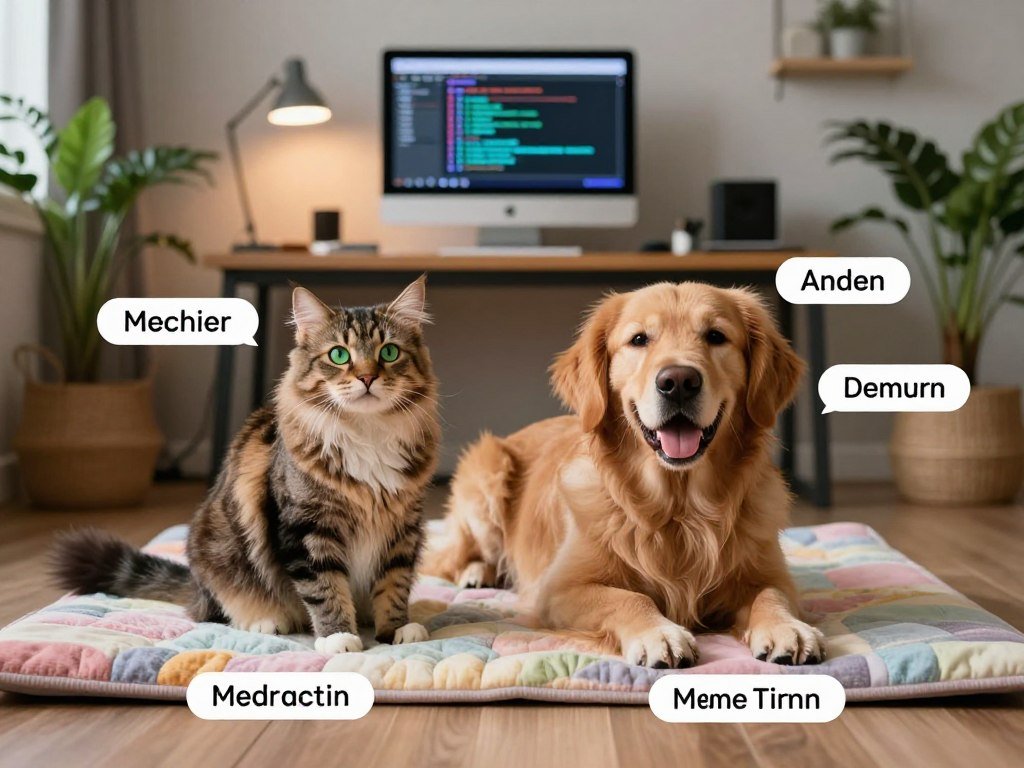
A recommendation, photo label, or text response can look effortless, but a model first has to learn patterns from examples. That learning matters when you want useful predictions, accurate content, or helpful applications. A photo app, for instance, may sort pictures of pets into different groups. It can do that because it has learned from many examples, not because someone wrote a fixed rule for every possible picture.
What Is AI Model Training? It is the process of helping a system learn from examples so it can handle new inputs. You can think of it as practice with feedback: examples shape how the system responds, and later use tests what it has learned. The same idea can help predict a number, suggest a song, or draft a text response. Still, training does not make every output reliable. A model’s output is a learned prediction, not a guarantee that its answer is correct.
Key Takeaways
- Training uses examples to shape a model’s predictions or content.
- Examples can teach a system to sort photos or estimate numbers.
- A model learns patterns instead of following only fixed rules.
- Training does not guarantee accuracy on every new input.
- Check important outputs before acting on them.
What Is AI Model Training?
AI model training fits an algorithm to examples so its adjustable parameters produce more useful outputs. Fitting means adjusting the settings inside the algorithm based on data. The fitted system is called a model, while the algorithm is the mathematical procedure used to make it.
The training data is not the model; it is the set of examples used to shape the model. For instance, a photo set might pair each picture with a “dog” or “cat” label. During fitting, the algorithm adjusts its parameters to better match those labels.
An algorithm is the procedure; a model is that procedure fitted to examples.
Linear regression is one algorithm used to create a fitted model. It can learn how changes in one or more inputs relate to a number, such as a home’s estimated sale price. The resulting model contains parameter values that reflect its training data.
Two models can use the same algorithm and still make different predictions. If one learns from pictures taken in bright light and another from dim rooms, their fitted parameters may differ. You can read more about training versus inference, the process of using a fitted model to produce an output. The same algorithm can behave differently after it has been fitted to different examples.
How Does a Model Learn From Examples?
Show a picture of a cat to a model trained on labeled images, and its first guess may be wrong. Training helps the model improve by comparing its predictions with known targets. A loss is a numerical measure of the error between a model’s prediction and its target.
Suppose the picture’s target label is “cat,” but the model predicts “dog.” The loss measures how far that prediction is from the target. An optimizer uses the error to adjust parameters, such as weights, which affect how strongly the model responds to parts of its input.
A basic training loop has four steps:
- Make a prediction from the input.
- Compare the prediction with its target.
- Calculate the error as a loss value.
- Update parameters to improve later predictions.
Then the model sees more examples and repeats the process. A full pass through the dataset is one epoch. Training often uses more than one epoch, since a single pass may not give the model enough practice.
More passes do not always mean better performance. A model can learn details that fit its training examples but fail on new ones. That problem is called overfitting, and checks on unseen data can help reveal it. For a wider view of how AI systems learn and work, see this guide to AI basics. A good training result requires checking performance on examples the model did not learn from.

What Data Goes Into Training?
A training dataset is the collection of examples chosen to teach a model a particular task. Training data can include text, audio, images, video, or sensor readings. Useful examples must match the task the model is meant to handle.
A labeled photo might show a dog, with “dog” as its target label. A language model may instead learn from passages of text. Common Crawl, a collection of webpages, contains terabytes of data from billions of webpages.
Raw information often needs preparation before it can become useful training data. A team may remove errors, put values on a shared scale, or make file formats consistent. Dataset quality matters because missing, incorrect, duplicate, or mislabeled examples can weaken results. A survey on machine-learning dataset quality reviews common problems and ways to assess them.
Preparing a dataset usually includes these tasks:
- Collect examples that relate to the intended task.
- Clean errors, duplicates, and inconsistent labels.
- Standardize formats and normalize values when needed.
- Check that examples represent the intended use.
Free AI training data may be available through public datasets. Public access does not grant permission for every use, so check a dataset’s terms before using it. Information about an open model may describe its data without sharing the full dataset; learn more about what open-source AI means. A large dataset cannot compensate for examples that are inaccurate or poorly matched to the task.

How Do Training, Validation, and Test Data Differ?
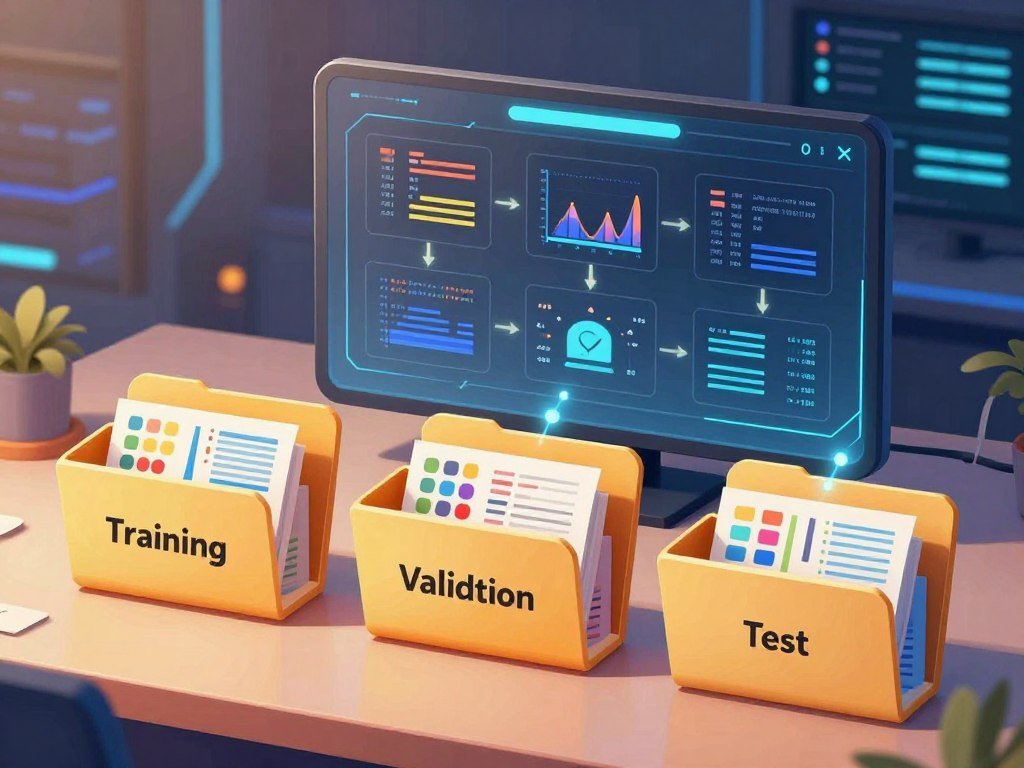
Training data teaches the model, validation data helps tune it, and test data checks its final performance. Each portion has a separate job, so examples used for one job should not quietly shape another. Keeping validation and test examples out of training helps reduce overfitting.
Training data fits the model’s parameters. Validation data helps you compare choices, such as the number and width of a model’s layers. It can also support early stopping: if validation error begins to rise, training may have gone too far.
The test set stays out of training and tuning. You use it for a final check on examples the model has not seen. Overfitting happens when a model learns apparent patterns that do not hold for new examples, so a clean test can help show whether its performance carries over.
| Dataset portion | Used for | Used during | Main safeguard |
|---|---|---|---|
| Training | Fitting model parameters | Model fitting | Keep its examples distinct |
| Validation | Tuning choices and early stopping | Model selection | Do not fit parameters to it |
| Test | Final check on unseen examples | Final evaluation | Keep it out of training and tuning |
An 80% training, 10% validation, and 10% test split is a reasonable starting point when you have enough data. The 80/10/10 split is not a fixed rule; the right share depends on the task, model, and dataset. In a small dataset, saving too many examples for testing can leave too little for fitting.
Keeping each portion separate makes the results easier to trust. For practical steps on preparing and checking a model, see this step-by-step model-training guide. Keep the test set out of both training and tuning so the final evaluation remains meaningful.
Which Training Method Fits the Task?
The right learning method depends on whether the task has known answers, hidden structure to discover, or feedback from actions. The available signal is the information a model can use while learning. Supervised learning uses labeled examples with known outcomes.
For example, a model can learn to sort email into “spam” or “not spam” by studying messages with those labels. Classification assigns an item to a group, while regression predicts a number. Both are supervised learning tasks.
Unsupervised learning works with unlabeled inputs. A model can group customers by shared shopping patterns without being told which group each person belongs to. Clustering and dimensionality reduction are unsupervised tasks. Dimensionality reduction represents complex data with fewer values.
Reinforcement learning uses feedback from an environment. A model takes an action and receives a reward or penalty, then learns to seek better outcomes. For instance, a game-playing system can try moves and gain points for progress.
| Method | Signal available during learning | Example task |
|---|---|---|
| Supervised | Examples with known labels or values | Classify messages as spam |
| Unsupervised | Unlabeled inputs with structure to find | Cluster shoppers by behavior |
| Reinforcement | Rewards or penalties after actions | Learn moves in a game |
These methods suit different tasks, and the same broad goal can call for different feedback. A model that labels a picture needs known examples, while one that explores a game learns from results of its actions. You can read about reinforcement learning with rewards and penalties for more detail.
Machine learning is one approach within artificial intelligence, and its methods depend on the learning signal. This distinction can help you separate AI from machine learning and its methods. Choose the method based on the signal available for learning, not just the kind of output you want.
How Are Deep Learning and Generative AI Related?
Deep learning uses layered neural networks, and generative AI is one of the ways those networks can be used. Neural networks are systems made of connected units that learn patterns from data. Generative AI creates new content from patterns learned during training.
Deep learning can support image recognition, forecasting, and natural-language processing. In image recognition, a model might label an object already present in a picture. A forecasting model predicts a future value, such as demand for a product.
Generative AI has a different goal: it creates new text, images, or other content. Transformers, generative adversarial networks, and variational autoencoders are techniques used in this field. Large language models are one type of generative-AI model, trained on large text collections to generate text from text inputs.
Neural-network systems can need substantial computer power to train and run, especially when the model or dataset is large. Their resource needs still depend on the task and system. A small image classifier is not the same workload as a large language model generating long responses.
These terms describe related ideas, not interchangeable names. Deep learning refers to neural-network methods; generative AI refers to systems that make new content. A language model is one kind of generative model, not a synonym for every AI system.
How Does GPT Learn to Generate Text?
GPT models learn to generate text by predicting which token is likely to come next in a sequence. GPT stands for generative pre-trained transformer. A token is a small piece of text, such as a word, part of a word, or punctuation mark.
Pretraining Builds Broad Language Patterns
Pretraining exposes a model to large collections of text, often without labels written by people. The model learns patterns in how words and ideas tend to appear together. Later fine-tuning can shape the model for particular tasks, such as answering questions or following instructions.
Pretraining and fine-tuning serve different purposes. Broad pretraining gives the model general language patterns. Fine-tuning uses more focused examples to guide how it handles a narrower set of tasks.
Transformers Predict the Next Token
A GPT model predicts one token, then uses the growing sequence to predict another. It repeats this step to produce a longer response. Next-token prediction creates likely text, not a fact-check of every claim.
Transformers use self-attention to process relationships among tokens across a sequence. This lets the system weigh how different parts of the input relate to one another. The architecture appeared in the 2017 research paper “Attention Is All You Need”.
GPT Models Developed Through Successive Versions
OpenAI introduced GPT-1 in 2018. It used generative pretraining on BookCorpus, followed by fine-tuning for language tasks. GPT-2 had 1.5 billion parameters and learned from WebText, a 40-gigabyte dataset with 8 million webpages.
GPT-3 had 175 billion parameters and showed few-shot and zero-shot learning abilities. Few-shot learning uses a small number of examples in a prompt; zero-shot learning asks the model to handle a task without examples in that prompt. ChatGPT launched in November 2022 using GPT-3.5.
Text fluency comes from learned patterns, so a convincing response is not proof of accuracy. A smooth answer can still contain a mistake, an outdated claim, or a weak guess. Text fluency comes from learned patterns, so a convincing response is not by itself proof that its claims are correct.
How Does Human Feedback Refine an AI Model?
A fluent response can still be unhelpful or unsafe, which is why some training includes human judgments. Human feedback can guide a model toward responses people prefer. Those judgments shape behavior, but they do not guarantee that every answer is safe or correct.
OpenAI developed InstructGPT using reinforcement learning from human feedback to align GPT-3’s behavior more closely with human preferences. Raters can compare candidate responses and rank them for qualities such as helpfulness or safety. Their choices can train a separate reward model, which then guides the main model.
This process differs from adding more unlabeled text. Unlabeled text teaches broad language patterns, while response rankings show which answers people prefer in a given setting. The cycle can work like this:
- Generate several responses to the same input.
- Ask people to review and compare them.
- Record their preferences about the responses.
- Use those preferences to guide model refinement.
Human judgments reflect the people who provide them. Their views can carry bias, and a reward model can learn that bias along with the preferred response style. A system’s answer should not be treated as a safe way to share private information or as expert advice.
Do not share private details with a model, and do not accept an unverified response for a high-stakes choice. Treat a model’s answer as a starting point, not as a substitute for qualified help in a high-stakes decision.
What Determines the Scale of Model Training?
Training scale can be described by compute thresholds or by how a model ranks against others at release. Compute means the processing work used to train a model. A FLOP is one floating-point operation, a calculation involving decimal numbers.
Model architecture, dataset size, available compute, and the task all affect resource needs. Some regulatory frameworks define large-scale models as using more than 1023 FLOP of training compute. Epoch AI uses that fixed threshold in its definition of large-scale models.
Epoch AI defines frontier models as those ranked among the top five by training compute when released. This label is a ranking, not a fixed compute threshold. Estimates can carry wide uncertainty: confident within a factor of 3, likely within 10, or speculative within 30.
Epoch AI’s public database tracks more than 3,600 machine-learning models, but it is not exhaustive. Model estimates are not exact measurements, and different confidence ranges can change comparisons. Treat model-size and compute estimates as estimates, and check the confidence range before comparing them.
How Can Beginners Learn or Work in AI Training?
Beginners can explore AI without starting by building a model from scratch. A short course can help you learn basic terms before you decide how much coding you want to do. Three months of regular study can establish AI fundamentals, while independent model-building takes more practice.
Choose a Learning Route That Fits Your Background
You can begin with broad AI concepts, then move into machine learning or Python if your goals call for it. Elements of AI offers a free, self-paced Introduction to AI course without a need for complicated math or programming. Its separate Building AI course recommends basic Python skills.
Google offers an online beginner course in generative-AI basics and practical uses of AI tools. Its clinician-focused AI program is self-paced and approved for five CME credits. The table compares a few starting points:
| Course | Audience or starting point | Format or useful detail |
|---|---|---|
| Elements of AI Introduction to AI | Beginners and non-experts | Free and self-paced; no complex math or coding |
| Elements of AI Building AI | Learners with basic Python skills | Free course focused on building AI |
| Google beginner generative-AI course | Beginners learning AI tools | Online course on basics and practical use |
| Google clinician-focused AI program | Clinicians | Self-paced; approved for 5 CME credits |
Training Jobs Range From Model Building to Data Review
Model-building jobs can involve coding, testing, and checking machine-learning systems. AI data review and annotation jobs focus more on labeling examples or judging model responses. Job titles and wage categories do not map neatly onto one AI occupation.
The median annual pay for computer and information research scientists was $145,080 in the 2026 AI-engineer salary guide. That figure refers to the Bureau of Labor Statistics occupation, not a separate AI-engineer job category.
In May 2025, proofreaders and copy markers had a median annual wage of $51,120. AI data trainers are counted within that occupation, and the Bureau of Labor Statistics does not report a separate wage figure for them.
Three months can build AI fundamentals with regular study, but independent model-building depends on your starting skills and practice.
You can also explore AI-related work and services as you build skills. Pick one beginner-level course and set a steady study schedule before deciding whether to pursue coding or evaluation work.
Conclusion
A useful mental model is to treat an AI response as a prediction shaped by examples, not as automatic proof. The model’s output reflects patterns in its training data, so gaps in those examples can lead to weak results. Accuracy matters most when a wrong answer could cause harm.
Before using an AI tool, choose a small prediction task and write down what a correct result would look like. That gives you a clear way to check whether the tool helps. Start with one small task and a clear standard for what counts as a correct answer.
FAQ
What to not ask an AI?
Do not share sensitive personal information or rely on an unverified response for a high-stakes medical, legal, or financial decision. A model may store or process what you enter, and its answer may sound certain while still being wrong. Remove names, account details, and other private facts from prompts. For serious choices, use qualified human help.
What is training data and testing data?
Training data fits a model’s parameters, while a held-back test set checks the fitted model on unseen examples. The training examples shape the model during learning. The test examples help show whether its performance carries over to new cases. Keeping the test set out of training and tuning makes that final check more useful.
Is ChatGPT a deep learning model?
Yes, ChatGPT uses large language models, which are generative-AI models based on deep learning. Deep learning uses neural networks to learn patterns from data. A large language model generates text from text inputs, while ChatGPT is the product people interact with. Its fluent replies can still include errors, so check claims that matter.
Why is ChatGPT called GPT?
GPT means generative pre-trained transformer. GPT models generate text by predicting the next token in a sequence. “Pre-trained” refers to learning broad patterns from large text collections before later tuning. “Transformer” names the neural-network design used to process relationships among tokens. The name describes a model approach, not a promise that every answer is accurate.
Should I learn ML or AI first?
Start with AI fundamentals for broad context, then learn machine-learning concepts if you want to understand how models learn from data. AI includes many approaches, while machine learning is one way to build systems that learn patterns. You can add Python when you are ready to work with code. A nontechnical introduction can help you decide what to study next.
Which AI job is highly paid?
The $145,080 median annual pay figure is for computer and information research scientists, not a separately reported AI-engineer occupation. The occupation includes research work that can involve AI, but its wage figure does not describe every AI job. Pay can differ by role, employer, location, and experience, so compare job duties as well as titles.
What is the best AI class for beginners?
Elements of AI’s free, self-paced Introduction to AI course is designed for non-experts and does not require complicated math or programming. It can give you a broad base before you choose a technical path. If you later want to build AI systems, the separate Building AI course recommends basic Python skills. Pick the level that fits your current experience.
Can I learn AI in 3 months?
You can learn AI fundamentals in three months with regular study, but building and validating a model independently depends on your starting skills and practice. A steady plan can cover basic terms, common uses, and introductory machine learning. Coding experience helps when you move into model-building tasks. Set a clear goal, then track the time you spend studying and practicing.



