
A polished paragraph or convincing photo can still leave a simple question: what evidence supports what it shows or says? In 2025, researchers estimated that at least 10% of PubMed abstracts published that year had been processed with large language models. That estimate shows why people need careful checks, not quick guesses.
In a few minutes, you can check a claim, compare its context, and decide how much confidence the evidence supports. No single clue proves who made a text, image, or video. Provenance means information about where a digital file came from and how it changed. Many files have no usable record.
This guide offers a practical way to assess suspicious content without treating a strange detail as proof. Your goal is not to guess perfectly. It is to find out whether the claims hold up before you act or share.
Key Takeaways
- One unusual word or visual flaw cannot prove AI authorship.
- Check claims against independent outlets or official information.
- Review the source, date, and setting behind an image or clip.
- An AI detector can guide review, but cannot give a final verdict.
- Content Credentials may show file history, not whether a claim is true.
- Pause before sharing material that could harm someone.
Start by checking the content’s claims and context, not just whether its style feels unusual.
How to Spot AI Generated Content in Text
Repeated phrasing can be a useful prompt to look closer, but one familiar word is not a diagnosis. When you assess text, look for several signs together and compare them with the writer’s knowledge, experience, and context. Writing patterns are clues, not proof of authorship.
Style and structure patterns
Some generated content uses sentence shapes that repeat across a paragraph. Transitions may explain every step, even when the link between ideas is clear.
Stacked adjectives can make a simple point sound grand. Formulaic openings and tidy endings may also stand out, though people use these habits too.
A polished voice or one familiar phrase is weak evidence unless it sits beside a concrete mismatch.
Terms such as “delve” or “tapestry” may catch your eye, but either word alone says little. A 2025 PubMed word-use study found 135 potentially AI-influenced terms; 103 rose meaningfully in 2024 records.
Those terms had started rising before ChatGPT’s 2022 release, then climbed faster in 2023 and 2024. A 2024 analysis estimated that large language models had processed at least 10% of PubMed abstracts published that year, based on excess word use.
Depth, context, and personal detail
Look for generic examples where a specific case should appear. A confident answer may lack support, leave out a relevant detail, or include a factual error.
Compare the claims with what the situation requires. A writer describing a work project, for example, should be able to explain choices that the text only names.
Context matters: a short overview may be broad by design, while a personal account should fit the person’s known experience. A polished voice or one familiar phrase is weak evidence unless it sits beside a concrete mismatch.
How Can You Verify Claims and AI-Generated Code?
A questionable factual claim is easier to assess by tracing it to an independent source than by guessing from its wording. To assess AI-generated content online, compare its central information with official pages or independent outlets. Check the evidence before judging the writing.
For code, run tests in a safe setting and confirm that its package names exist. Python and JavaScript projects can use tests, while npm and PyPI list packages for those languages.
Use this checklist to check authorship context and the work itself:
- Compare the work with a known sample from the same author.
- Open cited sources and confirm they support the claims.
- Ask the author to explain a key argument or code choice.
- Inspect draft history, run code tests, and check its dependencies.
Google Docs Version History can show a document’s edits, but a revision history alone cannot establish who wrote each line. Nerves or time since writing can affect how well an author answers questions.
A draft record may show when edits happened, not who made every change. Use it as one piece of context, not a final authorship finding.
Some assistants search the web, while others draw mostly on learned information or supplied material. This comparison of AI assistants explains how tools such as Perplexity and Grok handle search differently.
If the reasoning and sources hold up, a stylistic pattern alone should not settle the question.
Are AI Detector Tools Reliable?
An AI detector can flag patterns, but its score is not a dependable verdict about authorship. A false positive means a tool labels human writing as AI-made; a false negative means it misses AI-generated text. Never treat a detector score as proof of authorship or misconduct.
OpenAI stopped offering its text classifier in 2023 after describing it as not fully reliable. In an English challenge-set evaluation, the tool marked 26% of AI-written text as “likely AI-written.”
| Detector or result | Evaluation | What the figure means |
|---|---|---|
| OpenAI classifier | 26% | AI-written text identified as likely AI-written |
| OpenAI classifier | 9% | Human-written text incorrectly labeled AI-written |
| Turnitin AI checker | Roughly 15% | AI-generated text missed in a document |
| Turnitin AI checker | 1% | False-positive rate reported by Turnitin |
The same OpenAI evaluation incorrectly labeled human writing as AI-written 9% of the time. Turnitin says its false-positive rate is 1%, while its checker can miss roughly 15% of AI-generated text in a document.
A tool’s result can change with the text and the conditions used to test it. Short passages, edited writing, and different evaluation methods can lead to different results.
- Use a detector only as an initial screen.
- Review the specific passages and verify factual claims.
- Seek other evidence before making a consequential decision.
An AI detector app may help you choose what to inspect, but the score cannot settle a dispute. Use a detector result to choose what to inspect next, never as the sole proof of who wrote something.
How to Detect AI-Generated Images
A convincing image can still fail a basic context check, such as whether the person actually attended the event shown. Check visual details, then trace the image’s source and setting. A visual error or detector score is not conclusive proof.
Inspect details and visual consistency
Look closely at hands, faces, signs, and logos. Check whether lighting and reflections match, and whether background details make sense.
Some AI images distort fingers or letter shapes, while shadows may point in odd directions. Real photos can contain distortions too, especially after editing, cropping, or poor capture.
Image detectors also vary. A 2025 study tested 16 open-source methods, including 23 detector versions, across 12 datasets. The data covered 2.6 million images from 291 generators.
| Benchmark finding | Result | What it cautions against |
|---|---|---|
| Best detector | 75.0% mean accuracy | Treating one score as proof |
| Worst detector | 37.5% mean accuracy | Assuming every tool works well |
| Flux Dev, Firefly v4, and Midjourney v7 | 18-30% average accuracy | Expecting strong results on every model |
| Detector rankings across dataset pairs | Spearman correlations of 0.01-0.87 | Assuming rankings stay the same |
The study found no universal winner across datasets. Its image detector benchmark study also found that 64 tested generators, or 22%, defeated most detectors, with average accuracy below 50%.
Trace the image’s source and context
Try a reverse image search to find earlier copies or an original post. Check metadata when available, then compare the claimed event with reliable reporting.
A viral image falsely showed Katy Perry at the 2024 Met Gala and drew over 16 million views. The carpet in the image came from the 2018 event, a context clue that mattered more than a quick visual impression.

If a reverse-image search finds no original, treat that as missing confirmation, not proof that the scene is fake.
Can You Spot AI-Generated Videos and Deepfakes?
A clip that appears to show a familiar person saying something shocking deserves a source check before it is shared. Check faces, movement, sound, and context together. One odd frame or sound does not prove a video is synthetic.
Check faces, movement, and sound together
Watch whether expressions match the words and stay steady across the clip. Check that lighting, shadows, and nearby objects remain consistent as the person moves.
Listen for speech that seems out of time with the mouth, or background audio that changes without a clear reason. Flickering light and lip-sync mismatch are warning signs, not proof.
Editing, compression, and poor recording can create odd frames or rough sound. A low-quality upload may blur a face or make speech seem uneven.
Verify the clip’s source and claim
Find the earliest available post and check whether its stated date and location make sense. Then compare the claim with independent reporting or an official statement.
AP and Reuters are independent outlets that can help you check a clip’s claim. A video may be real but old, or show a real person in a different place or situation.
Ask what the clip actually shows, rather than accepting the caption’s claim. A short video can leave out what happened just before or after the recorded moment.
For a consequential clip, wait for independent confirmation before reposting it.
What Can Content Credentials Prove?
A Content Credential can help trace a file’s history, but it cannot certify that the story shown in the file is true. It is a cryptographically bound provenance record that can document an asset’s origin, changes, and use of AI. A valid record does not prove a real-world event happened.
C2PA checks whether credentials are well-formed, untampered, valid, and trusted under a known trust list. Those checks concern the record and its signer, not whether the information inside it is true.
The C2PA Content Credentials explainer describes how credentials record an asset’s origin and edits. A credential may be absent, and an existing record may not answer whether the scene or claim is accurate.
Credentials are optional, so their absence alone does not show that an image or video is false. The record can still help you see whether a file changed after its creation.
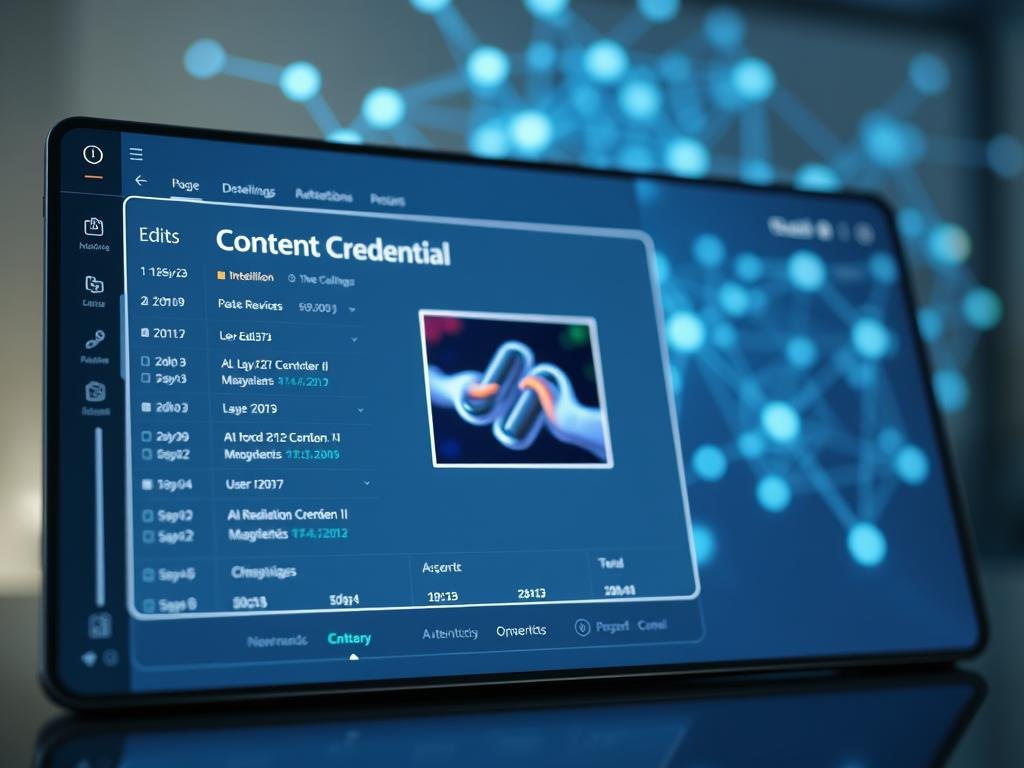
Check any available credential alongside independent evidence about the event.
What Should You Do Before Sharing a Suspected Deepfake?
If a suspected deepfake could expose someone to harm, do not repost it while you are still checking it. Pause, keep the details you need, and report harmful material through the platform. Do not amplify suspected intimate imagery or impersonation.
- Pause before sharing the post or clip.
- Preserve the post URL and relevant details.
- Use the platform’s reporting process for suspected non-consensual intimate imagery or impersonation.
The federal Take It Down Act, enacted in 2025, requires online platforms to remove AI-modified or AI-generated non-consensual sexual content. In 2025, lawmakers in every state introduced some form of legislation addressing sexual deepfakes or AI-created child sexual abuse material.
Before sharing, save the post URL and use the platform’s reporting process if intimate imagery or impersonation is involved.
State rules do not all cover the same conduct or carry the same status. Some state laws require disclaimers on political campaign ads, and some have faced constitutional challenges.
Legal rules can depend on the content and location, so this general information is not personal legal advice. You can also choose which AI and technology topics to receive through the technology newsletter.
Conclusion
A careful check is more useful than a fast guess about whether something feels artificial. Confidence comes from matching evidence with context, not from a single word, glitch, or score.
Choose the most important factual claim and verify it through an independent source before acting or sharing. That one check can keep a misleading post from shaping your next move.
For the next questionable post, verify its central claim independently before you decide what to do with it.
FAQ
Can a deepfake be detected?
Sometimes, but no single visual or audio flaw proves a clip is fake. Editing, compression, and poor recording can also cause strange frames or sound. Find the earliest post you can, then check its claim against independent reporting or an official statement. For a serious claim, wait for confirmation before sharing the clip.
What do AI faces look like?
AI faces may show inconsistent details around eyes, teeth, hair, or skin texture. Those clues can prompt a closer look, but real images also contain visual flaws from lighting, editing, or low image quality. Compare the whole scene and its context rather than deciding from one unusual feature. A detector score is not a final answer.
How does AI gather information?
AI models generate responses from patterns learned in training data. Access to current web information depends on the tool and whether it uses search or material you provide. Some tools can cite pages, but a citation does not guarantee that the answer is correct. Open the cited page and check whether it supports the specific claim.
How to tell something is written by AI?
Look for several clues together, then check the facts and context. Repeated structures or generic examples may invite closer review, but people can write that way too. A polished style or detector score alone is not enough to identify an author. Compare the writing with a known sample and ask whether its claims hold up.
What are some common signs of AI writing?
Repeated structures, generic examples, and unsupported claims can prompt closer review, but none proves AI authorship. You might also notice transitions that explain every step or confident statements without support. These habits occur in human writing as well. Check whether the content fits the writer’s knowledge and whether its key details are accurate.
What words trigger AI detection?
There is no single reliable trigger word. AI detectors assess patterns, and a term such as “delve” is only a weak clue by itself. A word’s meaning and use depend on the sentence and the writer. Do not judge authorship from a vocabulary list; check the passage’s claims, detail, and context instead.
What words throw off AI detection?
No dependable word swap makes a detector accurate. Changing a few terms may alter a score without making the text more truthful or showing who wrote it. Edit for clear, supported writing rather than trying to game a tool. If the result matters, review the work and seek evidence beyond the detector’s label.
What are the most common words used in ChatGPT?
There is no stable, universal list of words that identifies ChatGPT writing. Often-noted terms such as “delve” depend on context and cannot show authorship on their own. Word use also shifts across fields and over time. Treat a familiar term as a reason to check the passage, not as a verdict about who wrote it.