

Can Apple build AI servers that compete without ever touching an NVIDIA GPU? That question has followed the company since it announced Private Cloud Compute (PCC) at WWDC 2024, and it has only gotten louder as rumors swirl about an “M8 Ultra” chip and supposed NVLink integration heading into 2026. The short answer: Apple’s direction is real and documented, but the specifics floating around online deserve a lot more skepticism than they usually get. Here’s a clear-eyed look at what Apple has actually confirmed, what remains unverified, and how to separate signal from noise.
What Apple Has Actually Confirmed About Its AI Servers
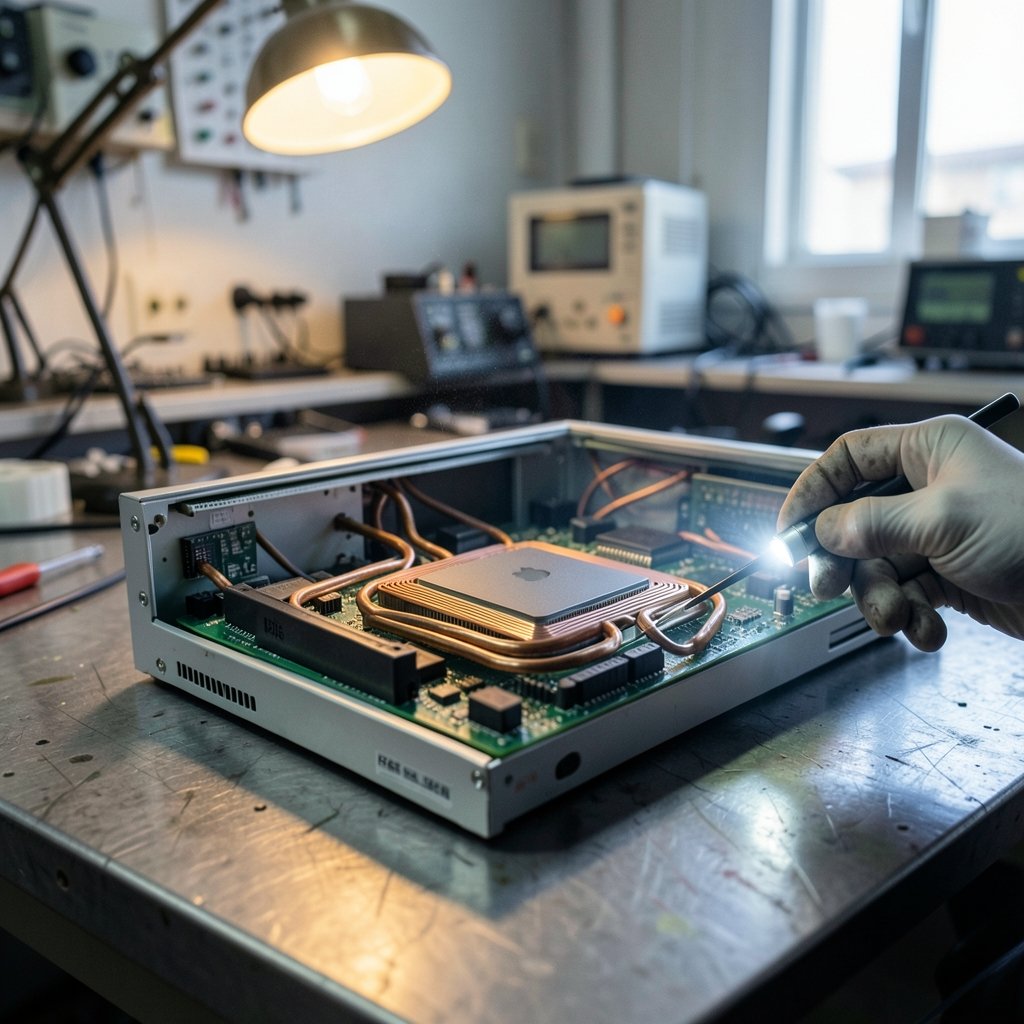
Apple’s public story starts with Private Cloud Compute, announced in June 2024. The pitch was straightforward: when an Apple Intelligence request is too heavy for an on-device model, it gets routed to servers running on Apple silicon — not x86 hardware, not NVIDIA GPUs. Apple published software images for these servers so independent researchers could verify the privacy claims, a move documented on Apple’s security research blog and in the company’s platform security materials.
That detail matters more than it first appears. By publishing verifiable server images, Apple committed itself to a vertically integrated stack: its own chips, its own operating system, its own security model. It is the same playbook Apple used with the M-series in Macs, scaled up to the data center.
What Apple has not confirmed is equally important. As of early 2025, there was no announced “M8 Ultra” chip, no published roadmap for 2026 server silicon, and no evidence of NVLink integration. The M4 family was the current generation. Anyone treating an M8 Ultra as fact is working from speculation, not documentation.
The M8 Ultra Rumor: Where It Comes From and Why to Doubt It
Apple’s naming cadence makes an M8 plausible eventually — M1 through M4 shipped roughly annually, so M8 would land several generations out. A 2026 date, though, would require Apple to skip multiple generations or dramatically accelerate its schedule. Neither has been hinted at in any primary source.
There’s also a technical wrinkle. Apple’s Ultra chips are built by fusing two Max dies with a proprietary interconnect, and they lean on unified memory — a shared pool the CPU and GPU draw from directly. That architecture is elegant for on-device inference, where memory bandwidth per watt is king. It is a different design philosophy from NVIDIA’s data-center parts, which pair huge GPU compute with NVLink for chip-to-chip communication at enormous bandwidth.
So when a rumor claims Apple is adopting NVLink, it is proposing a strategic reversal, not an incremental update. NVLink is NVIDIA’s proprietary interconnect. Apple building servers around it would mean abandoning the integration advantage that makes PCC’s privacy story work in the first place. Until that appears on an Apple or NVIDIA primary page, treat it as unconfirmed.
NVLink Explained: Why It Keeps Showing Up in Apple Rumors
NVLink is NVIDIA’s high-speed link that lets GPUs share data far faster than standard PCIe connections. In large training clusters, it is the plumbing that makes multi-GPU systems behave like one big machine. NVIDIA documents its specifications extensively in its developer materials, and the technology has become shorthand for serious AI infrastructure.
That’s exactly why it gets attached to Apple rumors. Writers looking for a signal that “Apple is getting serious about AI servers” reach for the most recognizable infrastructure brand they know. But recognizable does not mean accurate. Apple’s whole PCC architecture is built on the premise that it controls every layer — chip, firmware, OS, and attestation. Bolting NVIDIA hardware into that stack would complicate the verification story Apple spent years constructing.
A useful rule of thumb: if a claim about Apple’s servers would require Apple to publicly reverse a stated architectural principle, it needs a primary-source citation before it belongs in a headline.
The Real Competitive Pressure: Custom Silicon Everywhere
The broader context is genuine. The AI chip market has been reshaping the entire semiconductor industry, and Apple is far from the only company moving toward custom silicon. Nvidia’s own valuation debates have centered on whether custom chips from hyperscalers will erode its margins — a theme worth following in coverage of Nvidia’s forward PE and custom chip margins. Apple’s server chips fit squarely into that story.
Meanwhile, the PC chip landscape is shifting too. Reports of Nvidia entering the consumer PC market with an N1X chip have rattled investors in Intel and AMD stock, showing how quickly silicon rivalries now cross category lines. Apple’s advantage is that it already owns its full stack, so a server chip push builds on existing work rather than starting from zero.
There’s a supply-chain angle as well. Trade policy has made hardware planning harder across the board, and coverage of semiconductor tariffs affecting laptops and servers shows why data-center buildouts now carry cost uncertainty that did not exist a few years ago. Apple’s decision to design its own server silicon gives it more control over both cost and supply timing than relying on merchant GPUs would.
How Private Cloud Compute Actually Works in Practice
For teams thinking about building on Apple’s AI stack, understanding PCC’s mechanics is more useful than chasing chip rumors. The flow is simple: an Apple Intelligence request that exceeds on-device capacity gets encrypted and sent to a PCC node. The node processes it in a stateless way — Apple says no request data is retained — and returns the result.
The verification piece is what makes it unusual. Apple publishes the software images running on PCC nodes, and independent researchers can inspect them. If the published image does not match what a server is running, the trust model breaks. This is a meaningfully different approach from most cloud AI, where customers simply trust the provider.
Practically speaking, developers building with Apple’s frameworks should treat PCC as an opaque backend with strong privacy guarantees rather than something they configure. The lessons that transfer to other platforms are about architecture: keep sensitive inference on-device when possible, encrypt everything in transit, and prefer stateless server processing.
For teams running their own multiplayer or backend infrastructure alongside AI features, the operational discipline is similar to what’s covered in guides on PlayFab multiplayer server setup — plan capacity around peak load, keep state off the server where you can, and test failover before launch.
M-Series vs. NVIDIA Data-Center Chips: An Honest Comparison
The table below reflects what is publicly documented about each approach, not unverified 2026 claims.
| Dimension | Apple silicon servers (PCC) | NVIDIA data-center GPUs |
|---|---|---|
| Memory model | Unified memory shared across CPU/GPU | Dedicated high-bandwidth GPU memory |
| Chip-to-chip link | Apple proprietary fabric | NVLink (NVIDIA proprietary) |
| Primary design goal | Efficiency per watt, privacy, integration | Peak compute throughput at scale |
| Software verification | Published images, third-party inspection | Varies by deployment |
| Typical workload fit | Inference, on-device-adjacent tasks | Large-scale training and inference |
Neither column is “better” in the abstract. Apple optimized for a specific problem — running personal-context AI privately and efficiently. NVIDIA optimized for raw throughput across massive clusters. The mistake is assuming one company’s roadmap must converge on the other’s.
Practical Tips: How to Evaluate Apple AI Server Claims
If you’re tracking this space for work — investing, procurement, or development — a few habits will save you from bad information.
- Check the primary source first. Apple announces chips through its newsroom and documents server security on its security research blog. If a claim isn’t there, it’s speculation.
- Watch for architectural reversals. Any story claiming Apple adopted NVIDIA interconnect should explain why Apple would abandon vertical integration. If it doesn’t, it’s probably recycled rumor.
- Distinguish inference from training. Apple’s public work centers on inference for user-facing features. Claims about Apple training frontier models on its own servers are a different, unverified assertion.
- Treat generation numbers with suspicion. An “M8 Ultra” in 2026 implies a cadence Apple has never demonstrated. Verify against actual announced generations.
- Follow the supply chain. Tariffs, foundry capacity, and memory pricing shape server plans as much as chip design does.
The most common mistake people make is treating a plausible-sounding leak as a confirmed roadmap. The second most common is dismissing Apple’s server ambitions entirely because the rumors are shaky. Both miss the point: PCC is real, documented, and shipping, and it represents a genuine architectural bet even if the specific 2026 chip details remain unknown.
The Regulatory and Platform Pressure Shaping Apple’s AI Plans
Apple’s AI server strategy does not exist in a vacuum. App Store economics and platform rules are under intense scrutiny worldwide, and those battles affect how Apple funds and prioritizes infrastructure. Coverage of the Apple Supreme Court case over the 27 percent App Store fee shows how legal pressure can reshape platform incentives, while EU App Store fee rules for game developers illustrates how regional regulation fragments Apple’s global model. (Apple Newsroom)
There’s also the cloud partnership question. Reports about Apple’s Private Cloud Compute and Google Cloud highlight an awkward tension: Apple’s privacy story depends on controlling the hardware, yet scale may require renting capacity from someone else. How Apple resolves that tension will say more about its 2026 server plans than any chip leak.
Conclusion
The honest state of play is this: Apple’s AI server ambitions are real, documented, and built on Apple silicon with a privacy-first architecture. The “M8 Ultra with NVLink” story is not. It combines a plausible future chip name with a technology Apple has shown no sign of adopting, and it lacks any primary-source support. Readers who want reliable information should anchor on Apple’s own announcements, NVIDIA’s developer documentation, and a healthy suspicion of roadmap claims that would require either company to reverse a core strategy. The 2026 data center will be shaped by custom silicon, supply-chain pressure, and regulation — not by a rumor that skips several chip generations and rewrites an architecture along the way.
FAQ
Is Apple really building its own AI server chips?
Yes, with an important caveat. Apple confirmed at WWDC 2024 that Private Cloud Compute runs on Apple silicon servers, and it publishes software images for independent verification. What Apple has not confirmed is any specific future chip named “M8 Ultra” or a 2026 timeline for it.
Does Apple use NVIDIA NVLink in its AI servers?
There is no evidence for this. NVLink is NVIDIA’s proprietary GPU interconnect, and Apple’s documented server architecture relies on its own silicon and integration. A claim that Apple adopted NVLink would require a primary-source citation from Apple or NVIDIA before it should be believed.
What is Private Cloud Compute?
Private Cloud Compute is Apple’s system for handling Apple Intelligence requests that are too demanding for on-device processing. Requests go to servers running Apple silicon, are processed statelessly without retention, and the server software images are published so researchers can verify the privacy claims.
Why do people keep linking Apple to NVIDIA hardware?
Because NVIDIA is the most recognizable name in AI infrastructure, and writers often use it as shorthand for “serious AI ambitions.” The rumors tend to fill gaps in Apple’s public roadmap with familiar brand names rather than documented facts.
Should developers plan around an M8 Ultra server chip?
No. Developers should build against Apple’s documented frameworks and treat PCC as a privacy-preserving backend they do not configure. Planning infrastructure around an unannounced chip generation is a recipe for wasted engineering effort.
What should I watch to track this story accurately?
Follow Apple’s newsroom and security research blog for chip and PCC announcements, and NVIDIA’s developer documentation for interconnect specifications. For market context, watch custom silicon competition and semiconductor trade policy — those forces will shape 2026 data centers more than any single leak.



