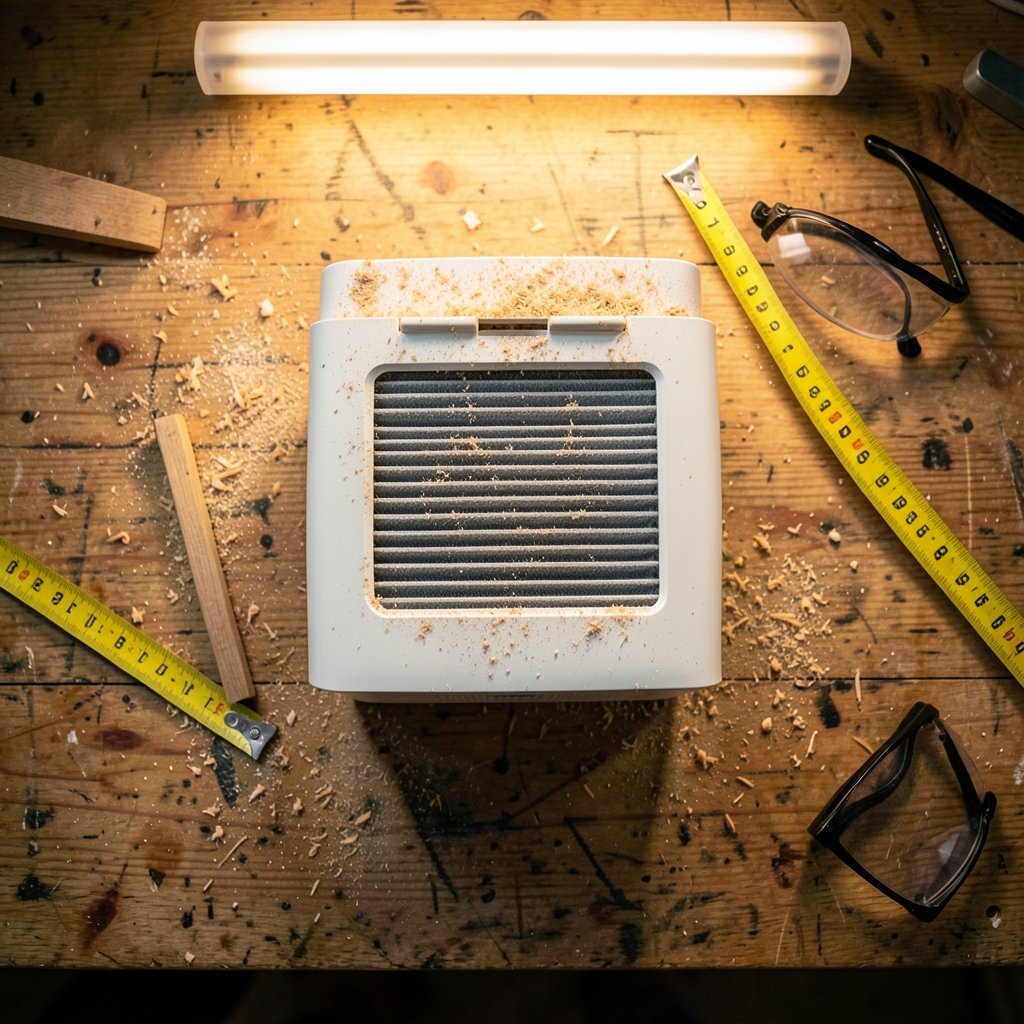
Can a box with a fan and a filter really save your lungs in a sawdust-filled shop? Walk into most home woodworking shops and you can see the dust hanging in the light from a window. You can smell it. You can taste it. And if you’ve ever blown your nose after a day at the table saw, you know exactly what’s been floating around you.
An air purifier can help with that. But it’s not the magic box the marketing photos suggest, and buying the wrong one wastes money while giving you a false sense of safety. This guide covers what works in a real workshop, what doesn’t, and how to size and place a unit so it actually earns its floor space.
Why workshop dust is a bigger deal than most people think
Wood dust isn’t just annoying. The International Agency for Research on Cancer classified wood dust as a Group 1 carcinogen, meaning it’s known to cause cancer in humans. The evidence came largely from furniture workers who developed nasal cancer after years of exposure.
The fine particles are the problem. Chips and shavings fall fast, but particles under 10 microns can hang in the air for hours. The smallest ones drift deep into your lungs. Sanding, routing, and cutting MDF or plywood throw off the most of it, and a shop vac hooked to one tool rarely catches everything.
There’s also a regulatory angle worth knowing. OSHA sets a permissible exposure limit for wood dust at 5 mg/m³ over an eight-hour shift, with a short-term limit of 10 mg/m³ over 15 minutes. Those numbers are for workplaces with monitoring programs, but they’re a useful reality check: if you can see a haze in the air, you’re likely well above them.
What an air purifier can and cannot do in a shop
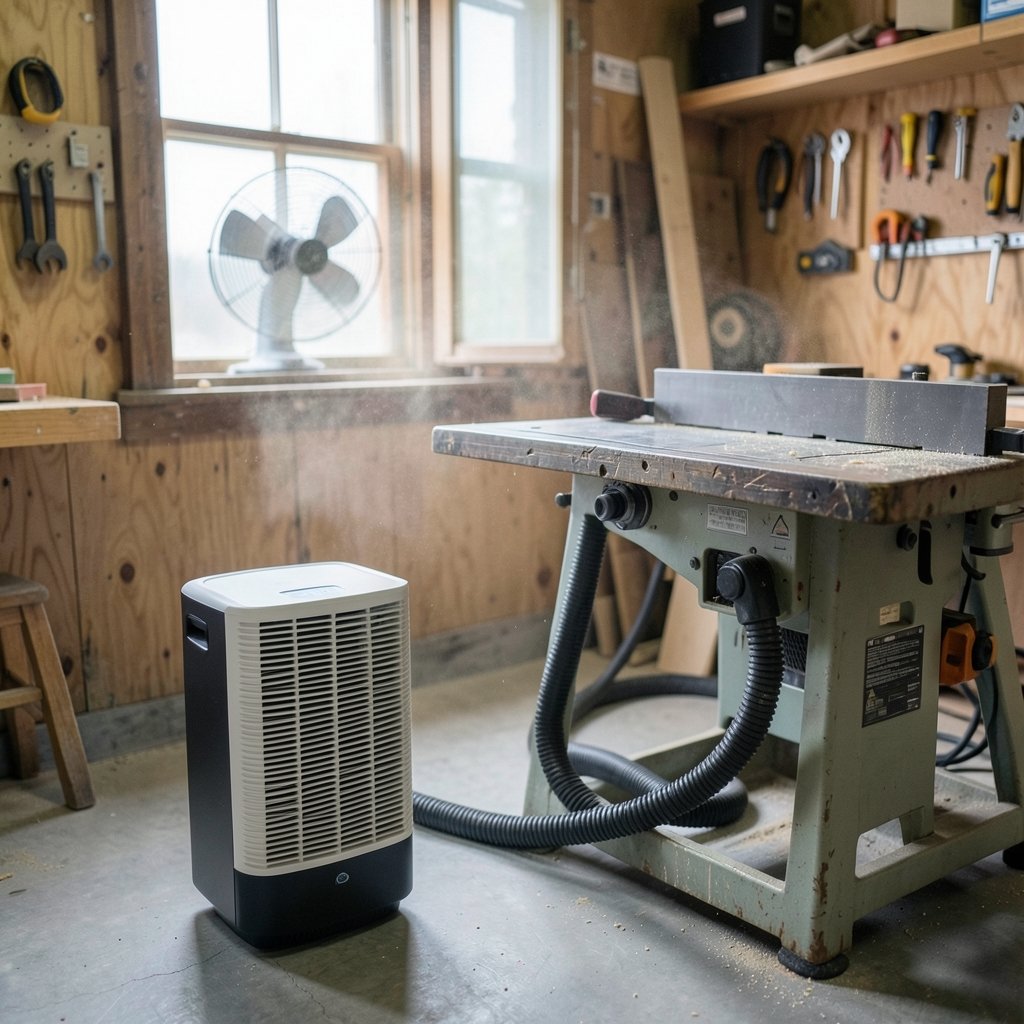
An air purifier is a supplemental tool. It cleans air that’s already dirty. It does not stop dust at the source, and no filter unit replaces a properly ducted dust collector on your big machines.
Think of it as a second line of defense. The first line is capture at the tool: a dust collector or shop vac on the saw, planer, and sander. The second line is ventilation, like an open window or an exhaust fan pushing air outside. The purifier is the third line, catching the fine stuff that escapes and stays suspended.
One caution from public health guidance applies directly here: air cleaners alone are not enough to protect people from exposure and should be used alongside other measures, according to the U.S. Environmental Protection Agency’s guidance on air cleaners and HVAC filters. That’s written about viruses, but the principle holds for dust too.
The filter spec that actually matters
Look for true HEPA filtration. The standard definition, used by the U.S. Department of Energy in its HEPA filter specification, is a filter that removes at least 99.97% of particles at 0.3 microns, which is the hardest particle size to catch.
That last part trips people up. A filter rated at 0.3 microns isn’t worse at smaller particles. It’s actually the worst-case size, and efficiency typically goes up for both larger and smaller particles.
Watch for marketing language. “HEPA-type,” “HEPA-like,” and “99% HEPA” are not the same as a certified HEPA filter. If the spec sheet doesn’t say true HEPA or H13/H14, assume it’s a lesser filter.
Prefilters are your best friend
Here’s where most shop owners learn the hard way. A fine HEPA filter loaded with coarse sawdust clogs fast, and replacements aren’t cheap. A washable or cheap-to-replace prefilter catches the bulk of the sawdust before it reaches the expensive media.
In practice, that means checking the prefilter every few sessions during heavy sanding season. Vacuum it, rinse it if it’s washable, and keep a spare on hand. A clogged prefilter doesn’t just cut airflow; it makes the motor work harder and shortens the unit’s life.
Sizing: the math that keeps you honest
Air cleaners are rated by clean air delivery rate (CADR), measured in cubic feet per minute. The testing standard comes from the Association of Home Appliance Manufacturers. A common industry rule of thumb: pick a CADR roughly equal to two-thirds of your room’s square footage to hit about 4.8 air changes per hour.
For a 300-square-foot shop, that means a CADR around 200 cfm. For a 500-square-foot shop, closer to 330 cfm. Here’s the catch: workshops usually need more air changes than living rooms because dust generation is intense and intermittent. Sizing up one tier is rarely a mistake.
| Shop size | Rule-of-thumb CADR | Practical target for heavy dust |
|---|---|---|
| 150 sq ft | ~100 cfm | 150+ cfm |
| 300 sq ft | ~200 cfm | 300+ cfm |
| 500 sq ft | ~330 cfm | 450+ cfm |
| 800 sq ft | ~530 cfm | 700+ cfm, or two units |
Manufacturer CADR figures come from lab tests under ideal conditions. Real shops with coarse dust loading will see lower performance, so treat the label as a ceiling, not a promise.
Placement tips that make a real difference
Placement is where people make the most common mistakes. A few practical rules:
- Put the unit near the dust source, not across the room. Clean the air where it is dirtiest.
- Keep it off the floor if possible. Fine dust settles slowly, and an intake near breathing height catches more of what you would otherwise inhale.
- Do not box it into a corner. Units need clearance on all sides for airflow.
- Run it during work and for at least an hour afterward. Particles stay airborne long after you stop cutting.
- Change the filter when pressure drop or visible loading calls for it, not on a fixed calendar alone.
A second smaller unit often beats one giant unit in an L-shaped or divided shop. Air doesn’t move around corners well, and two intakes in two zones will outperform one central machine.
Noise, running costs, and the reality of shop life
A purifier running at full blast in a small shop can hit 55 to 65 decibels, which is loud enough to be irritating during quiet hand-tool work. Many units have a sleep or low setting, but low settings move far less air. If noise matters, look for a unit with a high CADR at a moderate fan speed rather than one that only hits its rating at maximum.
Electricity use is modest for most units, typically in the range of a small fan. Filter replacement is the bigger ongoing cost. Budget for a new HEPA filter every six to twelve months in a busy shop, more often if you sand a lot of MDF.
One more practical note: an air purifier doesn’t cool or heat the shop, and it doesn’t remove odors well unless it has a carbon stage. If fumes from finishes bother you, that’s a ventilation job, not a filtration job.
What about DIY box-fan filters?
You’ve probably seen the viral videos: a box fan with a furnace filter taped to it. Do they work? Sort of. A decent MERV-13 filter on a box fan does move and clean air, and it’s cheap. But the airflow is low, the seal is usually leaky, and the fan motor isn’t built for the static pressure of a loaded filter.
For a small shop on a tight budget, a box-fan build can be a stopgap. For daily dust exposure, a purpose-built HEPA unit with a real seal and a rated CADR is the better long-term tool. If you’re already deep into the tech side of your shop setup, the same logic of matching the tool to the job applies whether you’re picking a USB-C hub for a MacBook Air or a filter unit.
A quick note on other hazards in the air
Wood dust isn’t the only thing floating around. If you cut concrete, stone, or tile, you’re generating crystalline silica, a separate hazard with its own much stricter exposure limit of 50 micrograms per cubic meter over eight hours. A standard HEPA purifier helps with fine particulate, but it doesn’t replace proper wet-cutting or local exhaust.
Similarly, if you’re spraying finishes or working with solvents, filtration won’t protect you from vapors. That’s a ventilation and respiratory protection question. Knowing what malware is and how it works is useful for your computer; knowing what’s in your shop air is useful for your lungs.
Matching the purifier to your workflow
Different shops need different setups. A hand-tool woodworker doing light work in a garage might get by with a single mid-size HEPA unit. A cabinet shop running a planer and drum sander daily needs a serious dust collector plus a large purifier as backup.
If you’re tracking equipment trends and how tools evolve, the same way readers follow major auto news and industry updates, you’ll notice air filtration tech has improved: better seals, smarter sensors, and quieter motors. But the fundamentals haven’t changed. Capture at the source, ventilate, then filter what’s left.
Common mistakes to avoid
- Buying on price alone and ending up with a “HEPA-type” filter that lets fine dust through.
- Skipping the prefilter and burning through expensive HEPA media.
- Placing the unit in a corner where it recirculates its own exhaust.
- Assuming the purifier replaces a dust collector. It doesn’t.
- Running it only while working, then shutting it off while dust is still airborne.
Conclusion
An air purifier for workshop dust is a smart addition to a shop, but only when it’s part of a layered approach. Capture dust at the tool, ventilate the space, and let a true HEPA unit with a properly sized CADR clean up what’s left. Size it generously, protect it with a prefilter, place it near the work, and run it longer than feels necessary.
Your lungs don’t get a second set. A few hundred dollars spent on the right filtration setup is one of the best investments a woodworker can make.
Frequently asked questions
Do I really need an air purifier if I have a dust collector?
Yes, in most cases. A dust collector captures chips and most dust at the machine, but fine particles escape and stay airborne. A HEPA purifier catches that residual fine dust. The two tools do different jobs and work best together.
How often should I replace the HEPA filter in a workshop?
In a busy shop, every six to twelve months is typical, and more often if you sand a lot of MDF or work daily. Watch for reduced airflow, a visible dust layer on the media, or a filter indicator light. Replacing too early wastes money; waiting too long strains the motor.
Is a HEPA filter rated at 0.3 microns useless for smaller particles?
No, the opposite. 0.3 microns is the most penetrating particle size, meaning it’s the hardest size to catch. Efficiency is typically higher for both larger and smaller particles, so a true HEPA filter also captures the ultrafine dust that reaches deep into your lungs.
Can I just use a box fan with a furnace filter?
It can help in a pinch, especially with a MERV-13 filter, but airflow is limited, seals leak, and the motor isn’t designed for a loaded filter. For regular exposure to fine wood dust, a purpose-built HEPA unit with a rated CADR is the more effective and durable choice.
Where should I place the purifier in my shop?
Put it near the dust source, off the floor if possible, and away from corners so it has clearance on all sides. In a divided or L-shaped shop, two smaller units usually outperform one large one because air doesn’t circulate well around corners.
Does an air purifier remove finish fumes and odors?
Not effectively. Standard HEPA filtration targets particles, not gases. A carbon stage can help with some odors, but solvent vapors need real ventilation and, for spraying, proper respiratory protection. Treat filtration and ventilation as separate tools.