
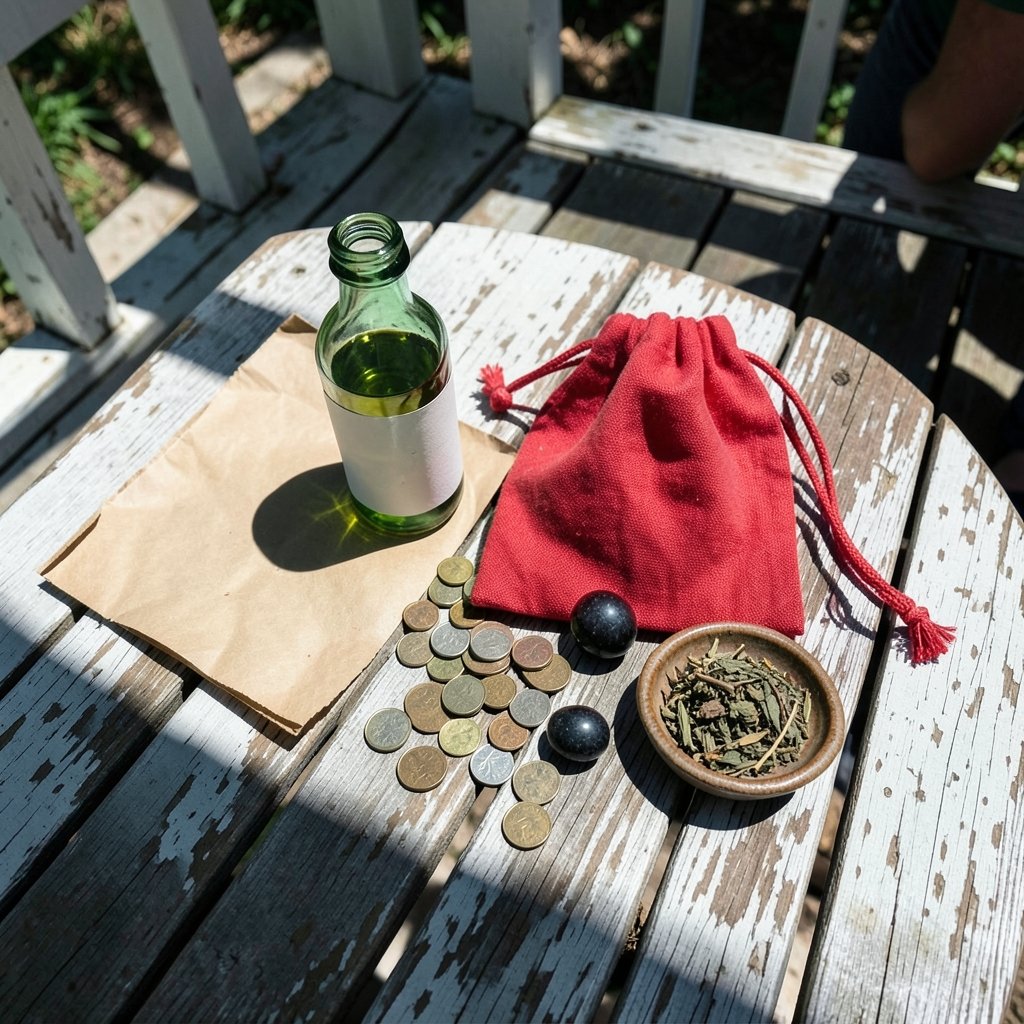
What do you picture when you hear the phrase “money drawing” — a bottle of green oil with a handwritten label, a folded paper tucked in a wallet, or a modern get-rich plan dressed up in old language? The phrase is ambiguous, and that ambiguity trips people up. Some use it to describe a living folk-magic tradition. Others use it as a loose adjective for anything that pulls in cash. This article sorts out the first meaning, the one with real cultural roots, and explains how the practice actually works in the hands of the people who keep it.
What “money drawing” actually refers to
In everyday use, money drawing describes a category of folk-magic practice aimed at attracting money and financial luck. It sits inside American hoodoo or conjure, a set of traditions with African roots that took shape in the southern United States. The term is not standardized. A spiritual-supply shop, a scholar, and a practitioner may each draw the edges a little differently, and that is worth keeping in mind before treating any single definition as final.
The dominant usage is the folk-magic one. The secondary usage is commercial — a “money-drawing” product, a “money-drawing” campaign — and it carries none of the cultural weight. When someone asks about money drawing in a serious way, they almost always mean the tradition.
Where the tradition comes from

Hoodoo scholarship generally places the tradition’s development in the 19th and 20th centuries in the American South. It grew out of the religious and cultural life of enslaved and later free African Americans, blending African spiritual practices with elements absorbed from the surrounding culture. Exact origins are uncertain, and careful writers say so rather than inventing a tidy founding date.
Two academic books anchor most serious reading on the subject. Yvonne Chireau’s Black Magic: Religion and the African American Conjuring Tradition, published by the University of California Press in 2003, treats conjure as part of African American religious history rather than as a curiosity. Katrina Hazzard-Donald’s Mojo Workin’: The Old African American Hoodoo System, from the University of Illinois Press in 2013, offers a scholarly history of the hoodoo system itself. Editions and dates should be checked before citing them in formal work.
The practice also overlaps with broader prosperity magic found in many folk traditions around the world. That cross-cultural claim is common but needs careful sourcing, because the specific forms differ enormously from place to place.
How the practice takes material form
Money drawing is a hands-on tradition. It shows up as physical goods: money drawing oil, money drawing powder, and money drawing incense are the classic three, sold in spiritual-supply shops for much of the 20th century and still today. A practitioner might dress a candle with oil, dust a paper with powder, or burn incense while stating an intention.
Ingredients vary by tradition and by shop. Cinnamon, pyrite, and various herbs described as “money” plants appear often, chosen for symbolic association rather than for any tested effect. This is the part where newcomers get lost: there is no master ingredient list. A recipe from one rootworker is a recipe from one rootworker, not a standard.
The practical takeaway for anyone curious is to treat ingredient lists as tradition-specific. If a seller presents a single “authentic” formula, ask which lineage it comes from. The answer tells you more than the ingredient list does.
The commercial layer, and why it matters
Selling spiritual supplies is a distinct modern retail phenomenon, and it is easy to confuse with the practice itself. The two are not the same thing. A bottle on a shelf is a product. The tradition is a set of beliefs, techniques, and community knowledge that existed before anyone printed a label.
This distinction matters because marketing language drifts. Retailers sometimes borrow the authority of tradition to sell a product, and the product’s claims are not backed by evidence. There is no peer-reviewed support for magical efficacy, and honest writing states that as an absence of evidence rather than pretending a study proved anything either way.
The same caution applies to any money-making scheme that adopts spiritual vocabulary. Scams dressed in mystical language follow patterns that are well documented elsewhere, and the mechanics are worth understanding. A look at how a gift card scam works and why victims rarely get their money back shows how fast money leaves a wallet when a story is convincing. Anyone spending on supplies should apply the same skepticism they would to any other purchase.
What actually works in practice, according to practitioners
Practitioners describe money drawing as a discipline of attention rather than a vending machine. The parts that experienced people emphasize are unglamorous.
First, clarity of intention. A vague wish for “more money” gives the work nothing to organize around. A specific, stated aim — a debt cleared, a job landed — is the starting point in nearly every account.
Second, consistency. Rootwork traditions tend to favor repeated, small actions over one dramatic gesture. A candle lit on a schedule, a paper carried daily, a prayer said at the same hour. The repetition is the method.
Third, keeping the work private. Many practitioners treat money drawing as personal business, not a public performance. That is a cultural norm as much as a technique. (Feng shui)
Fourth, pairing the work with ordinary effort. The people who take the tradition seriously rarely describe it as a replacement for action. It sits alongside the job application, the budget, the phone call. Anyone who treats it as a substitute has misunderstood the role it plays.
Common mistakes follow from those points. Buying supplies with no plan is the big one. Chasing every new oil or powder instead of sticking with one approach is another. Treating a retailer’s claim as a guarantee is the third. The people who get the most out of the tradition, in their own telling, are the ones who treat it as a practice rather than a purchase.
Money drawing versus money-making: two different conversations
The phrase gets borrowed a lot by people talking about income, and it helps to separate the conversations.
| Question | Folk-magic money drawing | Commercial money-making |
|---|---|---|
| What is it? | A tradition of intention and ritual | A plan for earning or attracting revenue |
| What is the evidence base? | None for magical efficacy | Varies; depends on the specific claim |
| Who sets the rules? | Practitioners and lineage | Markets, employers, customers |
| What does success look like? | Stated intention, consistent practice | Measurable income |
| Main risk | Spending on supplies with no plan | Fraud, bad advice, wasted effort |
The two conversations touch at one point: both involve money and both attract people looking for a shortcut. Beyond that, they are different subjects. Mixing them produces confused advice. A person worried about their budget needs a financial plan, not a bottle of oil. A person drawn to the tradition for cultural or spiritual reasons deserves an account of the tradition, not a sales pitch.
That same discipline of separating a real method from a sales story shows up across modern money topics. Understanding where the money actually goes in a security budget, for instance, is a very different exercise from buying a product that promises protection. The identity threat detection cost breakdown makes the point well: the useful questions are about allocation and evidence, not branding. The same logic applies to threat intelligence spending, where the line between genuine value and marketing is exactly what a careful buyer needs to find.
Why the ambiguity persists
The phrase survives in two senses because both are useful to someone. Folk practitioners use it precisely. Marketers use it loosely because it sounds old and potent. Scholars use it cautiously because the tradition resists tidy definition.
Readers can protect themselves with a simple habit: when you see “money drawing” in the wild, ask which conversation you are in. Is this a cultural practice being described, or a product being sold? The answer changes what you should do next.
There is also a broader lesson in how unfamiliar financial language gets used to lower people’s guard. New forms of money and new investment pitches arrive with their own vocabulary, and the vocabulary often outruns the understanding. A plain explanation of what a CBDC, or central bank digital currency, actually is shows how much clarity matters when a topic is wrapped in jargon. The same goes for the many claims about automated income. A grounded look at how to make money with AI separates the tools that work from the promises that do not, and a realistic account of how AI companies make money reveals whose interests the hype serves.
Conclusion
Money drawing is a real tradition with real history, and it is also a phrase that has been stretched to cover things it was never meant to describe. The folk practice is about intention, consistency, and community knowledge, kept alive by people who treat it as a discipline. The commercial usage is about selling something. Both exist, and neither cancels the other out.
The practical path for a curious reader is straightforward. Learn the tradition from serious sources before spending a dollar on supplies. Treat ingredient lists as tradition-specific rather than universal. Keep the practice separate from your actual financial planning, and apply ordinary skepticism to anyone who blurs the line. Whether the subject is old folk magic or a brand-new financial product, the same rule holds: understand what you are looking at before you pay for it.
Frequently asked questions
What is money drawing?
Money drawing is a category of folk-magic practice focused on attracting money and financial luck, most closely associated with American hoodoo or conjure. It typically involves oils, powders, incense, and stated intentions. The term is not standardized, and definitions vary between practitioners, scholars, and retailers.
Is money drawing the same as hoodoo?
No. Money drawing is one focus within hoodoo, not the whole tradition. Hoodoo covers a much wider range of concerns, including protection, health, love, and justice. Money drawing is a subset that deals specifically with financial matters.
Does money drawing have scientific support?
There is no peer-reviewed evidence that money drawing produces financial results through magical means. That is an absence of evidence, not proof of the opposite. The practice is best understood as a cultural and spiritual tradition rather than a tested method.
Why do ingredient lists differ so much between sellers?
Because the tradition is not standardized. Recipes pass down through lineages, regions, and individual practitioners, and they change along the way. Cinnamon, pyrite, and various herbs appear often for symbolic reasons, but no single formula is authoritative. A seller claiming one “true” recipe is worth questioning.
Can I practice money drawing without buying anything?
Many practitioners describe the core of the work as intention and consistency rather than purchased goods. A stated aim, a repeated routine, and privacy are the elements most often emphasized. Supplies are a common aid, not a requirement, in many accounts of the practice.
How do I tell a tradition from a sales pitch?
Ask what is being described and who benefits. A description of a cultural practice explains history, variation, and limits. A sales pitch promises outcomes and discourages questions. If a seller cannot say where a formula comes from or what it will not do, that is your answer.
The line between cultural respect and commercial exploitation is worth watching closely. When a tradition’s vocabulary is borrowed to move product, the tradition itself can be diluted or misrepresented. Readers who care about the practice can support sellers who explain their sources, acknowledge limits, and do not promise outcomes they cannot deliver. That standard is reasonable for any purchase, spiritual or otherwise. ## A closing note on curiosity Curiosity is the right starting point, and skepticism is its natural companion. Approach money drawing as you would any unfamiliar subject: read widely, ask where claims come from, and stay alert to the moment a description turns into a pitch. The tradition has survived because people found meaning in it, not because it was sold. Keep that distinction in view, and the subject stays what it should be — a window into folk belief, not a shortcut to a fuller wallet.



