
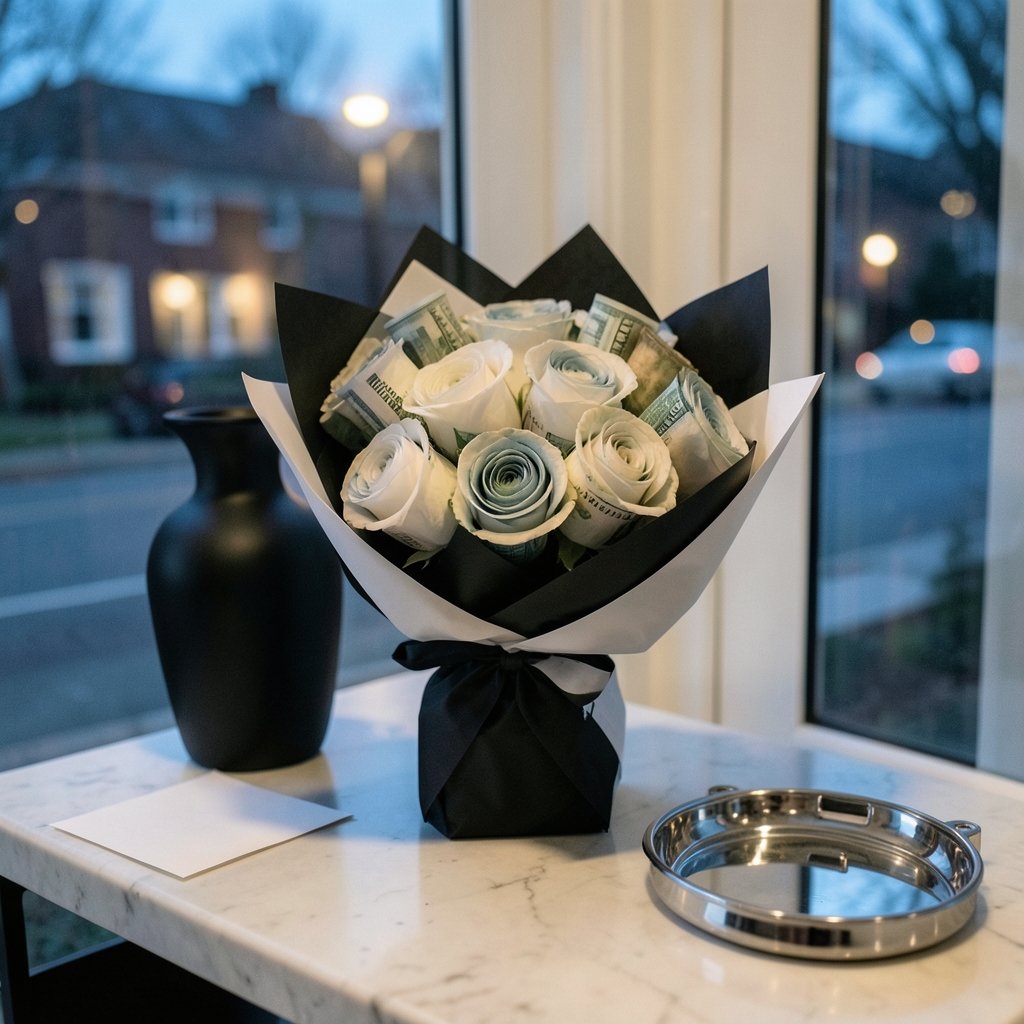
What do you give someone who already has everything, hates clutter, and would rather have cash than another scented candle? A money bouquet, of course. It is exactly what it sounds like: banknotes folded, rolled, or fanned into something that looks like flowers, then wrapped like a real arrangement. It photographs beautifully, it is impossible to regift, and it turns a plain cash gift into something with a bit of theater.
But there is more to a good money bouquet than rolling up a few twenties and hoping for the best. There is the craft side, the etiquette side, and a surprisingly murky legal side that most tutorials skip entirely. This guide walks through all three, with the practical details that separate a bouquet that looks expensive from one that looks like laundry.
What a Money Bouquet Actually Is
A money bouquet is a gift arrangement in which folded or rolled banknotes are wired, skewered, or taped onto stems and presented like a bunch of flowers, often mixed with real or artificial blooms. It is a craft and gift trend rather than a formal product category, so there is no standard definition and no official rules about how one should look.
It belongs to a small family of cash-based gift formats:
| Format | What it looks like | Typical occasion |
|---|---|---|
| Money bouquet | Folded bills on stems, wrapped like flowers | Birthdays, graduations, Valentine’s Day |
| Money lei | Bills folded and strung into a wearable garland | Hawaiian graduations and milestones |
| Money tree | Bills folded into origami leaves on a branch | Housewarmings, business openings |
| Cash envelope | Bills in a decorated card or box | Weddings, holidays, Lunar New Year |
The money lei is the best-documented member of that family, with a long association with Hawaiian graduation celebrations. The bouquet, by contrast, is a newer craft format that spread largely through DIY tutorials and social media rather than through any single cultural tradition.
Why Cash Gifts Keep Winning
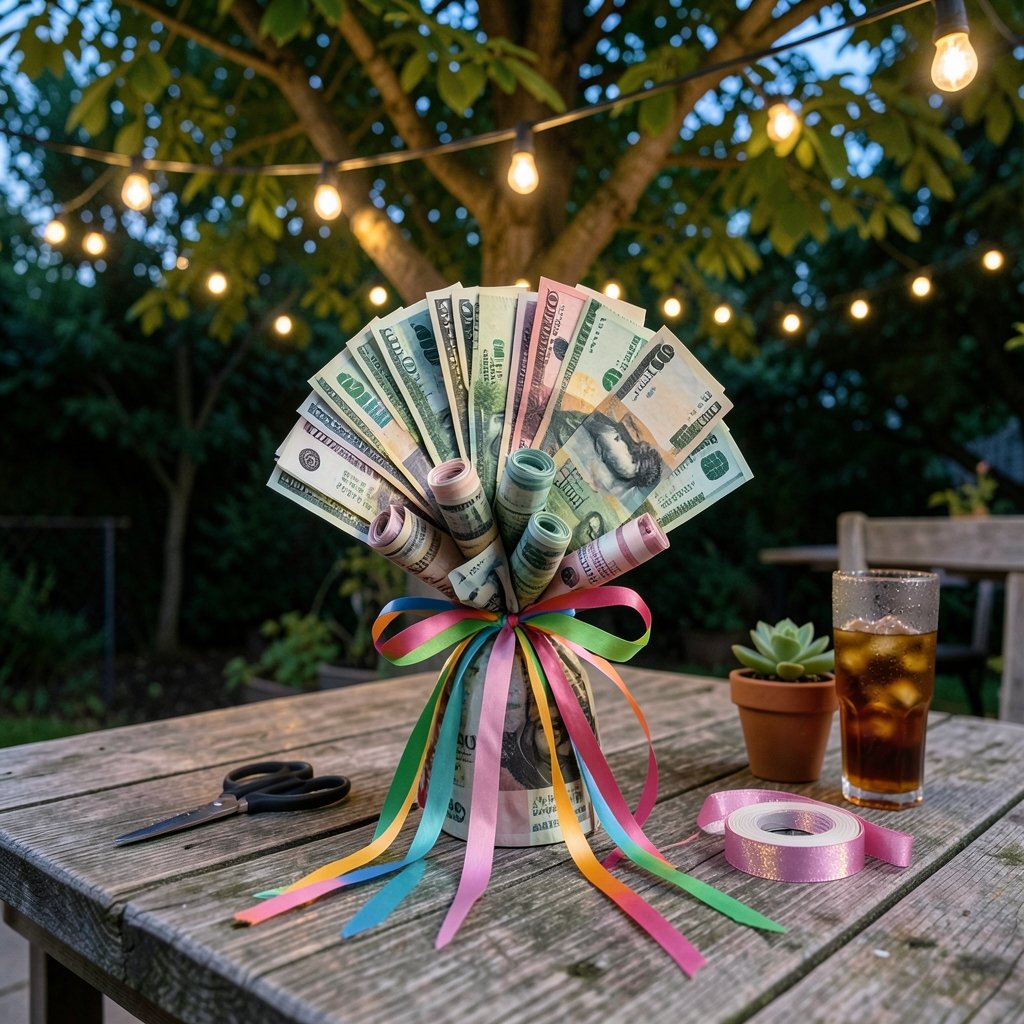
There is a reason the cash gift refuses to die. It is efficient. It never needs a receipt. And for a generation that is drowning in possessions and short on space, it solves a problem rather than creating one.
A bouquet also fixes the one weakness of giving cash: the awkwardness. Handing someone a folded bill feels transactional. Handing them something that looks like a florist’s delivery feels like a gift. The money is the same; the presentation does the emotional work.
That said, presentation costs money and time. If the goal is to make a cash gift feel generous rather than to spend a lot on ribbon and filler, it helps to think about the total budget the way you would any purchase. The same logic applies to any gift that involves real value changing hands, whether it is a bouquet, a cash envelope, or a digital transfer. If you are weighing up the real cost of a gift against its perceived value, the breakdown of where money actually goes in identity threat detection costs is a useful reminder that the visible part of any purchase is rarely the whole story.
The Legal Question Nobody Answers Clearly
Search for money bouquet tutorials and you will eventually hit a claim that defacing currency is illegal. It usually arrives without nuance, and it often scares people off a perfectly reasonable gift.
Here is the more accurate picture. United States federal law does restrict the mutilation of banknotes, but the statute is narrower than the folk wisdom suggests. The relevant provision, 18 U.S.C. § 333 on mutilation of national bank obligations, targets people who deface, mutilate, cut, disfigure, perforate, unite, or cement together notes with the intent to render them unfit to be reissued. The intent element matters. Folding a bill for a gift is not the same act as destroying it so it can never circulate again.
There is also a common mix-up worth clearing up. Rules about reproducing currency, which people often cite in these conversations, are a separate matter from rules about handling real notes. The reproduction side sits in 18 U.S.C. § 474 on counterfeit obligations, and it has nothing to do with whether you can roll a twenty into a rose shape.
Two honest caveats. First, whether piercing a bill with a wire could ever be argued as perforating is not clearly settled in public guidance, so treat pinning as the riskiest technique and skewering through a folded edge as the safer one. Second, the official anti-counterfeiting guidance published by the U.S. Secret Service on counterfeit currency focuses on detecting and reporting fake money, not on gift crafts. Anyone who tells you that page settles the bouquet question is overselling it. Rules also differ outside the United States, so check local guidance if you are unsure.
What You Need Before You Start
The craft itself is forgiving. Most people already own half the supplies.
Core materials
- Clean, crisp bills. Newer notes fold better and crease less. Ask a bank teller for fresh notes if you can.
- Floral wire or wooden skewers. Wire gives you more control over the curve; skewers are faster and cheaper.
- Tape or a small elastic. Double-sided tape hides best.
- A base. A small foam block, a cup, or a jar filled with filler.
- Wrap and ribbon. Kraft paper, tissue, or cellophane, plus something to tie it.
- Filler flowers. Artificial blooms or greenery hide the mechanics and add color.
Choosing the denomination
This is where most people overthink. A bouquet of twenty single dollar bills looks impressive in volume but feels thin in value. A bouquet of five twenties looks sparse but feels generous. The sweet spot is usually a mix: a layer of smaller bills for visual density, with the higher denominations folded into the more prominent blooms.
One practical tip that rarely gets mentioned: avoid heavily creased bills if the recipient might deposit them. Sharp folds along the portrait can make notes harder to feed into an ATM or get accepted at a bank counter. Fold along the long edge where you can, and keep the folds loose enough to unfold cleanly.
How to Build a Money Bouquet, Step by Step
The method below works for a beginner and produces something that holds its shape for a full evening of photographs. (Banknote)
Step 1: Prepare the bills
Lay each note face up and flatten it. Decide on a fold: a simple fan fold, a roll, or a pointed “leaf” fold. Keep the portrait visible on at least some of the bills, because that is what makes the gift instantly readable as money.
Step 2: Attach the stems
Tape a wire or skewer to the back of each folded bill, running along the fold line. For rolls, slide the wire through the center so the bill wraps around it. Keep the attachment point small and near the base, so it disappears into the arrangement.
Step 3: Build in layers
Start with the tallest stems in the center and work outward and downward. Alternate money blooms with filler flowers so the arrangement reads as a bouquet rather than a pile of cash. This is also where you hide any visible tape.
Step 4: Set the base
Push the stems into foam or a weighted cup. Test the balance by lifting the whole thing. A top-heavy bouquet that flops over is the single most common failure point, and it is entirely avoidable with a heavier base.
Step 5: Wrap and finish
Wrap the base in kraft paper or tissue, tie it with ribbon, and trim the stems so nothing sharp pokes through. Add a small tag with the amount written on it, which saves the recipient from counting in front of everyone.
Mistakes That Make a Bouquet Look Cheap
- Using wrinkled bills. Creases read as carelessness. Smooth them under a book overnight.
- Skipping the filler. An all-cash bouquet looks like a craft project. A little greenery makes it look bought.
- Over-taping. Visible tape is the giveaway that ruins the illusion.
- Making it too tall. Anything above about 18 inches becomes hard to wrap and harder to carry.
- Forgetting the recipient has to unfold it. Fold gently and avoid staples through the printed area.
Money Bouquets and the Wider Cash Conversation
Cash gifts sit at an interesting moment. Physical notes still carry emotional weight, but the way people move money is changing fast. Central banks around the world are exploring digital versions of their currencies, and the shift from paper to ledger raises genuine questions about what a cash gift even means in a decade. If that subject interests you, this explainer on CBDC digital currency and central bank money going digital covers the basics without the hype. (How much does it cost to produce currency and coin?)
There is also a fraud angle worth knowing about, because cash gifts and scams unfortunately intersect. Gift cards are a favorite tool for scammers precisely because they are hard to trace, and the pattern of how a gift card scam works and why victims rarely get their money back is worth reading before you buy a card as a stand-in for a bouquet. Real notes in a real bouquet have one quiet advantage: they cannot be drained by a stranger who copied a code off the back.
Etiquette: When a Money Bouquet Works and When It Doesn’t
A money bouquet lands well at graduations, milestone birthdays, engagements, and housewarmings. It lands badly at funerals, formal weddings where a card is expected, and any event where the gift is opened publicly and the amount becomes a spectacle.
A few practical rules of thumb:
- Match the occasion’s tone. Playful events suit a playful gift.
- Keep the amount private. Put it on a card inside the wrap, not on a visible tag.
- Ask about the venue. Some formal settings have rules about what can be brought in.
- Consider the recipient’s comfort. Some people find public cash gifts awkward, and that is worth respecting.
If the recipient is more practical than playful, a plain envelope with a thoughtful note will often mean more than a crafted arrangement. The bouquet is a format, not a moral obligation.
Making It Yourself vs. Buying It
Custom money bouquets are sold by florists and online sellers, and prices vary wildly because you are paying for the cash inside plus a labor fee. Doing it yourself usually costs the price of supplies, which is often under twenty dollars on top of the money itself.
The trade-off is time. A medium bouquet takes roughly an hour for a first-timer and about half that once you have the fold down. If the gift is for tomorrow morning and you have never folded a bill into a rose, buying is the safer call. If you have an evening and a podcast, DIY wins on both cost and charm.
One more consideration: if you enjoy the craft, it scales. The same folding skills feed into origami gifts, party favors, and small side projects. People who turn a hobby into income often start exactly this way, and this overview of how to make money with AI tools is a useful contrast for anyone weighing a craft sideline against a digital one.
Conclusion
A money bouquet is a small, clever idea that rewards a bit of care. Fold clean bills, build in layers, hide the mechanics, and keep the total sensible. Know that the legal worry is smaller than the internet suggests, while the practical worry about creased notes and top-heavy arrangements is larger. Do those things and you end up with a gift that looks like it took far more effort than it did, which is the whole point.
Frequently Asked Questions
Is it illegal to make a money bouquet?
In the United States, folding or rolling banknotes for a gift is generally not treated as the mutilation that federal law targets, because the statute focuses on acts intended to render notes unfit to be reissued. Piercing a bill with wire is the murkiest technique, so many makers skewer through a folded edge instead. Rules vary outside the U.S., so check local guidance if you are unsure.
How much money should go into a money bouquet?
There is no standard amount. Most people treat the bouquet as the gift itself and spend what they would have spent on a present, then let the denomination mix do the visual work. A layer of smaller bills plus a few larger ones gives both volume and value.
How long does it take to make one?
A first attempt usually takes about an hour, including folding, wiring, and wrapping. Once you have practiced the fold, a medium bouquet can come together in twenty to thirty minutes. Building in layers from the center outward is the step that saves the most time.
Will banks accept folded bills?
Usually yes, as long as the note is intact and clearly genuine. Sharp creases can make a bill harder to feed into an ATM, so fold along the long edge, keep folds loose, and avoid staples through the printed area. Heavily damaged notes can be exchanged at a bank.
What occasions suit a money bouquet?
Graduations, milestone birthdays, engagements, housewarmings, and Valentine’s Day are the natural fits. It works less well at funerals or formal weddings where a card is expected, and it is worth checking whether the recipient enjoys public cash gifts before making one the centerpiece.
Can I make a money bouquet with coins instead?
You can, but it is awkward. Coins are heavy, they do not fold, and they tend to fall out of an arrangement. If you want a metallic look, use folded bills in a fan shape and add a few decorative coins at the base rather than trying to build the structure from them.



