
What if the cash in your wallet could tell you exactly where it was born? Here’s a surprise for most people: no single “money factory” makes American money. Paper bills and metal coins come from two completely separate government operations, and neither one decides how much money should exist. That confusion trips up tourists, trivia teams, and even some journalists. This guide untangles the term, walks through how a dollar bill is actually produced, and explains the part of the system most people never think about: who decides how many bills get printed in the first place. (Money)
What Does “The Money Factory” Actually Mean?
The phrase gets used three different ways, and mixing them up causes most of the confusion:
| Meaning | What it refers to | What it makes |
|---|---|---|
| The Bureau of Engraving and Printing (BEP) | A Treasury bureau | Paper currency (bills) |
| The U.S. Mint’s Philadelphia facility | A separate Treasury bureau | Coins |
| Central-bank money creation | Federal Reserve policy | Digital reserves and new money supply |
This article uses the first meaning as its main focus, because the BEP is the closest thing America has to a literal money factory. It is a bureau of the U.S. Treasury that produces paper currency, and it was established by an Act of Congress in 1862, during the Civil War push to issue legal-tender “greenbacks.”
The second meaning matters too. The U.S. Mint, a separate Treasury bureau, produces coins, and its Philadelphia facility is sometimes nicknamed “the money factory.” So if someone says they toured the money factory and saw coins, they mean the Mint. If they saw sheets of $20 bills, they mean the BEP.
The third meaning is the most misunderstood. In economics, a “money factory” describes how central banks create base money. That is a policy function, not a printing press.
Where the Bills Are Actually Printed
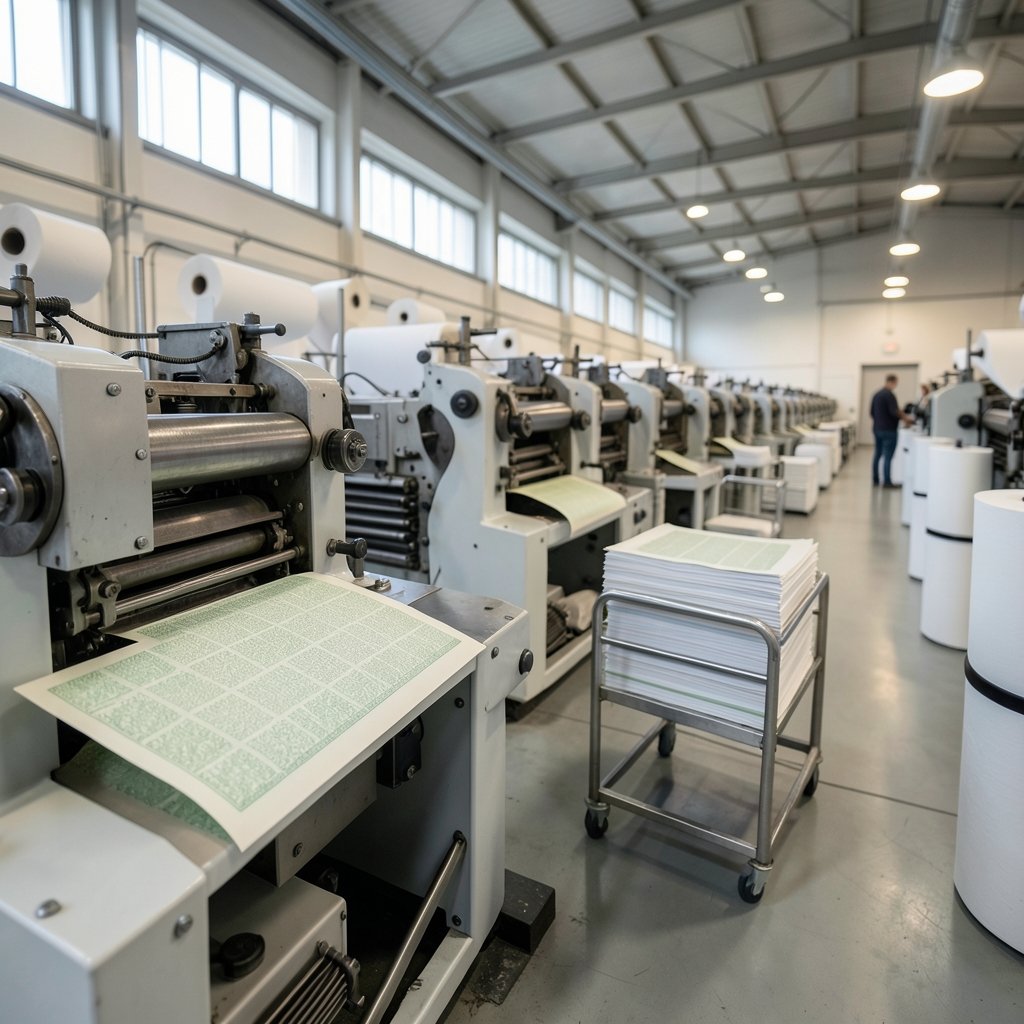
The BEP runs two production facilities: one in Washington, D.C., and the Western Currency Facility in Fort Worth, Texas, which opened in 1991. Fort Worth exists largely to shorten the distance between the printing presses and the Federal Reserve banks in the western half of the country, which cuts shipping time and cost.
Both facilities handle the full production cycle, from engraving to cutting to packaging. A single press can run around the clock, and the sheets it produces are inspected by hand and machine before anything gets cut. Workers reject sheets for the smallest flaws: a smudge, a misaligned print, a torn edge. That rejection rate is one reason currency production is more expensive per note than most people assume.
For anyone curious about the security side of the operation, the cost of protecting identities and systems inside facilities like these is a useful parallel. The real cost of identity threat detection breaks down where that money goes, and it explains why secure production sites invest so heavily in monitoring.
Not Paper, and Not Ordinary Ink
U.S. notes are not printed on wood-pulp paper. They are printed on a cotton-linen blend, which is why a bill survives a trip through the washing machine far better than a receipt does. The exact ratio is widely reported as 75 percent cotton and 25 percent linen, though it is worth checking the latest official description before quoting it, since the bureau occasionally updates its materials pages.
The ink is just as specialized. The familiar green is a specific shade, and modern notes add color-shifting ink and other features that are hard to copy. The redesigned $100 note, issued in 2013, added a blue 3-D security ribbon woven into the paper itself.
Who Decides How Much Money Gets Printed?
This is the part that surprises almost everyone. The BEP does not decide how much currency to print, and it does not set monetary policy. The Federal Reserve System orders notes from the BEP, and the bureau fills those orders. The Fed’s own explanation of who decides how much currency is printed lays out the ordering relationship clearly. (How is U.S. currency made and issued?)
That distinction matters because it separates two very different ideas that both get called “making money”:
- Printing currency replaces worn-out bills and meets public demand for cash. It does not by itself add to the money supply, because old bills are destroyed as new ones enter circulation.
- Creating money supply happens when the central bank expands reserves or buys assets. That is policy, and it is where the real economic action is.
The Federal Reserve’s explanation of how monetary policy works in practice covers the money supply and its components, including M1 and M2, for readers who want the full picture.
How a Bill Moves Through the System
Here is the practical sequence, in order:
- The Federal Reserve places an order with the BEP for specific denominations.
- The BEP prints, inspects, cuts, and packages the notes.
- The notes ship to Federal Reserve banks.
- Reserve banks distribute currency to commercial banks as customers withdraw cash.
- Banks return worn or damaged notes to the Fed.
- The Fed destroys unfit notes and credits the order for replacements.
That loop is the reason a dollar bill can circulate for years. The average lifespan varies by denomination, and higher-value notes tend to last longer because they change hands less often and get checked more carefully.
What Happens to Torn, Burnt, or Buried Cash?
Every year, people send the government bags of shredded, waterlogged, or partially burned money. Some of it comes from house fires. Some comes from pets. Some comes from cash buried in a backyard and forgotten for a decade.
The BEP’s Mutilated Currency Division handles these claims, and the service is free. The key rule is the “more than half” standard: if more than 50 percent of a note is clearly identifiable, the claim is usually paid in full. If less, examiners may still pay if they can determine the note’s value from the fragments. The bureau’s page on mutilated currency redemption explains what to include with a claim and how to package fragments safely.
A practical tip from people who have been through the process: do not tape fragments to paper or use glue. Tape can obscure security features and make an examiner’s job harder. Send the pieces loose in a sealed bag with a letter explaining what happened.
Scam victims often end up in a similar situation, holding damaged or worthless cash and hoping someone will make it whole. The reality is that in a gift card scam, victims rarely get their money back, and the same hard truth applies to most fraud losses: recovery is the exception, not the rule.
The Coin Side of the Money Factory
Coins follow a different path. The U.S. Mint produces them, and its Philadelphia facility is one of several production sites. Pennies, nickels, dimes, and quarters are struck from metal blanks, not printed on sheets, and the process uses enormous presses that strike thousands of coins per minute.
The Mint’s page on its Philadelphia coin production facility covers the plant’s history and its role. One detail that surprises visitors: the Mint also produces collectible and bullion coins, which is a separate business line from circulating pocket change.
The economics of small coins are famously awkward. The cost of making a penny has exceeded its face value in many recent years, a fact that resurfaces in policy debates every few years. That mismatch is a good reminder that “making money” and “making a profit” are not the same thing.
Money in the Digital Age
Cash is no longer the only thing people call money, and the “money factory” concept is shifting with it. Central banks around the world are researching digital versions of their currencies, often called central bank digital currencies. These would be direct claims on a central bank, held in digital form rather than on paper. The shift toward central bank digital currency explains how that model differs from the commercial bank deposits most people use today.
For ordinary readers, the practical takeaway is simple: the printing press is only one small part of how money comes into existence. Most of the money in circulation is created digitally, through lending and central bank operations, and never touches a sheet of cotton-linen paper.
That shift also changes what “factory” means. A modern money factory is less a building full of presses and more a set of institutions, rules, and computer systems. Some people even try to build their own income streams in that space, and a guide to making money with AI tools covers what realistically works and what does not.
Common Mistakes People Make
A few misunderstandings come up again and again:
- Assuming the BEP sets interest rates. It does not. That is the Federal Reserve’s job.
- Confusing the BEP with the Mint. Bills versus coins. Different bureaus, different buildings.
- Thinking printing more bills causes inflation directly. Replacing worn notes does not expand the money supply directly.
- Assuming damaged cash is worthless. The redemption process is free and often pays out.
- Believing the money factory is a single place. It is at least two facilities, plus a policy apparatus that most people never see.
There is also a device-related mistake worth mentioning, because it comes up in reader questions. People preparing to sell or trade in a phone sometimes worry that a reset will destroy records of transactions or receipts stored on the device. A guide on how to factory reset an iPhone without losing what matters walks through the backup steps, and a companion piece on resetting an Android phone without losing your data covers the other major platform.
Conclusion
The money factory is not one building, one machine, or one agency. It is a chain: the BEP prints bills in Washington and Fort Worth, the Mint strikes coins in Philadelphia and elsewhere, the Federal Reserve decides how much currency is needed, and commercial banks move it into the hands of the public. Once you see the chain, the phrase stops being confusing and starts being useful. The next time someone hands you a crisp new bill, you will know roughly where it came from, who ordered it, and what will eventually happen to it when it wears out.
Frequently Asked Questions
What is the money factory?
It is a nickname with more than one meaning. Most often it refers to the Bureau of Engraving and Printing, the Treasury bureau that prints U.S. paper currency at facilities in Washington, D.C., and Fort Worth, Texas. It can also refer to the U.S. Mint’s Philadelphia coin plant, or loosely to central-bank money creation.
Does the money factory decide how much money to print?
No. The Federal Reserve orders currency from the Bureau of Engraving and Printing, and the bureau fills those orders. Monetary policy, including decisions that affect the money supply, is set by the Federal Reserve, not by the printers.
Why is U.S. currency printed on cloth instead of paper?
U.S. notes use a cotton-linen blend rather than wood-pulp paper because the blend is far more durable. A bill made this way holds up to folding, handling, and even an accidental wash cycle much better than ordinary paper would.
What happens if my cash is torn or burnt?
The Bureau of Engraving and Printing’s Mutilated Currency Division handles claims, and the service is free. If more than half of a note is clearly identifiable, the claim is usually paid in full. Fragments should be sent loose, without tape or glue, along with a letter explaining the damage.
Is the money factory the same as the Mint?
No. They are separate Treasury bureaus. The Bureau of Engraving and Printing makes paper bills, while the U.S. Mint makes coins. Both are sometimes nicknamed “the money factory,” which is why the term causes so much confusion.
How long does a dollar bill stay in circulation?
It depends on the denomination. Higher-value notes tend to last longer because they change hands less often and get inspected more carefully. Worn notes are returned to the Federal Reserve, sorted, and destroyed, then replaced by new ones from the bureau’s presses.



