
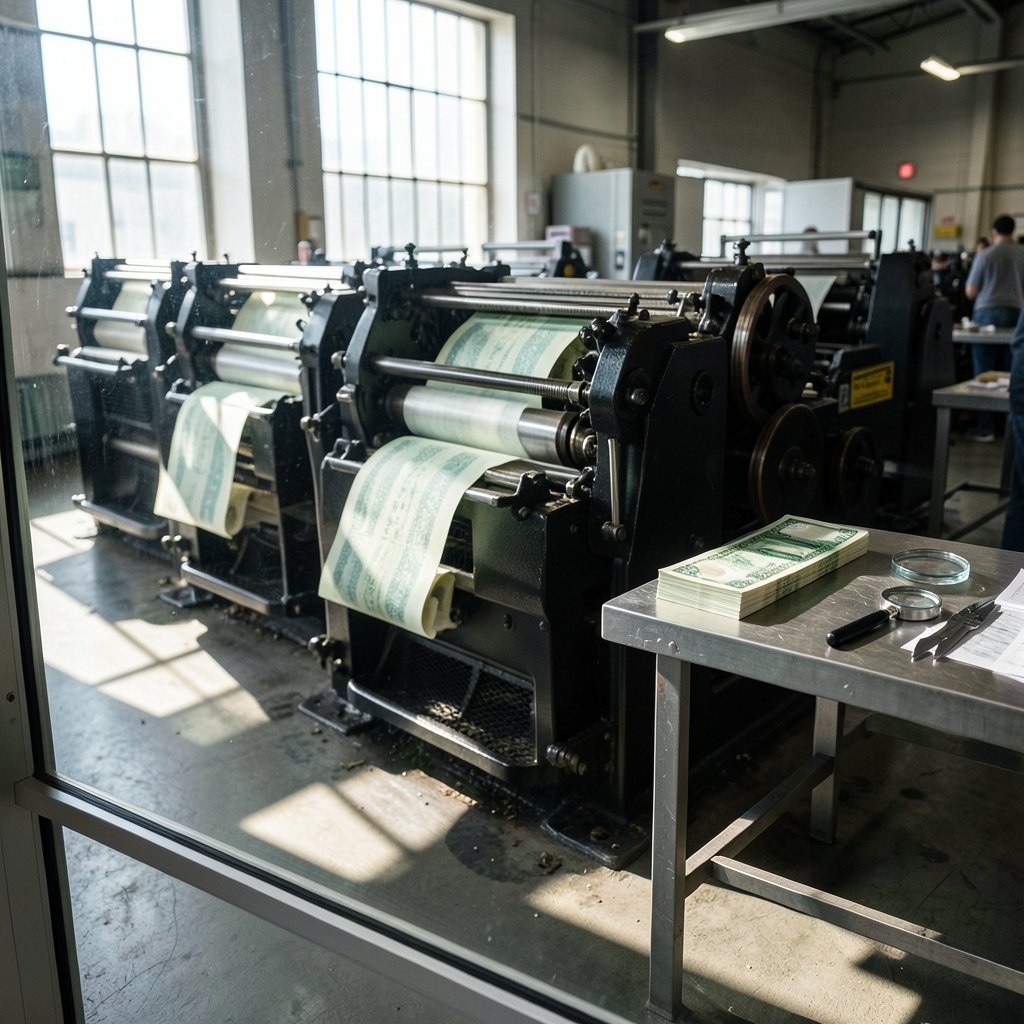
What if the phrase “money factory” doesn’t mean what most people think it does? Search the term and you’ll find everything from video games to slang for a cash-generating business. But in the United States, it points to something very specific: the federal agency that actually prints paper currency. Understanding what the Money Factory is, what it does, and what it does not do clears up a surprising amount of confusion about how cash moves through the economy.
Where the Name Comes From
The Money Factory is the public-facing brand of the Bureau of Engraving and Printing (BEP), a bureau of the U.S. Department of the Treasury. The nickname is used in tours, visitor materials, and educational content aimed at the public. It is not an official agency name, but it has stuck because it describes the work plainly: this is the place where dollar bills are manufactured.
The BEP’s history stretches back to 1862. In its early decades, the bureau’s work included printing a wide range of government documents as well as currency. Over time, currency production became its defining job. Today, when people talk about the money factory, they are almost always talking about the BEP’s currency printing operations.
Paper vs. Coins: A Split Most People Miss

One of the most common mistakes is assuming one agency makes all U.S. money. It doesn’t. Two separate Treasury bureaus handle two separate products, and mixing them up is a persistent error even among otherwise well-informed people.
| Feature | Bureau of Engraving and Printing | U.S. Mint |
|---|---|---|
| Product | Paper currency (bills) | Coins |
| Parent department | U.S. Department of the Treasury | U.S. Department of the Treasury |
| Main job | Printing notes | Producing circulating coins and collectibles |
| Public nickname | The Money Factory | No widely used equivalent |
So when someone says the money factory makes money, they mean paper notes. Coins come from a different bureau entirely. If you have ever wondered why a quarter and a dollar bill feel like they belong to different worlds, that’s because they do: different agencies, different production lines, different materials.
Who Decides How Much Money Gets Printed?
Here is the part that surprises people most. The Money Factory does not decide how much currency the country needs. It prints what it is asked to print.
The Federal Reserve orders currency from the BEP, and the BEP produces notes to fill those orders. This arrangement is a deliberate separation of roles. The central bank manages monetary policy and currency supply; the printing bureau manufactures the physical product. The money factory is a manufacturer, not a policymaker.
That distinction matters because it is easy to imagine that printing presses running fast means the government is “creating money.” In reality, the BEP replacing worn-out bills is routine maintenance of the physical money supply. Old notes get destroyed and new ones take their place. The number of notes in circulation is a logistics question, not a policy lever.
Money Creation Is a Different Idea Entirely
There is a second meaning of “money factory” that shows up in economics discussions: the process by which commercial banks create money through lending. This is a genuinely different concept from printing presses, and conflating the two leads to muddled thinking about inflation and banking.
When banks make loans, they create new deposits, which function as money in the economy. This is sometimes described as a money multiplier process. It happens in ledgers, not on printing presses. The physical cash in your wallet is a small fraction of the money that exists in an economy. So the money factory that prints bills and the “money factory” of bank lending are two unrelated systems that happen to share a catchy name. (Identity threat detection really costs where money goes) (Money)
Inside the Printing Process
The actual production of U.S. currency is a carefully controlled industrial process. While the exact security details are closely held, the broad strokes are well documented and genuinely interesting.
The Stages of Production
- Engraving and plate making. Highly skilled engravers create the master designs. Intaglio engraving produces the raised texture you can feel on a genuine bill.
- Paper production. Currency paper is a specialized blend, not ordinary paper. It is made to survive folding, handling, and moisture.
- Printing. Notes go through multiple passes, including the main intaglio printing that gives bills their distinctive feel, plus offset and letterpress stages for different elements.
- Overprinting and serialization. Serial numbers and seals are applied, giving each note a unique identity.
- Cutting and packaging. Sheets are cut into individual notes, inspected, and bundled for shipment to the Federal Reserve.
The result is a product designed to be hard to counterfeit and easy to authenticate. Security features are built in at multiple stages, and each redesign cycle adds new ones. The most recent major redesign of the $100 note, issued in 2013, added a blue 3-D security ribbon and other features that are difficult to replicate.
Where the Money Factory Operates
The BEP prints currency at two facilities. The Washington, D.C. location has produced currency since 1914. A second facility, the Western Currency Facility in Fort Worth, Texas, opened in 1991 to expand capacity and reduce the risk of concentrating all production in one place. (How is U.S. currency produced?)
Both facilities have historically offered public tours, which is how the “Money Factory” nickname reached a wide audience. Tour availability has changed over time, including suspensions during the COVID-19 pandemic, so anyone planning a visit should confirm current status before making travel plans. This is a practical tip worth repeating: check the official source directly rather than relying on older blog posts, because tour programs and schedules shift.
Common Mistakes People Make About the Money Factory
A few misunderstandings come up again and again. Knowing them in advance saves confusion.
Confusing the BEP with the Mint. As covered above, they are separate bureaus with separate products. The Treasury maintains a list of its bureaus, and the two are distinct entries.
Assuming the BEP sets interest rates or money supply. It does not. Those are central bank functions. The printing bureau fills orders.
Thinking all U.S. money is printed. Coins are struck, not printed. The word “mint” refers to coin production, and “print” refers to paper currency. The vocabulary is a useful signal.
Believing the money factory can simply print more to solve problems. Physical currency production is tied to orders and replacement needs. It is not a lever for economic policy, and treating it as one misunderstands both the agency and the economy.
Overlooking security features. People who handle cash casually often don’t know how to check a bill. Learning two or three authentication features is a small habit with real payoff, especially for small businesses and anyone who handles cash regularly.
Why the Money Factory Matters Beyond Cash
Even in a world of digital payments, physical currency remains important. It serves people who lack bank access, it works when networks fail, and it remains a store of value in uncertain times. The infrastructure behind it, including the Money Factory, is part of the country’s financial plumbing.
That plumbing connects to broader questions about money itself. Central banks around the world are exploring digital versions of their currencies, a shift that raises new questions about privacy, access, and what money will look like in the future. Readers curious about that transition can explore how central bank digital currencies work and why the design choices matter. The physical money factory and the digital money debate are two ends of the same long story about how societies create and manage money. (Gift card scam works victims rarely get their money back)
Fraud is another place where cash knowledge pays off. Scams that target cash and payment instruments are common, and victims often find that recovering funds is difficult. Understanding how gift card scams work, for example, helps people recognize the pattern before money is gone. The same instinct that makes someone check a bill’s security ribbon can make them pause before an unusual payment request.
Practical Tips for Anyone Curious About Currency
If the money factory topic has sparked interest, a few concrete steps turn curiosity into useful knowledge.
First, learn the security features of the bills you handle most. The raised print, the security thread, and the color-shifting ink are quick checks that take seconds.
Second, know the difference between the agencies. When someone mentions the Mint, think coins. When someone mentions the BEP or the Money Factory, think paper.
Third, if you plan a facility tour, verify the current schedule directly. Tour programs are subject to change, and outdated information circulates widely.
Fourth, treat cash-handling knowledge as a life skill. Small businesses, market vendors, and anyone who receives cash benefit from knowing what a genuine note looks like and what to do when something seems off.
The Bigger Picture
The phrase “money factory” is a good example of how a casual nickname can hide a precise institutional reality. Behind the catchy name is a Treasury bureau with a specific job, a specific product, and a clear boundary between manufacturing and policy. The BEP prints notes; the Federal Reserve orders them; the Mint makes coins; banks create money through lending. Each piece plays a different role.
Understanding that division is more than trivia. It shapes how people think about inflation, currency, and the trust that makes money work. A bill is a physical object with security features and a serial number, but it is also a promise backed by institutions. The factory makes the object. The institutions make the promise.
For readers who want to go further, the practical path is simple: learn to authenticate the cash you handle, verify tour information at the source, and stay curious about how money systems evolve. The money factory is a starting point for a much larger conversation about how value moves through the world, and that conversation is worth having.
Frequently Asked Questions
What exactly is the Money Factory?
The Money Factory is the public nickname for the Bureau of Engraving and Printing, the Treasury bureau that prints U.S. paper currency. The name appears in tours and educational materials rather than official documents, but it accurately describes the agency’s core work: manufacturing dollar bills at its facilities in Washington, D.C., and Fort Worth, Texas.
Does the Money Factory decide how much money to print?
No. The Federal Reserve orders currency, and the BEP produces notes to fill those orders. The bureau is a manufacturer, not a policymaker. Decisions about monetary policy and the size of the money supply rest with the central bank, not the printing agency.
Is the Money Factory the same as the U.S. Mint?
No, and this is one of the most common confusions. The BEP prints paper currency. The U.S. Mint produces coins. Both are bureaus of the U.S. Department of the Treasury, but they are separate organizations with separate products and separate facilities.
Can I tour the Money Factory?
The BEP has historically offered public tours at its facilities, which is how the nickname became widely known. Tour availability has changed over time, including suspensions during the COVID-19 pandemic. Anyone planning a visit should confirm the current schedule directly with the agency rather than relying on older articles or blog posts.
Why does a dollar bill feel different from ordinary paper?
U.S. currency paper is a specialized blend designed for durability and security, not ordinary writing paper. The distinctive texture comes partly from the paper itself and partly from the intaglio printing process, which leaves raised ink you can feel. That raised texture is one of the simplest ways to check whether a bill is genuine.
Does printing more currency cause inflation?
Physical currency production is tied to orders and the replacement of worn-out notes, not to creating new value. Inflation is driven by broader economic forces, including the money created through bank lending and central bank policy. The printing press is a small and largely logistical part of that picture, which is why the money factory is best understood as a manufacturer rather than an economic lever.



