
Quick Answer: How did gatsby make his money?
Jay Gatsby made his money through organized crime, most likely bootlegging illegal liquor during Prohibition, working with the gambler Meyer Wolfsheim. The novel never states this outright. Instead, it stacks up rumors, a suspicious business front, and one slippery confession until the reader draws the conclusion.
Gatsby’s own version of events is different. He claims he inherited a family fortune and traveled Europe collecting jewels. Nick Carraway doubts that story immediately, and the details Gatsby supplies keep collapsing under small slips and contradictions.
Fitzgerald leaves the exact trade deliberately blurry. Anyone weighing the evidence should check four things: who is speaking, whether that character has a reason to lie, what the drugstore business actually hides, and what the Prohibition-era timeline allows.
A Man in a Pink Suit and a Cloud of Rumors

Picture the first party. The champagne is endless, the orchestra is real, and the host has vanished. Guests trade theories about him the way people trade stock tips, with total confidence and no proof. That is the whole problem with Gatsby’s money: everyone has an answer, and nobody has a receipt.
F. Scott Fitzgerald published The Great Gatsby in 1925, in the middle of Prohibition. His narrator, Nick Carraway, is a Midwestern transplant who wants to believe the best about his neighbor. That makes him a decent witness and a lousy auditor. He reports what he hears, doubts what he is told, and never gets a ledger.
The result is one of the most famous gaps in American literature. Readers have spent a century trying to fill it in.
What Gatsby Claims About His Own Money
When Gatsby finally explains himself, he does it in a rush, like a man reciting lines he rehearsed in the car. His family, he says, is wealthy and long dead. He inherited the money. He traveled through Europe collecting jewels and painting, then came home and went to war.
Nick’s reaction is blunt and funny. He thinks the phrase “educated at Oxford” is a lie, and he suspects the whole speech is a performance. Then Gatsby produces a medal and a photograph, and Nick half-believes him again.
The cracks show up fast. Gatsby says he lived in “San Francisco,” then catches himself and says the Midwest. He talks about a family tradition he cannot quite keep straight. The story is not a lie told to Nick so much as a story Gatsby is telling himself about who he is.
That matters for the money question. If Gatsby will invent his own childhood, he will invent his own income statement.
The One Name He Cannot Hide: Meyer Wolfsheim
The concrete evidence arrives in a lunch meeting. Gatsby introduces Nick to Meyer Wolfsheim, a small, cufflink-wearing man with human molars on his sleeve. Wolfsheim is a gambler, and the novel ties him to fixing the 1919 World Series.
That reference is not invented. The Black Sox scandal was real: eight Chicago White Sox players were accused of throwing the World Series to gamblers. You can read the historical record of the 1919 World Series scandal for the full story of how the fix worked and who was involved. Tying Wolfsheim to it tells the reader exactly what kind of world Gatsby has entered.
Then comes the sentence that answers the question better than anything else in the book. Gatsby says Wolfsheim is the man “who gave me my start.”
A start in what? Gatsby never says. But a man who starts with a gambling fixer does not usually finish with an inheritance.
Bootlegging: The Most Likely Answer
Prohibition ran from 1920 to 1933, and it made illegal alcohol one of the most profitable businesses in America. The National Archives’ explanation of the Volstead Act shows how the law worked, what it banned, and why enforcement was so uneven. When legal supply disappears and demand stays strong, someone fills the gap at a markup.
Gatsby fits the bootlegger profile almost too neatly:
| Clue in the novel | What it suggests |
|---|---|
| A mansion full of liquor nobody bought legally | Access to a steady illegal supply |
| Sudden wealth with no visible business | Income from a trade he cannot name |
| Connections to a gambler and fixer | Entry into organized crime networks |
| A chain of drugstores | A cover for distribution |
| Parties designed to attract one person | Money as a tool, not a goal |
The timeline fits too. Gatsby’s fortune appears fast, in the years right after the war, exactly when Prohibition turned ordinary liquor into a gold mine.
The Drugstore Front
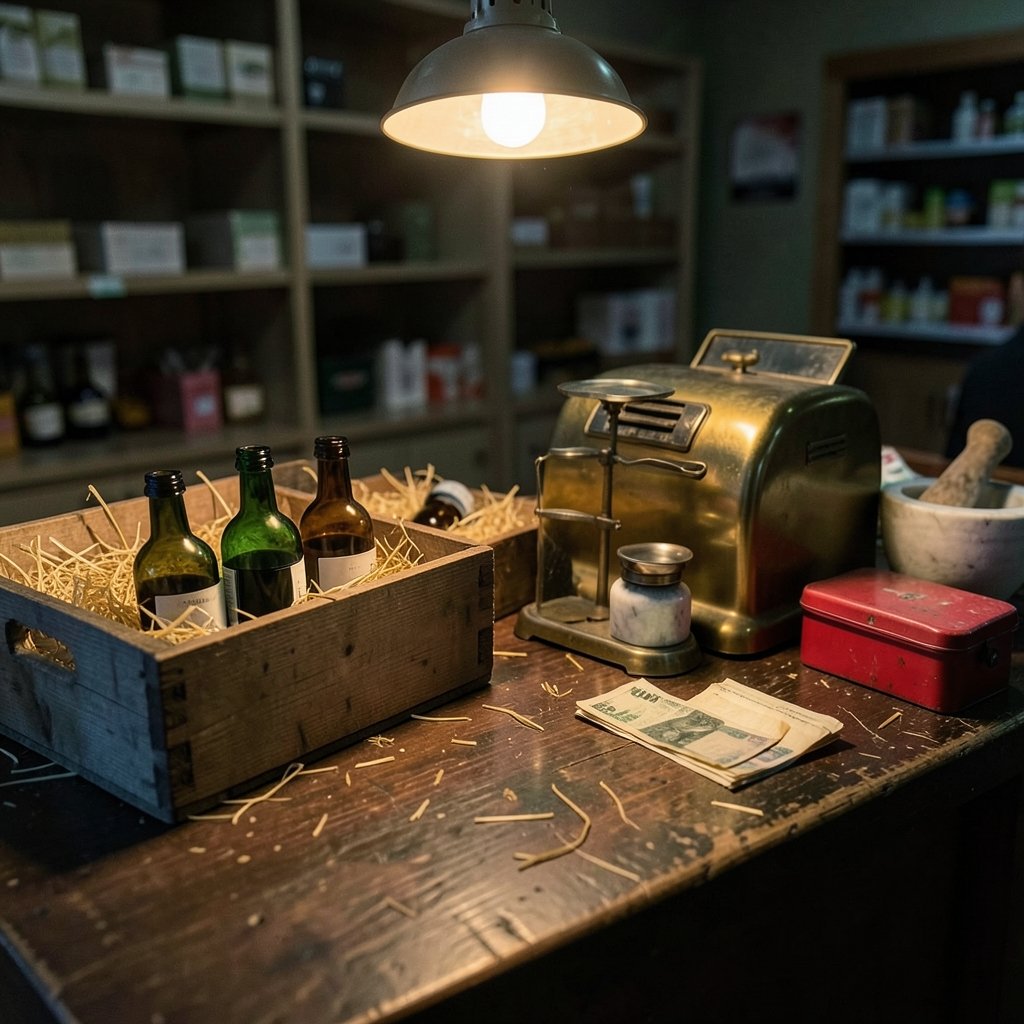
Gatsby tells Nick he owns a chain of drugstores. It sounds almost boring, which is the point. In the 1920s, drugstores sold liquor legally on prescription, and many operated as fronts for illegal sales.
Nick notices the tell. Gatsby mentions a “side street” drugstore business, and the phrase hangs in the air. Why would a man with a mansion and a hydroplane care about side-street pharmacies?
The drugstore detail is the closest the novel comes to naming a mechanism. It is also the detail that makes the inheritance story impossible to swallow. You do not inherit a chain of corner stores and then hide them in a sentence.
Why Fitzgerald Left It Vague
Fitzgerald could have written a chapter explaining the whole operation. He chose not to, and that choice is part of the art. Gatsby is a man who invented himself, and a self-invented man cannot have a simple paper trail.
The novel’s broader themes support the ambiguity. Gatsby’s tragedy is that he believes money can buy the past back. A precise accounting of his fortune would turn a myth into a business report. You can read a broader overview of The Great Gatsby and its themes to see how critics have treated that ambiguity over the decades.
There is also a practical reason. Fitzgerald wanted the reader to feel what Nick feels: suspicion, then belief, then suspicion again. If you knew exactly where the money came from, you would stop asking.
What the Rumors Get Wrong
The party guests offer a grab bag of theories. Gatsby ran a bootlegging operation. He was a German spy. He killed a man. He had a “drug business.”
Some of these are obviously nonsense. The spy rumor belongs to wartime paranoia. The murder rumor belongs to gossip. But the bootlegging and drug business rumors sit closer to the truth, which is why they stick.
The mistake readers make is treating any single rumor as the answer. The text supports bootlegging, gambling, and drugstores as overlapping parts of one operation, not as competing theories. A bootlegger needs distribution, a gambler needs capital, and a drugstore needs a reason to exist.
How the Money Actually Showed Up
Gatsby’s wealth is a stage set rather than a number. Every prop tells you something.
The mansion sits across the bay from Daisy’s house, positioned for a view. The shirts are imported. The library contains real books, though nobody has cut the pages. The car is a cream-colored status symbol that later becomes a weapon.
In practice, this is how you spot a fortune with a hidden source. The spending is public and the earning is private. Gatsby hosts hundreds of strangers but never discusses how he pays for them. If a person’s lifestyle is loud and their income is quiet, the quiet part is usually the interesting part.
That pattern shows up in real life too. When money moves through opaque channels, the visible spending is often the only clue. The same logic applies to how identity threat detection really costs where money goes, where the damage hides behind the surface.
Gatsby, Wolfsheim, and the World of 1920s Crime
The 1920s were a boom decade for organized crime, and Prohibition was the engine. Gangsters built distribution networks, bribed officials, and laundered profits through legitimate businesses. Drugstores, laundromats, and nightclubs were common fronts.
Gatsby’s relationship with Wolfsheim places him inside that economy. Wolfsheim does not sell liquor; he fixes outcomes. That means Gatsby’s start came not from a product but from a network.
This is where the novel is sharpest. Gatsby wants to be seen as a gentleman, but his fortune comes from the same world as the men he looks down on. The money is not old, not new, and not clean. It is borrowed from people who would never be invited to dinner.
The Green Light and the Price Tag
The green light at the end of Daisy’s dock is the novel’s most famous symbol, and it connects directly to the money question. Gatsby’s wealth exists to close a gap, and the gap is not financial. Daisy chose Tom Buchanan, who has old money, a Yale education, and no need to invent a past. (Cbdc digital currency central bank money going digital)
So Gatsby buys what he thinks will work. He buys proximity, then attention, then a version of himself that looks like he belongs. The money is a means to a romantic end, which is why he never bothers to make it look legitimate.
This is the practical lesson buried in the fiction. Money earned fast and spent fast rarely survives scrutiny, and the people you are trying to impress can usually tell. Gatsby’s parties are full of guests who never learn his name, which is a warning about building a life on display.
What the Novel Never Confirms
Here is the honest answer. The novel does not specify volumes, partners, routes, or a single criminal enterprise. Any figure you see quoted, whether it is a dollar amount or a number of drugstores, is a fan reconstruction, not text.
What the novel does confirm is smaller and more useful. Gatsby’s fortune appeared quickly. It came through Meyer Wolfsheim. It was protected by a legitimate-looking business. It was spent on a woman who had already chosen someone else.
Everything else is inference, which is exactly what Fitzgerald intended.
Conclusion
So how did Gatsby make his money? The strongest reading is organized crime, most likely bootlegging during Prohibition, launched through Meyer Wolfsheim and covered by a chain of drugstores. Gatsby’s inheritance story does not hold up, and Nick knows it.
But the deeper answer is that Fitzgerald never wanted a clean answer. He wanted a man whose fortune is as invented as his name, and a reader who keeps asking the same question Nick asks. The money is a mystery because Gatsby is a mystery, and the mystery is the point.
If you take one thing away, take this: when someone’s spending is loud and their income is quiet, the quiet part is where the story lives. That rule works on a fictional dock in West Egg and on any balance sheet you will ever read.
Frequently Asked Questions
Was Gatsby a bootlegger?
Most readers and critics think so. The novel never says the word directly, but Gatsby’s fast fortune, his mansion full of liquor, and his connection to a gambler all point to illegal alcohol during Prohibition. The drugstore chain he mentions fits the pattern of a distribution front.
Who was Meyer Wolfsheim based on?
Wolfsheim is a fictional gambler, but he is widely believed to be modeled on Arnold Rothstein, the real New York gambler linked to the 1919 World Series fix. Fitzgerald uses the connection to place Gatsby inside actual criminal networks of the era.
Did Gatsby really inherit his money?
Almost certainly not. Gatsby tells Nick he inherited a family fortune and traveled Europe collecting jewels, but he contradicts himself about where he grew up, and Nick openly doubts the story. The claim reads as a rehearsed cover for a criminal income.
Why did Fitzgerald never explain Gatsby’s business?
Leaving the source vague keeps Gatsby a self-invented man. A precise explanation would turn a myth into a business report and would let the reader stop asking questions. The ambiguity is a deliberate craft choice, not an oversight.
What did Gatsby’s drugstores actually sell?
The novel does not say. In the 1920s, drugstores could sell liquor legally on prescription, and many served as fronts for illegal sales. Gatsby’s mention of a “side street” drugstore business is the detail that makes readers suspicious.
Did Gatsby’s money ever make him happy?
No, and the novel is clear about why. His wealth was a tool for winning Daisy back, not a goal in itself. Once she rejects him, the mansion, the parties, and the shirts lose their purpose, which is the book’s central point about money and meaning. (Gift card scam works victims rarely get their money back)



