
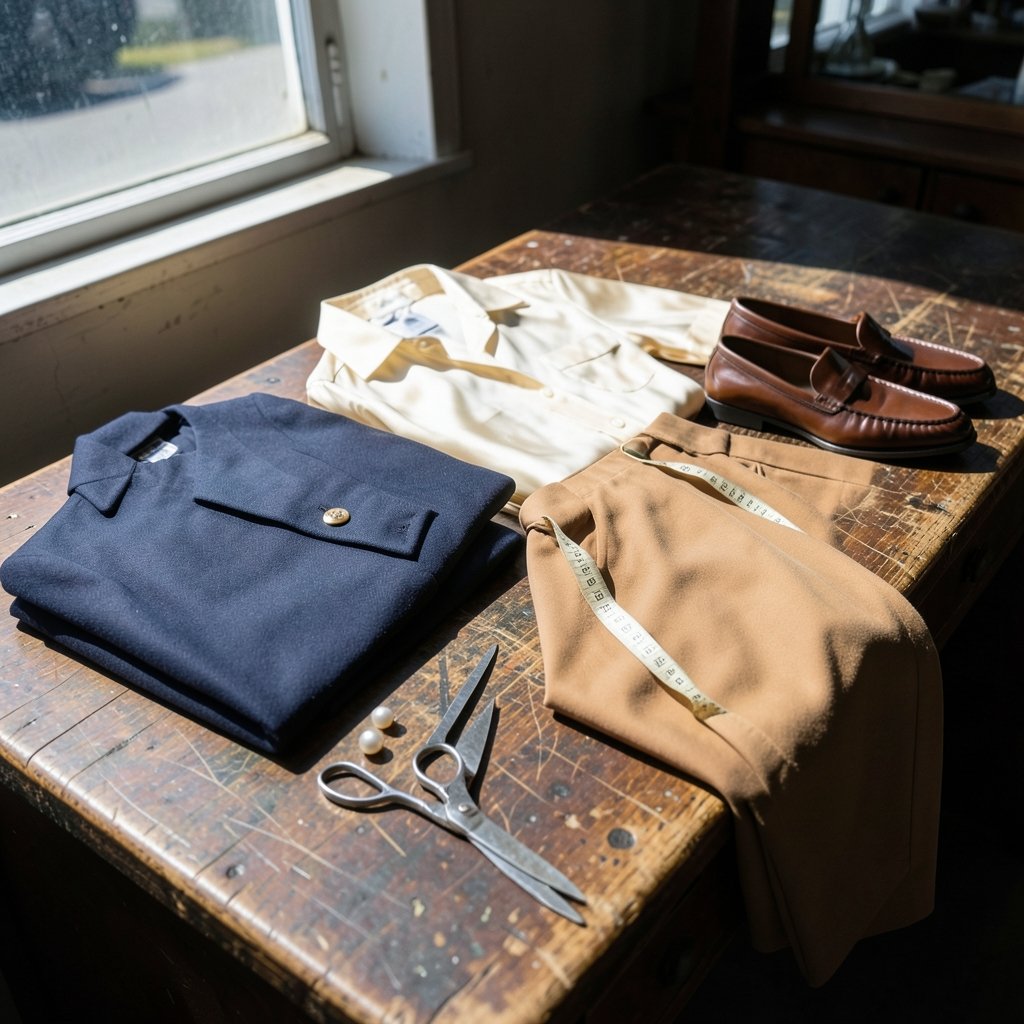
What makes a woman in a plain navy blazer and loafers look “expensive” while someone in head-to-toe logos looks like she’s trying too hard? That question is central to the old money aesthetic, one of the most searched style terms of the past few years. The answer isn’t a bigger budget. It’s a set of quiet rules about fit, fabric, color, and restraint that anyone can learn.
What “Old Money Style” Actually Means
Here’s the first thing to know: the label itself is new. The term old money aesthetic spread across social media around 2022 and 2023, riding alongside a related phrase, quiet luxury. Neither describes an actual historical dress code. They’re retrofitted names for a look that borrows heavily from mid-20th-century elite leisure dress: tailored blazers, fine knitwear, pearls, loafers, and muted colors with almost no visible branding.
The look’s real ancestor is preppy style, which grew out of U.S. preparatory school and Ivy League campus dress in the early-to-mid 20th century before being commercialized in the late 1970s and 1980s. That history matters because it explains why the aesthetic leans on a specific vocabulary: rugby stripes, polo shirts, penny loafers, tweed, and khaki. The polo shirt itself came from sportswear, not aristocracy, with the Lacoste version dating to 1933 and Ralph Lauren’s Polo brand launching in 1967.
The pearl-and-tweed association has a similar origin story. Chanel’s designs from the 1920s through the 1950s, particularly the tweed suit and costume pearls, cemented those elements as symbols of established wealth. The “old money” framing came decades later.
So when you see an outfit described as old money, you’re looking at a modern reinterpretation of several older style traditions stitched together. That’s useful to know, because it frees you from chasing some secret formula. You’re working with a well-documented visual language.
Why Understatement Signals Status
There’s a sociological layer here that most style articles skip. Understated dress can function as a class marker precisely because it requires cultural knowledge rather than visible spending. Recognizing that a particular shade of camel or a specific cut of trouser reads as “good taste” takes exposure and confidence, not money alone. The French sociologist Pierre Bourdieu made this argument in his 1979 book Distinction, which analyzed how taste operates as a form of social capital.
In practice, this explains the whole stealth wealth moment. Fashion press in 2022 and 2023 described a shift away from the logomania of the 2010s toward logo-free, high-quality basics. It’s worth treating that as commentary rather than measured data, but the direction is clear: visible branding became loud, and loud stopped reading as refined.
For the average shopper, the takeaway is practical. You don’t need a designer label to hit this look. You need clothes that fit well, fabrics that hold up, and a color palette that doesn’t shout.
The Core Color Palette
Old money outfits live and die by color discipline. The palette is neutral and muted, and it’s remarkably consistent across every version of the aesthetic you’ll see.
| Color family | Specific shades | Where it works best |
|---|---|---|
| Navy | Deep navy, midnight blue | Blazers, trousers, knitwear |
| Cream and white | Ivory, off-white, ecru | Shirts, knit tops, silk blouses |
| Camel and beige | Tan, sand, warm taupe | Coats, trousers, bags |
| Grey | Charcoal, dove grey | Tailoring, skirts, knit dresses |
| Green | Forest, olive, bottle green | Knitwear, outerwear, accents |
| Accents | Burgundy, chocolate brown | Shoes, belts, scarves |
The rule of thumb: pick two or three colors per outfit and let them repeat. A navy blazer, cream shirt, and camel trouser is a complete look. Add a burgundy loafer and you’re done. What you avoid is neon, high-contrast prints, and anything that competes for attention.
One common mistake is treating “neutral” as “boring.” It isn’t, as long as you vary texture. A cream cashmere crewneck against cream wool trousers looks flat. The same cream knit against navy flannel or grey herringbone has depth because the surfaces catch light differently. Texture is what keeps a limited palette from going stale, and it’s the single most underrated tool in this style.
The Outfit Formulas That Actually Work
Style conventions aren’t rules, but a few combinations show up again and again because they work. Think of these as starting points you can adapt to your body, climate, and daily life.
The Blazer Formula
A navy blazer, a white or cream shirt, and tailored trousers. This is the backbone of the entire aesthetic. The blazer should hit at the hip or just below, with a shoulder seam that sits exactly on your shoulder bone. A structured blazer in a slightly heavier wool reads more expensive than a soft, floppy one, because it holds its shape.
The Knitwear Formula
A cashmere or fine merino crewneck, a pleated skirt or straight-leg trouser, and loafers. This one is forgiving and comfortable, which is why it dominates real-world wear. A crewneck in a good yarn will outlast three cheaper sweaters, so it’s worth buying one well rather than three poorly.
The Outerwear Formula
A trench coat in stone or camel, a neutral knit underneath, and pearl studs. The trench is the great equalizer of this look. A well-fitting trench elevates jeans and a plain tee instantly.
The Shirtdress Formula
A crisp cotton poplin shirtdress in white, light blue, or stripe, belted at the waist, with flat leather shoes. It’s the easiest single-piece outfit in the category and works from spring through early fall.
Fabric and Fit: Where the Money Actually Shows
If you ignore everything else in this article, keep this: fabric quality and fit matter more than brand. The old money look reads as expensive because the clothes drape well and sit correctly, not because of a label.
Fabrics that carry the look: wool and wool blends for tailoring, cashmere and merino for knits, cotton poplin and oxford for shirts, silk for blouses and scarves, and leather for shoes and bags. Fabrics that fight it: shiny synthetics, thin jersey that clings, and anything with a visible sheen under indoor lighting.
On fit, a few practical checks before you buy:
- Check the shoulder seam. It should end at the edge of your shoulder, no further.
- Button the blazer. If it pulls into an X across the chest, it’s too small.
- Sit down in the trousers. If the waistband digs or the seat pulls tight, size up and tailor down.
- Look at sleeve length. A blazer sleeve should show about half an inch of shirt cuff.
- Test the shoe. Loafers should hold your heel without slipping, or you’ll walk out of them.
A tailor is the best-value purchase in this entire style. Taking in a waist or shortening a hem costs a fraction of a new garment and changes how a piece reads more than any label ever will. Many people skip this step and then wonder why their blazer looks off. It’s almost always the fit.
Accessories: The Quiet Details
Accessories make or break the look because they’re where restraint gets tested. The goal is a small number of well-chosen pieces, not a pile.
Pearl studs are the signature. Small, simple, and unfussy. A silk scarf adds color without print noise. A structured leather bag in tan, black, or burgundy, ideally without a giant logo. A thin leather belt that matches your shoes. A classic watch with a leather strap or a simple metal band.
The mistakes people make here are predictable. Stacking too many bracelets, wearing a bag with a huge monogram, or choosing shoes that are too trendy for the rest of the outfit. If you’re unsure whether an accessory belongs, take it off. The look rewards subtraction.
Watches and jewelry also connect to a broader point about how status symbols work and how people read them. If you’re interested in how branding and perceived value shape consumer behavior, the same logic that drives the gift card scam economy (paying for perceived value rather than substance) applies to fashion logos. People pay premiums for marks that signal something, whether or not the underlying product is better.
Shoes and Bags That Fit the Look
Footwear anchors the aesthetic more than most people realize. The shortlist:
- Penny loafers or horsebit loafers in brown or burgundy leather
- Ballet flats in nude, black, or navy
- Knee-high leather boots in dark brown or black
- Low block-heel pumps for formal settings
- White leather sneakers for casual days, kept clean
Avoid chunky platforms, heavy hardware, and anything with a prominent logo. On bags, structured shapes in smooth leather work best: a top-handle bag, a simple tote, a small shoulder bag. One good bag beats five trend pieces.
Building the Wardrobe Without Overspending
The honest truth about this aesthetic is that it can be built on any budget, but it rewards patience over speed. A workable approach:
- Start with the base: one navy blazer, one pair of tailored trousers, one cream shirt, one pair of loafers.
- Add one knit: a cashmere or merino crewneck in navy, grey, or cream.
- Add outerwear: a trench or a wool coat in camel or navy.
- Fill in with a pleated skirt, a shirtdress, and a second pair of trousers in a different neutral.
- Buy accessories last, once the core is solid.
Buy fewer pieces and buy them well. Secondhand and vintage are excellent routes here, because older wool and cashmere garments often have better construction than new fast-fashion equivalents. Check seams, lining, and fabric content before you commit. If a piece needs alterations, factor that cost in.
One more practical note: this style overlaps with a lot of everyday wardrobe planning, where the same principle applies. Just as a wedding venue guide that saves money and stress stresses planning the big decisions before the small ones, building this wardrobe works best when you set the core pieces first and resist impulse buys. And if you’re thinking about where your spending goes more broadly, the same discipline that makes a budget for AI side projects work applies to clothes: decide the number, then shop inside it.
Common Mistakes to Avoid
Even people who understand the aesthetic trip on the same few things.
Chasing the label instead of the fit. A perfectly tailored mid-range blazer beats an ill-fitting designer one every time.
Over-accessorizing. The look is quiet. Three accessories is usually the ceiling.
Ignoring proportion. A cropped blazer with wide trousers works. A cropped blazer with skinny jeans and a long shirt does not. Balance volume against volume.
Buying trendy versions of classic pieces. A trench with an exaggerated sleeve or an odd collar will date fast. Stick to the classic cut.
Skipping the tailor. Covered above, but it bears repeating.
Treating the palette as a uniform. You can wear color. Just keep it muted and deliberate.
How to Adapt the Look to Real Life
Not everyone works in an office or lives in a mild climate, and that’s fine. The aesthetic flexes.
For casual days, swap the blazer for a cardigan and the trousers for dark straight-leg jeans. For cold weather, layer a turtleneck under a wool coat and add boots. For warm climates, use linen and cotton in the same palette and drop the heavy tailoring. For a formal event, a column dress in navy or forest green with pearl studs does the job without a single logo.
The through-line is consistency. Whatever the setting, the colors stay muted, the fabrics stay natural, and the branding stays hidden.
Conclusion
Old money outfits for women aren’t a secret handshake or a shopping list with a designer price tag. They’re a set of habits: a tight neutral palette, natural fabrics, precise fit, restrained accessories, and a willingness to buy less and tailor more. The label is recent, the visual language is borrowed from preppy and mid-century leisure dress, and the underlying logic is older still, rooted in how taste signals status without saying a word.
Start with one good blazer, one good knit, and one good pair of loafers. Get them fitted. Build from there. The look rewards patience, and it never really goes out of style, which is rather the point.
Frequently Asked Questions
What is the old money aesthetic in fashion?
It’s a style built on tailored blazers, fine knitwear, pearls, loafers, and muted neutral colors with minimal visible branding. The term itself is recent, spreading on social media around 2022 and 2023, but the visual vocabulary borrows from mid-20th-century preppy and Ivy League dress.
Do you need expensive clothes to dress old money?
No. Fabric quality and fit matter far more than brand or price. A well-tailored wool blazer from a mid-range label will read better than an ill-fitting designer piece. Secondhand cashmere and vintage wool are often better made than new fast-fashion equivalents.
What colors are best for an old money wardrobe?
Navy, cream, white, camel, beige, grey, olive, and forest green, with burgundy and chocolate brown as accents. Pick two or three per outfit and repeat them. Vary texture rather than color to keep the look from going flat.
Is old money style the same as quiet luxury?
They’re closely related but not identical. Quiet luxury is the better-documented term, widely discussed in fashion press in 2023 and often tied to understated high-end brands and to the costume design of the series Succession. Old money is the broader social-media label for a similar look.
What shoes go with old money outfits?
Penny or horsebit loafers in brown or burgundy, ballet flats, knee-high leather boots, low block-heel pumps, and clean white leather sneakers for casual days. Avoid chunky platforms, heavy hardware, and prominent logos.
How do I start building this wardrobe on a budget?
Buy the core first: one navy blazer, one pair of tailored trousers, one cream shirt, one pair of loafers. Add a cashmere or merino crewneck next, then outerwear. Shop secondhand where you can, and budget for a tailor, since alterations cost little and change how a garment reads more than any label.



