
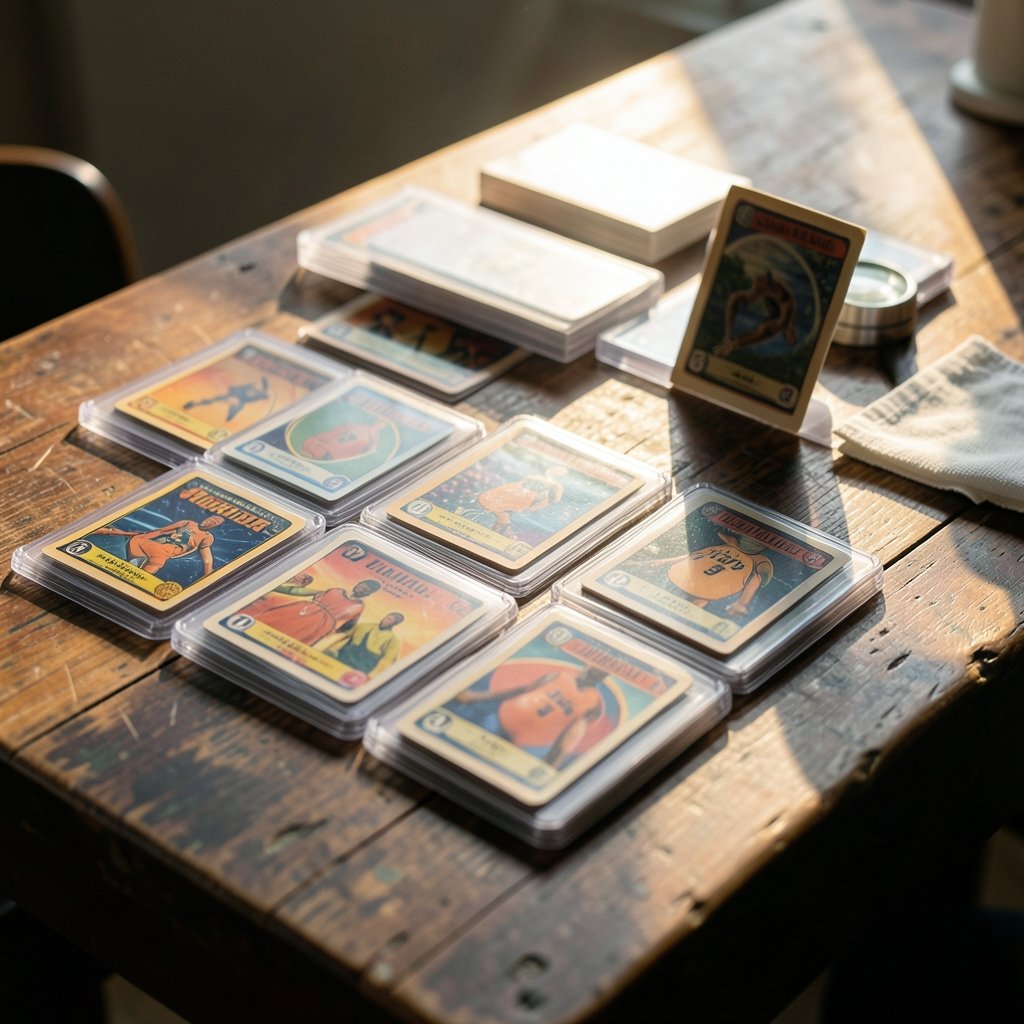
What makes one basketball card worth a used car and another worth less than the sleeve it sits in? The answer is rarely the player alone. Condition, print run, era, and authentication all stack on top of each other, and a single weak link can sink a card’s value. This guide breaks down the cards collectors chase, the mistakes that destroy value, and how to tell a real find from a common base card.
The Cards That Actually Command Big Money
A small group of cards anchors the entire basketball market. They are the ones auction houses feature and the ones forgers copy most often.
The 1986-87 Fleer Michael Jordan rookie is the most famous modern-era basketball card and the most counterfeited. High-grade copies have sold for hundreds of thousands of dollars, with reported PSA 10 sales above $700,000 in 2021. That gap between a raw copy and a gem-mint copy is the whole lesson of the hobby in one card.
On the vintage side, the 1948 Bowman George Mikan rookie and the 1957-58 Topps Bill Russell rookie rank among the most sought-after early cards. High-grade examples (PSA 8 and up) have crossed into six figures.
Then there’s the modern benchmark: the 2003-04 Exquisite Collection LeBron James Rookie Patch Autograph, numbered to 23. It sold for $1.8 million in July 2020 and reportedly around $2.4 million in April 2021. That card reset expectations for what a modern card could be worth and pushed the entire high-end market upward.
| Card | Era | What drives value |
|---|---|---|
| 1986-87 Fleer Michael Jordan RC | Modern vintage | Icon status, heavy counterfeiting, huge grade spread |
| 1948 Bowman George Mikan RC | Vintage | True scarcity, early basketball history |
| 1957-58 Topps Bill Russell RC | Vintage | Low surviving population in high grade |
| 2003-04 Exquisite LeBron RPA /23 | Modern | On-card auto, patch, tiny print run |
Why Grading Changes Everything
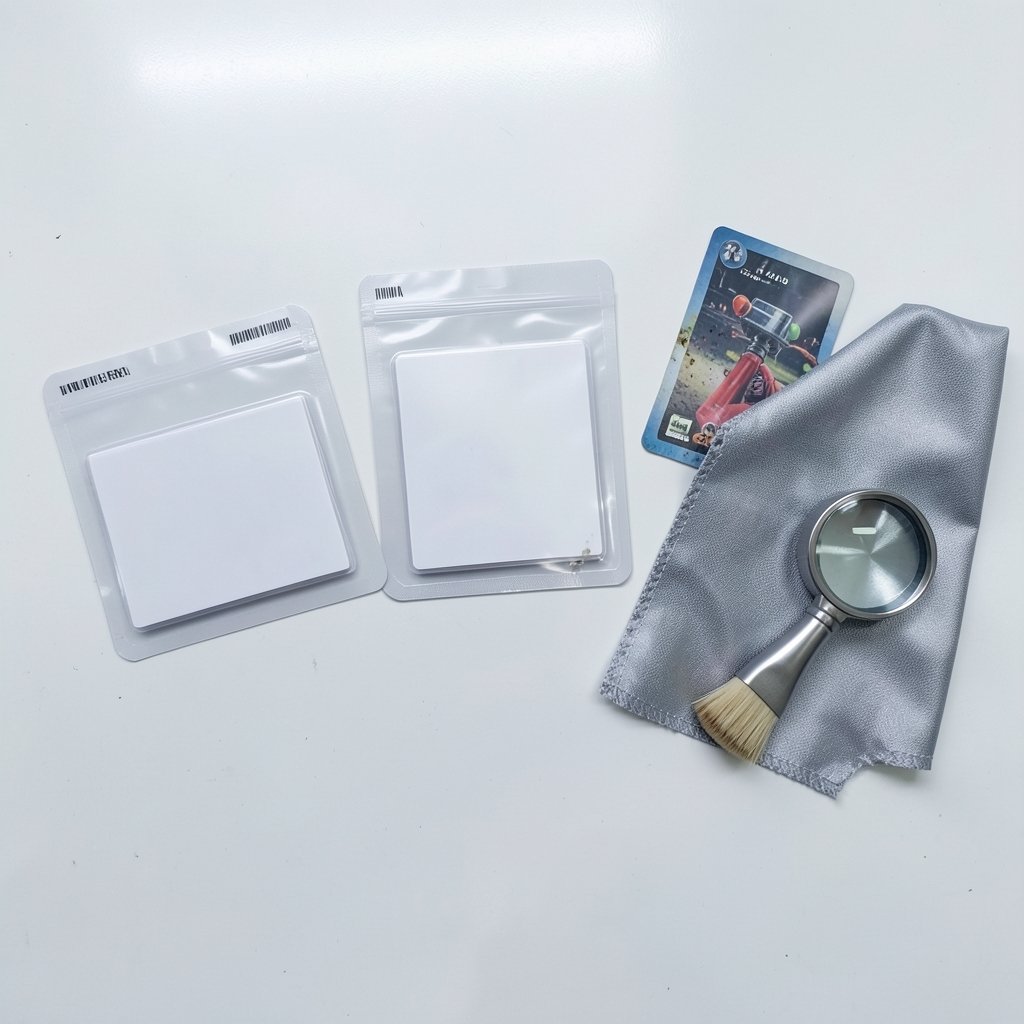
Third-party grading is the single biggest value multiplier in the hobby. A company assigns a numeric condition grade, and the same card can be worth wildly different amounts depending on that number. A card that looks fine to your eye might grade a 6 because of a soft corner or a faint surface scratch you never noticed.
Four graders dominate: PSA, Beckett (BGS), SGC, and CGC. Each publishes standards and certification lookup tools so buyers can verify a slab is genuine. PSA’s population report is especially useful because it shows how many examples exist at each grade. A card with 4,000 copies at grade 9 and 12 at grade 10 is a different animal from one with 40 at grade 9.
Here’s the practical trap. New collectors often buy raw cards hoping to grade them for a profit. In practice, grading costs money, takes weeks, and returns plenty of disappointing numbers. Experienced buyers usually let the seller absorb that risk and pay for an already-graded card when the grade matters. If you’re weighing a hobby purchase against other spending, the same logic that applies to a graphics card worth buying for beginners and everyday use applies here: pay for verified performance, not hopeful specs.
The Grade Spread in Plain Numbers
A rough illustration of how condition reshapes value for a key card:
| Condition | Typical market position |
|---|---|
| Raw, ungraded | Baseline, high uncertainty |
| Graded 7-8 | Solid mid-tier premium |
| Graded 9 | Strong premium |
| Graded 10 | Multiples above grade 9 |
The exact multiplier varies by card and by how scarce top grades are. That’s why the population report matters more than any single price guide.
The Junk Wax Trap: Why Most 1990s Cards Are Worthless
Roughly 1988 to 1995, manufacturers printed cards in enormous quantities. Sets like 1990-91 Hoops and 1991-92 Fleer are everywhere. Most cards from that window are worth very little unless they’re rare inserts or high-grade stars.
This is the most common mistake new collectors make. They find a shoebox of 1990s cards, see a famous name, and assume they’ve hit paydirt. Usually they haven’t. The player is famous; the card is not scarce. Value comes from scarcity plus demand, and junk wax era cards fail the scarcity test.
The exceptions are real, though. Rare inserts, low-numbered parallels, and high-grade copies of star cards from that era can still sell well. The trick is learning to identify inserts and serial numbers before assuming a card is common.
Rookie Cards, Autographs, and Serial Numbers
Three features drive most modern card value.
Rookie cards matter because they represent a player’s first appearance in a major set. Collectors pay for the beginning of the story.
On-card autographs carry a premium over sticker autos. A signature the player actually signed on the card is worth more than a label affixed later.
Serial numbering signals scarcity. A card stamped /25, /10, or 1/1 is worth more than an unnumbered base card, all else equal. The Rookie Patch Autograph (RPA) format, popularized by Upper Deck Exquisite in 2003-04, combined a rookie, a patch, and an autograph into one high-end product category that still defines the top of the modern market.
If you’re building a collection on a budget, focus on one player or one set rather than spraying money across everything. Discipline beats volume. The same principle shows up in subscription decisions, where people ask whether Xbox Game Pass is worth the 2025 price — the answer depends on how much you’ll actually use it, not on how good the deal sounds.
Authentication: Where Money Gets Lost
Counterfeits and altered cards are a real risk, especially for the 1986-87 Fleer Jordan. Trimming, recoloring, and outright fakes are common enough that serious buyers treat raw high-value cards with suspicion.
What actually works in practice:
- Buy graded cards from reputable graders when spending real money.
- Check the certification number against the grader’s lookup tool before paying.
- Compare the slab’s label and holder to known examples.
- Walk away from deals that pressure you to decide fast.
What doesn’t work: trusting a photo, trusting a seller’s story, or assuming a plastic sleeve means authenticity. Scams in collectibles follow the same pattern as other fraud, where victims often can’t recover funds once they’ve paid — the mechanics of a gift card scam and why victims rarely get their money back show how quickly irreversible payments turn a bad deal into a total loss.
The Market Cycle: Peak, Correction, and What Comes Next
The basketball card market surged in 2020 and 2021, driven partly by the pandemic and celebrity attention, then cooled in 2022 and 2023. Prices on many modern cards fell from their highs. Vintage and truly scarce cards held up better than mass-produced modern parallels.
What does that mean for a buyer? Treat any price as a snapshot, not a promise. The LeBron Exquisite sale at $1.8 million in 2020 and the reported $2.4 million in 2021 happened during a specific moment. Whether a card repeats that performance depends on demand that no one can guarantee.
A balanced approach: buy cards you’d be happy to own if the price stayed flat. That way a market correction stings less.
Taxes: The Part Nobody Mentions
Card sales can trigger capital gains tax in the U.S., and collectibles get special treatment. Under IRC §1(h)(4), collectibles face a maximum rate of 28%, higher than the standard long-term capital gains rate. The IRS explains the general framework in its guidance on capital gains and losses, and Publication 544 covers sales and other dispositions of assets in detail.
Keep records. Purchase price, sale price, fees, grading costs, and shipping all matter at tax time. Collectors who sell casually often forget this until a big sale arrives. If you’re tracking a collection’s value the way you’d track any asset, the mindset is similar to comparing budgeting approaches — a YNAB vs Monarch comparison of zero-based budgeting and net worth tracking shows how different tools frame the same money question. For cards, the tool is a simple spreadsheet: what you paid, what it’s worth, and what you’d owe if you sold.
How to Spot Value Before You Buy
A practical checklist that separates a real find from a common card:
- Check the year. If it’s from the junk wax window, assume low value until proven otherwise.
- Look for serial numbers. Stamped numbering means scarcity.
- Confirm it’s a rookie card. Not every early card is a true RC.
- Check the grade and population. A high grade on a common card is still a common card.
- Verify authenticity. Certification lookup, every time.
- Compare recent sales. Not asking prices — actual completed sales.
That last point trips up a lot of people. Asking prices are wishes. Completed sales are facts. A card listed at $5,000 that never sells tells you nothing.
Should You Collect for Money or for Fun?
Honest answer: mostly for fun, with money as a bonus. The collectors who do best over time tend to be the ones who learned the market deeply because they loved it, not because they were chasing returns. Chasing hot cards at peak prices is how people lose money.
That said, there’s nothing wrong with treating a collection as an asset. Just be clear about which game you’re playing. If you’re buying to flip, you need to know grading costs, fees, shipping, and taxes cold. If you’re buying to keep, buy what you love and let the value take care of itself.
The hobby also rewards patience in ways that other purchases don’t. A card bought at a fair price and held for a decade has time to appreciate. A card bought at a peak has time to fall. The difference is usually timing and discipline, not luck.
Conclusion
Basketball cards worth money share a few traits: scarcity, demand, condition, and proof of authenticity. The famous names — the 1986-87 Fleer Jordan, the Mikan and Russell rookies, the LeBron Exquisite RPA — sit at the top because they combine all four. Most cards, especially from the junk wax era, combine none of them.
The practical path is unglamorous. Learn the eras. Check population reports. Verify certifications. Compare completed sales instead of asking prices. Keep records for tax purposes. And buy cards you’d be content to own if the market went quiet for a few years. Do that, and you’ll avoid the expensive mistakes that catch most newcomers.
Frequently Asked Questions
What is the most valuable basketball card?
The 2003-04 Exquisite Collection LeBron James Rookie Patch Autograph, numbered to 23, is among the most valuable modern cards, with reported sales of $1.8 million in 2020 and about $2.4 million in 2021. Vintage keys like the 1948 Bowman George Mikan rookie and the 1957-58 Topps Bill Russell rookie also reach six figures in high grade.
Are 1990s basketball cards worth anything?
Most are not. Cards from roughly 1988 to 1995 were mass-produced, so common base cards from sets like 1990-91 Hoops and 1991-92 Fleer carry little value. Exceptions include rare inserts, low-numbered parallels, and high-grade star cards.
How much does grading increase a card’s value?
It depends on the card and how rare top grades are. A grade 10 can be worth multiples of a grade 9 for the same card, while a mid-grade copy may only add a modest premium over raw. Checking the population report tells you how many examples exist at each grade.
How can I tell if a basketball card is fake?
Buy graded cards from reputable graders when spending significant money, and verify the certification number using the grader’s lookup tool. Watch for trimmed edges, recolored borders, and suspiciously low prices on high-demand cards like the 1986-87 Fleer Jordan.
Do I have to pay taxes when I sell basketball cards?
In the U.S., yes, sales can trigger capital gains tax. Collectibles face a maximum rate of 28% under IRC §1(h)(4). Keep records of purchase price, sale price, fees, and grading costs.
Is it worth buying basketball cards as an investment?
Only with clear eyes. The market surged in 2020-2021 and cooled in 2022-2023, so prices are not guaranteed. Buy cards you’d be happy to own if values stayed flat, and factor in grading, fees, shipping, and taxes before expecting a profit.



