
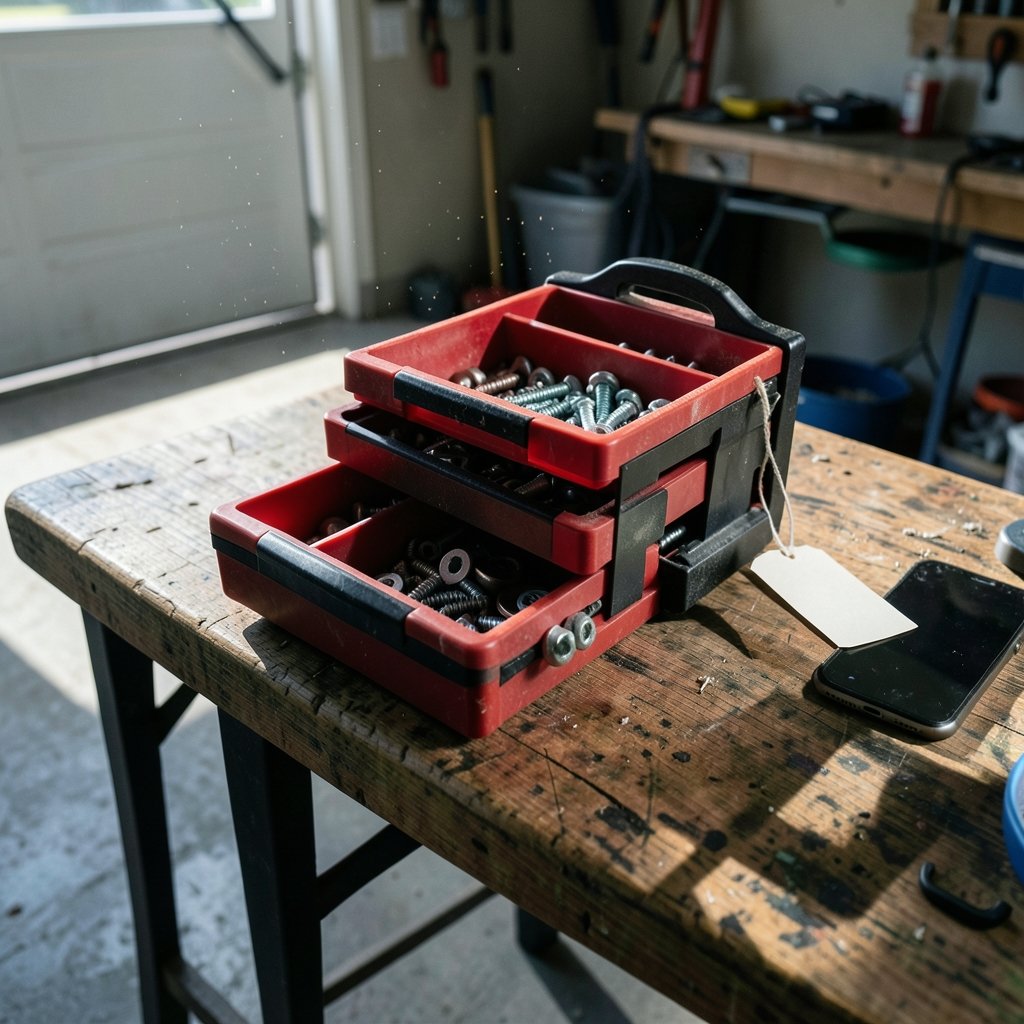
Is that Craftsman 9-drawer organizer deal in your feed actually a bargain, or is it a full-price unit wearing a red sale tag? Small-parts organizers are one of the most heavily promoted items in the tool aisle, and the discounts are often smaller than the marketing suggests. The good news is that a few simple checks separate a genuine markdown from a dressed-up regular price, and they take less time than driving to the store. (Drawer (furniture) overview)
This guide walks through what the organizer actually is, how Craftsman pricing tends to behave across the year, and the practical habits that keep buyers from overpaying. It also covers the mistakes people make most often, plus the questions worth asking before checkout.
What the Craftsman 9-Drawer Organizer Actually Is
The name trips people up. A 9-drawer organizer is not a rolling tool chest. It is a small-parts storage unit: a compact cabinet, usually plastic or metal, with nine shallow drawers meant for screws, nails, washers, drill bits, and other hardware that otherwise ends up loose in a coffee can.
That distinction matters for pricing. Tool chests and roller cabinets are big-ticket items with slow-moving inventory, so retailers discount them aggressively at specific times. Small-parts organizers sit in a different category. They are cheap to ship, cheap to stock, and often sold as add-ons or impulse buys near the register or at the end of an aisle. That means their “deals” follow a different rhythm.
Craftsman itself has changed hands. Sears Holdings sold the brand to Stanley Black & Decker in 2017, and the tool line now sells through home improvement chains, hardware stores, and online marketplaces rather than mainly through Sears. That shift matters to shoppers because the same Craftsman organizer can carry different prices at different retailers on the same day, and the “list price” printed on a tag is set by the seller, not by the brand.
Plastic Versus Metal Units
Most 9-drawer organizers in this size class are molded plastic with clear or smoked drawers, which lets you see contents without pulling anything out. Metal versions exist and cost more. Before comparing prices, confirm which material the listing describes, because a plastic unit at 40 percent off can still cost less than a metal unit at full price. Comparing the wrong two products is one of the most common ways shoppers talk themselves into a bad buy.
Why Craftsman Deal Pricing Is Harder to Read Than It Looks

Retail pricing in tools is built around promotional calendars. Big markdowns cluster around back-to-school season, Labor Day, Black Friday, and Father’s Day, with smaller promotions scattered between. Outside those windows, a “sale” price is frequently just the everyday price with a strikethrough next to it.
Regulators have noticed. The Federal Trade Commission publishes guidance on former-price and sale-price advertising, and the core idea is simple: a discount claim should be measured against a price the seller actually charged recently, not an inflated figure invented for the tag. When you see a Craftsman organizer marked down from a number that never appeared on the shelf, that is the pattern the guidance is aimed at.
The practical takeaway is not that every sale is fake. It is that the strikethrough is a claim, not a fact. A shopper who treats it that way, and checks one or two other sellers, will almost always do better than one who buys on impulse.
The Retailer Rotation Problem
Craftsman storage shows up at multiple chains, and each runs its own promotions on its own schedule. A unit that is full price at one store this week may be marked down at another, and the gap can be large on a low-priced item where a ten-dollar swing is a big share of the price. Checking two or three sellers takes about five minutes and is the single most valuable habit in this category.
A Practical Checklist for Spotting a Real Markdown
Here is a sequence that works whether you are shopping online or standing in the aisle.
- Identify the exact model. Note the model number or SKU from the product page or box. Craftsman has sold several organizer configurations over the years, and listings sometimes swap similar units.
- Check the price at two other sellers. Search the model number rather than the product name. Model-number searches surface the same item at other retailers instead of a pile of near-matches.
- Look at the price history. Many online listings show a price trend, and camel-tracking tools exist for exactly this. If the current price matches the price from three months ago, the “deal” is a label.
- Read the drawer specs, not the headline. Drawer depth, load rating per drawer, and whether the drawers have stops or removable bins matter more than the count. Nine shallow drawers that sag under a handful of bolts are not a bargain at any price.
- Confirm what is included. Some listings are the organizer alone; others bundle it with a wall-mount bracket or a set of labels. Compare like with like.
- Check the return window. Storage items are bulky to ship back. A generous return period is worth more than a few dollars off.
What Actually Works in Practice
The shoppers who consistently get good prices on small storage do three things. They buy out of season rather than during the promoted weekends, when demand spikes and stock thins. They buy multiple units at once when a genuine markdown appears, because organizer pricing rarely falls much below the promotional floor. And they ignore the urgency messaging on countdown timers, which reset.
What does not work: buying the first organizer you see because the tag says limited time, and assuming a bigger drawer count always means a better unit. Nine drawers of thin plastic are worse than six sturdy ones, and the price difference between the two is usually small.
Comparing a Craftsman Organizer Against Alternatives
It helps to know what else sits in the same price band. The table below compares the typical trade-offs rather than specific prices, since those move constantly.
| Option | Typical strength | Typical weakness | Best for |
|---|---|---|---|
| Craftsman 9-drawer organizer | Wide retail availability, easy returns, recognizable brand | Promotional pricing can obscure the real value | Buyers who want a known brand and simple exchanges |
| Generic stacked bin systems | Lower entry price, sold in multi-packs | Inconsistent drawer fit, fewer replacement parts | High-volume sorting on a tight budget |
| Metal shop cabinet | Durability, higher drawer load | Two to four times the price, heavy | Heavy hardware and long-term shop use |
| Wall-mounted rail and bin sets | Uses vertical space, expandable | Not portable, needs wall space | Small garages and workbenches |
The honest read is that the Craftsman unit competes on convenience and availability more than on raw price. If the lowest possible cost per drawer is the goal, a generic multi-pack usually wins. If you want something you can return locally and match with other Craftsman storage later, the brand premium is small enough to be reasonable.
Mistakes That Cost Buyers Money
A few errors show up again and again in this category.
Comparing a sale price to a list price instead of to other sellers. The list price is set by whoever is selling. The only comparison that matters is what someone else will charge you today for the same model.
Buying a drawer count instead of a drawer size. Nine tiny drawers hold less than six deep ones. Measure the hardware you actually need to store before choosing.
Overlooking shipping and pickup costs. A discount that disappears once shipping is added is not a discount. Store pickup often erases the gap.
Assuming the organizer is stackable. Many are, but not across model years. If you plan to build a system, buy matching units in one order rather than adding later.
Skipping the recall check. Storage products occasionally get pulled for tip-over or latch problems. A quick check of the Consumer Product Safety Commission’s recall database takes a minute and covers the whole category, this brand included.
Forgetting the workspace around it. An organizer needs a shelf or bench spot with clearance above it. Buyers regularly bring home a unit that will not fit under the cabinet they intended to slide it beneath.
Timing the Purchase Without Guessing
Nobody can promise a specific price on a specific date, and any article that does is guessing. What a shopper can do is stack the odds.
Promotional windows in tools are fairly predictable in shape even when the numbers are not. Late November brings the deepest cuts of the year across home improvement categories. Spring and early summer bring gift-driven promotions around Father’s Day. Late summer brings back-to-school and workshop-reset sales. If you are not in a hurry, waiting for one of those windows is usually worth it.
If you are in a hurry, the better move is to set a target price and buy when you see it, rather than waiting for a perfect deal that may not arrive before you need the organizer. Pick a number about 20 percent below the everyday price and treat that as your trigger. It is a simple rule that removes most of the regret from the decision.
It also helps to keep an eye on broader deal patterns. Watching how discounts behave on larger purchases, like a Ram truck lease deal or a 2025 Ford Explorer ST lease deal, teaches you how promotional cycles work in general: the advertised headline is rarely the whole story, and the fine print carries the real terms. The same instinct applies to a fifteen-dollar organizer and a three-year vehicle contract. If you follow dealer daily style coverage of pricing shifts, you start to notice when a “sale” is just the normal rhythm dressed up. (OSHA ergonomics overview)
For anyone who also shops the used market, the same discipline pays off. A used car deals mindset, meaning check the history, compare against three listings, and walk away from pressure, translates almost perfectly to small tools and storage.
Conclusion
A Craftsman 9-drawer organizer can be a genuinely good buy, but the deal label deserves skepticism. The unit is a small-parts cabinet, not a tool chest, and its pricing swings with retail promotional calendars rather than with any fixed discount schedule. The shoppers who do well are the ones who identify the exact model, check two or three sellers, read the drawer specs instead of the headline, and set a target price before they start looking.
None of that requires special knowledge. It requires about ten minutes and a willingness to treat a strikethrough price as a claim to verify. Do that, and the organizer you bring home will be one you actually got a deal on, not one that got a deal on you.
Frequently Asked Questions
What is a Craftsman 9-drawer organizer used for?
It is a small-parts storage cabinet with nine shallow drawers, designed for screws, nails, washers, drill bits, and other loose hardware. It is not a tool chest and will not hold hand tools like wrenches or hammers. Most buyers put it on a workbench or shelf near where they assemble and repair things.
When do Craftsman organizers usually go on sale?
Promotions cluster around late November, Father’s Day, back-to-school season, and Labor Day, with smaller sales in between. Outside those windows, a sale tag often reflects the everyday price. Checking the price at two other sellers is a faster way to judge a markdown than waiting for a calendar event.
How can I tell if a discount is real?
Compare the current price against what other retailers charge for the same model number today, and against the price from a few months ago if a price history is available. A discount measured only against a strikethrough figure set by the seller tells you very little. The FTC publishes guidance on how former-price claims are supposed to work, which is useful context for judging any sale tag.
Is the plastic version worth buying, or should I pay more for metal?
For light hardware and occasional use, plastic is fine and costs much less. Metal makes sense if drawers will hold heavy fasteners, if the unit lives in an unheated garage, or if you want it to last a decade. Compare drawer load ratings rather than material alone, since a well-built plastic unit can outperform a flimsy metal one.
How many drawers do I actually need?
Fewer than you think, if the drawers are deep. Six deep drawers often hold more usable volume than nine shallow ones. Count the categories of hardware you actually keep, add one or two spare drawers, and choose depth over count. Buying by drawer count alone is one of the most common mistakes in this category.
Where should I check for safety recalls?
The Consumer Product Safety Commission maintains a public recall database covering storage products, including tip-over and latch hazards. A search takes about a minute and is worth doing before you buy any cabinet that will hold weight above floor level, especially in a garage with children or pets around.



