
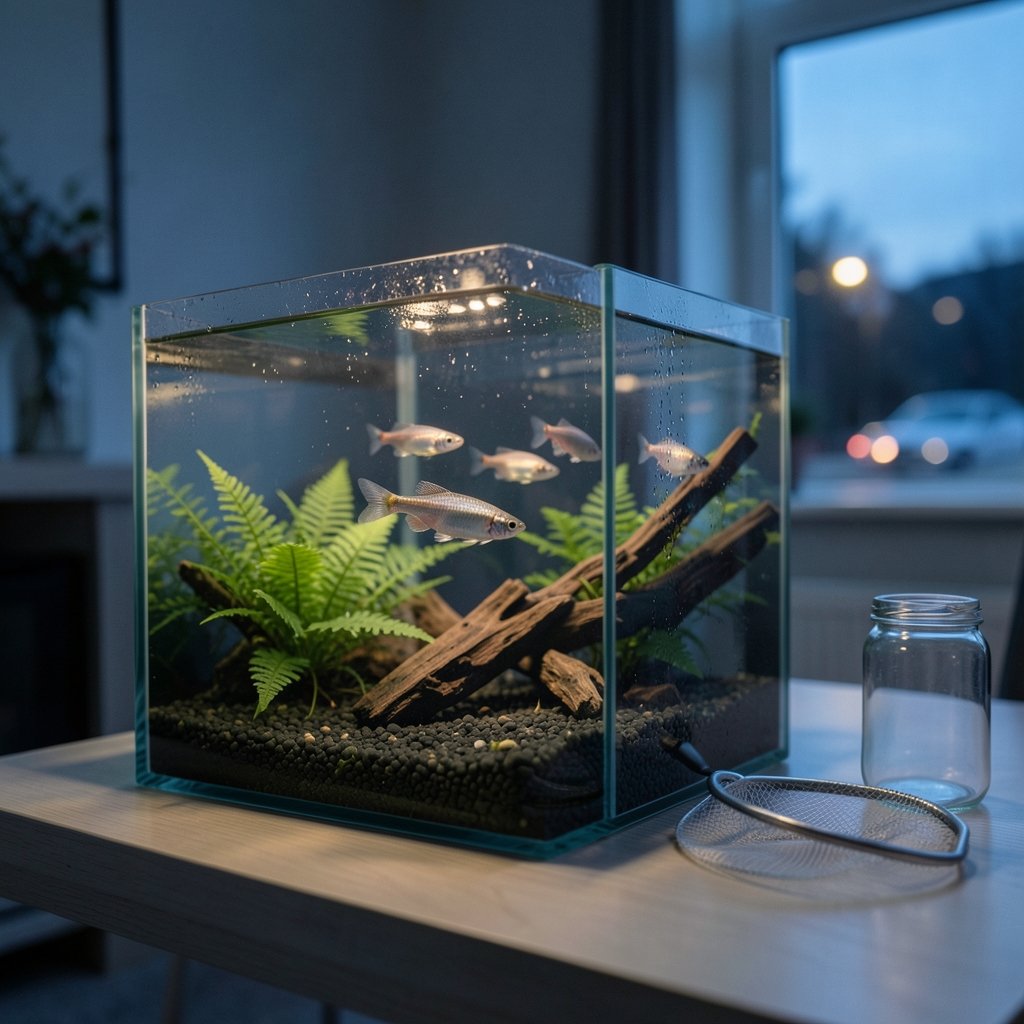
What do you do when a fish is listed as “rasbora het” and no care sheet anywhere matches that name? Search the term and you will find forum posts asking the same question, shop labels that offer no scientific name, and hobbyists guessing at answers. The short version is that rasbora het is not a recognized species name. It is a label, and labels in the aquarium trade can mean several different things depending on where you saw it.
This article unpacks the most plausible explanations, explains how to identify the fish you are actually looking at, and covers the care basics that apply to almost every small rasbora in the trade. By the end, a vague label should feel like a starting point rather than a dead end.
Why “Rasbora Het” Confuses So Many Keepers
The confusion starts with the word rasbora itself. It is not one fish. It is a common name attached to dozens of small freshwater cyprinids from South and Southeast Asia, spread across several genera including Rasbora, Trigonostigma, and Boraras. The family placement has also shifted over time, with many of these fishes now grouped in Danionidae rather than Cyprinidae depending on which authority you follow. That alone makes “rasbora” a broad umbrella rather than a precise identification.
Then there is het. In Dutch, “het” is simply the definite article “the.” In Indonesian and Malay trade contexts, short labels and local names are common and do not map cleanly onto scientific names. In genetics, “het” is shorthand for heterozygous. And in English-language shops, “het” sometimes appears as a fragment of a longer word, most famously the “hetero-” in Trigonostigma heteromorpha, the harlequin rasbora.
Put those possibilities together and you get a term that could be a language fragment, a trade shorthand, a typo, or a truncated species name. What it almost certainly is not is a valid scientific name. No standard taxonomic authority lists “rasbora het” as an accepted common name, so treat any listing that uses it as incomplete rather than authoritative.
The Most Likely Explanations, Ranked
Not all explanations are equally probable. Based on how the trade actually labels fish, here is a practical ranking.
| Explanation | Likelihood | What It Means for You |
|---|---|---|
| Dutch or Indonesian trade shorthand | High | The label is descriptive, not taxonomic; ask for the scientific name |
| Truncated “heteromorpha” | High | You are probably looking at a harlequin rasbora or a close relative |
| Typo or OCR error on a shop list | Medium | The real name may be one letter away |
| Local common name with no fixed translation | Medium | Identification requires a photo, not a word |
| Genetics shorthand (heterozygous) | Very low | Almost never used for rasboras in retail listings |
The practical takeaway is simple. If a seller cannot give you a scientific name, ask for a clear photo of the actual fish. A single sharp image resolves more ambiguity than any amount of label decoding.
When “Het” Is Just Dutch for “The”
Dutch aquarium literature and Dutch-run wholesalers have influenced the European trade for decades, and “het” appears constantly in Dutch phrasing. A list that reads “het rasbora” may simply be a Dutch fragment that survived translation into an English-language shop or marketplace listing. This is especially common on platforms where sellers copy text from supplier sheets without editing.
If this is the case, the word carries no information about the species at all. It is grammatical noise. The useful part of the listing is whatever else appears alongside it: color description, size, origin, or a photo.
When “Het” Is a Clipped “Heteromorpha”
The harlequin rasbora, Trigonostigma heteromorpha, is one of the best-known rasboras in the hobby, and its species name begins with “hetero-.” It takes very little for that to be shortened to “het” in a handwritten stock list, a marketplace title, or a translated product name. If the fish in question has the classic harlequin look, a deep reddish-copper body with a bold black wedge along the rear flank, this explanation fits neatly.
It is worth knowing that the harlequin has close relatives in the trade, including other Trigonostigma species that look similar at a glance. That is another reason a photo matters more than a label.
When It Is a Typo or a Local Name
Trade lists are typed by hand, translated by software, and copied between platforms. “Het” could be a mangled fragment of a species epithet, a dropped syllable, or a local name from a collecting region that never had an English equivalent. Indonesian and Malay hobbyists use many local common names that do not translate one-to-one into scientific names, and those names sometimes leak into export lists.
In these cases, decoding the word is a waste of time. Identification has to come from the fish itself.
How to Identify the Fish You Actually Have
Forget the label for a moment and look at the fish. Small rasboras can be sorted into rough groups by body pattern, and that gets you most of the way to a workable identification.
- Check the flank pattern. A bold black wedge or triangle on the rear half of the body points toward Trigonostigma. A single dark lateral stripe running nose to tail suggests a Rasbora species. A small round or oval spot is typical of many Boraras.
- Note the size. Most rasboras run roughly 2 to 10 cm as adults depending on species. Genuinely tiny fish under 2.5 cm are usually Boraras.
- Look at the fins and color. Red, orange, and black dominate this group. Fin shape, the presence of barbels, and the exact position of any dark marking all narrow things down.
- Ask where it was collected or bred. Wild-caught fish from Sumatra, Borneo, Thailand, or Malaysia narrow the field considerably. Commercially bred fish are often produced far from their native range, so this is a clue rather than proof.
- Photograph it properly. A side-on shot in good light, with the fish close to the glass, is what experienced keepers need to help you. Blurry top-down phone shots rarely settle anything.
Once you have a candidate name, cross-check it against a taxonomy database rather than a shop page. Scientific names get revised, and a name that was current a decade ago may now be a synonym.
Care Basics That Apply to Nearly Every Small Rasbora
Here is the good news. Whatever “rasbora het” turns out to be, the odds are strong that it is a small, schooling, soft-water fish from Southeast Asia, and the care basics overlap heavily across the group. These are the parameters that work in practice.
Group size matters more than almost anything else. Rasboras are schooling fish, and kept alone or in pairs they tend to hide, pale out, and stress. Groups of eight to twelve or more bring out natural behavior and better color. This is the single most common mistake keepers make with these fish.
Water should be soft and on the acidic side for most species. A pH around 6.0 to 7.0 and low hardness suits the majority. Chasing an exact number matters less than keeping conditions stable. Wild-caught fish are often more sensitive than tank-bred ones.
Temperature depends on origin. Many popular species sit comfortably around 23 to 26 degrees Celsius. Some Boraras from peat swamp habitats prefer it warmer and much softer, so confirm once you have an identification.
Filtration should be gentle. These are small fish from slow-moving forest streams. Strong current tires them out. A sponge filter or a well-baffled canister works well.
Diet is easy. They are micropredators in the wild, taking small insects and crustaceans. In captivity they accept micro pellets, crushed flake, and small live or frozen foods such as daphnia and baby brine shrimp. Variety improves color.
Tankmates should be calm and small. Large or boisterous fish intimidate them and can outcompete them at feeding time. A species-only setup or a community of similarly sized, peaceful fish works best.
Acclimation deserves patience. Drip acclimation over 45 minutes or more reduces shock, especially for wild-caught stock. Rushing this step is a quiet killer.
One more practical note. Quarantine any new rasbora for two to four weeks before adding it to a display tank. Small schooling fish are prone to introducing parasites and bacterial issues, and a cheap quarantine setup saves expensive problems later.
Buying Smart When the Label Is Vague
A vague label is a negotiating position, not a fact. Treat it that way.
Ask the seller for the scientific name in writing. If they cannot provide one, ask for the origin, the supplier, and a current photo. Reputable sellers will answer. Sellers who dodge these questions are telling you something useful about how they source and label livestock.
Compare prices with care. A fish sold under an unclear name at a suspiciously low price is often wild-caught stock with no history, or a misidentified species that grows larger or behaves differently than expected. Neither outcome is a bargain.
Finally, plan the tank before you buy. Buying first and researching later is how people end up with a shoal of fish that need softer water than their tap provides, or a group too small to feel safe. The label on the bag is the least reliable part of the purchase. Your own preparation is the most reliable part.
Conclusion
“Rasbora het” is not a species. It is a label with several plausible origins: a Dutch or Indonesian language fragment, a clipped version of heteromorpha, a typo, or a local trade name that never had a clean English equivalent. None of those possibilities should stop a keeper from getting good care right. Identify the fish from its body pattern and a clear photo, confirm the name against a taxonomy reference, and then apply the standard rasbora formula: a decent-sized group, soft and stable water, gentle flow, small foods, and calm tankmates.
The lesson generalizes well beyond this one term. Aquarium labels are marketing and shorthand, and scientific names are the only reliable common ground between buyers, sellers, and keepers. When a name looks strange, the fish in front of you is always the better source of truth. For more practical guidance on stocking, water chemistry, and identifying unusual trade fish, browse the resources at
What does “rasbora het” mean?
It is not a recognized species name. The most likely explanations are that “het” is the Dutch word for “the” surviving in a translated trade listing, that it is a shortened form of heteromorpha as in the harlequin rasbora, or that it is a typo or local trade name. No standard taxonomic authority lists it as an accepted common name, so the label should be treated as incomplete.
Is “rasbora het” the same as a harlequin rasbora?
Possibly, but not certainly. The harlequin rasbora is Trigonostigma heteromorpha, and “hetero-” shortening to “het” is a plausible path. However, several closely related Trigonostigma species look similar, so a photo of the actual fish is needed before assuming you have a harlequin.
Can I keep a single rasbora on its own?
It is not recommended. Rasboras are schooling fish, and kept alone or in very small numbers they tend to hide, lose color, and show stress. Groups of eight to twelve or more are far better for the fish and far more interesting to watch.
What water conditions do rasboras need?
Most species do best in soft, slightly acidic water with a pH around 6.0 to 7.0, moderate temperatures near 23 to 26 degrees Celsius, and gentle filtration. Stability matters more than hitting an exact number. Some tiny Boraras species from peat swamp habitats need warmer and softer water still.
How do I identify a rasbora without a scientific name?
Look at the body pattern first. A bold black wedge on the rear flank suggests Trigonostigma, a single lateral stripe suggests a Rasbora species, and a small round spot often points to Boraras. Then take a clear side-on photo and cross-check the candidate name against a taxonomy database.
Should I buy fish from a seller who cannot name the species?
Be cautious. Ask for the scientific name in writing, the origin, and a current photo. Sellers who answer clearly are usually sourcing and labeling responsibly. If the questions get dodged, that tells you something about the risk you are taking on.



