
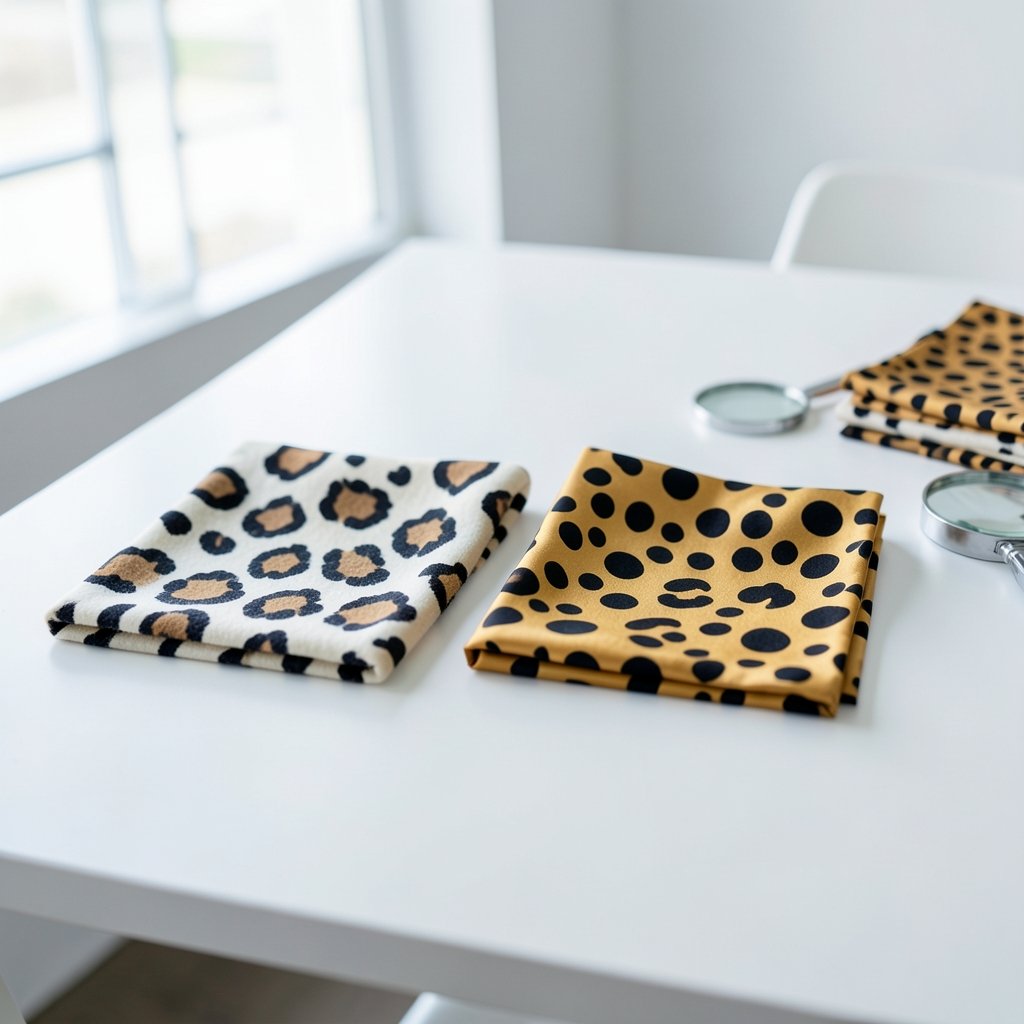
Can you spot the difference between leopard and cheetah print in under three seconds? Most people think they can, and most people get it wrong when the fabric is in front of them. The two patterns get swapped constantly, in clothing stores, in home decor listings, and in costume design. The confusion is understandable, but the fix is simpler than most people expect.
This guide breaks down the real difference between the two prints, explains why labels lie, and gives you a few practical tricks that work in a fitting room or a fabric shop.
The Core Difference: Rosettes vs. Solid Spots
The single most useful rule is this: leopard print is built from rosettes, and cheetah print is built from solid spots.
A rosette is a broken ring of dark markings around a lighter center. The ring is usually not closed. It looks like someone pressed a small, irregular horseshoe or a cluster of dark blobs around a patch of the coat’s base color. The center of the rosette is lighter than the ring, often a warm tan or cream.
A cheetah spot is a single, solid dot. It sits alone. It has no lighter center, no surrounding ring, and it tends to be round or slightly oval. Cheetah spots are also spaced more evenly across the coat, which gives the pattern a cleaner, more geometric look.
That distinction is the backbone of almost every accurate identification. If you remember nothing else, remember “hollow ring equals leopard, solid dot equals cheetah.”
A Side-by-Side Comparison
The table below sums up the practical differences most people care about when they are shopping, sewing, or designing.
| Feature | Leopard print | Cheetah print |
|---|---|---|
| Main marking | Broken dark rings (rosettes) | Solid dark dots |
| Center of marking | Lighter, often tan or cream | Same color as the dot |
| Spacing | Irregular, clustered | More even, evenly distributed |
| Overall feel | Dense, busy, warm | Cleaner, lighter, more open |
| Common lookalikes | Jaguar (spot inside rosette), snow leopard (larger, open rosettes) | Sometimes confused with small leopard rosettes |
| Typical fabric use | Coats, dresses, scarves, upholstery | Dresses, swimwear, accessories, kids’ clothing |
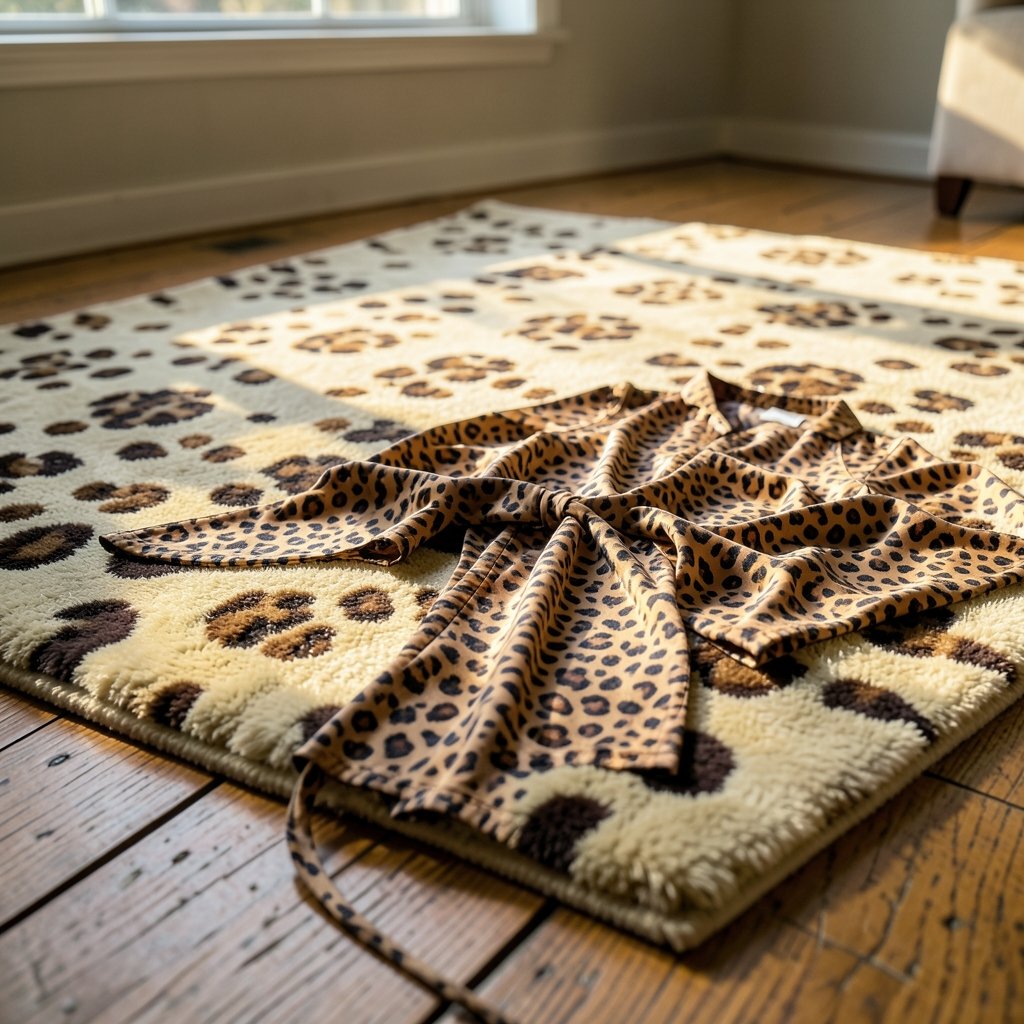
One thing the table cannot capture is scale. Print size changes everything. A tiny rosette pattern on a silk blouse can read almost like a cheetah print from a few feet away, while a giant cheetah spot on a rug looks bold and graphic. Scale matters as much as shape.
Why the Labels Get It Wrong So Often
Here is the part that frustrates people who care about accuracy: in fashion and textiles, the two terms are used loosely and often interchangeably. There is no binding standard that defines what a fabric label must call a rosette pattern versus a spot pattern. A retailer can call a rosette fabric “cheetah” and face no consequence.
That means you cannot trust the hang tag. You have to trust your eyes. The label tells you what the buyer thought would sell, not what the pattern actually is.
The same looseness shows up in home decor. A cushion cover described as “cheetah” may show perfect rosettes, and a “leopard” throw may be covered in solid dots. If pattern accuracy matters to you, whether for a costume, a design project, or a wildlife-themed room, check the image, not the product name.
The Jaguar and Snow Leopard Curveballs
If rosettes versus spots feels manageable, the big cat family has a few more traps waiting.
Jaguar rosettes often contain a small spot inside the ring. That inner dot is the giveaway. A leopard rosette usually has a clean, lighter center. If you see a dark speck sitting inside the ring, you are probably looking at a jaguar-inspired pattern.
Snow leopard rosettes are larger and more open, with wider spacing and a paler overall palette. They read as airy and soft rather than dense.
These distinctions matter more than they might seem. Designers borrow from all four cats, and a pattern described as “leopard” in a product listing may actually be modeled on a jaguar or a snow leopard. Knowing the family tree of spots helps you describe what you want with precision, which is useful when you are commissioning fabric or briefing a printer.
The Animals Behind the Prints
The patterns come from two very different cats. The cheetah is Acinonyx jubatus, a sprinter built for speed. The leopard is Panthera pardus, a stalker and climber in the same genus as lions, tigers, and jaguars. They are not close relatives, despite the similar coats.
Their conservation status is also similar in one respect: both are listed as Vulnerable on the IUCN Red List, though the assessments were carried out in different years. That shared status is a reminder that these prints borrow from animals under real pressure, which is one reason some designers now lean toward abstract or stylized interpretations rather than literal copies.
The patterns themselves are not heraldic. Unlike tartan, which has registered setts and formal rules, leopard and cheetah prints have no registry, no governing body, and no official definitions. They are decorative conventions, which is exactly why they drift and blur in the marketplace.
A Practical Test You Can Run in Ten Seconds
When you are standing in a store with a garment in your hands, try this sequence.
- Find one marking and look at its center. Is the middle lighter than the edge? If yes, you are looking at a rosette.
- Check whether the ring closes. Broken, irregular dark shapes around a light center point to leopard.
- Look for a solid dot. A single dark blob with no lighter middle points to cheetah.
- Step back two meters. Small rosettes can blur into what looks like spots at a distance. Judge the pattern from both close up and far away.
- Check the spacing. Even, orderly spacing leans cheetah. Clustered, uneven spacing leans leopard.
- Look for an inner dot. A spot inside the ring suggests jaguar, not leopard.
That sequence takes about ten seconds once you have practiced it, and it will beat the label almost every time.
Common Mistakes People Make
A few errors come up again and again, and each one is easy to avoid once you know about it.
Trusting the product name. As covered above, retail labeling is inconsistent. Treat the name as marketing, not taxonomy.
Judging from a thumbnail. Small product photos compress pattern detail. Rosettes lose their hollow centers and start to look like solid dots. Zoom in before you decide.
Ignoring scale. A pattern that is technically rosettes can look like spots if the motifs are tiny. Scale changes perception more than most people expect.
Forgetting about the jaguar. The inner-spot detail is the most common source of confident wrong answers.
Assuming “cheetah” means small. Cheetah spots can be printed large and graphic. Size is a design choice, not a species marker.
Overlooking the base color. Leopard prints usually sit on warm tan, gold, or cream grounds. Cheetah prints often use a paler, sandier base. Color is a supporting clue, not a primary one, but it helps.
Where the Prints Show Up in Print and Design Work
The distinction is more than a fashion curiosity. Anyone who prints, designs, or sells imagery runs into it. If you are preparing artwork that reproduces currency or banknote imagery, the rules around what you can legally reproduce are their own separate puzzle, and it pays to check the money pictures you can legally show before you commit a design to a print run.
Material choice also shapes how a print reads. A pattern printed on a matte fabric looks different from the same file printed on a glossy surface, and the same logic applies across making disciplines. If you work with 3D printing, you already know that material behavior changes outcomes, whether you are comparing ASA vs ABS filament weather resistance and print settings trade-offs or dialing in a machine. The principle carries over: the substrate decides how the pattern lands.
For anyone producing physical samples, the finishing steps matter as much as the design file. Resin print washing and curing times that actually work can make or break a small detail like a rosette’s hollow center, and a resin printer FEP replacement guide can save a project when smudged prints start blurring fine pattern work. Even something as mundane as retraction settings affects whether a printed texture reads cleanly, which is why a solid 3d printer retraction settings guide is worth keeping on hand. And if you are outputting reference sheets or pattern swatches on paper, the real cost per page matters, as any honest Epson EcoTank ET-2800 review of real printing costs and trade-offs will tell you.
The through-line is simple: pattern accuracy survives or dies in production. A rosette with a filled-in center is no longer a rosette.
How to Describe the Print You Actually Want
If you are buying, commissioning, or briefing someone on a pattern, precise language saves everyone time. Use these phrases.
- “Broken rosettes with a light center” for a true leopard look.
- “Solid round spots, evenly spaced” for cheetah.
- “Rosettes with an inner spot” for jaguar-inspired patterns.
- “Large open rosettes, pale base” for a snow leopard feel.
Adding scale and base color to the description, for example “small rosettes on a warm tan ground,” removes most of the ambiguity. Designers and fabric sellers respond well to specific language because it tells them you know what you are looking at.
Conclusion
Leopard versus cheetah print comes down to one structural fact: rosettes versus spots. Leopard markings are broken dark rings around a lighter center. Cheetah markings are solid dots, usually spaced more evenly. Everything else, including scale, base color, and the jaguar’s telltale inner spot, is supporting detail.
The trick is to stop trusting labels and start trusting the center of the marking. Once you train your eye to look for the hollow middle, the two prints stop blurring together. You will spot a mislabeled “cheetah” dress from across the room, and you will know exactly which words to use when you want a pattern made the way you pictured it.
What is the main difference between leopard and cheetah print?
Leopard print is made of rosettes, which are broken dark rings around a lighter center. Cheetah print is made of solid dark dots with no lighter middle. That structural difference is the most reliable way to tell them apart.
Are cheetah spots always smaller than leopard rosettes?
Not necessarily. Cheetah spots are often smaller and more uniform, but print scale is a design choice. A large-scale cheetah print can have spots bigger than small leopard rosettes, so judge shape and center before you judge size.
Why do stores label rosette patterns as cheetah print?
There is no binding standard for animal print names in apparel. Retailers use whichever term they think will sell, and the two words are often treated as interchangeable. The label reflects marketing, not pattern accuracy.
How can I tell leopard print from jaguar print?
Look inside the ring. Jaguar rosettes often contain a small dark spot in the center, while leopard rosettes usually have a clean, lighter middle. If you see an inner dot, the pattern is probably jaguar-inspired.
Is it okay to wear leopard and cheetah print together?
Yes, and the trick is contrast. Because the two patterns have different structures, mixing them works best when the scales differ clearly, for example a large leopard rosette piece with a small cheetah spot accessory. Matching scale and similar base colors tend to make the combination look muddy.
Do leopard and cheetah prints have any official definition?
No. Unlike tartan, which has registered patterns and formal rules, leopard and cheetah prints have no registry or governing body. They are decorative conventions, which is why the terms blur so easily in fashion and home decor.



