

Have you ever peered through a museum window at a frozen scene of wolves in snow or a street corner from 1890 and felt, for a second, that you could step inside? That small window into another world is a diorama. But here is the twist: the word did not originally mean a miniature model at all. It started as the name of a spectacular light-and-painting show in 1820s Paris, and its meaning has shifted several times since. Understanding what a diorama is today means untangling that history, because the older and newer senses still bump into each other in museums, classrooms, and hobby forums.
What does diorama mean in plain English?
In everyday modern English, a diorama is a three-dimensional model of a scene, usually built to scale and often viewed through a window, opening, or glass case. It typically combines sculpted figures and objects in the foreground with a painted backdrop behind them, so the eye reads the whole thing as one continuous scene. Dictionaries describe it as a scenic representation where lifelike details blend into a painted background, and also as the room or building where such a display is shown.
That definition covers a lot of ground. A shoebox school project with clay dinosaurs counts. So does a glass case at a natural history museum holding a full-size moose standing in fake autumn leaves. The common thread is not size or budget. It is the deliberate staging of a scene: objects arranged in space, a background supplying context, and a viewpoint the builder wants you to stand at.
Where the word came from: a Paris light show, not a model
The word diorama comes from French, built from Greek roots: dia-, meaning “through,” and horama, meaning “that which is seen” or “a sight,” from horan, “to see.” So the literal sense is something like “seeing through” or “a sight seen through.” That root is your first clue that the original diorama involved looking through something.
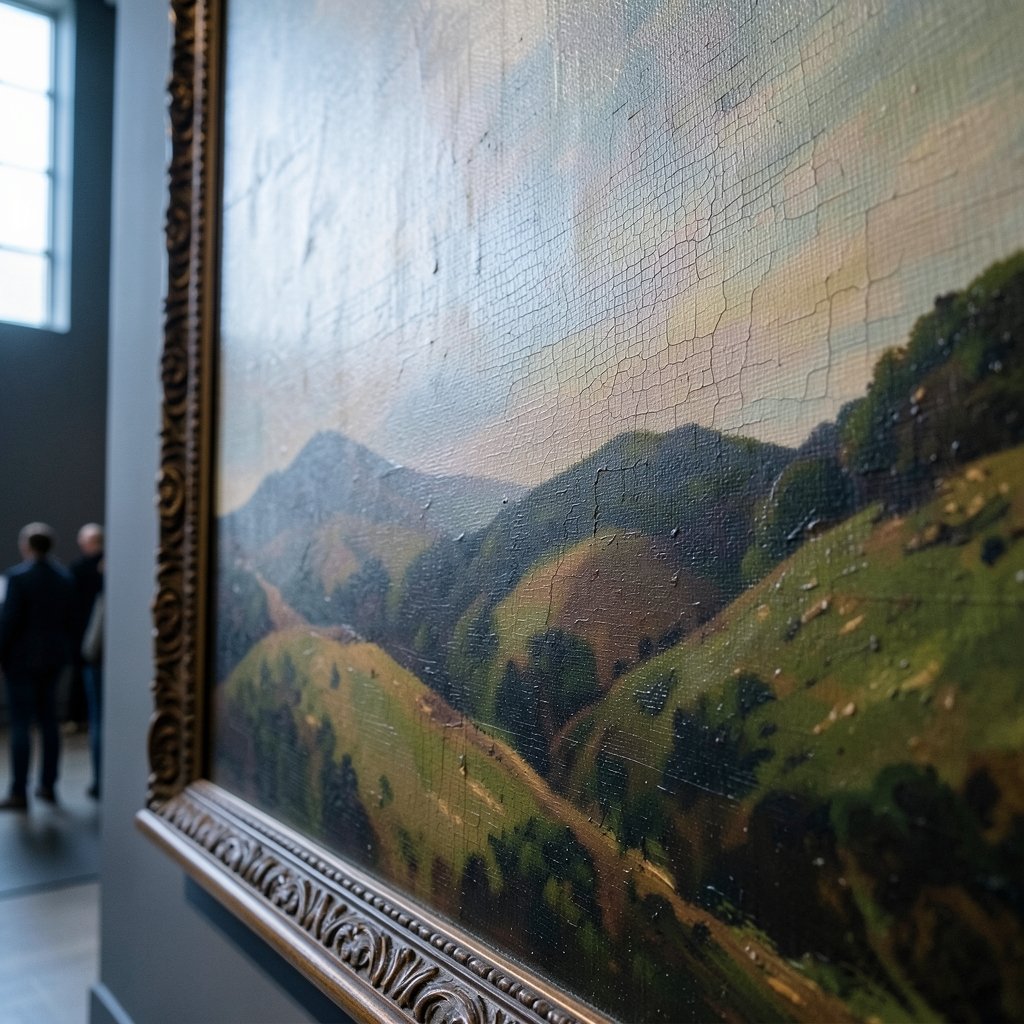
It did. The French inventor Louis Daguerre, later famous for early photography, coined the term with his collaborator Charles-Marie Bouton. In 1822 they opened the first Diorama in Paris: a theatre built for enormous painted scenes that changed appearance as the light shifted. A second Diorama opened in London’s Regent’s Park in 1823. Audiences sat in a darkened room and watched huge paintings, often of landscapes or cathedral interiors, appear to shift from daylight to dusk to storm as light was directed onto them from different angles. No tiny figures. No scale models. Just painting, light, and a rotating viewing chamber.
That original sense has almost vanished from daily speech, but it explains why the word still carries a whiff of theatrical illusion. When people say a modern display has a “diorama feel,” they are echoing Daguerre’s trick: a controlled scene that fools the eye for a moment.
How the meaning shifted to miniature scenes
So how did a word for giant light-painted canvases become the label for a shoebox project? The change happened gradually through the 19th and 20th centuries, as museum display practice evolved. Institutions needed ways to show objects in context, and the staged scene was a natural fit.
Natural history museums were the big driver. From the late 19th century onward, they built habitat dioramas: animals mounted and arranged against painted backgrounds that recreated their environment. The American Museum of Natural History’s habitat halls are the best-known example, and they shaped public expectations of what a diorama should look like. A visitor who saw a diorama there saw taxidermy, painted backdrop, and lighting working together as one illusion.
From there the word spread into model-making, education, and popular culture, loosening as it went. Today it can mean a museum habitat group, a tabletop wargaming scene, a school assignment, or even a decorative display in a shop window. The old theatrical sense survives mostly in historical writing about Daguerre.
Diorama versus panorama, model, and maquette
People mix these terms up constantly, and the confusion is understandable because the categories overlap. Here is a working comparison.
| Term | What it usually means | Key distinguishing feature |
|---|---|---|
| Diorama | A 3D scene with figures or objects set against a backdrop | Staged scene with a viewpoint |
| Panorama | A wide continuous painted view, often 360 degrees | Painted surface, no foreground objects |
| Model | A scaled representation of an object, like a car or ship | Reproduces a thing, not a scene |
| Maquette | A small preliminary model used for planning | Working tool, not a finished display |
| Vignette | A small scene, often without a full enclosure | Looser, more decorative framing |
The distinction between a diorama and a model is the one that trips people up most. A scale model of a Spitfire is a model. Put that Spitfire on a textured base with a painted sky backdrop, a fuel drum, and a mechanic figure, and most hobbyists will call it a diorama. The scene, not the object, is what earns the label. Note that these boundaries are conventional rather than standardized, so usage overlaps and arguments about edge cases are common.
Dioramas in museums, classrooms, and hobby rooms
The museum sense remains the most formal. Habitat dioramas are still built and restored, and they serve a real interpretive purpose: they show an animal in a place, at a scale and angle a photograph cannot quite match. They also raise interesting questions about accuracy, since a diorama freezes one moment and one interpretation of an environment.
In education, the diorama is a durable assignment because it forces students to think spatially. A book report diorama, a biome diorama, a volcano cross-section: each requires choosing what to include and what to leave out. Teachers tend to value the planning more than the craft, though the craft is what gets photographed.
In the hobby world, dioramas are a recognized category in modelling competitions and a thriving online genre. Military modellers build ruined streets, railway modellers build landscape slices, and fantasy painters build dungeon scenes. Kits and aftermarket scenery have made the entry barrier lower than it once was, but the skills that separate a convincing scene from a cluttered one have not changed.
Practical tips that actually make a diorama work
First-hand experience in model-making circles points to a handful of habits that separate scenes that read well from scenes that look like a pile of parts.
- Pick one viewpoint before you build anything. Decide where the viewer stands and build toward that spot. Scenes designed to look good from every angle usually look mediocre from all of them.
- Match your light direction. Paint shadows and highlights as if light comes from one consistent direction, and if the display has real lighting, align the two. Mismatched light is the most common reason a scene looks fake.
- Carry the backdrop into the base. Blend the painted background into the ground texture at the seam. A hard line where paint meets model is the giveaway that breaks the illusion.
- Use forced perspective deliberately. Slightly smaller figures and details toward the back strengthen depth. Random scaling weakens it.
- Weather everything, including the backdrop. Clean, bright paint reads as a toy. Dust, streaks, and uneven tones read as a place.
The most common beginner mistake is overcrowding. New builders add figures, crates, and props until the scene becomes noise. A diorama with three well-placed elements and a strong backdrop usually beats one with thirty competing details. The second most common mistake is ignoring scale consistency: a 1:35 figure next to a 1:48 vehicle destroys the illusion faster than any painting error.
What the word signals in advertising and culture
Because “diorama” carries connotations of craft and wonder, it gets borrowed. Retailers describe window displays as dioramas. Filmmakers describe miniature sets as dioramas. The word shows up whenever someone wants to suggest a contained, carefully staged world. That borrowing is worth noticing, because it shows how a term migrates from a technical sense to a mood.
This pattern is common with words tied to money and value, too. Terms get stretched until their original meaning blurs, and readers have to work out which sense is intended. The same thing happens with symbols and slogans: a phrase sounds authoritative until you trace what it originally described. If you enjoy that kind of digging, the way people unpack what the money cat meaning beckoning cat really symbolizes shows how a single object can carry several layers of meaning at once, and the same is true of how money symbols really mean text in different contexts. Words and objects drift, and tracing the drift is often more interesting than the tidy definition. (Medal really history materials meaning)
Common misconceptions about dioramas
A few myths deserve clearing up. One is that a diorama must be small. Museum habitat halls are room-sized, and some historical dioramas filled entire buildings. Scale is not the defining feature; staging is. Another myth is that a diorama must be enclosed in a box. Many are open-fronted or built into walls. The enclosure helps control viewpoint and light, but it is a technique, not a requirement.
A third misconception is that dioramas are purely for children or purely historical. Contemporary artists use the form, and commercial designers use it for prototypes and presentations. The format is flexible enough to serve a science exhibit, a film set, and a school project without stretching the definition past breaking.
There is also genuine uncertainty in the record about which sense of the word appeared first in English. Some sources point to the Paris and London light-show theatres; others suggest later miniature displays. A dated historical dictionary would settle it, and anyone writing seriously about the term should check one rather than trusting a summary.
Conclusion
The diorama meaning story is really a story about how language adapts to technology and taste. A word coined for Daguerre’s 1822 light-and-painting theatre, built from Greek roots meaning “a sight seen through,” migrated into museum halls, then into classrooms and hobby benches, picking up new associations at each stop. What holds the senses together is the core idea: a scene arranged for a viewer, with a background doing half the work. Whether you are standing in front of a moose in a museum case or gluing gravel onto a shoebox, you are participating in a tradition that started with painted light and never quite lost its theatrical streak.
Frequently asked questions
What is the simple definition of a diorama?
A diorama is a three-dimensional model of a scene, usually built to scale, with figures or objects in front of a painted backdrop. It is designed to be viewed from a particular spot so the parts read as one continuous scene. The word also refers to the room or case where such a display is shown.
Where did the word diorama originally come from?
It comes from French, coined by Louis Daguerre from the Greek roots dia- (“through”) and horama (“a sight”), so it literally suggests “a sight seen through.” Daguerre and Charles-Marie Bouton used it for a Paris theatre opened in 1822 where huge painted scenes appeared to change as the lighting shifted. A second Diorama opened in London in 1823.
Is a diorama the same as a model?
No, though they overlap. A model reproduces an object, like a car or an aircraft. A diorama places objects in a staged scene with a background and a viewpoint. Put a finished model on a textured base with a painted sky behind it and most people will call the result a diorama. The boundary is conventional rather than strictly defined.
Why do natural history museums use dioramas?
They show animals in context. A mounted specimen alone tells you what an animal looked like; a habitat diorama shows where it lived, what surrounded it, and how it stood in its environment. Museums have built these displays since the late 19th century, and the best-known examples remain the habitat halls of major natural history institutions.
What is the difference between a diorama and a panorama?
A panorama is a wide, continuous painted view, often wrapping around the viewer through a full circle, with no foreground objects. A diorama adds three-dimensional elements in front of the backdrop and stages a specific scene from a specific viewpoint. Both aim to surround or absorb the viewer, but they use different means.
Do dioramas have to be in a box?
No. Many are open-fronted, built into walls, or set on open tables. An enclosure helps control the viewing angle and the lighting, which makes the illusion easier to maintain, but it is a technique rather than a rule. Plenty of competition and classroom dioramas have no box at all.



