

What if you could walk into a clinic with a mouth full of failing teeth and walk out with a fixed set of replacements in a single day? That’s the promise behind all-on-four dental implants, one of the most talked-about protocols in modern restorative dentistry. It sounds almost too good to be true, and that’s exactly why it deserves a closer look. The concept is real, it’s widely used, and it has a solid body of clinical literature behind it. But it’s also a term that gets stretched by marketing, applied to patients who may not be good candidates, and misunderstood by people who assume “four implants” means “four is always enough.” (Open bios windows 11 four methods that actually work)
This article breaks down what the protocol actually is, where it came from, how it compares to alternatives, what the evidence says, and the mistakes people make when choosing a provider. No hype, no scare tactics, just the practical picture.
What All-on-Four Actually Means
The name describes a treatment concept, not a specific brand of implant or a single surgical technique. In an all-on-four case, a full arch of fixed teeth, usually somewhere between 10 and 12 units, is supported on four dental implants. The two front implants are placed roughly vertically. The two back implants are tilted distally, meaning they lean backward at an angle. (Tie tie four knots step by step mistakes avoid)
That tilt is the mechanical heart of the idea. By angling the rear implants, the surgeon can extend the anteroposterior spread of the support base, which gives the prosthesis better stability and reduces the need for bone grafting. In the upper jaw, tilting helps steer the implant away from the maxillary sinus. In the lower jaw, it helps avoid the mandibular nerve. Common descriptions put the tilt somewhere around 30 to 45 degrees, though the exact range varies by source and protocol, so treat any specific number as approximate rather than a rule.
The concept is generally credited to Paulo Maló and colleagues, who published clinical results from the early 2000s onward. A widely cited early report is Maló, Rangert and Nobre’s 2003 paper in Clinical Implant Dentistry and Related Research on the all-on-four immediate-function concept for completely edentulous mandibles. The original protocol was built around immediate function: a provisional fixed prosthesis is placed at or shortly after surgery rather than after months of healing. That’s a design feature of the protocol, not proof that immediate loading suits every patient.
One caution worth stating plainly: “all-on-four” is as much a marketing term as a clinical one. It isn’t a standardized entry in a formal taxonomy, so definitions shift between clinicians and manufacturers. Two practices advertising the same phrase may mean quite different things.
The Appeal, and the Honest Trade-Offs
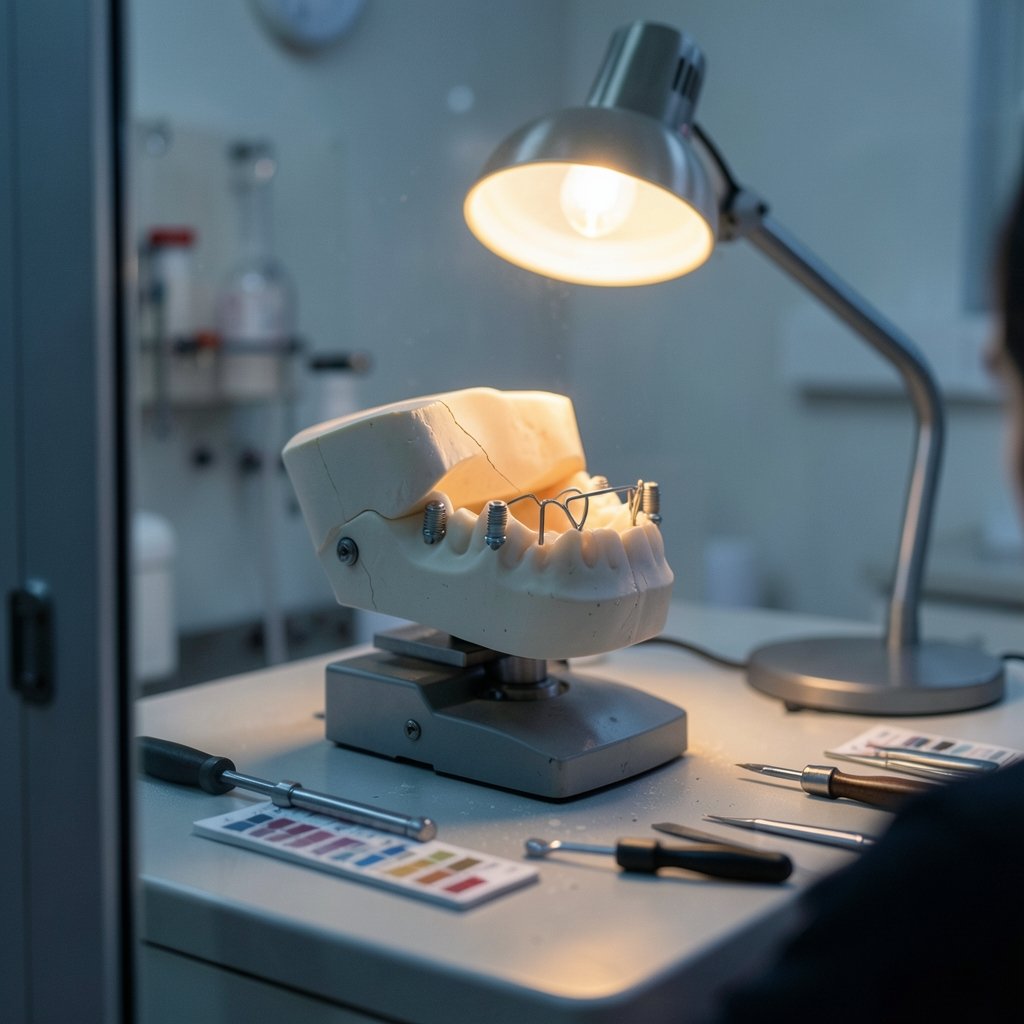
People are drawn to the protocol for obvious reasons. Fewer implants than a traditional full-arch reconstruction means less surgery, often lower cost, and frequently a shorter path to a fixed set of teeth. Avoiding grafting is a major draw for patients with significant bone loss. And the immediate provisional prosthesis means nobody has to spend months without teeth.
But the appeal comes with trade-offs that deserve equal billing. Four implants carry less total support than six or eight. The biomechanical load on each implant is higher, particularly at the tilted rear sites. The literature consistently flags prosthetic fracture, peri-implant disease, and stress concentration at tilted implants as known risks. None of these makes the protocol a bad choice. They make it a choice that depends heavily on case selection and on the skill of the team doing the work.
There’s also a subtler issue: much of the foundational evidence comes from a relatively small number of research groups. That doesn’t invalidate the findings, but it is a potential source of bias that a careful reader should keep in mind when comparing survival numbers across studies.
How All-on-Four Compares to Other Approaches
The clearest way to understand the protocol is to see it beside its alternatives. The table below summarizes the main differences at a conceptual level; actual recommendations depend on the individual case.
| Approach | Implants per arch | Typical bone grafting need | Loading timeline | Best suited to |
|---|---|---|---|---|
| All-on-four | Four, two tilted | Often avoided | Immediate provisional common | Significant bone loss, wanting a fixed arch with less surgery |
| All-on-six or more | Six or more | More often required | Variable, often delayed | Cases needing maximum support and load distribution |
| Implant-supported overdenture | Two to four | Variable | Variable | Patients prioritizing cost and simpler hygiene access |
| Conventional bridge | None (uses abutment teeth) | Not applicable | Short | Cases with healthy adjacent teeth and adequate support |
The “four implants” figure is a protocol convention, not a biological requirement. Some mouths genuinely need more support. Others do fine with four. That judgment belongs to a clinician with imaging and a full history, not to a brochure.
If you’re the type who likes to plan carefully before committing to anything expensive, the same instinct that helps people build a realistic financial plan for big decisions applies here: get the numbers in writing, compare more than one quote, and understand what happens if the plan changes midway.
What the Evidence Says, and What It Doesn’t
Systematic reviews and meta-analyses of the all-on-four concept have generally reported high short- to medium-term implant survival, with figures commonly cited in the range of roughly 95 percent or better at one to five years. That’s a genuinely encouraging picture for a protocol that spares many patients from grafting.
The caveats matter just as much. Long-term data beyond ten years are thinner. Study designs are heterogeneous, meaning the reviews are pooling cases that differ in patient selection, implant systems, prosthesis materials, and follow-up protocols. And as noted, a limited number of research groups dominate the literature. Anyone quoting a single survival percentage as if it settles the question is oversimplifying.
Regulatory context is worth knowing too. In the United States, dental implants are Class II medical devices regulated by the FDA. In the European Union, they fall under the Medical Device Regulation (EU) 2017/745, which applied from 26 May 2021. That framework governs how implants reach the market, not how well a particular clinic places them, so it’s a floor rather than a guarantee.
Practical Tips From the Chair-Side Reality
First-hand experience in implant dentistry points to a handful of things that separate smooth cases from difficult ones. These aren’t secrets, but they’re routinely skipped in consultations.
Get the imaging done properly. A cone-beam CT scan is the difference between a plan and a guess. Bone volume, sinus position, and nerve location all need to be mapped before anyone commits to four implants.
Ask who does the surgery and who makes the teeth. Many clinics split this between a surgeon and a prosthodontist. That arrangement can work, but you need to know the team and their combined experience, beyond the name on the door.
Push for the maintenance plan in writing. Peri-implant disease is one of the most cited complications, and it’s heavily influenced by hygiene and follow-up. If the quote doesn’t include a recall schedule, ask why.
Be skeptical of same-day promises without a diagnosis. Immediate function is a legitimate protocol feature, but it’s not universal. A clinic that promises it before examining you has the sequence backwards.
Understand what “fixed” means for cleaning. A fixed full-arch prosthesis isn’t removed daily. You’ll need specific tools and techniques to keep the underside clean. Ask to see them before you commit.
Check the provisional-to-final timeline. The provisional prosthesis is a temporary stage. Know how long it stays, what it costs to replace, and what happens if an implant fails to integrate.
The broader lesson from other high-stakes technical decisions applies here too: a step-by-step plan with checkpoints beats a leap of faith. Whether you’re setting up network segmentation or choosing a surgical protocol, the discipline of sequencing and verification is what actually protects you.
Common Mistakes That Cost Patients Money and Time
The most frequent error is treating “all-on-four” as a product you can shop on price alone. Two quotes for the same headline number can cover wildly different things: imaging, extractions, grafting if needed, the provisional prosthesis, the final prosthesis, sedation, follow-up visits, and the warranty terms.
The second mistake is skipping a second opinion to avoid seeming indecisive. In implant dentistry, a second opinion is standard practice, not an insult.
The third is assuming the cheapest quote is the same treatment. It rarely is. Materials for the final prosthesis vary enormously, and so does the laboratory work behind them. This is the same trap people fall into when comparing software subscriptions: the headline price hides what’s actually included, which is why a practical switching plan always starts with a line-by-line comparison rather than a monthly figure.
The fourth mistake is neglecting the rest of the mouth. Implants don’t make you immune to gum disease, and uncontrolled disease around remaining teeth or implants can undermine an otherwise excellent reconstruction.
Who Should Consider It, and Who Should Pause
All-on-four tends to suit people who have lost most or all teeth in an arch, who have enough bone to avoid extensive grafting, and who want a fixed restoration rather than a removable denture. It also appeals to people who want fewer surgical visits.
It deserves caution in patients with uncontrolled systemic conditions that affect healing, heavy smokers, people with a history of severe periodontal disease that isn’t under control, and anyone whose bone volume simply can’t support four implants in the planned positions. Bruxism is another factor that changes the calculus, because heavy clenching loads a four-implant design harder than a six- or eight-implant one.
None of these are automatic disqualifiers. They’re variables that a good clinician weighs openly with you.
Conclusion
All-on-four dental implants are a genuine, well-documented treatment concept with concrete advantages: fewer implants, less grafting, and a fixed arch that can often be delivered quickly. They are not a universal answer, and the phrase itself is loose enough that the details behind it matter more than the label. The sound approach is unglamorous: verify the diagnosis with proper imaging, ask exactly what’s included in the quote, understand the maintenance commitment, and choose a team based on demonstrated experience rather than a same-day slogan. Four implants can absolutely rebuild a smile. Getting the decision right is what makes it last.
Frequently Asked Questions
Are all-on-four implants the same as dentures?
No. Dentures are removable, while an all-on-four prosthesis is fixed in place on four implants and is not taken out daily for cleaning. It is also different from a single implant, which replaces one tooth. The all-on-four concept replaces an entire arch of teeth using four supporting implants, two of which are typically tilted to improve stability and avoid anatomical structures like the sinus or nerve. (Ea closes bioware four bets portfolio 2026)
How long do all-on-four implants last?
There’s no single answer. Short- to medium-term survival figures commonly cited in the literature sit around 95 percent or better at one to five years, but long-term data beyond ten years are thinner and study designs vary widely. Real-world longevity depends on bone quality, hygiene, smoking status, clenching habits, the quality of the prosthesis, and regular follow-up care. Anyone promising a specific number of years is guessing.
Is the surgery painful?
Most patients report that the procedure itself is not painful because it’s performed under local anesthesia, with sedation options available for longer or more complex cases. Discomfort typically peaks in the first few days afterward and is managed with standard pain relief. Swelling and bruising are common and usually settle within a week or two. Your clinic should give you clear aftercare instructions and a contact point for concerns.
Can all-on-four be done in one day?
The protocol was designed around immediate function, meaning a fixed provisional prosthesis can be placed at or shortly after surgery. That said, immediate loading isn’t appropriate for every patient. Bone quality, implant stability at placement, and the bite all influence the decision. A clinic that guarantees same-day teeth before examining you is putting marketing ahead of diagnosis.
What happens if one of the four implants fails?
It’s uncommon but possible. If an implant fails to integrate, the team assesses whether the remaining three can carry the prosthesis temporarily, whether a replacement implant can be placed, or whether the plan needs to shift to additional implants. This is one reason the provisional stage exists: it buys time to confirm healing before the final prosthesis is fabricated. Ask upfront what the warranty and retreatment policy covers.
How much does all-on-four cost, and why do quotes vary so much?
Costs vary enormously by country, city, materials, and what’s bundled into the price. A quote may or may not include imaging, extractions, sedation, the provisional prosthesis, the final prosthesis, follow-up visits, and warranty terms. That’s why comparing headline prices is misleading. Ask for an itemized quote from at least two providers and compare line by line rather than on the total alone.



