

When a refrigerator is marked “40% off,” is that a genuine bargain or just clever math? Every appliance sale raises that question, and the answer matters more than most shoppers realize. Major appliances are among the few purchases a household makes that run for a decade or more, quietly adding to the power bill every single month. A sale that saves $300 up front but locks in $90 extra in annual energy costs can wipe out its own discount in under four years. (Coachella 2027 tickets registered sale actually works)
This guide cuts through the noise. It covers what actually drives appliance prices down, how to read the labels that reveal long-term costs, which add-ons quietly erase sale savings, and the practical habits that separate smart buyers from people who just bought something shiny on a holiday weekend.
What “on sale” really means for appliances
Appliance pricing follows a predictable rhythm, and understanding it changes how a buyer sees every red tag. Retailers anchor discounts to a manufacturer’s suggested retail price, not to what the machine typically sells for. Consumer-protection rules in the U.S. and the UK specifically target this practice, warning against “was/now” comparisons built on prices that were never really charged. A washer listed at “$1,199, now $799” may simply be a $799 washer that carried a padded sticker for three weeks.
The practical takeaway: ignore the percentage and check the actual price against other sellers and against the model’s history. A sale is only real if the final, out-the-door number beats what the same machine costs elsewhere on an ordinary Tuesday.
The seasonal pattern that actually holds up
Major U.S. appliance promotions cluster around federal holidays and retail events: Presidents’ Day, Memorial Day, Labor Day, and Black Friday. This is a widely observed retail pattern rather than an official statistic, so treat it as a starting point, not gospel. The deeper truth is that appliance discounts are driven by inventory cycles and model-year rollovers. When a manufacturer introduces a new line, the outgoing models get cut hard, and those markdowns often beat holiday promotions on value per dollar.
Read the yellow label before you read the price tag
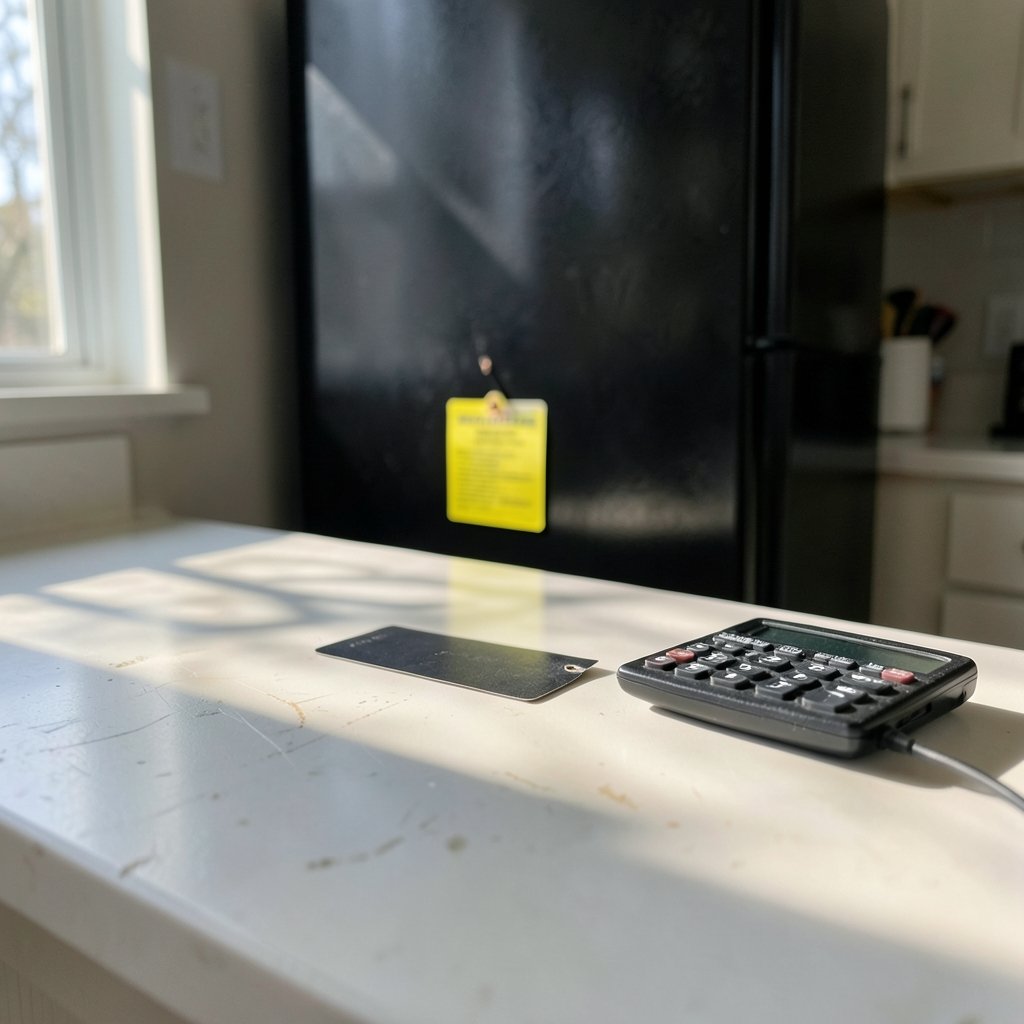
Every major appliance purchase is really two purchases: the machine and the energy it will consume. In the U.S., the familiar yellow EnergyGuide label exists precisely to make that second cost visible. The Federal Trade Commission has required the label on most new appliances since the late 1970s, with the current format introduced in 2011. It shows estimated annual energy use and estimated annual operating cost, which lets a shopper compare two refrigerators on total cost rather than sticker price alone.
The math is blunt. If one model costs $150 more but saves $40 a year in electricity, it pays for itself in under four years and keeps saving after that. Over a 12-year lifespan, the “cheaper” machine can end up costing hundreds more.
ENERGY STAR certification, a voluntary program run since 1992, flags models that meet efficiency thresholds above the federal minimum. One caution: specifications get revised periodically, so a certification claim should be checked against the current version rather than assumed from an old review or a salesperson’s memory. Federal minimum standards themselves are set by rulemaking and have tightened repeatedly over the decades, which means an older unit is almost always less efficient than a comparable new one.
| What to compare | Where to find it | Why it matters |
|---|---|---|
| Estimated annual energy cost | EnergyGuide label | Converts sticker price into lifetime cost |
| Efficiency certification | Current program listing | Confirms the model meets today’s thresholds |
| Capacity vs. household size | Product specs | Oversized units waste energy on partial loads |
| Repair record and parts availability | Owner reviews, repair forums | Predicts year-8 headaches, not year-1 delight |
A note for shoppers outside the U.S.
In the EU, energy labels were rescaled to a strict A–G format starting in March 2021 for several product groups, including refrigerators and washing machines. The old A+/A++ classes were retired because too many products had clustered at the top. This creates a real trap: older stock may still carry the old scale, and a label reading “A+++” on a clearance unit is not comparable to an “A” on a new one. Shoppers comparing across scales are comparing apples to oranges.
Where sale savings quietly disappear
The sticker price is the most visible number in the transaction and often the least important. Three add-ons routinely eat the discount.
Delivery and installation fees. A $60 delivery charge plus $120 for hooking up a washer and hauling away the old one can consume a third of a modest discount. Ask for the full out-the-door quote in writing before committing.
Extended warranties. Service contracts are frequently pitched at the register with urgency that outstrips their value. Many major appliances already carry a manufacturer’s warranty covering the first year, and credit cards sometimes extend that coverage. The FTC publishes consumer guidance on service contracts worth reading before saying yes.
Accessories and “required” parts. Hoses, cords, vent kits, and water lines are often marked up steeply at the point of sale. Buying them separately usually costs less.
The rebate stack most shoppers forget
In the U.S., the Inflation Reduction Act of 2022 created electrification and appliance rebate programs administered by individual states. Availability and dollar amounts vary widely by state and by program status, so a buyer’s best move is to check their state energy office before shopping. When a rebate stacks on top of a genuine sale, the combined savings can dwarf the advertised discount. The catch is paperwork and timing, so confirm eligibility before the delivery truck arrives, not after.
The efficiency-versus-price trap in every appliance category
Different appliances fail in different ways on sale day. Here is where shoppers most often misjudge value.
Refrigerators
Refrigerators run 24 hours a day, every day, which makes them the poster child for lifetime-cost thinking. A side-by-side with an ice dispenser in the door uses noticeably more energy than a simple top-freezer of similar capacity. Buyers who chase a big discount on a feature-heavy model sometimes pay it back monthly for a decade. Measure the space, confirm the door swing, and check that the model fits before falling for a markdown.
Washers and dryers
Clothes washer standards tightened notably in 2015 and 2018, so efficiency gaps between older and newer units are real. Front-loaders generally use less water and energy than top-loaders, though they cost more up front and need occasional door-gasket care. Pairing a high-efficiency washer with an old dryer is a common mistake: the dryer becomes the bottleneck, and the savings never fully materialize. (Common salesforce alternatives mistakes that sink crm)
Dishwashers
Dishwasher efficiency has improved dramatically, and the difference between a bargain-bin model and a mid-range efficient one is often smaller than the difference in noise level and rack flexibility. For open-plan kitchens, noise ratings deserve as much attention as energy figures.
Ranges and ovens
Induction cooktops are efficient and responsive but require compatible cookware, an upgrade cost that rarely appears in the sale math. Gas and electric ranges vary less on energy than refrigerators do, so fit, ventilation, and burner layout should drive the decision more than the discount.
Practical habits that separate smart buyers
Some of the most useful sale-shopping advice has nothing to do with hunting for coupons.
- Set a total budget, not a sticker budget. Include delivery, installation, haul-away, cords, hoses, and any warranty you genuinely want.
- Write down the model number and check the price at three sellers. Model numbers often differ by a digit between retailers specifically to prevent comparison. Match the specs, not the name.
- Photograph the EnergyGuide label in the store. It is the single most useful piece of paper in the showroom and the easiest to forget.
- Ask when the model year changes. End-of-line markdowns on outgoing models are frequently the best genuine deals in the building.
- Confirm the return window and restocking fee. A great price on a machine that does not fit the alcove is not a great price.
- Check repair history before buying. A discount on a model with a known compressor or control-board failure is a future expense, not a saving.
The same discipline applies to buying decisions well beyond the laundry room. Anyone who has watched shoppers chase a hyped launch and get burned knows the pattern, whether the topic is a console restock or a ticketing scramble. The lesson from how the Coachella 2027 tickets registered sale actually works is that understanding the mechanics of a “deal” beats reacting to the marketing. The same holds for anyone comparing software vendors or browsing commercial real estate listings for sale: the headline number is never the whole story.
When to walk away
Walking away is a skill. If the salesperson cannot produce the full out-the-door price, if the “sale” ends today but the same model is listed elsewhere at the same price, or if the extended warranty pitch arrives before the machine has even been discussed, the environment is optimized for urgency rather than value. Appliance sales recur constantly. There is almost never a genuine reason to decide in ten minutes.
Repairability is the quiet discount nobody advertises
A machine that can be fixed cheaply in year seven is worth more than one that cannot, even at a higher price. Right-to-repair rules have expanded in several U.S. states and in the EU, covering some electronics and appliances, though coverage of large appliances varies by jurisdiction and law. For shoppers, the practical test is simpler than the legal one: can the filter, belt, or heating element be replaced by a homeowner with basic tools, and are parts stocked locally? A few minutes of research on parts availability often reveals more about long-term value than any star rating.
This is the same reasoning that makes seasoned buyers skeptical of flashy discounts in other markets. People who understand the bricks, minifigs and the lego resale chain collector culture know that condition and longevity drive real value, not the sticker. Appliances reward the same mindset.
How to build a buying checklist that fits on one page
Before heading to the store or opening a browser tab, a shopper should be able to answer six questions: What is the total budget including installation? What are the exact dimensions of the space? What is the estimated annual energy cost of the leading candidate? Does the model qualify for any state or utility rebate? What is the return policy? And what do owner reviews say about reliability in year five rather than year one?
If all six answers are in hand, the sale price becomes a tiebreaker rather than the deciding factor. That inversion, putting lifetime cost and fit ahead of the red tag, is the entire game.
Conclusion
The best appliance sale is not the one with the biggest percentage on the sign. It is the one where a well-fitted, efficient, repairable machine lands in the home at a genuinely competitive out-the-door price, with no warranty upsell and no surprise installation fee. Holiday weekends and model-year rollovers create real opportunities, but they reward prepared buyers and punish impulsive ones. Read the yellow label, do the lifetime math, stack the rebates, and be willing to walk away. Do that, and the discount on the tag becomes the least interesting thing about a very good purchase.
Frequently Asked Questions
When is the best time of year to buy appliances on sale?
Major promotions cluster around Presidents’ Day, Memorial Day, Labor Day, and Black Friday, but model-year rollovers often produce deeper, quieter discounts. A shopper who tracks a specific model number for a few weeks will usually spot the genuine low point better than someone who waits for a holiday.
Is a bigger discount worth choosing a less efficient model?
Usually not for appliances that run constantly. Refrigerators and washers operate for years, so a modest efficiency gain compounds. Compare the EnergyGuide estimates for annual operating cost, multiply by the expected lifespan, and add that to the purchase price before deciding.
Do extended warranties ever make sense on appliances?
Sometimes, but rarely at the register under pressure. Manufacturer warranties already cover the first year, and some credit cards extend coverage. A service contract is more defensible on complex, repair-prone machines with long coverage terms, and only after reading the actual terms.
How can I tell if a sale price is genuine?
Check the model’s price at several sellers on a normal day, match specifications rather than names since retailers use slightly different model numbers, and ignore the “was” price entirely. Consumer-protection guidance in multiple countries targets fictitious former-price comparisons for exactly this reason.
Can rebates be combined with a sale price?
Often yes, which is why they matter so much. State-administered electrification and appliance rebate programs vary widely in availability and amount, so check the state energy office before purchase. Confirm eligibility and paperwork requirements early, since rebates are frequently claimed after delivery.
Should I buy the floor model to save money?
It can be a strong deal if the unit is undamaged, comes with the full manufacturer warranty, and includes all accessories and manuals. Ask specifically about warranty status and return rights, inspect for scratches and missing parts, and get the discount in writing. Floor models are often the best value in the building for buyers who ask the right questions.



