
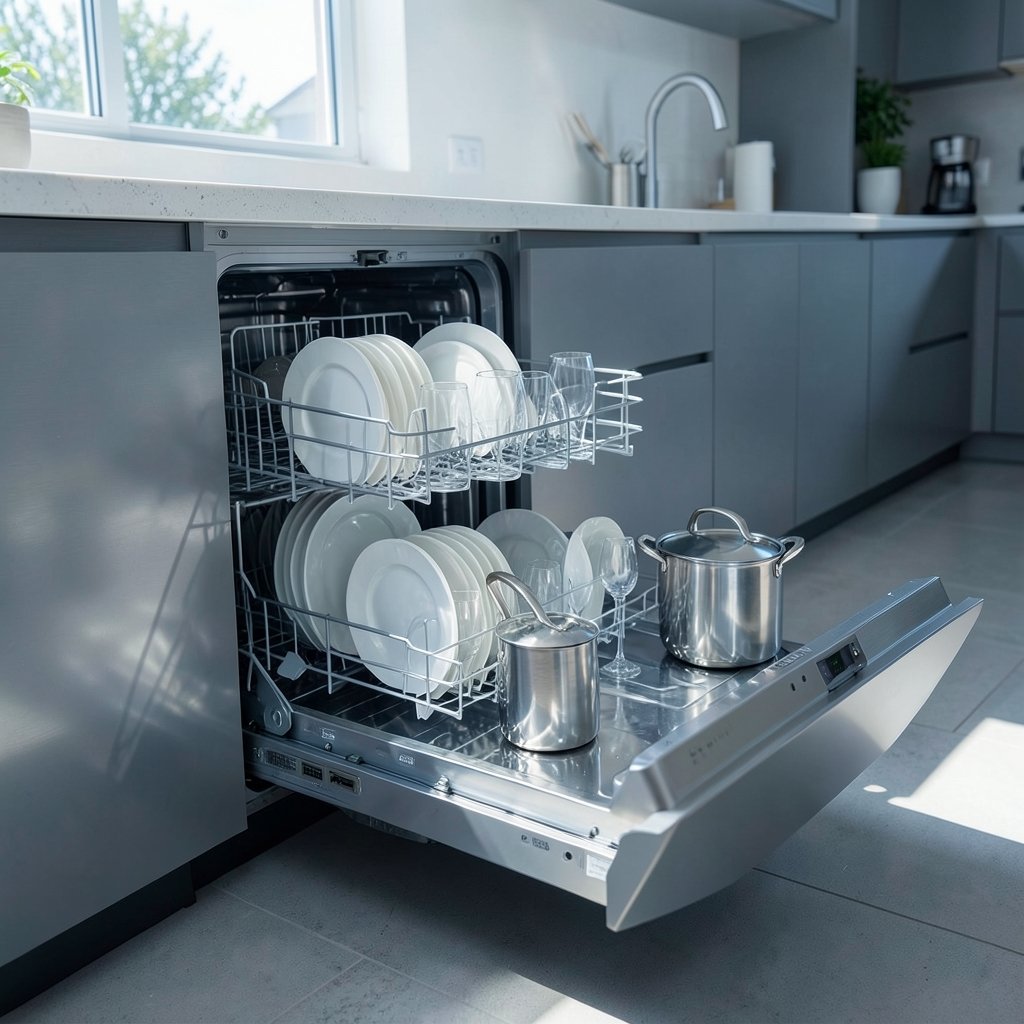
What if the dishwasher everyone calls “the best” would be a poor fit for your kitchen? That question drives the search for the highest-rated dishwasher, because ratings are not one thing. A lab score, a retailer star average and an energy certificate measure completely different qualities. Understanding that gap is the difference between buying a machine you love for a decade and one you regret by month three.
Why “Highest Rated” Means Different Things in Different Places
The single biggest mistake shoppers make is treating all ratings as comparable. They are not.
Lab-tested ratings come from organizations that buy machines anonymously and run standardized cycles. These tests control soil load, water hardness, and cycle selection, so results are repeatable. A lab score tells you how well a machine cleans under fixed conditions.
Retailer star ratings come from people who already bought the product. That introduces selection bias: happy buyers review more often, and a machine that fails in year two may never get an updated review. Star averages also drift with promotions and review campaigns.
Energy and water certifications measure efficiency, not cleaning. A machine can be exceptionally efficient and still leave film on glassware.
Because methods differ, “best” picks from different outlets regularly disagree. One reviewer weights drying performance heavily; another prioritizes cycle time or noise. Neither is wrong. They are answering different questions.
The Practical Takeaway
Before trusting any rating, ask three things: Who tested it? How? And does their test match how you actually run a dishwasher? A household that pre-rinses everything needs different performance than one that scrapes and loads.
What Lab Testing Actually Measures

Standardized dishwasher testing typically covers a consistent set of performance dimensions. Knowing them helps you read a scorecard instead of skimming it.
| Test Dimension | What It Reveals | Why It Matters at Home |
|---|---|---|
| Cleaning performance | Soil removal across dish types | Core function; varies by cycle and load placement |
| Drying performance | Residual moisture on plastic and glass | Plastic dries worst; affects unload timing |
| Energy use per cycle | Electricity consumed under test conditions | Drives long-term cost |
| Water use per cycle | Liters or gallons consumed | Matters in drought-prone or metered areas |
| Cycle time | Duration of normal and heavy cycles | Affects daily scheduling |
| Noise level | Sound pressure in decibels | Open-plan kitchens feel this most |
Two of these deserve extra attention because shoppers consistently misread them.
Noise in decibels is logarithmic. A 44 dB machine is not “slightly” quieter than a 50 dB one; the difference is perceptually substantial. In an open-plan home, dropping from the low 50s into the low 40s changes how often you run the machine while people are in the room.
Place settings are a capacity claim, not a loading promise. A stated 15-place-setting capacity assumes a specific mix of items loaded in a specific way. Real loads are messier. Tall wine glasses, stockpots, and odd-shaped serving pieces eat capacity fast.
Efficiency Ratings Are Not Cleaning Ratings
Efficiency programs certify that a dishwasher meets limits on energy and water use. That is valuable information, but it is a different axis from cleaning.
In the United States, the Energy Star program sets voluntary efficiency criteria above the federal minimum. In the European Union, the energy label was rescaled to a stricter A–G scale under Regulation 2019/2017, which applied from March 2021. Both systems give you a comparable efficiency signal across brands.
Here is the trap. A highly efficient machine may use longer cycles at lower temperatures, and some eco modes trade cleaning power for savings. That is a reasonable trade, but you should know you are making it. Check whether the efficiency figure comes from the eco program or the normal program, because the two can differ dramatically. (Trade makes most money highest paying skilled trades ranked)
The same principle applies whenever headline numbers stand in for real-world outcomes: read the methodology before trusting the figure.
Reliability Is the Weakest Link in the Rating Chain
Cleaning performance is well tested. Long-term reliability is not.
Most reliability data comes from subscriber surveys and member questionnaires rather than controlled durability testing. That makes it indicative rather than definitive. Survey data can tell you a brand has a pattern of complaints about pumps or control boards, but it cannot tell you your specific unit will fail.
Practical signals that correlate with fewer headaches:
- Simple control boards. Touch panels with many features have more failure points than dial-and-button interfaces.
- Stainless steel tubs. They resist staining and hold heat better than plastic tubs.
- Accessible filters. A filter you can remove and rinse in under a minute gets cleaned. One that requires disassembly does not.
- Available parts. A brand with a strong service network and stocked parts is easier to repair in year eight.
- Warranty terms on the tub and motor. These often outlast the general warranty and signal where the manufacturer expects durability.
A machine with a slightly lower cleaning score and a repairable design often beats a top-scoring model that becomes landfill fodder when a control board dies.
How to Read Retailer Star Ratings Without Getting Fooled
Star averages compress a lot of noise into one number. A few habits cut through it.
First, sort reviews by lowest rating and read those. Patterns matter more than individual complaints. Five reviews mentioning the same drainage error is a signal; one review complaining about delivery is not.
Second, check the distribution rather than only the average. A product with 80 percent five-star reviews and 12 percent one-star reviews tells a more honest story than a flat 4.2 across the board.
Third, look for reviews that mention household size and water hardness. Performance varies enormously with water chemistry. A machine that sparkles in soft water may etch glass in hard water without rinse aid.
Fourth, discount reviews written within 48 hours of delivery. Those capture excitement, not experience.
Matching the Rating to Your Actual Kitchen
The highest-rated dishwasher in a lab may be the wrong machine for your home. Match on constraints first, scores second.
Open-plan kitchen or living area adjacent? Noise becomes a top-three criterion. Prioritize low decibel ratings and check whether the quiet rating applies to the normal cycle or only a special silent mode.
Plastic-heavy household with kids? Drying performance on plastic matters more than glass shine. Look for machines with heated drying or door-opening drying features.
Hard water? Built-in water softeners exist on some models and change the maintenance picture entirely.
Small household running half loads? Half-load or zone-wash options save real money over a decade.
Aging plumbing or a rental? Installation constraints, height clearance, and electrical requirements may eliminate your top pick before performance enters the conversation.
Measure your cabinet opening and check the water supply and drain access before you fall in love with a spec sheet. This is the most common practical mistake: buyers optimize for ratings and discover at delivery that the machine does not fit.
Features That Earn Their Keep and Features That Don’t
Not every feature improves the experience. Here is an honest split.
| Worth Paying For | Usually Not Worth It |
|---|---|
| Adjustable upper rack | App-controlled cycles |
| Third rack for utensils | Dozens of specialty modes |
| Stainless steel tub | Interior lighting |
| Quality filtration with easy access | Decorative front panels at a premium |
| Soil sensor that adjusts the cycle | Auto-dose detergent systems with proprietary pods |
| Door-open or heated drying | Wi-Fi notifications you will mute |
The pattern is simple: mechanical and structural features pay off over years. Digital features tend to age badly and add failure points. A dishwasher is a ten-year appliance; software support rarely lasts that long.
A Realistic Buying Sequence
Following a fixed order prevents the most common regret.
- Measure the opening, depth, and door swing clearance.
- Confirm electrical, water, and drain access.
- Set a hard budget including installation and haul-away.
- Shortlist three to five models that fit the space.
- Compare lab-tested cleaning and drying scores within that shortlist.
- Check noise ratings if the kitchen is open to living space.
- Review efficiency figures and estimate annual running cost.
- Read the lowest reviews for failure patterns.
- Verify parts availability and warranty terms on tub and motor.
- Buy from a seller with a clear return window.
Steps one through four eliminate most bad choices before ratings even matter. Skipping them is how people end up with a highly rated machine wedged into a cabinet with the door hitting a drawer pull.
Where Ratings Research Fits a Bigger Picture
Buying decisions rarely stand alone. The same discipline that makes dishwasher ratings useful applies to comparing financial products, evaluating tools, or judging technical specifications. Understanding why headline numbers mislead is central to evaluating any advertised rate, where the advertised figure and the effective figure often diverge. The skill is transferable: find the methodology, then decide if it matches your situation. (Best ai high yield savings accounts 2027 daily rate)
That habit also explains why some shoppers research performance specs the way others research peripherals. Someone comparing cycle noise to fan noise is doing the same work as a buyer checking a mouse’s polling rate: both are asking whether a specification number translates into a felt difference. Usually it does, but only past a certain threshold. (Startups should choose best conversion rate optimization)
And when a machine starts misbehaving, the diagnostic instinct matters too. A dishwasher that suddenly runs hot or slow is not unlike a computer that spikes for no clear reason, and the fix often starts with the same step: identify the process consuming resources before replacing hardware. Patience and method beat guesswork in both cases.
Conclusion
The highest-rated dishwashers are not a single list. They are the machines that score well on tests that match your household, fit your actual cabinet, and can be repaired when something breaks in year eight. Lab scores tell you about cleaning and drying under controlled conditions. Efficiency labels tell you about running costs. Retailer stars tell you about buyer sentiment, with all its bias. Reliability surveys tell you about patterns, not promises.
Read the methodology before the number. Measure before you shop. Weight mechanical quality over digital novelty. Do those three things, and the rating you end up trusting will be the one that matters most: your own, formed after a few years of quiet, clean dishes.
Frequently Asked Questions
Which source has the most trustworthy dishwasher ratings?
Lab-based testing from independent organizations that buy products anonymously is generally the most trustworthy starting point, because the conditions are controlled and repeatable. Retailer star ratings are useful for spotting failure patterns but reflect buyer sentiment rather than measured performance. Use both, and weight the lab data more heavily on cleaning and drying.
Why do different reviewers pick different “best” dishwashers?
Because they weight different criteria. One outlet may prioritize cleaning and drying performance, another cycle time, another noise, and another value within a price band. Different test loads, water hardness, and detergent also shift results. Disagreement between reviewers is normal and often tells you which trade-offs each one considers acceptable.
Is a quieter dishwasher always better?
Not always, but noise matters more than most shoppers expect because decibels are logarithmic. Dropping from around 50 dB to the low 40s is a clearly audible improvement, which matters in open-plan homes. However, a very quiet machine may trade cleaning power or cycle time to get there, so check which cycle the noise rating refers to.
Do Energy Star or A–G ratings mean better cleaning?
No. Efficiency certifications measure energy and water consumption against defined limits, not soil removal. A machine can be highly efficient and mediocre at cleaning, especially in eco modes that use lower temperatures and longer cycles. Treat efficiency and cleaning as separate scores and evaluate both.
How long should a dishwasher last?
Most dishwashers are expected to serve roughly a decade with normal use, though water hardness, cycle frequency, and maintenance habits shift that considerably. Rinsing the filter regularly and using rinse aid in hard-water areas extend service life. Machines with simple controls and available replacement parts are far more likely to reach that lifespan.
Should I trust a 4.2-star average with only 30 reviews?
Treat it as a weak signal. Small sample sizes swing wildly, and early reviews skew positive because they are written soon after delivery. Look for a few hundred reviews, check the distribution of one-star versus five-star ratings, and read the negative ones for repeated complaints about the same component.



