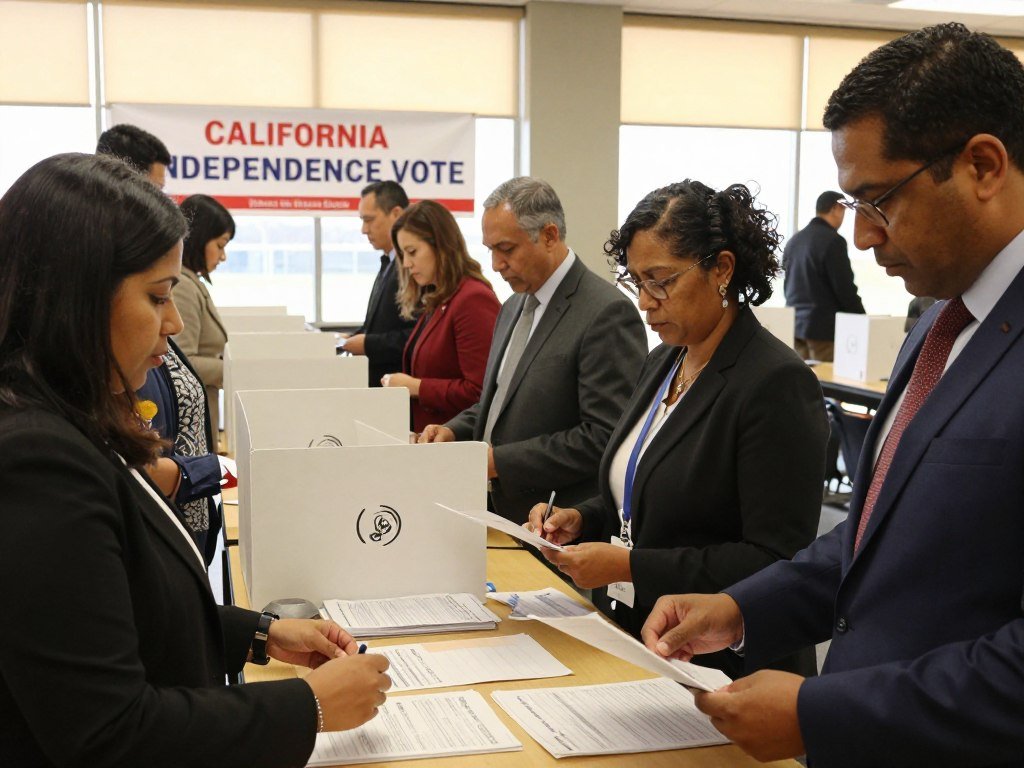
California’s listed 2026 ballot measures include no question about leaving the United States, but they do include a high-profile billionaire-tax proposal. The California independence vote 2026 prediction market search points to that tax measure, Proposition 40, or Prop 40. A vote on independence would ask California voters whether the state should leave the country. Prop 40 instead asks voters to decide a tax proposal. Those are different questions, and the forecast concerns the proposition, not independence. The market offers a signal about traders’ expectations, not a count of ballots cast or votes tallied. An implied chance is the probability suggested by a yes share’s price, not a guarantee of the outcome. The 2026 forecast may shift as traders react to new information. California voters will make the decision at the ballot box, not on a trading platform. Treat any market percentage as a snapshot of traders’ expectations, not a prediction of what California voters have decided.
Key Takeaways
- The listed November ballot has no California independence measure.
- Prop 40 is a proposed billionaire tax, not an independence vote.
- Market prices show trader expectations, not certified election results.
- Ballot language and market contract wording may differ.
- Market odds can change as trading continues.
What Is Actually on California’s 2026 Ballot?
California’s statewide ballot-measure status included 16 qualified measures as of October 20, but the listed November ballot contains no California-independence question. The November 3 list includes Prop 40, but no measure asks voters to leave the United States.
“Qualified statewide ballot measures” describes measures that met the state’s requirements to appear on a statewide ballot. It is a status count, not a final count of every item on the November ballot. The official list names propositions and their subjects, so voters can check the actual measure behind a news headline.
A headline or market label does not replace the official wording printed for a proposition.
The California Secretary of State list shows the November 3, 2026 ballot items. Its current list includes Prop 40, while no independence proposition appears. Examples of topics among California’s qualified ballot measures include housing bonds, taxes, voter rules, and environmental policy.
These five subjects help show the range of issues voters may see on a California ballot:
- Housing bonds for housing programs
- Taxes on high earners
- Voter identification rules
- A proposed billionaire tax
- Changes to environmental review
Each proposition has its own legal text and effect. A ballot title may shorten the issue, while a trading market may use a different label. California voters should read the full proposition before deciding what a yes or no vote would do. Check the official ballot wording for the exact question attached to any proposition before treating a headline or market label as its name.

What Does the California Independence Vote 2026 Prediction Market Show?
In the October 27 snapshot, Kalshi and Polymarket International put Prop 40’s pass chance at 25% and 22%, respectively, for a 23% average. No listed contract forecasts a California independence vote. The market snapshot reflects prices observed between 3:43 PM and 8:29 PM ET that day.
Those numbers refer to the basic question of whether each ballot measure passes. Kalshi and Polymarket International are separate prediction markets, so their prices can differ. The average combines the two figures for a quick comparison, not a new contract or official forecast.

The November 3 Snapshot
The table compares five propositions and their October 27 pass forecasts. Prop 1 concerns a housing bond, Prop 3 extends a high-earner tax, and Prop 39 concerns voter ID.
| Proposition | Topic | Kalshi chance | Polymarket International chance | Average chance |
|---|---|---|---|---|
| Prop 1 | Housing bond | 75% | 89% | 82% |
| Prop 3 | High-earner tax extension | 95% | 94% | 94% |
| Prop 39 | Voter ID | 19% | 15% | 17% |
| Prop 40 | Billionaire tax | 25% | 22% | 23% |
| Prop 41 | Tax spending limit and audits | 50% | 59% | 54% |
The numbers are odds, not votes cast, and they do not establish which side will win. The Polymarket California measures appeared on its international exchange; no California measure markets appeared on Polymarket US.
Prop 40’s Separate Markets
Other contracts ask narrower questions than whether Prop 40 passes. Kalshi placed the chance that it takes effect before 2027 at 18%. Polymarket International put the chance that it defeats the opposing propositions at 16%.
Those outcomes are not interchangeable: one asks about timing, while the other asks about a contest with competing measures. Keep the date and market question beside every percentage, since a pass forecast is not the same as a forecast that the tax takes effect.
How Would Proposition 40’s One-Time Tax Work?
Proposition 40 proposes a one-time 5% tax on billionaires who lived in California on January 1, 2026. The levy would apply once, rather than functioning as an annual income tax. Its reach depends on a person’s wealth and whether that person met the residency test on that date.
The one-time tax is aimed at billionaires who were California residents on January 1, 2026. The proposal generally excludes real estate, pensions, and retirement accounts from the tax base. Those rules distinguish this wealth tax from a yearly tax on wages or other income.

Who and what the tax would cover
The state’s official Prop 40 analysis describes the tax and its exclusions. A person’s connection to California on the named date matters, even if that person later moves. The proposal is about wealth held by qualifying billionaires, not every taxpayer in the state.
Supporters describe the tax as a way to raise money from a small group of very wealthy residents. Critics question the likely revenue and warn that the policy could affect state finances beyond the tax itself. These are competing estimates, not money already collected.
Where the revenue is meant to go
If approved, 90% of the revenue would go to healthcare. The rest would support education, food assistance, and tax administration. That split sets the intended use of proceeds, but the amount raised remains uncertain.
Supporters estimate the tax could raise $100 billion. Critics estimate $40 billion upfront and at least $25 billion in eventual state costs. Those projections differ because the tax base, taxpayer response, and related state revenue effects are uncertain. The projected revenue is not guaranteed, and the opposing estimates make the measure’s fiscal effect a key point for voters to examine.
Could Propositions 41 and 42 Block Proposition 40?
A yes majority for Prop 40 would not by itself guarantee that the tax takes effect if a competing measure also passes. When measures conflict, the proposition with more yes votes may prevail. That means Prop 40 could win more yes than no votes and still be voided.
Propositions 41 and 42 address tax rules that may conflict with Prop 40. The ballot measures do not act as three unrelated choices if their provisions clash. The total yes votes across a conflicting pair can matter more than Prop 40’s standalone majority.

| Measure | What it would do | How it relates to Prop 40 |
|---|---|---|
| Prop 40 | Set a one-time tax on billionaires | Its tax could conflict with Props 41 or 42 |
| Prop 41 | Restrict certain new state taxes and address spending-limit rules | Could challenge Prop 40’s tax and treatment under spending limits |
| Prop 42 | Restrict certain new state personal-property taxes and some retroactive state taxes | Could conflict with Prop 40’s tax rules |
Prop 41 addresses new state taxes and spending-limit rules. Prop 42 concerns new state personal-property taxes and certain retroactive state taxes. Their exact effects depend on how the measures’ rules apply together if voters approve more than one.
A voter weighing this cluster has two jobs: judge each proposition on its own terms and consider whether another measure could take priority. A favorable result for one side does not settle the legal outcome alone. Voters assessing this cluster need to consider both each measure’s own terms and the possibility that the measures conflict.
How Should Readers Interpret Kalshi and Polymarket Odds?
A 70-cent yes share suggests traders assign about a 70% chance to that outcome, and pays $1 only if the contract resolves yes. An implied chance is the probability suggested by a yes share’s price, not a guarantee of the outcome. A yes share pays if the contract’s stated event happens.
A no share pays if the event does not happen. A correct yes or no share can be redeemed for $1 when the market resolves. The price offers a crowd-sourced estimate, shaped by traders who buy and sell positions.
How a yes share is priced
A yes share priced at 70 cents points to an implied chance near 70%, since a winning share pays $1. This is a useful shorthand, not a promise that the outcome will occur. The final result depends on the contract’s rules and the event itself.
The Federal Reserve Bank of Cleveland explanation describes how an event contract’s price can reflect traders’ probability estimates. That background explains the basic link between a contract price and a possible payout, not the details of current California markets.
Why a displayed price can mislead
A screen price may not be the price a buyer can get. On Polymarket, a displayed figure can be a bid-ask midpoint when the spread is within 10 cents. With a wider spread, the figure can show the last trade instead.
Polymarket’s California page listed 500 active California markets and more than $47.2 million in trading volume. That total covers activity across the page, not volume on one proposition. A thin market can make buying cost more than its displayed price.
Before relying on a number, check these details:
- Read the exact contract question.
- See whether the price is a midpoint or last trade.
- Compare the display with the actual cost to buy.
Kalshi and Polymarket can show different odds because they are separate markets, with their own traders and trades. A broad California volume total also cannot show how active one contract is. A reader tracking odds without trading should still note the contract wording and the time of each price snapshot.
What Could Still Change the Picture Before Election Day?
The key qualification deadlines are concrete: initiatives need verified signatures and generally qualify 131 days before a statewide general election, while referendums can qualify as late as 31 days before an election. Those deadlines shape when a new measure can join the ballot.
California’s rules set a signature and review process for an initiative. County elections officials verify submitted signatures. The timing gives proponents and voters a defined schedule, though proponents may withdraw an initiative before qualification.
Proponents can withdraw an initiative before it qualifies for the ballot.
The main procedural steps are:
- Proponents submit signatures, which county elections officials verify.
- An initiative generally qualifies 131 days before the statewide general election.
- A referendum can qualify up to 31 days before an election.
Prop 40 has also drawn a sharp political split. Gavin Newsom opposed it, while California Democrats endorsed it. Bernie Sanders supported the measure, and Sergey Brin spent more than $100 million opposing it.
These positions show the campaign’s divisions, not the likely result. Endorsements and campaign spending can shape attention, but neither substitutes for the certified result.
Conclusion
The 2026 California forecast in these markets concerns ballot propositions, not a vote on independence. No independence question appears on the listed measures. Market prices are time-stamped signals, and a later price may reflect a different moment or contract wording.
That distinction matters when headlines use a label that sounds broader than the ballot question. California voters can compare the official proposition text with the exact contract wording before relying on a forecast. The ballot tells voters what they are deciding; the market reflects traders’ views about an outcome.
Before acting on any headline, compare its exact ballot measure and contract wording with the official text.
FAQ
Is there a California independence proposition on the 2026 ballot?
No, the listed November measures contain no question about California leaving the United States. The state’s ballot list names propositions on subjects such as housing, taxes, voter rules, and environmental review. A prediction market label or campaign headline cannot add an item to the official ballot. The proposition text states what voters are being asked to approve or reject.
What is Proposition 40 in California?
Proposition 40 proposes a one-time 5% tax on billionaires who lived in California on January 1, 2026. It is a wealth-tax proposal, not an annual income tax or a vote on statehood. The proposal directs most revenue to healthcare, with the rest set aside for education, food assistance, and tax administration. The estimated revenue remains disputed.
What does a 70-cent yes share mean on a prediction market?
A 70-cent yes share implies about a 70% crowd-sourced chance that its stated outcome will happen. If the contract resolves yes, the share can be redeemed for $1. If it resolves no, the yes share does not pay out. The price reflects trading at a particular moment and does not guarantee the event’s result.
Can Proposition 40 pass and still fail to take effect?
Yes, a conflicting Proposition 41 or 42 could prevail if it receives more yes votes. California’s rule can make the yes-vote total across competing measures decisive, rather than Prop 40’s standalone majority alone. A yes vote for Prop 40 therefore does not by itself settle whether its provisions take effect. The measures’ legal terms matter together.
Why can Kalshi and Polymarket show different California odds?
Kalshi and Polymarket are separate markets, so their prices can differ as traders place different orders. Thin trading can leave prices apart, and a displayed figure may show a midpoint or a last trade. The actual cost to buy can also exceed the screen price. The contract wording and the time of each price help explain comparisons.
Does Polymarket’s California trading volume refer only to Proposition 40?
No, the listed total covers 500 active California markets and more than $47.2 million in aggregate trading volume. It includes activity across the California page, not just trades on Prop 40. A broad total cannot show how much money moved through one proposition’s contract. A single market’s activity is a separate measure from the page-wide figure.