What if the air inside your home is worse than the air outside, and the gadget on your shelf is quietly lying about it? That uncomfortable possibility shapes every buying decision in the air quality market. Monitors promise insight. Purifiers promise relief. Yet the two devices do completely different jobs, and confusing them is the most expensive mistake buyers make.
The global indoor air quality monitoring market was valued at just over £4 billion in 2023 and is projected to pass £7 billion by 2030, growing at a compound annual rate of 8.6%, according to industry analysis. That growth has flooded shelves with sensors and filters at every price point. Some are genuinely trustworthy instruments. Others are decorative plastic with a glowing light. Sorting one from the other takes about ten minutes of understanding, and this guide covers exactly that.
Monitors Measure, Purifiers Change: The Distinction That Saves Money
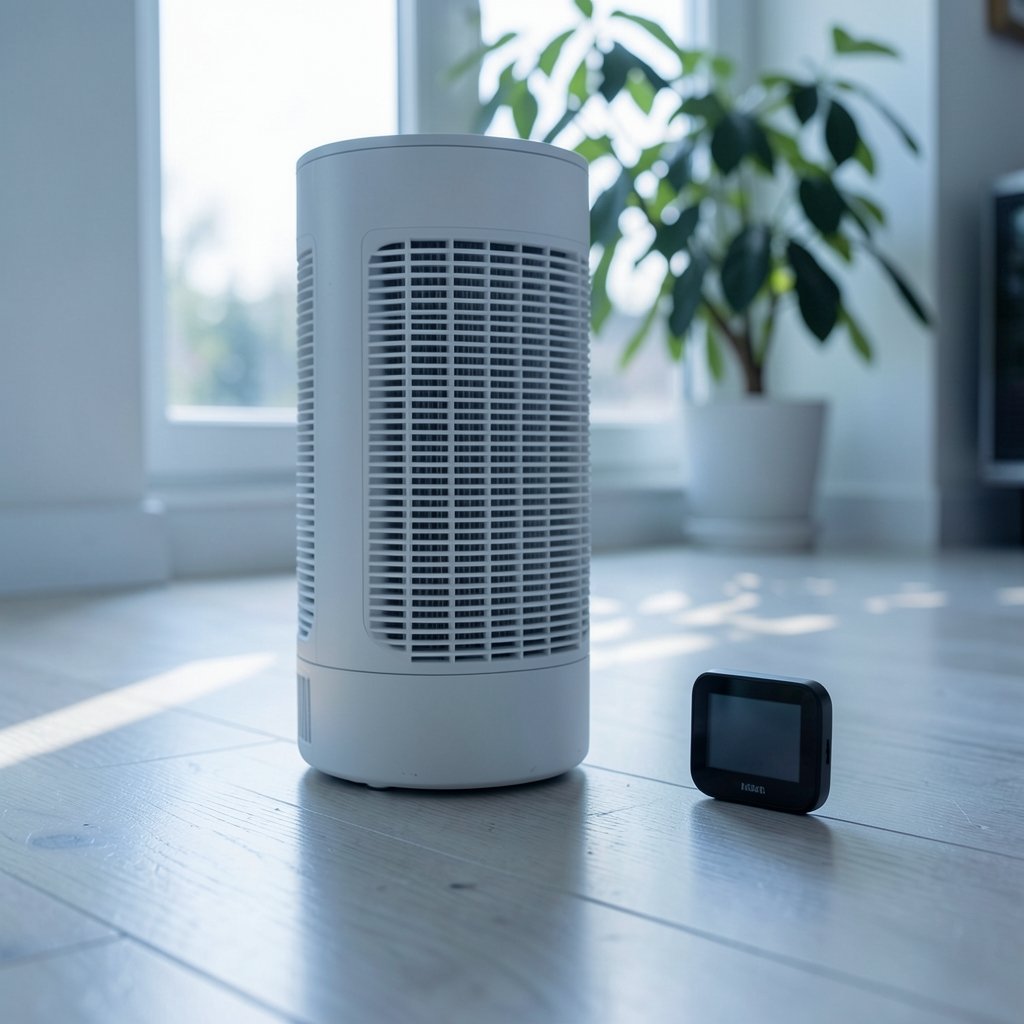
A monitor is a diagnostic instrument. It samples the air and reports numbers: carbon dioxide in parts per million, fine particles in micrograms per cubic metre, temperature, humidity, and often volatile organic compounds. It has no fan capable of cleaning a room and removes nothing. Its entire value is information.
A purifier is a treatment device. It pulls room air through filters and pushes cleaner air back out. It changes the air but tells you nothing about whether the change mattered.
That one-sentence split has consequences that surprise most buyers. A purifier running at full blast can leave a room feeling just as stuffy as before, because filtration does nothing about the gas most likely to be causing headaches: carbon dioxide. CO2 builds up from exhaled breath in closed rooms, and only ventilation moves it out. Meanwhile, a monitor can flag a problem all day long without fixing a single particle.
The practical order of operations is monitor first, purifier second. Without a baseline reading, there is no way to know whether a purifier is working, oversized, undersized, or solving a problem the room never had.
What a Monitor Can and Cannot Tell You
Sensors vary enormously in what they actually measure versus what their marketing claims to protect. That gap is the central theme of independent testing work in this space. One respected voice in sensor and purifier evaluation, writing for a community air quality project, frames the whole field around a single question: what can you trust, and why does it matter? The answer starts with knowing which sensor technology sits inside the box.
The sensor types that matter
Low-cost particulate sensors estimate PM2.5 using light scattering. They are useful for spotting trends, like a spike when someone fries food or a wildfire smoke plume drifts into the neighbourhood. They are not lab instruments, and readings can drift over months without calibration.
CO2 sensors are the most actionable cheap sensor you can buy. A bedroom above roughly 1,400 ppm during sleep is a ventilation problem, and research on cognitive performance at elevated CO2 concentrations suggests the effects are real rather than imagined. One tester who placed a monitor on a desk found levels above that threshold within an hour and realised the fatigue they had blamed on a long day was partly a stuffy room.
VOC sensors are the least reliable of the common set. They respond to many gases with different sensitivities, so a single index number is a rough signal at best.
What monitors cannot do
A monitor cannot confirm mould. Spores and microbial gases may nudge a sensor, but that is an early warning sign, not a diagnosis. Confirming mould requires a visual and moisture inspection plus air or surface sampling analysed by an accredited lab. The source, meaning the wet material feeding the colony, is what actually needs finding and fixing. Devices only interact with the airborne effects.
Choosing a Purifier That Matches the Room
Purifier marketing leans on coverage numbers that are often generous. The honest metric is CADR, the clean air delivery rate, which tells you how much filtered air the unit moves. A large-room unit with a genuine H13 HEPA filter and a CADR high enough to back up its coverage claims is worth the money. One that claims 100 square metres from a small fan is not.
Carbon is the second half of the story, and the half buyers overlook. A thin carbon mat handles light cooking odours. It does nothing meaningful for serious VOC or smoke remediation. Units built for chemical sensitivity or renovation off-gassing use granular activated carbon beds many times thicker than typical consumer designs, and they cost accordingly. That is overkill for a normal home but the correct tool for a home next to a workshop or fresh paint.
| Room problem | What actually helps | What wastes money |
|---|---|---|
| Dust, pollen, pet dander | HEPA purifier sized to the room | Carbon-heavy units |
| Cooking smells, light odours | HEPA plus modest carbon layer | Fragrance-emitting devices |
| Wildfire smoke | HEPA plus substantial carbon, windows shut | Small single-room units |
| Renovation off-gassing | Thick activated carbon bed | Any HEPA-only unit |
| Stuffy, headache-inducing air | Ventilation, CO2 monitoring | Running a purifier harder |
| Musty smell | Finding and fixing the moisture source | Any device alone |
The cheapest fixes rarely start with a purifier at all. Closing windows during a smoke event costs nothing. Swapping a car cabin filter is a small expense that smoke events chew through quickly. A DIY box fan filter build delivers real filtration for around the price of a mid-range console unit, though it cannot be ducted into an HVAC system. For anyone weighing subscription-style service plans alongside hardware, the logic mirrors other tech categories, and the same reasoning that applies to free vs paid antivirus in 2027 applies here: pay for the capability you will actually use, not the badge.
The HVAC Blind Spot Nobody Mentions
Homes are not airtight. Air leaks in around windows, under doors, through gaps at baseboards, and even around light switches and outlets. A typical HVAC system replaces the air inside a home with outdoor air two to three times every hour. Its filters capture only the largest particles, letting fine particulates and gaseous pollutants pass straight into living spaces.
That means the purifier in the corner is fighting a constant inflow. Two upgrades change the maths far more than buying a bigger purifier: sealing the obvious leaks, and upgrading the HVAC filter to the highest MERV rating the system can handle without restricting airflow. Both are unglamorous. Both work.
Smart integration is the other shift worth watching. Purifiers, monitors and ventilation systems are increasingly connected, sharing real-time pollutant data and allowing remote control and customised settings. Multi-pollutant devices are replacing single-function units, handling VOCs, particulate matter and airborne pathogens together. The indoor air quality solutions market is forecast to grow by around $13.9 billion between 2025 and 2029, and AI-driven monitoring is a big part of that story. Treat the AI label as a feature, though, not a guarantee. It is only as good as the sensors feeding it.
Common Mistakes Buyers Keep Making
Buying the purifier first. Without a monitor, there is no baseline. People spend hundreds on filtration for a room whose real problem is closed windows and stale CO2.
Trusting the coverage claim. Check CADR against room volume, not the box.
Ignoring filter replacement costs. A cheap unit with expensive annual filters can cost more over three years than a better unit with cheaper ones.
Expecting a device to fix mould. It will not. Find the moisture.
Placing the monitor next to the purifier’s exhaust. The reading will look wonderful and mean nothing. Monitors belong in the breathing zone, away from doors, windows and direct airflow.
Chasing a single index number. A monitor that reports one combined score hides which pollutant is actually elevated. Separate PM2.5, CO2 and VOC readings are far more useful.
What Trustworthy Looks Like in Practice
A device earns trust through transparency. Does the manufacturer publish sensor models, calibration guidance and filter specifications? Does the app show raw numbers or only a coloured ring? Independent testing communities have pushed hard on exactly these questions, and the devices that survive scrutiny tend to be the boring ones with published specs.
For anyone building out a broader smart-home toolkit, the evaluation mindset is the same one that helps when judging AI tools on output rather than marketing, as in this comparison of Claude Opus vs Sonnet vs Haiku output quality. Specs first, vibes second.
A sensible budget ladder looks like this: start with a CO2 monitor for the bedroom, the single highest-value purchase in most homes. Add a HEPA purifier sized correctly for the main living space if particulates are the issue. Upgrade carbon only if smoke, traffic fumes or renovation gases are genuinely present. Consider a professional-grade unit only for chemical sensitivity or industrial-adjacent settings.
And if the goal is a healthier home overall, air is one input among several. The same practical, evidence-first thinking applies to whether an air purifier for poor air quality actually cleans your home and to filtration choices elsewhere in the house. It also helps to plan purchases around seasonal sales windows, which is why a list of holidays in 2027 worth circling can save real money on big-ticket appliances.
Conclusion
The air quality tech worth trusting in 2027 is not the flashiest device on the shelf. It is the monitor that reports honest numbers in the room where you sleep, paired with a purifier whose CADR matches the space it sits in and whose carbon layer matches the pollutants you actually face. Measure first, treat second, ventilate always. Get that order right and most of the expensive mistakes disappear before you reach the checkout.
Frequently Asked Questions
Should I buy an air quality monitor or a purifier first?
Buy the monitor first. It establishes a baseline and tells you which pollutant is elevated, so the purifier you eventually buy targets a real problem rather than a guessed one. Many homes discover their main issue is CO2 from poor ventilation, which no purifier can fix.
Can an air purifier detect or remove mould?
No. A purifier can capture airborne spores, and a monitor may register an early warning signal, but neither can confirm or fix mould. Confirmation requires a moisture inspection plus air or surface sampling analysed by an accredited lab. The underlying damp source must be found and repaired.
Why does my room still feel stuffy with the purifier running?
Because filtration does not remove carbon dioxide. CO2 accumulates from exhaled breath in closed rooms and only drops when fresh air comes in. Crack a window, use mechanical ventilation, or run a heat recovery system, and the stuffiness usually clears within minutes.
What CADR do I need for my room size?
As a rough rule, aim for a CADR in cubic feet per minute equal to roughly two-thirds of the room’s floor area in square feet for a single air change per hour, and double it for a more thorough cleaning rate. Always check that the published CADR is independently verified rather than calculated by the seller.
Are cheap particulate sensors accurate enough to rely on?
They are good at spotting trends and spikes, which is most of what a household needs. They drift over time and are not lab-grade instruments. Look for devices that publish their sensor models and offer calibration guidance, and treat absolute numbers as estimates rather than measurements.
How often should filters be replaced?
Follow the manufacturer’s schedule, but check monthly during smoke season or heavy pollen periods. A clogged HEPA filter reduces airflow, which lowers real-world CADR even though the unit still runs. Carbon saturates faster than HEPA in homes with cooking fumes or traffic exposure, and a spent carbon layer passes odours straight through.