

Can a company really cut its cloud bill in half without breaking its products? In 2027, the answer is yes more often than most finance teams expect, but only if they stop treating the bill as one big number and start pulling it apart line by line. (Manychat pricing 2027 instagram automation really costs you)
The pressure is real. Cloud and AI spending has grown into one of the largest and most complex items on many profit and loss statements, sometimes climbing above 30% of revenue, according to a CFO-focused podcast discussion published in October 2026. That is why a 50% target has moved from wishful thinking to a planning assumption. This guide walks through the actual figures, the levers that move them, and the mistakes that quietly eat the savings.
The Numbers You Can Actually Plan Around
Vague promises do not survive a budget review. Here are concrete figures from recent industry analysis, each tied to the date it applies to.
| Item | Figure | Date it applies to |
|---|---|---|
| Typical cloud waste across organizations | About 32% | 2025 benchmark data cited in 2026 analysis |
| Waste range for AI and machine learning workloads | 20% to 50% | 2025-2026 analysis |
| Average Kubernetes CPU actually used | 10% of allocated | 2025 benchmark report covering 2,100+ organizations |
| Average Kubernetes memory actually used | 23% of allocated | 2025 benchmark report |
| Organizations naming cloud spend as top challenge | 84% | 2025 survey data |
| Average budget overrun | 17% | 2025 survey data |
| AWS p5.48xlarge GPU instance list price | $55.04 per hour | 2026 published rates |
| Google Cloud a3-highgpu-8g list price | $88.49 per hour | 2026 published rates |
| Azure ND96isr_H100_v5 list price | $98.32 per hour | 2026 published rates |
| Memory reduction from FP16 to INT8 or INT4 quantization | Up to 4x | 2026 analysis |
| Serving cost reduction from quantization | 50% to 75% | 2026 analysis |
| Throughput gain from modern inference engines | 2x to 4x | 2026 analysis |
| Token reduction from context compression tools | 20% to 95% | 2026 analysis |
| Batch API discount on input and output tokens | 50% | Anthropic pricing, November 2026 |
| EU Data Act switching charge ban for in-scope providers | Effective 12 January 2027 | Regulation (EU) 2023/2854, Article 29 |
Read that table twice. The waste percentages alone explain why a 50% cut is achievable: if roughly a third of spend is waste, and AI workloads waste up to half, the money is already sitting there. The job is finding it before the next invoice arrives.
One worked example shows how fast model choice changes the math. Sending a million prompts to a premium model costs $1,000 in input and $5,000 in output, or $6,000 a month. Routing the same volume to a small model priced at $0.10 and $0.50 per million tokens costs $600. If 70% of that volume passes an evaluation set on the small model, the monthly bill falls to $1,852.50, a saving of $4,147.50 a month, or $49,770 a year. That arithmetic comes from an analysis published in November 2026, and it assumes the routing is tested rather than assumed.
Where the Money Actually Leaks
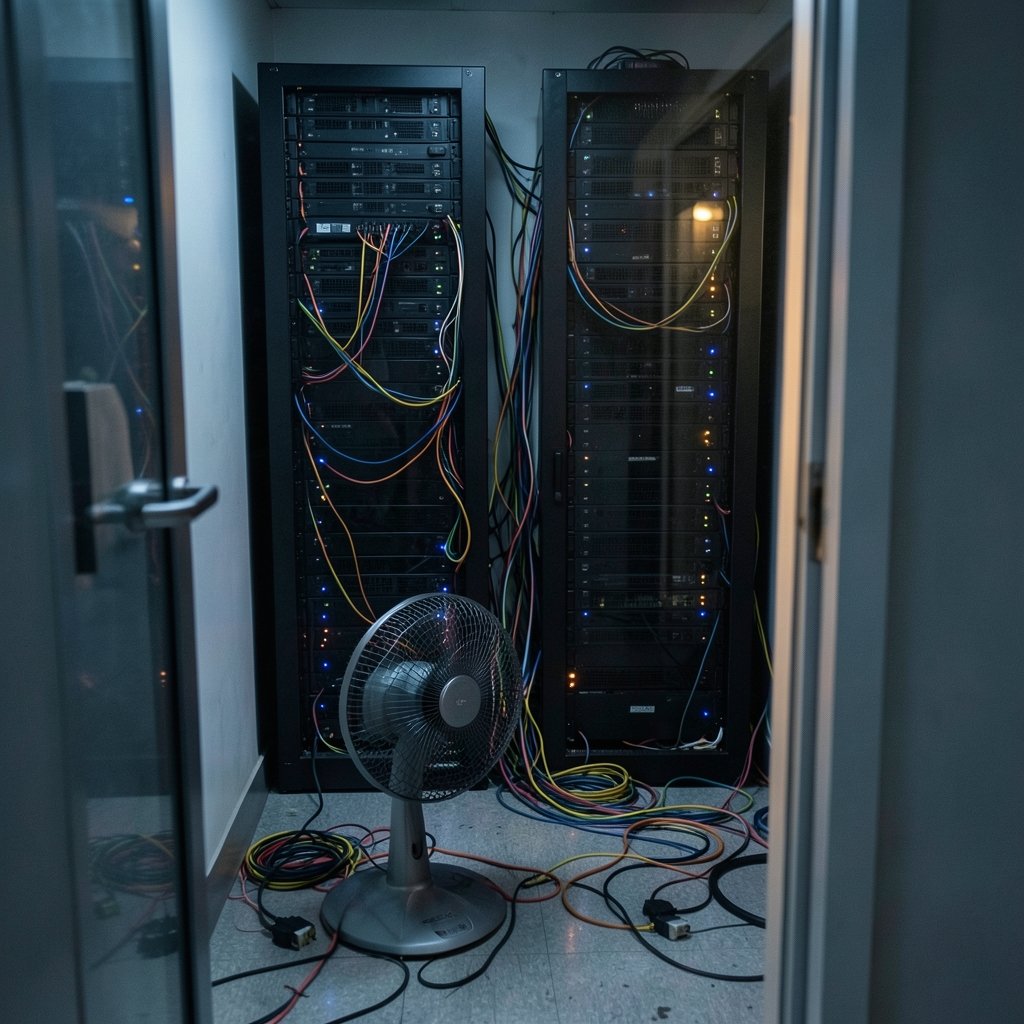
Idle and oversized compute
The single biggest leak is capacity nobody uses. Clusters running at 10% CPU and 23% memory utilization are not edge cases; they are the norm across thousands of organizations. Engineers provision a larger instance “just in case,” and the difference between what is reserved and what is needed runs 24 hours a day.
The practical fix is boring and effective. Pull up the provider’s rightsizing recommendations, filter for instances running below 20% utilization for two straight weeks, and downsize them one tier at a time. A practical cloud cost optimization guide that focuses on cutting waste will tell you the same thing: start with the obvious idle resources before touching architecture.
Unattached storage and forgotten resources
When an instance is terminated, attached block storage often survives and keeps billing. The same happens with old snapshots, idle load balancers, and development environments left running over the weekend. These are small line items individually and a serious number in aggregate. A monthly sweep that filters for unattached volumes and deletes them takes an afternoon and pays for itself immediately.
Token spend that outgrew the cloud bill
Agentic workloads changed the shape of the problem. Analysis published in October 2026 argues that for some companies the token bill will exceed the cloud bill, because agents read entire tool outputs into context windows and pay for every token. A database query returning 10,000 rows where three matter still bills for 10,000 rows. Context compression tools that trim tool outputs before they reach the model have shown reductions of 20% to 95% without hurting accuracy.
Lazy context management
The companion mistake is resending a full document on every turn of a conversation. A user uploads 100 pages, asks about page 3, and the naive implementation passes all 100 pages to the model each time. Aggressive context window management, where only relevant chunks travel with each request, is one of the cheapest wins available.
What Moves the Price Up or Down
Cloud pricing is not a fixed wall. Several forces push it in both directions, and knowing them is what separates a plan from a hope.
Commitment level. On-demand rates are the ceiling. Reserved capacity and savings plans trade flexibility for discounts, and the discount grows with term length. The risk is committing to a shape your workload no longer has in eighteen months.
Architecture. Serverless and auto-scaling designs remove idle consumption almost entirely. For workloads that run intermittently, this can cut compute usage by more than 80%. Refactoring decisions made for cost reasons also tend to reduce operational risk, which is why cloud refactoring best practices that cut costs and reduce risk are worth reading before a migration, not after.
Accelerator choice. GPU pricing varies enormously across providers and instance types, from roughly $55 to $98 per hour for comparable high-end configurations in 2026 published rates. Running the same workload on a different accelerator family, or on spot capacity for fault-tolerant jobs, changes the bill more than most optimization tweaks.
Model routing. Tiering features by cost is the most direct way to cut AI spending. Commodity work like spelling correction and basic summarization goes to quantized local models or the cheapest APIs. Standard chat and data analysis go to mid-tier models. Complex reasoning stays on premium endpoints and is gated behind paid tiers. The same analysis notes that batch processing discounts of 50% apply to work that can wait.
Regulation. From 12 January 2027, providers of data processing services in scope of the EU Data Act may not impose switching charges on customers for the switching process, under Regulation (EU) 2023/2854, Article 29. That lowers the cost of leaving a provider, which strengthens negotiating positions for anyone renewing in 2027.
Measurement discipline. None of the above survives without tagging. If you cannot attribute spend to a team, a product, and an environment, you cannot cut it deliberately. This is where cloud cost management tools that actually cut your bill earn their place, and where cloud waste reduction pays off fastest, because the first month of visibility usually funds the whole program.
A Practical Sequence That Works
Order matters. Teams that start with architecture refactoring before cleaning up waste spend months rebuilding things that were never the problem.
- Get visibility. Turn on cost allocation tags, split the bill by team and environment, and build one dashboard everyone trusts.
- Delete the obvious. Unattached volumes, old snapshots, idle load balancers, and forgotten development environments. This step alone often returns 5% to 15%.
- Rightsize. Downsize instances running below 20% utilization and watch for a week before going further.
- Schedule. Turn off non-production environments outside working hours. Nobody needs a staging cluster at 3 a.m.
- Tier storage. Move cold data to infrequent access tiers with lifecycle rules. Data that has not been read in 90 days should not sit on premium storage.
- Route AI workloads. Build an evaluation set first, then route by feature tier, then add batch processing for anything that can wait.
- Commit carefully. Once usage is stable and measured, buy reserved capacity against the baseline, not the peak.
- Review monthly. Costs drift back. A standing thirty-minute review with finance and engineering keeps them from drifting far.
The common mistake is skipping step one. Teams chase discounts on workloads they have not measured, negotiate commitments against inflated baselines, and then discover the discount locked in the waste. Another frequent error is cutting so aggressively that reliability suffers; an outage costs more than a year of idle instances. Cloud infrastructure best practices that cut costs and outages treat those goals as the same goal, because they usually are.
There is also a governance angle worth naming. The 2027 CFO playbook discussion makes the point that traditional forecasting methods no longer fit, because AI spend behaves differently from infrastructure spend. Finance and engineering need a shared model, not a quarterly argument.
One more lever deserves attention: where the workload runs at all. Local models in the 3B to 14B parameter range now run fast enough on consumer-grade hardware for many routine tasks, and the marginal cost of that inference is close to zero once the hardware exists. For companies paying per-seat subscriptions for tools employees barely use, the best cloud storage photos comparison logic applies to software too: pay for what protects your work, not for shelf space. If a workload can run offline, the best offline local AI tools for running models without cloud are worth evaluating before renewing another annual contract.
What a Realistic 50% Looks Like
Add the levers up honestly. Waste elimination at 32% gets you a third of the way. Rightsizing and scheduling add another 5% to 10%. Storage tiering contributes a few points. AI routing and context management can cut token spend by half or more on their own. The pieces compound, and that is how a 50% target becomes credible rather than aspirational.
What does not work is treating it as a one-time project. Every optimization decays. New services launch with default settings, engineers provision generously under deadline pressure, and agents start reading entire databases into context. The organizations that hold their savings run a monthly loop, not an annual panic.
Conclusion
Cutting cloud costs by 50% in 2027 is less about clever tricks and more about refusing to pay for things nobody uses. The data is unambiguous: roughly a third of cloud spend is waste, AI workloads waste up to half, and clusters sit at 10% CPU utilization while the invoices climb. The tools to fix this are available, the regulatory environment is about to make switching cheaper, and the pricing math on model routing is public. What separates the companies that hit the target from the ones that keep talking about it is a sequence: measure, delete, rightsize, route, commit, and review. Start with the dashboard. The rest follows.
FAQ
How much cloud waste is normal in 2027?
Benchmark data cited in 2026 analysis puts typical waste at about 32% across organizations, with AI and machine learning workloads wasting between 20% and 50%. If your waste is in that range, you are average, not broken. The gap between average and optimized is where the 50% target lives.
Is cutting cloud costs by 50% realistic for a small team?
Yes, often more so than for large enterprises, because small teams have less legacy architecture and fewer approval layers. The fastest wins are unattached storage, idle development environments, and rightsizing, all of which need hours rather than months. Small teams should start with visibility and deletion before touching commitments.
What is the single biggest cost lever for AI workloads?
Model routing. Sending every request to a premium model when a small model handles 70% of the volume can cut a monthly bill by roughly two-thirds, based on published per-token rates from November 2026. The catch is that routing must be validated against an evaluation set, or quality drops silently.
Do reserved instances always save money?
No. Reserved capacity saves money only when it matches a stable baseline. Committing against peak usage, or against a workload you plan to refactor, locks in spend you did not need. Measure first, stabilize second, commit third.
How does the EU Data Act affect cloud costs in 2027?
From 12 January 2027, providers of data processing services in scope of the EU Data Act may not impose switching charges for the switching process, under Regulation (EU) 2023/2854, Article 29. That removes a barrier to changing providers and gives buyers a stronger negotiating position at renewal. Check whether your provider falls in scope before assuming the rule applies to your contract.
How often should cloud costs be reviewed?
Monthly, at minimum, with a short standing meeting between finance and engineering. Costs drift within weeks as new services launch with default settings. An annual review finds the drift too late to prevent it, and the savings from a single cleanup cycle rarely survive twelve months of neglect.



