An anticipated graphics-card refresh has become a moving target, leaving PC gamers weighing an upgrade against an uncertain next step. NVIDIA’s RTX 50 family is its current gaming GPU generation, and the rumored RTX 50 SUPER refresh matters to buyers planning a new build. Memory bandwidth is the rate at which a GPU transfers data between its memory and processor, measured in GB/s. That rate, along with VRAM capacity, can shape how a card handles demanding games.
For U.S. buyers, this is a practical question, not just a technology headline. A new GPU can anchor a PC for years, while shifting supply and prices can change the value of waiting. CES 2026 brought no announced refresh, and reports have since raised doubts about its timing. The news calls for care: rumors can guide planning, but they cannot promise a product or price. This article separates the known facts from estimates and explains what matters for gaming and upgrades. A useful buying decision starts by separating confirmed product announcements from reported plans.
Key Takeaways
- The RTX 50 SUPER refresh has no confirmed release date.
- Reports point to memory supply as the main constraint.
- Rumored RTX 5080 SUPER specifications are not confirmed.
- August 2026 Newegg medians were above launch prices for several cards.
- Buyers can judge current cards by their games, display, and budget.
What the Nvidia RTX 50 Super Delay 2026 Means Now
The latest reported outlook rules out an RTX 50 SUPER launch during 2026, but NVIDIA has not publicly confirmed the reported delay. The reported shortage affects memory used by gaming GPUs and AI products alike. Reports say NVIDIA prioritized limited memory allocation for AI products and reduced production of existing GeForce RTX 50 cards.
NVIDIA said GeForce demand remained strong while memory supply was constrained. The company said it continued shipping GeForce products and working with suppliers, without directly commenting on the reported delay. That statement confirms supply pressure, not a canceled refresh or a set launch date.
Strong gaming demand does not guarantee equal priority when memory is scarce.
GPU memory serves both games and AI workloads, so demand from one market can affect supply for the other. AI demand for memory and silicon also contributed to higher gaming-GPU prices in 2026. That pressure is one part of a changing market, not a price quote for any specific card.
In Q3 2026, data center revenue reached $51.2 billion of NVIDIA’s $57 billion total. Gaming revenue rose 30 percent in that same period, but gaming made up roughly 8 percent of revenue for the nine months ending in October. Gaming had made up 35 percent during the same period in 2022.
The difference helps explain why AI products carry more weight in the company’s business. Operating margins for NVIDIA’s AI compute and networking segment also exceeded gaming margins. Still, a stronger AI focus does not itself confirm that a gaming product has been canceled.
Treat the memory shortage as the clearest reported constraint, not as proof that NVIDIA has permanently canceled the refresh.
When Is the RTX 50 SUPER Release Date?
The RTX 50 series launched in January 2025, while every reported SUPER window remained a rumor rather than a confirmed date. No model has a confirmed RTX 50 series SUPER release date, and the RTX 5080 SUPER release date is also unconfirmed. NVIDIA has not announced a release for any RTX SUPER model.
The RTX 50 SUPER release timeline contains reported estimates, not confirmed launch plans. The early rumor pointed to the first half of 2026, then later reporting moved the expected window to the third quarter. Reports described the refresh as delayed by several quarters.
How the RTX 50 generation began
NVIDIA announced the GeForce RTX 50 series on January 6, 2025. The RTX 5070, RTX 5080, and RTX 5090 debuted that January, starting the current generation’s lineup.
Those launches gave buyers a clear starting point for the RTX series. A SUPER refresh would add models within that generation, rather than mark a new GPU generation.
How the refresh timeline shifted
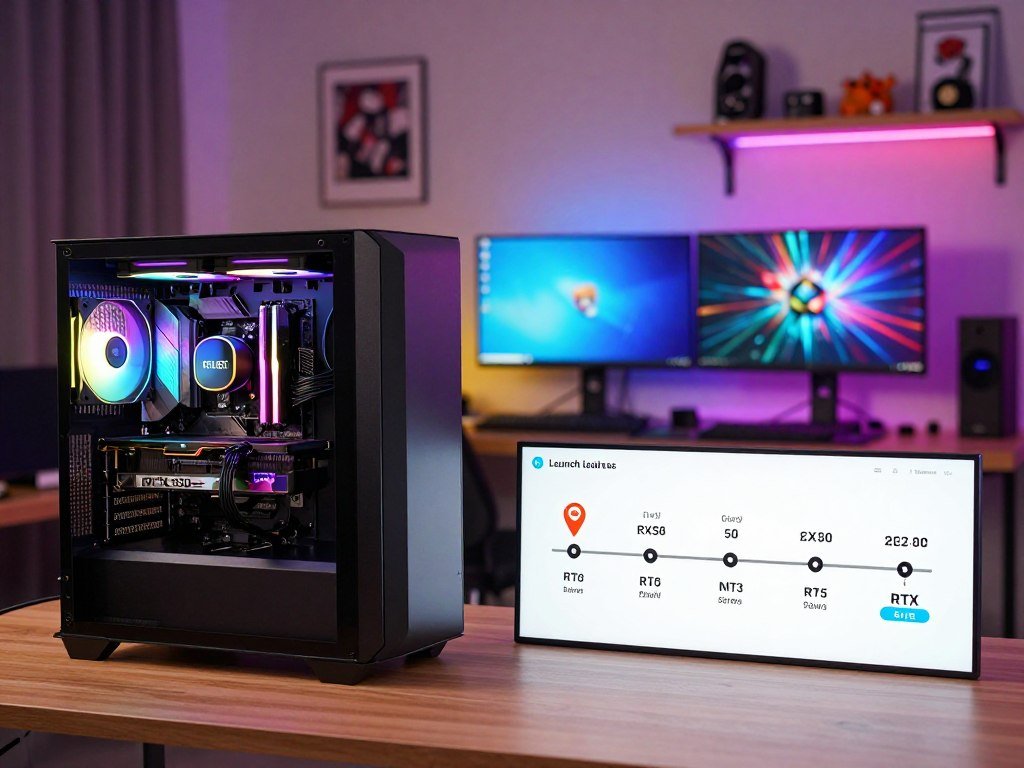
Early reports placed the super refresh in Q1-Q2 2026. Later reports moved it to Q3 2026, before describing a delay of several quarters. A quarter is still a broad window, and it can shift without a confirmed company announcement.
- January 6, 2025: NVIDIA announced the GeForce RTX 50 series.
- January 2025: RTX 5070, RTX 5080, and RTX 5090 debuted.
- Initial rumor: Q1-Q2 2026 refresh window.
- Later rumor: Q3 2026 refresh window.
For buyers comparing each model, the RTX 5080 SUPER release date remains as unconfirmed as the wider RTX 50 series SUPER release date. A rumored quarter is a planning clue, not a date buyers can rely on.
What Was Rumored for the RTX 5080 SUPER?
The rumored RTX 5080 SUPER’s headline change is 24 GB of GDDR7, up from 16 GB on the RTX 5080. If accurate, the larger VRAM capacity would pair with faster GDDR7 data rates and slightly higher memory bandwidth. None of these rumored details is a confirmed product specification.
The rumored configuration would raise both memory capacity and power use. NVIDIA’s RTX 50 series uses Blackwell architecture and GDDR7, the first consumer GPU series to use this memory type.
Rumored specifications and price
The RTX 5080 SUPER is rumored to use the complete GB203 configuration, with 10,752 cores. Its estimated price is $1,100-$1,300, and DRAM supply limits could push it higher.
| Attribute | RTX 5080 | Rumored RTX 5080 SUPER |
|---|---|---|
| VRAM | 16 GB GDDR7 | 24 GB GDDR7 |
| GDDR7 data rate | 30 Gbps | 32 Gbps |
| Memory bandwidth | 960 GB/s | 1024 GB/s |
| Memory bus | 256-bit | 256-bit |
| TDP | 360W | 415W |
Both cards use a 256-bit memory bus, while the rumored SUPER raises its TDP from 360W to 415W. NVIDIA’s VRAM and memory bandwidth explanation describes how memory capacity and transfer rates can affect graphics workloads.
Where extra VRAM could help
More VRAM can help with large textures and demanding 4K or 8K games. NVIDIA’s RTX 5090 has 32 GB of GDDR7, placing the rumored 24 GB configuration below its flagship card.
For esports and many 1080p or 1440p setups, extra capacity is not expected to make a worthwhile difference. The game, texture settings, and screen resolution shape the benefit. Buyers choosing a display can also compare 4K detail with 1440p gaming when weighing sharper images against smoother play.
More VRAM is most relevant to demanding high-resolution games, not a guaranteed frame-rate upgrade for every player.
What Do Current RTX 50 Cards Cost in the US?
Recent U.S. retail medians put the RTX 5080 well above its $999 launch price. Prices differ by card and market conditions, so a launch price does not show what every store charges. In August 2026, Newegg’s median RTX 5080 price was $1,499.99.
August 2026 medians were market snapshots, not guaranteed checkout prices. The RTX 5080 launched at $999, matching the RTX 4080 SUPER’s price a year earlier. By August, its median was $38 above June’s median.
| Card | August 2026 median U.S. Newegg price | June 2026 comparison |
|---|---|---|
| RTX 5080 | $1,499.99 | $1,461.99 |
| RTX 5090 | $4,699.99 | $4,299.99 |
| RTX 5070 | $899.99 | Up 36 percent |
| RTX 5060 Ti 16GB | $804.99 | Up 39 percent |
The RTX 5090 median also rose between June and August, reaching $4,699.99. The RTX 5070 and RTX 5060 Ti 16GB medians were up 36 percent and 39 percent, respectively.
These dated medians do not promise a buyer’s checkout price. A listing can differ by retailer, card design, and stock, so compare the seller and exact product details. That same care helps when checking other scarce devices, such as a PS5 Pro offer against its listed price.
Check the live price and the exact card configuration before comparing any offer with its launch price.
Should You Buy an RTX 50 Card or Wait?
Buy a current card when it solves a real performance problem at a price that fits your budget. For mainstream gaming, the RTX 5070 is the lower-entry RTX 50 choice, while the RTX 5090 is the flagship for buyers seeking maximum performance.
A rumored refresh does not guarantee better value than a card available today. A midrange-to-high-end GPU is a five-to-eight-year buying commitment for the average buyer in 2026, not a promise of how long the hardware will last.
When buying now makes sense
A new card can make sense when the current GPU struggles with the games being played. The RTX 5070 suits mainstream gaming, but it is not the best fit for every resolution or budget. Buyers who prioritize maximum performance can look at the RTX 5090, while weighing its place in the full PC budget.
For a lower-cost build, compare the GPU with the whole system rather than the tower price alone. A gaming PC under $1,000 may involve tradeoffs in resolution, parts, or included accessories.
When waiting may suit your build
Waiting makes sense when the current card still meets a player’s needs or when confirmed specifications matter before spending. A general gaming rule of thumb is 12 GB of VRAM for a new midrange-to-high-end card, with 16 GB offering more headroom for high-resolution textures. Games, resolution, and settings affect those needs.
- Match VRAM to the screen resolution and game settings.
- Compare the live card price with the full build budget.
- Check whether the current GPU still handles the games played.
RTX 50 cards support DLSS Multi Frame Generation, which creates and interpolates multiple frames from a traditionally rendered frame. The feature is exclusive to RTX 50, while RTX 40 cards are limited to one interpolated frame per traditionally rendered frame.
Tom’s Hardware compares gaming GPU performance and street prices in its 2026 graphics-card guide. Recheck the VRAM and power requirements of the specific games and card before placing an order.
Could the RTX 60 Series Be Delayed Too?
The RTX 60 series has no announced consumer launch date, while its reported production schedule remains vulnerable to change. Reported plans expected mass production toward the end of 2027, with a delay potentially pushing it into 2028 or later.
NVIDIA has not announced the RTX 60 series. The name refers to the next consumer gaming GPU generation, not an announced RTX 6000 consumer series. NVIDIA’s next-generation AI accelerators were already in mass production.
AI accelerator production alone does not prove that a future gaming GPU will be delayed.
AI chips and gaming cards can compete for parts and factory resources, but one production update cannot settle the other product’s schedule. The reported 2027 target remains a forecast, not a consumer launch date.
For buyers planning years ahead, the key difference is between an announced product and a reported production window. Treat any 2028 timing as a reported possibility rather than a date to build a purchase plan around.
Conclusion
The safest assumption is that the RTX 50 SUPER refresh is not a dependable near-term upgrade plan. Reported timing can change, and rumored specifications cannot establish the value of a future card.
A current GeForce RTX card should be judged by the games it needs to run, its VRAM, and its live price. Buy for the system you need now, not a release window that remains uncertain.
Before buying, compare the card’s current price and VRAM with the games and resolution you actually use.
FAQ
Which RTX 50 series graphics card is considered the best?
The RTX 5090 is the flagship choice for maximum performance, while the RTX 5070 is a lower-entry option for mainstream gaming. The right pick depends on the games, screen resolution, and budget. A high-end card may be unnecessary for a 1080p setup, while demanding 4K games can benefit from stronger hardware and more VRAM.
What is the best graphics card for gaming under $5000?
The RTX 5090 fits under $5,000 at its August 2026 median U.S. Newegg price of $4,699.99. That figure covers the graphics card, not a complete PC. Buyers should check the live card price and total build budget, including the processor, power supply, case, and other needed parts.
What is the cheapest but best graphics card?
Within the RTX 50 lineup, the RTX 5070 is the lower-entry mainstream gaming choice. Its August 2026 median U.S. Newegg price was $899.99, so it was not under $500. Compare its VRAM and gaming performance with the full system budget, rather than treating its position in NVIDIA’s lineup as a universal value ranking.
How much VRAM do I really need?
For a new midrange-to-high-end gaming card, 12 GB is a sensible general baseline. A 16 GB card gives more room for high-resolution textures and demanding settings. The amount a game uses can change with resolution, texture quality, and the game itself, so check requirements for the titles that matter most.
What is the lifespan of a GPU?
A midrange-to-high-end graphics card is commonly a five-to-eight-year buying commitment for the average buyer in 2026. That range describes how long many buyers plan to keep a card, not a guaranteed hardware lifespan. New games may demand more performance over time, while a player’s resolution and settings can affect when an upgrade feels needed.