
The useful starting point is separating what happened at the launch site from what readers can check in orbit afterward. Starlink Group 15-27 matters to readers following launch news, checking mission records, or looking for a satellite overhead. A satellite pass is the interval when a satellite travels above an observer’s local horizon. That term describes a viewing window, not a promise that a satellite will be visible.
The completed mission record can answer when the flight took place and what it carried. A tracker can help you check a spacecraft’s position, while a local forecast can estimate a viewing chance. Neither one confirms a change to broadband coverage, subscribers’ speeds, or service at a particular address. A clear launch record and a realistic tracking plan make the mission easier to understand.
Key Takeaways
- Starlink Group 15-27 completed its launch from California.
- The mission carried Starlink V2 Mini satellites toward low Earth orbit.
- A satellite pass describes a time above your local horizon.
- Trackers can show a group position or predict an individual pass.
- A launch alone does not guarantee better local broadband service.
What Happened on the Starlink Group 15 15 27 Satellites Vandenberg 2026 Launch?
SpaceX completed the Group 15-27 launch at 01:47 UTC on September 20, 2026. The mission was scheduled for September 20, and its California liftoff happened the evening before.
The flight succeeded, with liftoff at 6:47 p.m. PDT on September 19. That local date differs from the UTC record because California was still on September 19 when the UTC clock reached September 20.
A completed launch record can show two valid calendar dates when it lists both UTC and California local time.

Scheduled date and completed liftoff
The Starlink Group 15 15 27 satellites Vandenberg 2026 launch search points to the completed Starlink Group 15-27 mission. The launch schedule listed September 20, 2026, and a Falcon 9 FT5.
That schedule wording identifies the planned flight entry; it does not establish the rocket model that flew. The completed mission sent 27 Starlink satellites from California.
Launch-window conditions and result
The launch forecast called for 66°F, broken clouds, 51% cloud cover, and wind at 13 mph. Those numbers were forecast conditions, not a report of what observers saw at liftoff.
The mission reached its launch milestone successfully. Check the time-zone label before comparing the September 19 California date with September 20 UTC records.
Why Did the Mission Launch From Vandenberg’s SLC-4E?
Vandenberg’s SLC-4E is commonly used for polar launches, making it a fitting site for this flight. The West Coast location supports missions that need to travel toward polar paths around Earth.
The launch site is in California, but the satellites’ destination is orbit. SpaceX operates Space Launch Complex 4E at Vandenberg Space Force Base, a U.S. Space Force base in California.
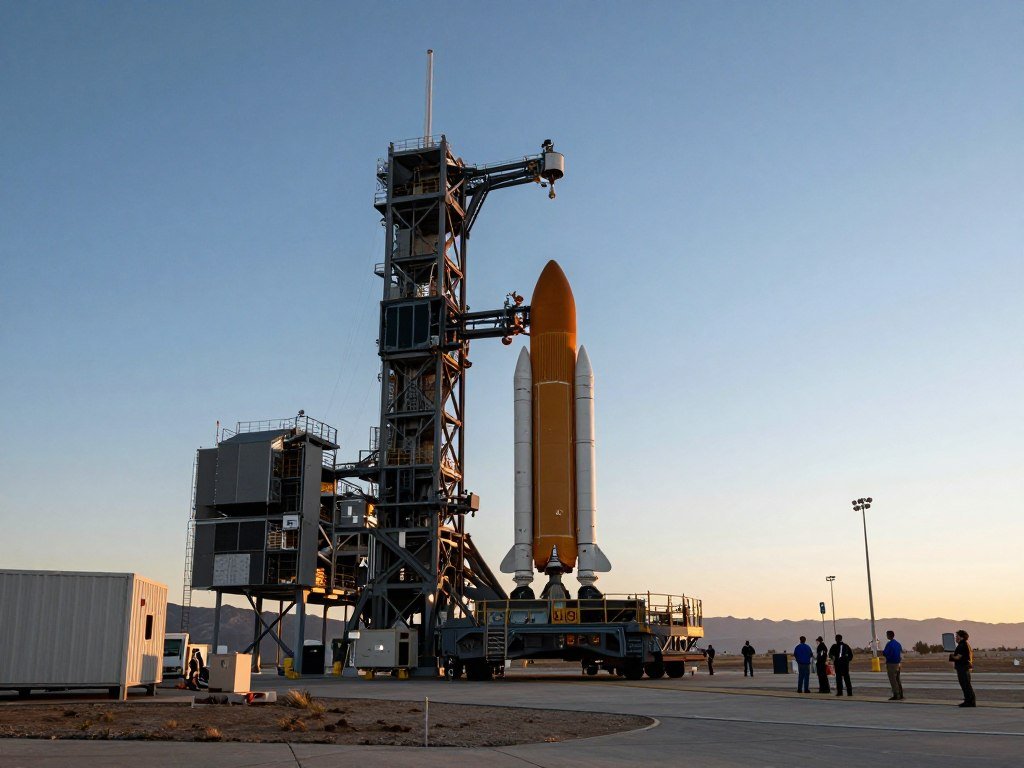
These three location details distinguish the facility from the wider base and state:
- Launch complex: Space Launch Complex 4E, also called SLC-4E.
- Force base: Vandenberg Space Force Base.
- State: California, on the U.S. West Coast.
Vandenberg Space Force Base is a launch site, not the satellites’ final destination. After launch, spacecraft travel away from the ground facility and continue toward their assigned orbit.
The launch site’s geography helps explain why SpaceX uses it for polar missions. A polar path can carry spacecraft around Earth rather than keeping them over one region.
That route does not mean the resulting Starlink network serves only the West Coast. The constellation operates across a wider area, so the California launch point does not set a service boundary.
Read “Vandenberg” as the launch location, not as a limit on where the constellation can provide service.
Which Falcon 9 Booster Flew and Where Did It Land?
The Group 15-27 flight used a Falcon 9 Block 5, and its first stage was booster B1093. The booster’s separate return followed its role in lifting the payload.
B1093 completed its 17th flight and landed on Of Course I Still Love You. The Falcon rocket carried the payload, while the first-stage booster returned to the recovery vessel.

The Falcon 9 Block 5 rocket
The two-stage Falcon 9 Block 5 measures 70.0 meters long and 3.7 meters in diameter. Its upper stage continued with the payload after the first stage separated.
The components have different jobs, so the rocket and its booster are not interchangeable terms. The launch pad stays behind as the flight continues.
| Component | Role | Group 15-27 detail |
|---|---|---|
| Falcon 9 Block 5 | Two-stage rocket carrying the payload | 70.0 m long, 3.7 m in diameter |
| First-stage booster B1093 | Rocket stage that returned after separation | Completed its 17th flight |
| Of Course I Still Love You | Recovery vessel for the booster | Landing took place on the Pacific droneship |
Booster B1093 and its recovery
A booster landing and satellite deployment are separate mission milestones. A successful landing shows that the first stage returned to the recovery vessel; it does not, on its own, describe what happened to the payload.
The vessel’s name, Of Course I Still Love You, is easy to confuse with a location or a launch pad. It is the droneship used for the landing.
The reported landing was on Of Course I Still Love You in the Pacific, not back at the launch pad.
What Reached Orbit, and When Did Deployment Finish?
The payload was a batch of Starlink V2 Mini communications satellites headed for low Earth orbit. V2 Mini names the satellite type, while low Earth orbit describes the destination.
Deployment occurred about 62 minutes after liftoff. The payload mass was estimated at 15.5 tonnes, a batch-level figure rather than a specification for each satellite.

The flight’s three main milestones were:
- Liftoff began the rocket’s trip from the launch site.
- The rocket carried its payload toward low Earth orbit.
- Satellite deployment took place about 62 minutes after liftoff.
Low Earth orbit is a region around Earth, not a single point above the launch site. The satellites travel in orbit after the rocket releases them.
The batch description does not supply a per-satellite mass or a full list of individual spacecraft details. It gives a useful estimate for the payload carried on this flight.
Deployment marks a different point in the mission from booster recovery. The first stage can return while the payload continues its path toward orbit.
Treat the 15.5-tonne payload figure as an estimate, not a unit-by-unit specification.
Does One Launch Change Starlink Coverage?
One Starlink launch adds to the network, but it does not by itself promise a measurable change for every subscriber. Starlink is a satellite broadband constellation operating in low Earth orbit.
Adding satellites contributes to the network’s overall capacity, but does not prove a local speed or availability change. A launch headline cannot tell a household whether service changed at its address.
Coverage is a network-level outcome shaped by more than one flight. The constellation’s size, orbital layout, and available service all matter to how the shared network works.
A satellite count alone cannot describe how a particular part of the network performs. For context on the risks of relying on one provider, see this discussion of Starlink’s network scale and service dependence.
For subscribers, the practical distinction is between a network addition and a confirmed change at home. One launch can add spacecraft without changing a household’s plan, speed, or access.
Check service availability and performance for the specific location rather than inferring them from an orbital addition.
Where Can You Watch the Launch Video?
The Group 15-27 launch is complete, so the available viewing option is a recording rather than a live countdown. Readers seeking Starlink Group 15 15 27 satellites Vandenberg 2026 live can watch a replay instead.
A completed launch can be watched again, but it is not a current live event. The video stream titles listed for the mission include:
- The Space Devs: “SpaceX Starlink Group 15-27.”
- Spaceflight Now: “SpaceX Falcon 9 rocket launches from California with 27 Starlink satellites.”
- SpaceX: “Starlink Mission.”
Look for recorded mission footage under those titles. A past countdown or launch stream may still be available as a replay, even though the launch itself is no longer live.
Launch footage shows the rocket’s flight from the ground. A satellite tracker serves a different purpose after deployment: it can show where spacecraft are in orbit or predict a pass.
The title matters when a video covers a different flight. Confirm that a video is labeled for Group 15-27 before using it to follow this mission.
Which Starlink Trackers Give the Most Useful Pass Details?
Sky Tonight is the most direct option for locating a Starlink launch group on a sky map. It can search Starlink launch groups and show a group’s position, which is different from a dated pass forecast.
Choose a group map for the group’s position, or a pass tool for an individual satellite’s predicted path. The best tool depends on which answer you need.
Sky Tonight for a group’s sky-map position
Sky Tonight helps when the question is where a launch group appears on a sky map. A group lookup and a prediction for one satellite are not the same task.
Heavens-Above provides pass predictions by mission and date. That makes it useful when you have a specific mission and date in mind.
Heavens-Above and N2YO for pass predictions
N2YO.com shows a satellite’s position and trajectory, with predictions covering 10 days. Use it when an individual satellite’s path or a longer prediction window is useful.
| Tool | Best use | Specific output |
|---|---|---|
| Sky Tonight | Finding a launch group | Group position on a sky map |
| Heavens-Above | Checking a mission and date | Pass predictions by mission and date |
| N2YO.com | Following an individual satellite | Position, trajectory, and 10-day predictions |
For a Starlink group mission, start with Sky Tonight when the goal is a group position. For an individual satellite’s pass on a chosen date, Heavens-Above or N2YO.com gives the more relevant kind of detail.
Match the tool to the question, since a group’s map position is not the same as an individual satellite’s dated pass prediction.
How Do Earth Maps, Sky Maps, and 3D Views Differ?
An Earth map answers where a satellite is over the globe, while a sky map answers where it appears overhead. A 3D view adds its current position above Earth.
Check the view type before reading a plotted path as a direction to look. The Satellite Tracker app can show a satellite’s trajectory on an Earth map or against the night sky.
Reading the ground track on an Earth map
An Earth map shows the trajectory over the globe. It helps you see the satellite’s path in relation to land and Earth’s surface.
Following the apparent path in the night sky
A night-sky map shows the satellite’s apparent path relative to the sky above an observer. Polaris marks the north celestial pole and can help orient a sky view, but that does not mean a satellite passes near Polaris.
| View | What it represents | Useful for |
|---|---|---|
| Earth map | Satellite trajectory over the globe | Reading the ground track |
| Night-sky map | Apparent path across the sky | Seeing where to look overhead |
| 3D model | Current position above Earth | Viewing the satellite in relation to Earth |
The app’s 3D model places the satellite’s current position above Earth. It gives a spatial view, rather than the ground path or apparent overhead direction shown in the other maps.
These views represent different frames of reference, so a line on one map may not look like the same direction in another. The map search for Starlink Group 15 15 27 satellites Vandenberg 2026 is easier to interpret when you first identify which view is active.
Check which view is active before treating a plotted path as a direction to look from your location.
When Can You See a Starlink Train?
A Starlink train is usually easiest to spot shortly after sunset or before sunrise, when the sky is dark but satellites can still reflect sunlight. Local lighting shapes whether a predicted pass can be seen.
Findstarlink.com gives expected visibility times for a location entered by name or coordinates. A satellite pass is the interval when a satellite travels above an observer’s local horizon.
The Sun, Earth, and local horizon affect visibility. A satellite may be above the horizon but hard to see if the sky is too bright or the view is blocked.
To check a local opportunity:
- Enter a place name or coordinates on Findstarlink.com.
- Check the predicted time for a pass.
- Confirm the date and local time zone.
- Find a clear view of the relevant part of the sky.
A predicted time is an estimate for the entered location, not a promise of a visible sighting. Do not assume this specific group will appear at a particular time without a local forecast.
Recheck a location-specific forecast on the day, since a predicted pass is not a guarantee of a visible sighting.
How Does Group 15-27 Fit Starlink’s 2026 Launch Pace?
Group 15-27 was the 81st Starlink mission of 2026, placing it within a sustained launch program. Its international designator is 2026-219.
The mission count describes Starlink’s flight cadence, not how many satellites flew on this mission. The designator is a separate identifier readers may see in orbital records.
A mission’s serial place in a busy year is a launch statistic, not a measure of coverage or speed.
Launch records can use different labels for the same event. “Group 15-27” identifies the Starlink mission, while 2026-219 is its international designator.
Those identifiers help readers distinguish one flight from another in mission lists and orbital records. They do not describe a subscriber’s service or the capacity available at a specific address.
The 81st-mission count places the flight in Starlink’s 2026 schedule. It is a count of missions, not a count of spacecraft launched on this flight.
Keep the mission count and the spacecraft count separate when comparing launch records.
Conclusion
A mission label is most useful when it is paired with the right kind of record. Group 15-27 identifies a launch, while a satellite-position view answers where a spacecraft is afterward.
Those details answer different questions about the broadband constellation and its network. A launch record does not, by itself, show a local coverage change.
Before sharing a clip, confirm that its title identifies Group 15-27 rather than another Starlink flight.
FAQ
What does low Earth orbit mean for a Starlink satellite?
Low Earth orbit is the region around Earth where a Starlink satellite travels, not the place where it launched. The launch site is on the ground, while the satellite’s orbit is its path around Earth. A satellite can pass above many locations as it moves, so its orbit is not tied to Vandenberg or California.
Why might a Starlink train look different on a later pass?
A Starlink train can look different because the satellites’ formation changes after deployment. Spacing may increase, and the satellites’ apparent brightness can differ from an early sighting. The view also depends on the observer’s location and the lighting around the pass. A later sighting may not resemble the close group seen soon after launch.
Does a successful booster landing confirm that the satellites deployed?
No, a successful booster landing does not confirm satellite deployment by itself. Booster recovery and payload deployment are separate mission milestones. For Group 15-27, satellite deployment occurred about 62 minutes after liftoff. The booster’s return describes the first stage, while deployment describes the payload continuing into orbit.
Can a Starlink train be mistaken for an airplane?
Yes, a Starlink satellite can be mistaken for an airplane at first glance. A satellite usually appears as a steady moving point, while aircraft commonly show blinking lights. A train may also contain several points moving along a similar path. Watching whether the light blinks can help distinguish the two.
Does a launch of 27 satellites guarantee better speeds at my address?
No, a launch of 27 satellites does not guarantee better speeds at your address. The flight adds spacecraft to Starlink’s shared network, but a launch alone cannot show whether local service changed. Network capacity and service at one location are different measures. Check your own connection rather than treating a launch count as a speed report.
Can I watch the Starlink Group 15-27 launch live now?
No, the Starlink Group 15-27 launch is complete, so it cannot be watched as a current live countdown. Look for a recorded mission stream or replay instead. A replay shows the launch footage, while a satellite tracker follows spacecraft after deployment. Check the recording’s title to make sure it names Group 15-27.