
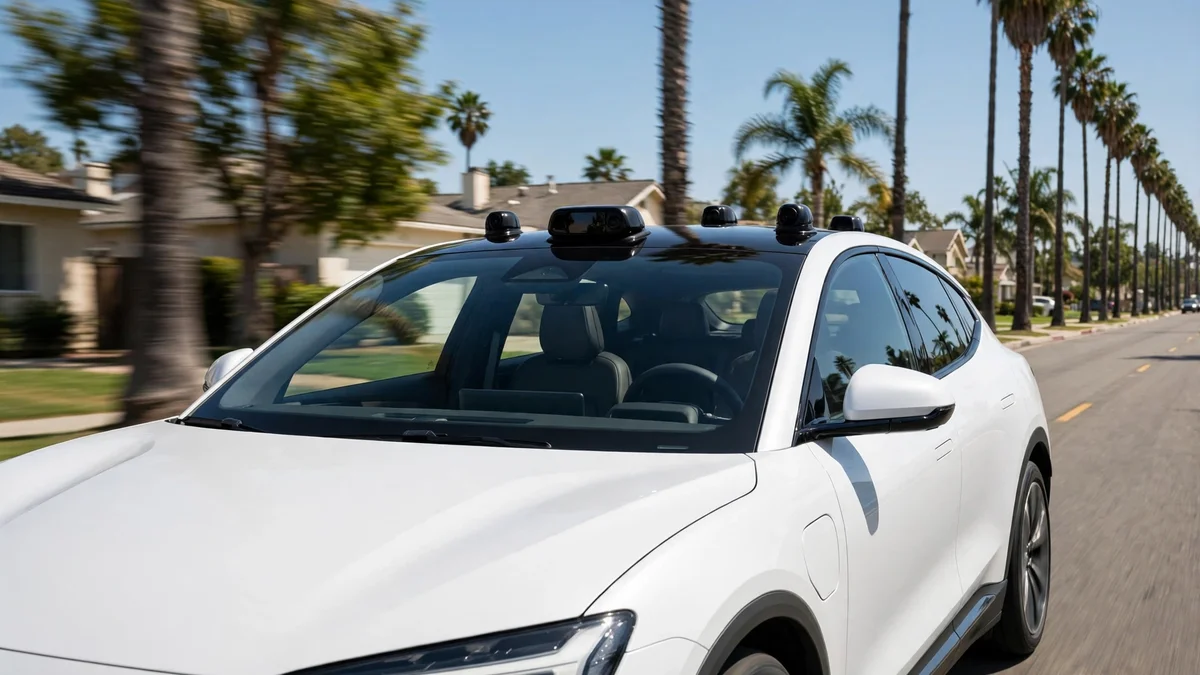
Uber, Nuro and Lucid have begun testing their robotaxis on public roads in the San Francisco Bay Area with nobody behind the wheel. The companies announced the start of fully driverless testing on 24 November 2026, moving the programme from supervised trials to the real thing, with employee rides due to follow shortly and a public launch planned for the first quarter of 2027.
The step matters because removing the safety driver is the hardest milestone in autonomous driving. A car with a human ready to take over is a demonstration; a car with an empty driver’s seat is a product. Nuro, which supplies the self-driving system, has been testing the Lucid Gravity robotaxis with safety drivers since December 2025, and the California Department of Motor Vehicles granted it a driverless testing permit in May 2026.
The timing also puts Uber back in a race it once quit. Uber sold its own self-driving division years ago after a troubled run, and this partnership, announced in July 2025, is its route back in: Lucid builds the cars, Nuro supplies the driving, and Uber supplies the riders. If the Bay Area launch works, the companies say the service will expand to dozens of markets around the world.
Key takeaways
- Uber, Nuro and Lucid began fully driverless testing on public roads in the San Francisco Bay Area on 24 November 2026.
- Testing starts in Palo Alto, Mountain View, Los Altos and Sunnyvale, with employee rides to follow and a public launch planned for Q1 2027.
- Lucid has delivered a fleet of more than 100 Gravity SUVs fitted with Nuro’s Level 4 self-driving system.
- Uber has committed to buy at least 35,000 Lucid vehicles equipped with the Nuro Driver.
- Nuro is one of only six companies permitted to test driverless vehicles on California public roads.
What the three companies actually announced
The announcement, made on 24 November 2026, is that fully driverless testing has begun on public roads across the San Francisco Bay Area. The robotaxis are Lucid Gravity SUVs fitted with the Nuro Driver, Nuro’s Level 4 autonomous driving system, and they are operating with no safety driver in the vehicle. The first testing covers Palo Alto, Mountain View, Los Altos and Sunnyvale, with more Bay Area cities to follow next year.
Employee rides are the next step. The companies said staff will soon be able to take driverless rides, which is the final stage before opening the service to the public in the first quarter of 2027. The public launch had originally been talked about for 2026, so the current timetable is a small slip, but the driverless testing itself is the milestone the partnership needed to hit first.
Lucid has delivered a fleet of more than 100 vehicles for the programme, with hardware, software and rider-experience updates aimed at making the robotaxi ready for paying passengers. The vehicles carry high-resolution cameras, solid-state lidar sensors and radars, and they run Nuro’s end-to-end autonomous system.
Our report on the best electric vehicles for tech lovers looks at the wider market for premium electric cars that vehicles like the Gravity belong to.
Why removing the safety driver changes everything
A safety driver is a crutch and a confession at the same time. It lets a company test on public roads while keeping a human in the loop, but it also means the system is not yet trusted to handle the unexpected on its own. Taking the driver out is the moment a company puts its safety case on the line, and regulators only allow it after reviewing evidence that the system can cope.

Nuro says the decision to remove the safety driver was driven by its Safety Case Framework, a structured process that builds evidence the system can operate safely on public roads. The company has been testing the Gravity robotaxis around the clock in the Bay Area and Houston since December 2025, always with a safety driver, and it has also run closed-course testing and simulation to validate the system before opening it to the public.
The regulatory position is also notable. Nuro is one of only six companies permitted to test without a driver on California roads, alongside Waymo, Zoox, WeRide, Tensor and AutoMo, according to the California DMV’s list. Waymo is the benchmark here: it already runs a paid, fully driverless service across much of the Bay Area, including the same Peninsula and South Bay streets where Nuro is only now pulling its safety drivers.
The commercial logic is simple. Uber’s global head of autonomous mobility, Samarth Kejriwal, said removing the safety operator was an important milestone and a testament to the three partners’ focus on their shared roadmap. Uber has committed to purchase at least 35,000 Lucid vehicles equipped with the Nuro Driver, up from the 20,000 originally planned, with the service initially launching in the Bay Area and Houston to follow later in 2027.
Houston is the second front. Nuro has been testing the Lucid Gravity robotaxis there with safety drivers, alongside the Bay Area programme, and the companies say the Texas city will follow the Bay Area into public service later in 2027. Running two cities at once is a test of whether the system can be scaled beyond a single, well-mapped area, and whether the safety case built in California transfers to different roads, weather and traffic patterns.
There is also a quieter change in the programme’s shape. The original plan called for a fleet of at least 20,000 vehicles over six years; the commitment has now grown to 35,000, and the launch city list has grown with it. That expansion suggests the partners are confident enough to plan for scale, but it also raises the stakes: a larger commitment means more capital at risk if the Bay Area launch stumbles.
The background: Uber’s long road back to robotaxis
Uber’s history with self-driving cars is complicated. The company once ran its own autonomous division, spent heavily on it, and then sold it after a fatal crash and years of losses. The July 2025 partnership with Lucid and Nuro was a different approach: instead of building the technology itself, Uber would buy cars from Lucid, license driving software from Nuro, and contribute what it does best, which is a ride-hailing network, fleet operations and riders.
Nuro’s own story is one of reinvention. The startup spent its first years building driverless delivery vehicles, then pivoted less than a year ago to licensing its autonomous technology to automakers and mobility companies. The company is about ten years old and has raised roughly 2.5 billion dollars, and the Uber partnership is its biggest bet on that new direction.
Lucid, meanwhile, is a luxury electric carmaker that needs volume. The Gravity SUV was unveiled in January 2026, and the robotaxi programme gives Lucid a guaranteed buyer for tens of thousands of vehicles, with Uber and its fleet partners owning and operating the cars. Rides will be available only through the Uber app.
For a sense of how the vehicles themselves compare with other premium electrics, our guide to the best micro electric vehicles for city driving covers the smaller end of the electric market, while the Gravity sits at the large, luxury end.
The caveats that matter
The most important caveat is that driverless testing is not a driverless service. The cars are running without safety drivers in four cities, but they are still being tested, and the public launch is months away. Things can still go wrong, and the history of autonomous driving is full of programmes that looked ready until they were not.
| Detail | What is known |
|---|---|
| Driverless testing began | 24 November 2026 |
| First test cities | Palo Alto, Mountain View, Los Altos, Sunnyvale |
| Vehicle | Lucid Gravity SUV with Nuro Driver, Level 4 autonomy |
| Fleet delivered | More than 100 vehicles |
| Public launch planned | First quarter of 2027, San Francisco Bay Area |
| Uber purchase commitment | At least 35,000 Lucid vehicles, up from 20,000 |
| Key permits | California DMV driverless testing permit, May 2026; CPUC drivered pilot permit |
| Partnership announced | July 2025 |
There is also the question of scale. A fleet of just over 100 vehicles is a pilot, and the jump from 100 cars in four cities to a service across dozens of global markets is enormous. The 35,000-vehicle commitment is a statement of intent, not a delivery schedule, and it depends on the Bay Area launch going well.
Competition is the other pressure. Waymo already operates a paid driverless service in the same area, which means Uber’s robotaxis will be judged against a service riders can already use. Being second to market is not fatal, but it means the new service has to be at least as good from day one.
Finally, the economics are unproven. Nobody outside the companies knows what a ride will cost, how the revenue will be split between Uber, Lucid and Nuro, or whether the service can make money at the prices riders will accept. Those answers will only come after the public launch.
Checklist: judging the robotaxi launch honestly
Use these checks before deciding whether this is a breakthrough or a press release.
- Separate testing from service: driverless testing is a milestone, not a launch.
- Watch the Q1 2027 date: a slip would say more than the announcement does.
- Compare with Waymo, which already runs paid driverless rides in the same streets.
- Ask how many cars are actually on the road, not how many are committed.
- Look for incident and disengagement reports once testing expands.
- Check pricing when the service opens: the business case depends on it.
Frequently asked questions
When did Uber, Nuro and Lucid start driverless testing?
On 24 November 2026, on public roads in the San Francisco Bay Area, with no safety driver in the vehicle.
Which cities are the robotaxis testing in first?
Palo Alto, Mountain View, Los Altos and Sunnyvale, with more Bay Area cities to follow in 2027.
When will the public be able to ride?
The companies plan a public launch in the first quarter of 2027 in the Bay Area, with Houston to follow later in the year. Employee rides will begin first.
What car is being used?
The Lucid Gravity SUV, fitted with Nuro’s Level 4 self-driving system, known as the Nuro Driver. It uses high-resolution cameras, solid-state lidar and radar.
How many robotaxis has Uber committed to buy?
At least 35,000 Lucid vehicles equipped with the Nuro Driver, up from the 20,000 originally planned when the partnership was announced in July 2025.
Who else can test driverless cars in California?
Nuro is one of six companies permitted to test without a driver on California public roads, alongside Waymo, Zoox, WeRide, Tensor and AutoMo, according to the California DMV.
The chip story behind the autonomous driving race is covered in our report on Nvidia’s AI rally and 2026 outlook, which tracks the hardware that powers much of the industry’s AI work.
The bottom line
Removing the safety driver is the moment a robotaxi programme stops being a demonstration and starts being a service, and Uber, Nuro and Lucid have now reached it in the Bay Area. The fleet is small, the launch is months away, and Waymo is already operating in the same streets, but the three-way partnership has cleared the hardest regulatory and technical hurdle in front of it.
What matters next is the first quarter of 2027. If employee rides go smoothly and the public launch happens on schedule, Uber will have its route back into autonomous ride-hailing. If it slips, the questions will be about whether the system was ready, and the answer will be measured in months, not press releases.



