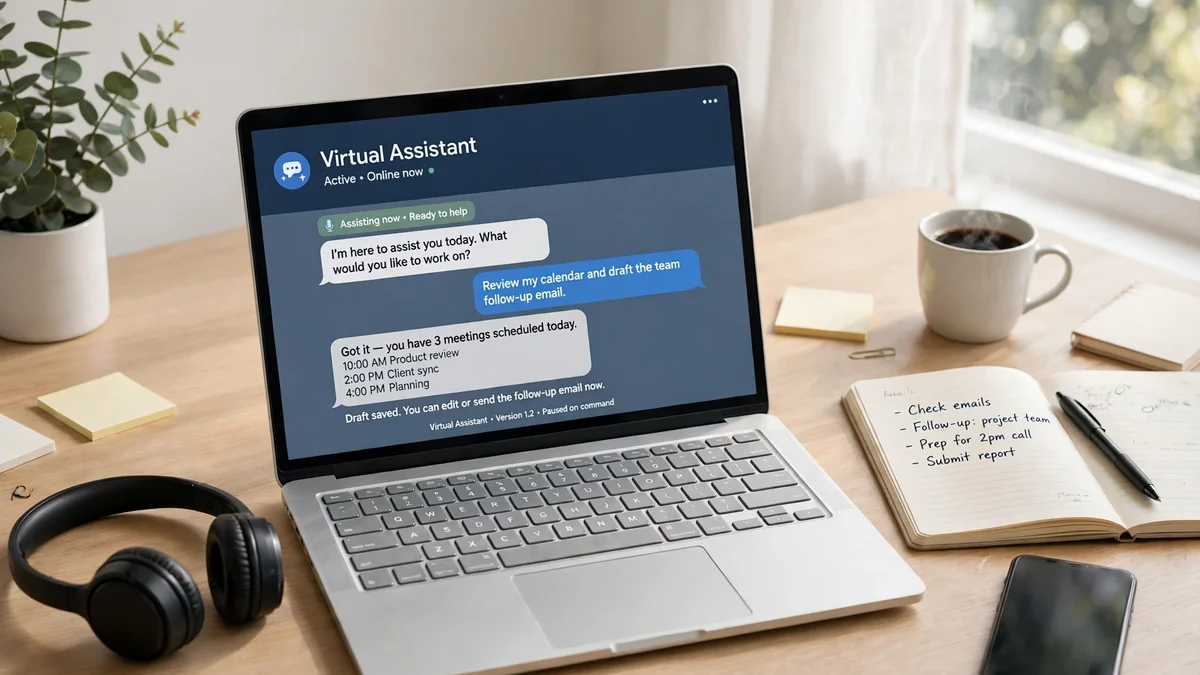
Former Sequoia Capital India investor Sudhanshu Mishra has launched Demi AI, an agentic AI assistant designed to work before its user asks, with an invite-only beta now open in the United States. Mishra announced the launch on 24 November 2026, positioning Demi as an assistant that lives on the Mac, learns how its owner works, and completes tasks without waiting for explicit instructions.
Demi AI enters a crowded field of proactive assistants, but its pitch is distinct: instead of answering prompts, it builds a running picture of a user’s work from meetings, connected applications and screen activity, then tracks commitments and prepares next steps on its own. The company, set up in June 2025, employs about ten people, and its individual paid plan starts at $25 per month, with team pricing customised.
The launch matters because it tests a question the whole AI industry is now asking: how much of a knowledge worker’s day can software safely take over without being told? Demi’s answer is to watch, learn and act, while keeping a human approval step in front of messages and changes to records. Whether that balance holds in daily use is the real test ahead.
Key takeaways
- Sudhanshu Mishra, a former Sequoia Capital India investor, launched Demi AI in the US with co-founder Logan Ford, his former college roommate.
- Demi is a Mac-based agentic assistant that learns from meetings, apps and screen activity to track commitments and automate routine work.
- The assistant aims to anticipate requirements and complete work before being asked, rather than waiting for prompts.
- An invite-only beta is open now; the individual paid plan starts at $25 per month and team pricing is customised.
- The company was set up in June 2025 and employs about ten people; funding details and the full beta timeline have not been confirmed publicly.
What Demi AI actually is
Demi AI is an agentic AI startup building a proactive desktop assistant for Mac users. Mishra announced the launch on social media on 24 November 2026, describing Demi as an assistant that lives on the Mac, learns how a person works, and does the work before being asked. The product is in an invite-only beta, so access is limited while the team tests it with early users.
The core idea is a shift from reactive to proactive software. Conventional assistants wait for a question or a command and then respond. Demi is designed to build an understanding of a user’s work continuously, spot tasks that need attention, and prepare or complete them. Inc42 reported that Mishra framed the idea as a way to reduce the effort users now spend making AI tools useful, including setting up workflows, supplying context and deciding which tasks to delegate. The governance questions this raises are covered in our report on AI transformation being a governance problem, not a technology problem.
Demi joins a growing group of startups betting that the next useful AI product is not a better chatbot but an assistant that executes. CIOL also covered the launch, noting the same focus on automating everyday work. The company’s co-founder is Logan Ford, Mishra’s college roommate, and the team numbers about ten people.
How Demi works
Demi builds context from a user’s meetings, connected applications and computer screen to understand ongoing projects, conversations and work patterns. That context is the product’s foundation: without it, a proactive assistant cannot tell a genuine commitment from a passing remark, or a deadline from a casual mention.

Based on that context, Demi tracks commitments, deadlines and recurring tasks, and proactively surfaces reminders or prepares the next steps. Inc42 gave a concrete example: if a user promises to share a document during a meeting, Demi can identify the commitment, locate the relevant information and prepare a follow-up email. The same approach extends to repetitive administrative work, including drafting email responses, preparing meeting briefs, capturing meeting notes and updating customer relationship management systems.
The platform then executes tasks either through its cloud-based computer or natively on a user’s Mac through the browser, and users do not need to create custom workflows or write instructions for individual skills to get started. That no-setup claim is central to the pitch, because workflow builders and skill configuration are exactly the chores that keep many AI tools unused.
Crucially, Demi retains a human approval layer. Messages, commitments and important changes to records are presented to users for approval before they are executed. That design choice matters more than any single feature: an assistant that drafts is useful, but an assistant that sends, updates or commits on its own is a different product, and a riskier one. Readers comparing automation options can look at our guide to the best AI tools for automation in 2027 to see how Demi’s approach compares with established workflow products.
The background: from investing to building
Mishra’s path to Demi runs through venture capital. He was earlier associated with Sequoia Capital as an investor, where he worked on early-stage investments and primarily led the firm’s crypto-focused efforts. He subsequently joined Paradigm, a crypto-focused investment firm, as an investment partner.
The move from investor to founder is a familiar one in technology, but it carries its own scrutiny. Investors turned founders are expected to understand markets, hiring and fundraising, and Demi’s small team of about ten people suggests a deliberately lean start. The company was set up in June 2025, giving it roughly seventeen months of building before the public beta announcement, a reasonable runway for a product that depends on getting the details of everyday work right.
Demi’s timing is also notable. Agentic AI has become one of the most discussed themes across the global technology ecosystem, with enterprises and individuals exploring ways to automate workflows. Grand View Research projects the global enterprise agentic AI market will reach $24.5 billion by 2030, growing at a compound annual rate of 46.2 percent. Those figures describe a market, not a guarantee, and they explain why investor interest is accelerating even as the products themselves are still proving their reliability.
Other founders are moving in the same direction. Sol Foundry, founded by former CRED executives, raised $4 million from General Catalyst, Nexus Venture Partners and others in September 2026 to build a proactive AI assistant that acts on commitments made over email. Demi’s emphasis on screen activity and meetings, rather than email alone, is one of the differences to watch as the two products develop.
The caveats that matter
The strongest reason to be careful about Demi is also the strongest reason it is interesting: it learns by watching. An assistant that reads meetings, applications and screen activity holds a detailed picture of a person’s working life. That picture is what makes proactive help possible, and it is also the most sensitive data the product will ever hold. How that data is stored, how long it is kept, and who can see it are questions the launch coverage has not yet answered in detail.
Pricing is partly confirmed and partly open. According to Demi’s website, the individual paid plan starts at $25 per month, while team pricing is customised. What the free or beta terms include, and what happens to pricing when the beta ends, has not been confirmed. Similarly, no funding details have been disclosed in the launch coverage, so the company’s runway and backers remain unconfirmed.
There is also a practical limit to judge. Proactive assistants are only as good as their judgement about what matters, and every incorrect guess costs the user time: a wrong reminder is a distraction, a wrong draft is rework, and a wrong commitment is worse. The human approval layer is designed to catch those errors, but if the approval step becomes a rubber stamp, the benefit fades. Early beta users’ experience will tell more than any launch announcement can.
| Detail | What is known |
|---|---|
| Product | Demi AI, a Mac-based agentic AI assistant |
| Founders | Sudhanshu Mishra and Logan Ford |
| Launched | 24 November 2026, announced on social media |
| Availability | Invite-only beta in the US |
| Company founded | June 2025 |
| Team size | About 10 people |
| Pricing | Individual plan from $25 per month; team pricing customised |
| Funding | Not confirmed in public launch coverage |
Finally, the market context cuts both ways. A projected $24.5 billion market by 2030 attracts serious competitors, including large platform companies that already own the email, calendar and meeting tools Demi must connect to. A small startup’s advantage is focus and speed; its risk is that the platforms it depends on change their rules.
Checklist: judging a proactive assistant honestly
Use these checks before handing a proactive assistant access to your work.
- Check what data it collects: meetings, apps and screen activity should each be listed, with a way to switch sources off.
- Check where that data lives and how long it is kept, including whether it is used to train models.
- Check what the assistant can do without asking, and what always needs approval.
- Check how it handles a wrong guess: can you correct it once and have it learn, or does it repeat the mistake?
- Check the real time cost: count the minutes spent reviewing its drafts and reminders against the minutes saved.
- Check the exit: make sure you can export or delete your data and stop the assistant without losing your work.
Frequently asked questions
What is Demi AI?
Demi AI is an agentic AI assistant for Mac that learns from meetings, connected apps and screen activity, tracks commitments and automates routine work, aiming to complete tasks before the user explicitly asks.
Who founded Demi AI?
Former Sequoia Capital India investor Sudhanshu Mishra founded Demi AI with co-founder Logan Ford, his former college roommate. Mishra later worked as an investment partner at Paradigm.
How much does Demi AI cost?
The individual paid plan starts at $25 per month, according to Demi’s website, while team pricing is customised. Beta terms and any free tier have not been confirmed publicly.
Is Demi AI available now?
Demi is in an invite-only beta in the US, announced on 24 November 2026. There is no confirmed date for a general release, and Mac is the supported platform at launch.
Does Demi act without asking the user?
Demi prepares and executes routine work proactively, but it keeps a human approval layer: messages, commitments and important changes to records are shown to users for approval before they are executed.
How is Demi different from a normal AI assistant?
Normal assistants mostly respond to prompts. Demi aims to build a continuous understanding of a user’s work and identify tasks that need attention, so it can act first. The trade-off is that it needs broader access to meetings, apps and screen activity to do so, and that access is exactly what users should weigh before signing up. The cost of that access is also worth comparing with the wider AI market, where demand for computing power keeps rising, as covered in our report on AI compute getting scarce and costly as demand outruns data centers.
The bottom line
Demi AI is a focused bet on a clear idea: the most useful assistant is the one that notices the work, not the one that waits to be asked. Mishra’s background, the small team and the seventeen months of quiet building before launch all suggest a deliberate start, and the $25 starting price puts it within reach of individual professionals rather than only enterprises.
What matters next is evidence from the beta: how accurate its commitments are, how honest its approval step stays under daily pressure, and how clearly the company answers questions about data handling. If Demi gets those right, it will have earned its place in a fast-growing market. If not, it will join the long list of assistants that promised to do the work and mostly created more of it.