
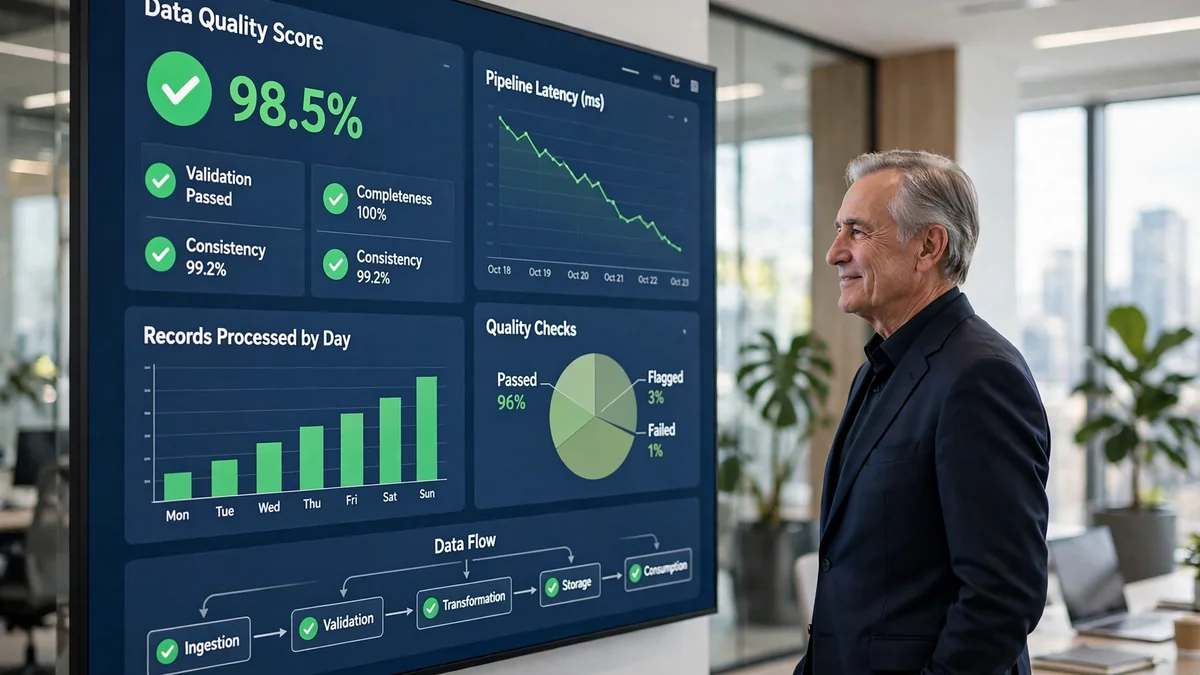
A vice president of data quality does not buy tools the way a data engineer does. An engineer wants a faster check or a cleaner pipeline. A VP of data quality is accountable for whether the numbers the business runs on can be trusted: the accuracy of board reporting, the reliability of customer data, the cost of bad data leaking into decisions, and the team that has to find and fix problems before anyone else notices them. The best AI tools for vice presidents of data quality in 2027 are therefore judged on a different scale, one that weighs enterprise coverage, the strength of AI detection, the quality organisation behind the tooling, and the ability to report trust to the board alongside raw capability.
That shift matters because data quality has moved from a back-office chore to a board-level risk. Most large companies now run hundreds of pipelines feeding dashboards, AI models, and customer-facing products, and a single broken feed can quietly corrupt a forecast, a billing run, or a regulatory report. The VP’s job is to choose the platform where that automation is reliable enough to defend, and to fund it like an investment in trust rather than a monitoring bill.
This guide compares nine tools through that VP-level lens. Each one is assessed on enterprise quality coverage, AI detection accuracy, ownership and workflow design, board-level quality reporting, total cost of ownership, and how quickly it turns a sprawling data estate into one the business can rely on. The shortlist is led by dedicated data quality and observability tools rather than dashboard suites or generic catalogs, and most of the products here are fresh to this series, chosen because they solve the quality problem itself rather than an adjacent one.
Key takeaways
- Monte Carlo is the best overall choice for a VP of data quality, because it combines broad observability coverage with AI anomaly detection and the reporting a leadership team needs.
- Sifflet is the strongest pick when AI-driven anomaly detection matters most, learning normal patterns automatically instead of relying on hand-written rules.
- Soda is the best option for teams that want quality enforced as code, with data quality contracts that data producers and consumers agree on in advance.
- Great Expectations is the best fit for test-driven quality inside engineering teams, turning quality checks into versioned, reviewable code.
- Budget for the quality organisation as well as the tool: ownership, stewardship, and incident response decide whether the platform actually improves trust.

At a glance: the shortlist
| Product | Best for | Starting price | Standout limit |
|---|---|---|---|
| Monte Carlo | Best overall observability | Custom quote | Usage-based pricing |
| Sifflet | AI observability for modern stacks | Custom quote | Usage-based pricing |
| Soda | Data quality contracts | Free tier available | Cloud pricing by usage |
| Great Expectations | Test-driven quality | Open source core | Cloud is paid |
| Precisely | Enterprise data integrity | Custom quote | Enterprise pricing |
| dbt Cloud | Quality in analytics engineering | From $100 per month | Seat-based pricing |
| Kensu | Data observability with lineage | Custom quote | Enterprise sales only |
| Acceldata | Enterprise observability at scale | Custom quote | Platform pricing |
| DvSum | AI quality for mid-size teams | Custom quote | Per-connector pricing |
Monte Carlo — Best overall
Monte Carlo is the data observability platform most large quality teams reach for first, and it earns the top spot here because it covers the whole quality problem rather than one corner of it. The platform watches pipelines end to end, from ingestion through transformation to the dashboards and models that consume the data, and it uses machine learning to learn what normal looks like for every table and column. When a volume drops, a schema changes, or a freshness SLA is missed, the alert arrives with the lineage that shows exactly what broke and who is affected.
That breadth is why vice presidents of data intelligence weigh catalog and quality tools together when they choose a platform, and why a VP of data quality should expect the quality tool to sit alongside the catalog rather than replace it. For a VP, the appeal is organisational as much as technical. Monte Carlo assigns ownership, routes incidents to the right team, and tracks time to resolution, so quality stops being a vague complaint and becomes a measurable operation. That combination of detection, workflow, and reporting is why it leads this list, even though it is priced for enterprises and needs a real implementation effort to reach full coverage.
Pros: broadest observability coverage, strong AI anomaly detection, clear incident workflows and ownership, board-ready quality reporting.
Cons: enterprise pricing with no public list, meaningful setup effort, smaller teams may find it more platform than they need.
Sifflet — Best for AI anomaly detection
Sifflet is a data observability platform built for modern cloud data stacks, and it earns its place here because its AI does the detection work that used to need a room full of hand-written rules. The platform monitors warehouses, lakes, and pipelines, learning the normal behaviour of every table and column, and it flags anomalies the moment they appear, whether that is a volume drop, a schema change, or a slow drift in a metric the business depends on.
That focus makes Sifflet a strong choice for a VP whose biggest risk is silent data drift rather than broken pipelines. It connects to the warehouses and orchestration tools teams already use, and its alerts are tuned to reduce noise, which matters when alert fatigue is the reason quality programs fail. The trade-off is scope: Sifflet does not try to be a catalog or a governance platform, so a VP still needs companion tooling for those jobs. Priced by usage, it fits organisations that already know data quality is a strategic risk and want AI detection without an enterprise platform rollout.
Pros: excellent AI anomaly detection, strong lineage and root-cause views, low-noise alerting, quick value on warehouse data.
Cons: narrower scope beyond detection, usage-based pricing scales with estate size, needs companion tools for catalog and governance.
Soda — Best for data quality contracts
Soda is built around a simple idea that fits a VP’s world well: quality should be agreed in advance, not discovered after a failure. Teams write data quality contracts in SodaCL, a human-readable language, that state what a dataset promises — its freshness, completeness, schema, and business rules — and Soda checks those promises continuously. When a contract breaks, the producer and the consumer both know immediately, and the conversation is about a broken agreement rather than a blame game.
Soda also brings AI into the workflow, suggesting checks based on profiling and drafting contract language from the data itself, which lowers the barrier for teams that have never written formal quality rules. The open-source Soda Core keeps the checks portable, while Soda Cloud adds collaboration, alerting, and reporting. For a VP designing a quality organisation, contracts are a powerful mechanism: they make ownership explicit, they scale across dozens of teams, and they give the board a clear statement of what trusted data means. The limitation is cultural as much as technical, since contracts only work when producers accept them.
Pros: quality contracts make ownership explicit, human-readable check language, AI-suggested checks, free open-source core.
Cons: needs producer buy-in to work, lighter on deep anomaly detection, cloud pricing scales with usage.
Great Expectations — Best for test-driven quality
Great Expectations brings software engineering discipline to data quality. Data teams define expectations — assertions about what a dataset should look like — as versioned code that lives beside the pipeline, gets reviewed like any other change, and runs in continuous integration. The result is a quality practice that engineers actually respect, because it uses the tools and habits they already have, and a record of every check that auditors can follow.
GX Cloud adds the managed layer a VP needs: shared expectation suites, profiling, alerting, and reporting across teams, without each team running its own infrastructure. The AI assistance in GX Cloud helps teams draft expectations from profiling results, which shortens the long tail of writing checks for hundreds of tables. The trade-off is that Great Expectations is fundamentally an engineering tool. It is strongest where data teams already work in code, and it needs companion observability tooling to catch the runtime failures that tests cannot predict. For a VP building a quality culture inside engineering, though, it is the most credible foundation available.
Pros: quality as versioned, reviewable code, strong engineering adoption, open-source core, GX Cloud adds managed reporting.
Cons: engineering-heavy setup, needs companion observability, less suited to non-technical data owners.
Precisely — Best for enterprise data integrity
Precisely is the enterprise data integrity vendor for a VP who wants quality, matching, enrichment, and governance in one system rather than four vendors. Its data quality engine profiles data, runs business rules, and scores datasets, while the same platform handles address verification, entity matching, and data enrichment. The AI features automate classification, suggest rules, and help stewards resolve issues faster, which matters when the estate spans thousands of datasets.
The unified approach has a real advantage at VP level: one ownership model, one quality score, and one set of enrichment and matching services that the board can understand. Instead of reconciling numbers from three tools, the VP reports from a single source of truth about trust. Precisely is priced and sold as an enterprise platform, and it rewards organisations that commit to it fully; a team that only wants lightweight checks will find it heavy. But for a large enterprise consolidating its data trust stack, it is the most complete option on this list.
Pros: quality, matching, enrichment, and governance in one platform, strong enterprise data quality engine, single quality score for reporting.
Cons: enterprise pricing and implementation effort, heavier than specialist tools, best for large committed rollouts.
dbt Cloud — Best for quality inside analytics engineering
dbt Cloud is where most modern analytics teams already build their transformations, and its quality features meet them exactly there. Tests are defined alongside models in the same project, run on every build, and surface in the same interface where analysts work. Data quality becomes part of the analytics workflow rather than a separate system that engineers visit only when something breaks.
For a VP of data quality, dbt Cloud’s strength is adoption. Because analysts and analytics engineers already live in dbt, quality checks get written, reviewed, and maintained at a rate that standalone tools rarely achieve. The platform adds freshness checks, model governance, and the Semantic Layer, which helps keep definitions consistent across reports. AI features assist with documentation and test generation. The limitation is scope: dbt Cloud covers the transformation layer well, but it does not watch source systems or ingestion, so a VP still needs observability for the full estate. Its pricing, starting from around $100 per month, is also the most transparent on this list.
Pros: quality built into the analytics workflow, high adoption among analysts, transparent starting price, Semantic Layer keeps definitions consistent.
Cons: covers the transformation layer only, needs observability for sources and ingestion, seat-based costs grow with team size.
Kensu — Best for data observability with lineage
Kensu is a data observability platform built around a simple idea: you cannot trust data you cannot trace. It monitors data as it moves through pipelines, checking schema, values, and business rules, and it builds lineage automatically so every dataset can be traced back to its source.
Kensu also profiles historical data to suggest monitors automatically, so teams do not have to hand-write hundreds of rules before they see value. For a VP whose organisation is moving toward real-time analytics and AI features, Kensu covers the gap that traditional nightly checks leave open, watching data in motion rather than only at rest. It is sold as an enterprise product, and it is most valuable where lineage and traceability are already central to how the business judges trust.
Pros: automatic lineage makes failures traceable, AI-suggested monitors speed up coverage, strong for data in motion, clear coverage reporting.
Cons: enterprise pricing, narrower fit for batch-only organisations, smaller ecosystem than larger rivals.
Acceldata — Best for enterprise observability at scale
Acceldata is an enterprise data observability platform built for very large, complex estates, including hybrid and multi-cloud environments. It monitors data pipelines, infrastructure, and compute costs together, using AI to detect anomalies in data quality, pipeline performance, and spend. That combined view is useful for a VP who is accountable not only for trust but also for the budget that quality and platform work consumes.
The platform’s strength is scale and depth: it handles the volume and variety of a large enterprise, tracks lineage across systems, and gives operations teams the detail they need to fix problems quickly. Its AI features prioritise incidents by business impact, which helps a quality organisation focus on the failures that matter instead of the loudest alerts. Acceldata is priced as an enterprise platform and aimed squarely at large organisations, so smaller teams will find it more than they need, but for a VP running quality across a sprawling estate, it is a serious contender.
Pros: built for very large estates, combines quality, pipeline, and cost observability, AI prioritisation by business impact, strong lineage.
Cons: enterprise pricing, aimed at large organisations, implementation takes time.
DvSum — Best for AI quality for mid-size teams
DvSum is the most accessible option on this list for a VP at a mid-size company that needs enterprise-grade quality without an enterprise-grade implementation. The platform combines data cataloging, quality monitoring, and AI assistance in one product, profiling data automatically, suggesting quality rules, and alerting teams when metrics drift. Its AI features draft documentation and help non-technical owners understand what a dataset contains and whether it is safe to use.
The appeal for a VP is the balance of capability and effort. DvSum covers the core quality jobs — profiling, monitoring, alerting, and ownership — without demanding a large platform team to run it. Per-connector pricing keeps the cost tied to the size of the estate, which makes budgeting straightforward. It does not match the depth of Monte Carlo or Precisely at the largest scale, and its ecosystem is smaller, but for a growing company that needs trustworthy data now rather than after a year-long rollout, it is the pragmatic choice.
Pros: good balance of capability and effort, AI-assisted profiling and documentation, per-connector pricing, fast time to value.
Cons: less depth at the largest enterprise scale, smaller ecosystem, fewer advanced governance features.
How to choose
Start from the risk, not the feature list. A VP whose board worries about regulatory reporting needs a different tool from one whose biggest cost is bad data in customer-facing AI features. Map the three or four quality failures that would hurt most, then check which tools detect those failures fastest and report them most clearly. A tool that is excellent at pipeline monitoring but weak on data drift will not help a team whose problem is silent metric decay.
Next, weigh the quality organisation the tool creates. The best platform is the one your teams will actually use: data producers who accept contracts, engineers who write tests, stewards who resolve incidents, and owners who answer for their datasets. Trial the workflow with two or three real teams before committing, and measure adoption, alert noise, and time to resolution rather than demo polish. heads of data governance set the policies these tools enforce, so the platform must fit the governance model rather than fight it.
Finally, price the whole programme, not just the licence. Ask vendors for total cost at your estate size, check renewal terms, and confirm data export and exit terms before signing. A quality platform should make trust cheaper over time, not lock the organisation into a tool it cannot leave.
Checklist: before you pay
- Trial the platform on your own dirtiest datasets, not the vendor’s demo data, and measure detection against failures you already know about.
- Confirm coverage across every source that feeds board reporting, not just the warehouse.
- Check renewal pricing and connector costs at your estate size before signing, not after the first year.
- Agree ownership for every critical dataset in writing, with a named owner and a response time.
- Test the alerting with real incidents and measure noise: too many false alerts will kill adoption within weeks.
- Confirm you can export rules, history, and quality scores if you ever change platforms.
Frequently asked questions
What does a VP of data quality actually own?
The role owns trust in the organisation’s data: accuracy, completeness, freshness, and fitness for purpose across the datasets the business relies on. That includes the quality platform, the ownership model, the incident process, and reporting on quality to leadership. It is distinct from running pipelines or dashboards, which are engineering and analytics responsibilities.
How is this different from data observability?
Observability is one part of data quality: watching pipelines and data for failures as they happen. Data quality is broader, covering rules, contracts, testing, stewardship, and the organisational design that decides who fixes what.
Should quality tools be bought centrally or by each team?
Centrally, in almost every case. Quality only works when rules, ownership, and reporting are consistent across teams, and a central platform gives the VP one view of trust across the estate. Teams can still choose their own checks within the platform, but the platform itself should be one system, funded and governed centrally.
How much should a VP budget for data quality tools?
Most enterprise platforms are priced by usage, connectors, or estate size, so there is no single figure. Budget for the licence plus implementation, training, and stewardship time, and expect the first year to cost more than later years. vice presidents of data fund the platform as part of the data budget, and the business case should compare that cost with the cost of bad decisions made on untrusted data.
Can AI really detect data quality problems on its own?
AI is strong at learning normal patterns and flagging deviations, which catches drift and anomalies that hand-written rules miss. The best tools combine AI detection with human review and clear ownership.
How long does it take to see results from a quality platform?
Most teams see their first real detections within weeks of connecting their main sources, because profiling and anomaly detection work on historical data immediately. Full coverage, clean ownership, and board-level reporting take longer, typically three to six months, depending on the size of the estate and how quickly teams adopt the workflow.
The bottom line
For most vice presidents of data quality, Monte Carlo is the right starting point: it covers the estate, detects problems with AI, and reports trust in a form leadership understands. Sifflet is the better pick when silent drift is the main risk, Soda when quality needs to be agreed as contracts, and Great Expectations when the quality culture lives inside engineering. dbt Cloud and DvSum are the pragmatic choices for teams that need quality inside the tools they already use, while Precisely, Kensu, and Acceldata serve the largest or most traceability-focused estates.
Whatever the choice, the tool is only half the job. Agree ownership for every critical dataset, measure time to resolution, report quality to the board in plain language, and revisit the platform as the estate grows. Data quality compounds: every quarter of reliable data makes the next decision easier, and every quarter of untrusted data makes it harder. Pick the platform your teams will actually use, fund the organisation behind it, and let trust become a number the business can manage.



