

Campervan life runs on borrowed Wi-Fi. The best VPN services for campervans in 2027 protect the connection between your devices and the internet whether you are on a campsite network, a café hotspot, or a mobile signal in a remote valley, so your logins, banking, and work files stay private wherever you park for the night.
A campervan is a moving home, and that creates a security problem most travellers never think about. You join a new network almost every day, often one shared with dozens of strangers, and you carry more connected devices than a typical holidaymaker: phones, laptops, tablets, and sometimes a smart TV or a router.
Our shortlist covers seven services, from the fastest all-rounder to the cheapest unlimited-device plan. Prices below are approximate starting prices; check current pricing before you buy, because long-term deals change often.
Key takeaways
- NordVPN is the best overall VPN for campervans, with fast speeds and a reliable kill switch for changing networks.
- Surfshark is the best value for van life, covering unlimited devices on one low-priced plan.
- ExpressVPN is the best pick when you need the fastest possible connection on weak campsite Wi-Fi.
- Proton VPN is the best choice for privacy-focused travellers, with a free tier to test first.
- Set the VPN up on your router if you can, so every device in the van is protected automatically.
At a glance: the shortlist
| Product | Best for | Starting price | Standout limit |
|---|---|---|---|
| NordVPN | Best overall | From about $3.09 per month on a two-year plan | 10 simultaneous connections |
| Surfshark | Best value | From about $1.99 per month on a two-year plan | Unlimited simultaneous connections |
| ExpressVPN | Best speed | From about $4.99 per month on a two-year plan | 8 simultaneous connections |
| Proton VPN | Best privacy | From about $3.59 per month on a two-year plan | 10 simultaneous connections |
| CyberGhost | Best for beginners | From about $2.03 per month on a two-year plan | 7 simultaneous connections |
| Private Internet Access | Best for customisation | From about $2.03 per month on a three-year plan | Unlimited simultaneous connections |
| Mullvad | Best for anonymity | About €5 per month, flat rate | 5 simultaneous connections |
NordVPN — Best overall
NordVPN is the best all-round choice for campervan travel because it copes well with the two things van life throws at a VPN: slow, shared networks and constant switching between them. Its NordLynx protocol keeps overhead low, which helps when a campsite connection is already shared between dozens of pitches.
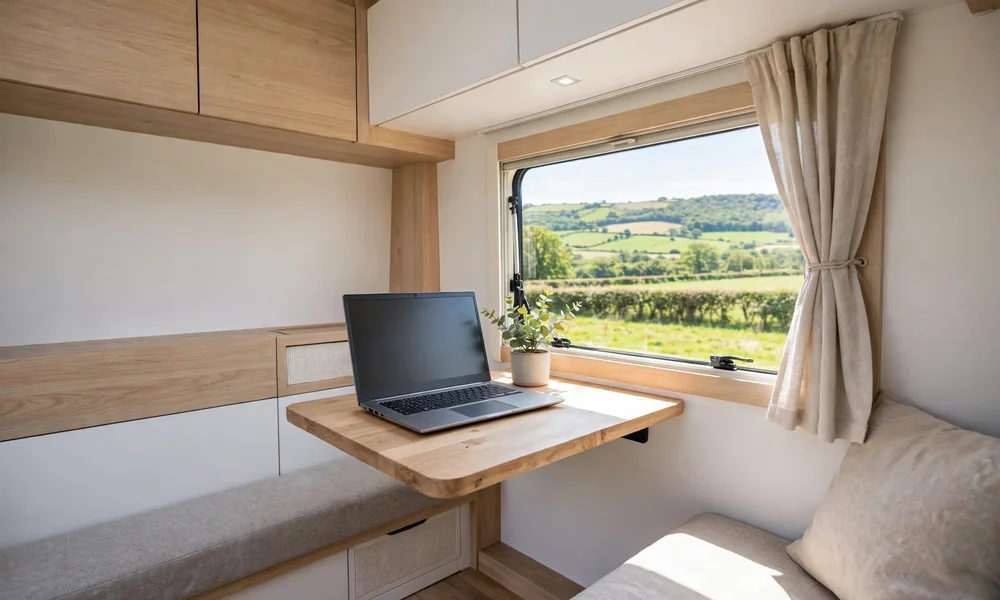
The service runs more than 7,000 servers in over 100 countries, so you can usually find a nearby server with low latency, even in rural areas. That matters for video calls and streaming in the evening, when campsite networks are at their busiest. For a close comparison with the nearest kind of road travel, see our guide to the best VPN services for RV travelers, which covers many of the same on-the-road network problems.
Pros: Fast NordLynx protocol, large server network, reliable kill switch, audited no-logs policy.
Cons: The desktop app can feel busy, and the cheapest price needs a two-year commitment.
Surfshark — Best value
Surfshark is the best value pick for campervan life, and the reason is the device limit: there is not one. A single subscription covers every phone, laptop, tablet, and smart TV in the van, which is exactly what you need when your whole household travels in one vehicle. On a long-term plan it costs roughly the price of a coffee per month.
Speed is solid rather than spectacular, and the WireGuard-based protocol keeps overhead low on weak campsite links. The app includes a kill switch, a CleanWeb ad and tracker blocker, and a GPS-spoofing feature on Android that can help location-based apps behave while you cross borders.
Pros: Unlimited devices, low long-term price, clean apps, useful extra features.
Cons: Speeds can vary by server, and the best price needs a two-year plan.
ExpressVPN — Best speed
ExpressVPN earns its place here on raw consistency. Its Lightway protocol connects in seconds and holds a steady speed even when the underlying connection is weak, which is exactly what a rural campsite or a remote lay-by delivers.
The apps are simple enough to set up in a few minutes, and the service works well on phones, tablets, laptops, and routers, which matters if you run a travel router in the van. It is more expensive than most rivals, and it allows eight simultaneous connections, which is enough for one or two travellers.
Pros: Very fast and stable Lightway protocol, simple apps, strong privacy record.
Cons: Higher price than rivals, and fewer simultaneous connections than Surfshark.
Proton VPN — Best privacy
Proton VPN is the privacy-first choice in this list. It is based in Switzerland, operates under a strict no-logs policy that has been independently audited, and offers a genuinely useful free tier, so you can test the service from your first campsite before paying. The paid plans add faster speeds, streaming support, and access to the full server network.
For campervan use, the standout feature is Secure Core, which routes traffic through privacy-friendly countries before it reaches its destination. That adds a small speed cost, so it is best saved for sensitive tasks such as banking rather than streaming.
Pros: Strong privacy credentials, audited no-logs policy, useful free tier, open-source apps.
Cons: Secure Core slows the connection, and the full feature set costs more than budget rivals.
CyberGhost — Best for beginners
CyberGhost is the easiest service in this guide to use, which counts for a lot when you have just arrived at a new site and want protection running before you unpack. The apps sort servers by purpose, with dedicated lists for streaming and torrenting, so you do not need to know anything about protocols or server load to get a good connection.
The network is large, with servers in more than 100 countries, and long-term prices are among the lowest here. Speeds are good for browsing and streaming, though they can dip on distant servers.
Pros: Very easy apps, servers sorted by purpose, low long-term price, long money-back guarantee.
Cons: Speeds vary on distant servers, and the interface offers fewer advanced settings.
Private Internet Access — Best for customisation
Private Internet Access, usually known as PIA, is the pick for travellers who like to tune their own setup. Its apps expose more settings than most rivals, including protocol choice, encryption level, and port forwarding, so you can trade a little security for extra speed when the campsite Wi-Fi is struggling. That flexibility is genuinely useful on a slow shared link.
PIA allows unlimited simultaneous connections and runs one of the largest server networks in the business, with servers in more than 90 countries. The trade-off is that the interface can feel technical at first, so it suits confident users more than complete beginners.
Pros: Unlimited devices, large server network, deep customisation, audited no-logs policy.
Cons: The interface can feel technical, and it is based in the United States.
Mullvad — Best for anonymity
Mullvad takes a different approach from every other service here: you do not need an email address or a name to sign up. You get a randomly generated account number, and you can pay in cash if you want no payment trail at all. For travellers who care about anonymity above all else, that is a meaningful difference.
The service is simple and honest about what it does. There are no long-term discounts and no flashy extras, just a flat €5 per month, a WireGuard-based connection, and a strict no-logs policy. The five-device limit is the main drawback, and there is no free tier, so it is best for travellers who already know they want a no-nonsense, privacy-first VPN.
Pros: No email needed to sign up, flat €5 monthly price, strong privacy record, simple apps.
Cons: Only five simultaneous connections, no free tier, and no long-term discount.
How to choose
Start by counting your devices. A campervan household often carries more connected gear than a hotel guest: two phones, a laptop, a tablet, and maybe a smart TV or a travel router. If your total is above five, pick a service with unlimited connections so you never have to choose which device goes unprotected.
Check the server locations along your route before you buy. A server in the country you are travelling through usually gives the lowest latency, and a large network means you are less likely to land on an overloaded server in the evening, when every campsite is streaming at once. Travellers with children in the van should also read our guide to the best VPN services for family vacations, since family trips add even more devices to protect.
Finally, consider installing the VPN on a travel router if your van has one. That protects every device that joins the van network automatically, including guests’ phones and smart devices that cannot run a VPN app themselves.
Checklist: before you pay
- Confirm the VPN has a kill switch on every device you will use in the van.
- Check that the server network covers every country on your route.
- Count your devices and make sure the simultaneous-connection limit covers them all.
- Compare the renewal price, not just the introductory offer, before committing to a long plan.
- Test the free trial or money-back guarantee on a real trip before a long journey.
- Check that the VPN supports a lightweight protocol such as WireGuard for slow campsite links.
Frequently asked questions
Do I need a VPN in a campervan?
Yes, if you use campsite Wi-Fi, café hotspots, or any shared network. Those networks are open to strangers, and a VPN encrypts your connection so other people on the same network cannot see your logins, messages, or banking sessions.
Will a VPN work on campsite Wi-Fi?
Yes, most campsite networks allow VPN traffic. Connect before you start working or banking, and choose a nearby server for the best speed.
Will a VPN slow down an already slow campsite connection?
It will add a small amount of overhead, but a good VPN using WireGuard or a similar lightweight protocol keeps the slowdown minimal.
Can I put a VPN on my campervan router?
Yes, if your travel router supports VPN clients. Many VPNs in this guide, including NordVPN, ExpressVPN, and Surfshark, offer router setup guides. A router VPN protects every device in the van automatically, including ones that cannot run a VPN app.
How many devices can I protect at once?
It depends on the service. Surfshark and Private Internet Access allow unlimited simultaneous connections, while NordVPN allows 10, ExpressVPN allows 8, and Mullvad allows 5.
Is it legal to use a VPN while travelling in a campervan?
In most countries, using a VPN for normal browsing, work, and streaming is legal. A VPN does not make illegal activity legal, and a small number of countries restrict VPN use, so check the rules for every country on your route before you travel. For tips on keeping video smooth on the road, see our guide to the best VPN services for streaming while traveling.
The bottom line
For most campervan travellers, NordVPN is the best overall choice: it is fast, it reconnects cleanly when you switch networks, and its kill switch protects you during handovers. If you need to cover a whole van full of devices on one subscription, Surfshark offers the best value, and if speed is your top priority, ExpressVPN is the better pick.
Whichever service you choose, set it up before you leave, enable the kill switch, and connect to a server close to where you are parked. Campsite Wi-Fi will never be fast, but with the right VPN it can at least be private.



