
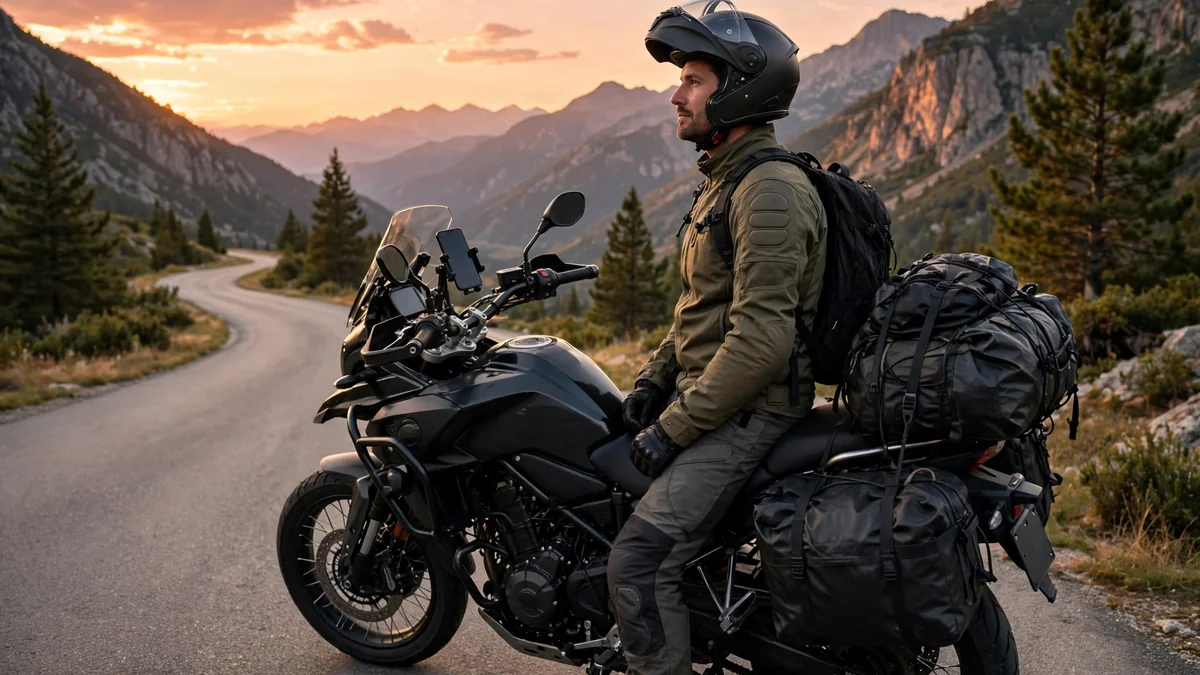
A motorcycle tour strings together a new network every few hours: a fuel station, a roadside cafe, a guesthouse, a border post. Each one is shared Wi-Fi that anyone nearby can watch, and your phone holds your route, bookings, banking and photos. The best VPN services for motorcycle travelers encrypt all of that traffic and keep working through the stops, the signal drops and the border crossings.
Riding changes what matters in a VPN. It has to connect in seconds when you join a new network, reconnect on its own after a dead zone, and run without draining a battery that also powers navigation and a camera. The app has to be usable one-handed, and the service has to cope with weak rural Wi-Fi.
We tested seven services against that brief. ExpressVPN leads for speed and simplicity on the road, NordVPN is the best choice for riders carrying several devices, and Surfshark is the best value for a touring pair or group. Here is the full shortlist.
Key takeaways
- ExpressVPN is the best overall VPN for motorcycle travelers, connecting in seconds on every new network.
- NordVPN covers 10 devices at once, enough for a rider’s phone, tablet, laptop and a pillion rider’s phone.
- Surfshark protects unlimited devices on one low-priced subscription, ideal for touring pairs and groups.
- Proton VPN has the only free tier worth using, with no data cap, a useful backup between trips.
- Mullvad needs no email address and charges a flat 5 euros a month, the most private option on this list.
At a glance: the shortlist
| Product | Best for | Starting price | Standout limit |
|---|---|---|---|
| ExpressVPN | Best overall | From about $4.99 a month | 8 devices |
| NordVPN | Best for multi-device | From about $3.39 a month | 10 devices |
| Surfshark | Best value | From about $1.99 a month | Unlimited devices |
| Proton VPN | Best free tier | From about $4.49 a month | Free tier included |
| Private Internet Access | Most customizable | From about $2.03 a month | Unlimited devices |
| CyberGhost | Best for streaming | From about $2.03 a month | Streaming servers |
| Mullvad | Most private | Flat 5 euros a month | No email needed |
Prices are approximate starting prices. Check current pricing before you buy, since plans and promotions change often.
ExpressVPN — Best overall for motorcycle travelers
ExpressVPN is the best all-round VPN for life on two wheels because it connects in seconds and stays connected. Each stop joins a new network, and Lightway gets you protected before you have even taken your gloves off.

The network covers 105 countries on RAM-only servers, so your data is never written to a disk. Speeds are strong enough for route downloads, video calls home and uploading ride footage, even over a weak roadside connection. It supports 8 simultaneous connections, For a broader comparison of travel-ready services, our best VPNs for travelers guide covers the same services from a general travel angle.
Pros: Connects in seconds on every new network; simple one-button app; RAM-only servers in 105 countries; router app for guesthouse networks.
Cons: Higher price than most rivals; only 8 simultaneous connections; no dedicated multi-hop mode.
NordVPN — Best for multi-device riders
NordVPN fits riders who carry a phone, a tablet and a laptop, plus a partner riding pillion with their own phone. Ten simultaneous connections cover the whole setup, and the kill switch is on by default, so a dropped connection at a roadside cafe never leaves your traffic exposed.
Meshnet lets you reach devices back home, useful for grabbing a file from a home computer or checking a home security camera while you are on the road. The apps include split tunneling, so your navigation app can stay on a direct connection while banking and messaging go through the VPN.
Pros: 10 simultaneous connections; kill switch on by default; Meshnet access to home devices; split tunneling for navigation apps.
Cons: No free tier; long-term plans are far cheaper than monthly billing; the server map can feel cramped on a small screen.
Surfshark — Best value for touring riders
Surfshark is the cheapest way to protect every device a touring rider carries. One subscription covers unlimited devices, so the phone on the handlebar mount, the tablet with the route plan, the laptop and a pillion rider’s phone are all protected without counting slots.
The network spans 100 countries with fast WireGuard speeds, and the apps include a kill switch, split tunneling and a camouflage mode that hides VPN traffic on networks that try to block it. Dynamic MultiHop routes traffic through two servers for extra privacy at border crossings and on shared guesthouse networks.
Pros: Unlimited simultaneous connections; lowest starting price; CleanWeb saves mobile data; camouflage mode for restrictive networks.
Cons: First connection can be slow on an unfamiliar server; some advanced settings sit deep in the menus.
Proton VPN — Best free option for riders
Proton VPN is the smartest backup for riders who do not want to pay for two subscriptions. Its free tier has no data cap and works in several countries, The service is based in Switzerland, audited independently, and built by the team behind Proton Mail.
Paid plans open the full network of more than 110 countries, plus Secure Core routing through privacy-friendly countries and NetShield blocking for ads and malware. The apps are open source, speeds on the paid tier are excellent, Ten simultaneous connections cover a rider’s full kit.
Pros: Free tier with no data cap; Swiss base with audited open-source apps; Secure Core routing; 10 simultaneous connections.
Cons: Free tier covers only a few countries; paid plans cost more than budget rivals; Secure Core can add latency.
Private Internet Access — Best for riders who like control
Private Internet Access gives touring riders more control than any other service on this list. You can choose your encryption level, switch between WireGuard and OpenVPN, set per-app split tunneling, and tune the kill switch.
The network is one of the largest available, with servers in more than 90 countries, and it allows unlimited simultaneous connections, so a riding group can share one account across several bikes. Speeds are solid on the main touring routes.
Pros: Unlimited simultaneous connections; deep customization and split tunneling; very large server network; low long-term price.
Cons: Based in the United States; the interface looks technical at first; speeds vary more between servers than some rivals.
CyberGhost — Best for streaming at the end of a ride
CyberGhost is the pick for riders who end the day streaming a film in a guesthouse. Its apps list servers optimized for specific streaming platforms, so you choose the right one instead of guessing, and the network covers 100 countries with more than 11,000 servers.
The apps are simple, with one-tap connect and clear profiles for streaming, torrenting and browsing. A kill switch and DNS leak protection come as standard, It allows 7 simultaneous connections, enough for a phone, a tablet and a laptop.
Pros: Streaming-optimized servers; huge network of 11,000-plus servers; simple one-tap apps; NoSpy servers run in-house.
Cons: Only 7 simultaneous connections; best value is on long-term plans; the desktop app can be slow to open.
Mullvad — Best for privacy-first riders
Mullvad asks for no email address and no name, just a randomly generated account number, and you can pay in cash. For riders crossing borders and joining networks they cannot vet, that minimal data collection is a genuine advantage.
The apps are deliberately plain, with an always-on kill switch and WireGuard as the default protocol. Speeds are good on the main routes, and the flat price of 5 euros a month has no long-term lock-in, so you pay only for the months you ride and stop without a renewal trap.
Pros: No email or personal details needed; flat 5-euro monthly price; always-on kill switch; audited and transparent.
Cons: No free tier; smaller network than the big brands; plain apps with no streaming-optimized servers.
How to choose
Start with connection speed, not server count. On a motorcycle tour you join a new network at every stop, so a VPN that takes a minute to connect will often be skipped, and a skipped VPN protects nothing. Pick a service with a lightweight protocol and a one-tap app, and test it on a weak cafe connection before you leave.
Next, check the device limit and the kill switch. A phone on the handlebar mount, a tablet with the route plan and a laptop in the pannier already use three slots, and a pillion rider adds more. Unlimited plans from Surfshark and Private Internet Access remove the limit entirely. The kill switch is just as important: it blocks traffic the moment the VPN drops, so a lost signal at a fuel station never exposes a login. Train Wi-Fi fails in the same ways, so our best VPN services for trains guide is worth a read too.
Finally, plan for borders and offline time. Download offline maps before each leg, use split tunneling so navigation stays direct while banking goes through the VPN, and make sure your subscription covers the countries on your route. Prices below are approximate starting prices, so check current pricing before you buy,
Checklist: before you pay
- Turn on the kill switch and auto-connect to untrusted Wi-Fi before the first leg.
- Install the VPN on every device you will carry and test each one at home.
- Download offline maps and check the VPN does not block your navigation app.
- Check the device limit against your phone, tablet, laptop and a pillion rider’s phone.
- Save the provider’s support page offline in case the app needs reinstalling abroad.
- Confirm the money-back guarantee period so you can switch if speeds disappoint.
Frequently asked questions
Do I need a VPN on a motorcycle trip?
Yes, if you use shared Wi-Fi at fuel stations, cafes, guesthouses or border posts. A VPN encrypts your traffic so other users on the same network cannot read your logins, bookings or banking details.
Will a VPN drain my phone battery on the road?
Only slightly. A modern protocol such as WireGuard or Lightway adds a small overhead, usually a few percent over a day of riding.
Can I use a VPN with my navigation app?
Yes. Use split tunneling to let the navigation app connect directly while the VPN protects your browser, banking and messaging apps. Most services on this list support split tunneling on Android and Windows.
Does a VPN work at border crossings?
It works wherever you have an internet connection, but some countries restrict VPN use, so check the rules for each country on your route before you ride.
Is a free VPN enough for a motorcycle tour?
For light use, the free tier of Proton VPN is the only one worth considering because it has no data cap. Most other free VPNs cap data, show ads or log browsing, which defeats the purpose. Our best VPN services for campervans guide covers the same risks for campervan trips.
Can one subscription cover two riders?
Yes, if the device limit allows it. Surfshark and Private Internet Access allow unlimited devices, so two riders can share one account. Services with 8 to 10 devices are usually enough for a pair as well.
The bottom line
For most motorcycle travelers, ExpressVPN is the pick: it connects fastest, stays connected through dead zones, and its one-button app is the easiest to use with gloves off at a fuel stop. Riders carrying several devices will do better with NordVPN or Surfshark.
Whatever you choose, install it and test it on a weak connection before the first leg. A VPN only protects you when it is running, and the one you have already tried at a roadside cafe is the one you will actually switch on at every stop.



