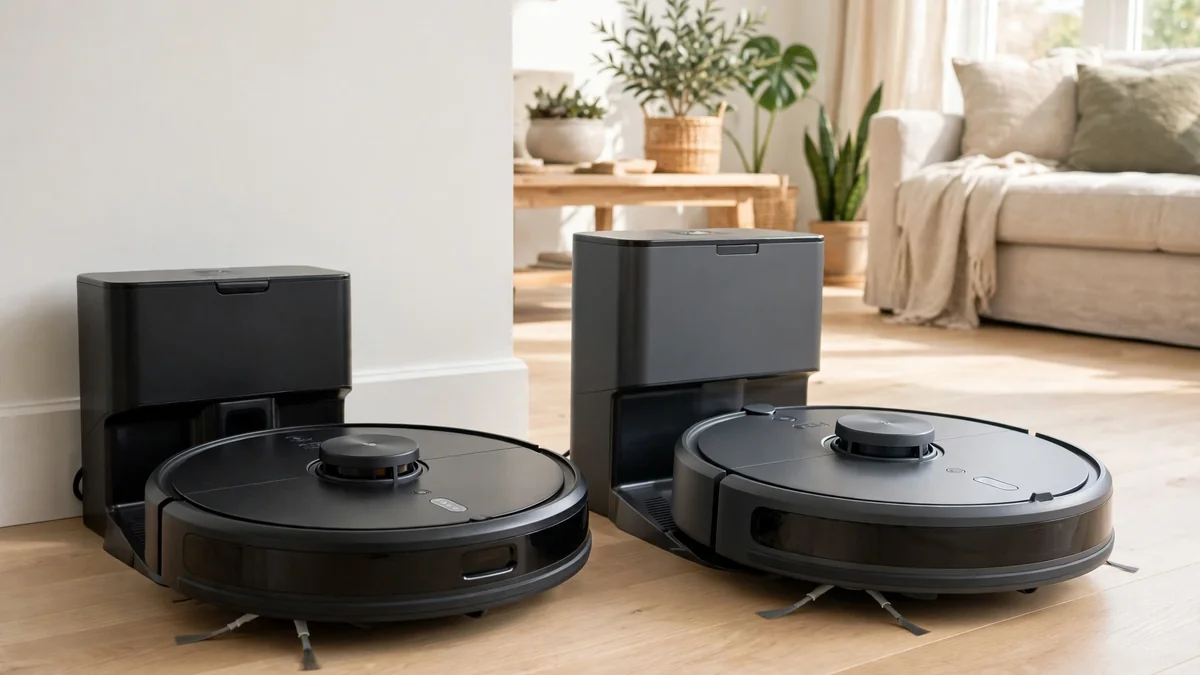
Roomba vs Shark robot vacuum in 2027 is the choice most buyers face when they want floors cleaned without pushing a vacuum themselves. Roomba, from iRobot, built the robot vacuum category and still leads on navigation, obstacle avoidance and hands-free emptying. Shark, from SharkNinja, arrived later and undercut Roomba on price while adding strong mopping and powerful suction.
The real difference is what each brand charges for, how much maintenance it asks of you, and which floors and messes you deal with most. Roomba models cost more upfront but need less attention day to day, especially with self-emptying docks. Shark models cost less, clean well with impressive suction, and bundle mopping into more of the range.
This comparison looks at the 2027 lineups on cleaning, navigation, pet hair, mopping, battery life, app control and running costs. Prices below are approximate starting prices, so check current pricing before you buy.
Key takeaways
- Roomba is the better pick for hands-free cleaning, pet hair and homes where the vacuum must avoid cables and pet messes on its own.
- Shark is the better pick for value, with strong suction and mopping bundled in at prices well below comparable Roombas.
- Roomba self-emptying docks and mapping are more polished, while Shark wins on cleaning power per dollar.
- Pet owners should weigh Roomba’s tangle-free rollers against Shark’s powerful suction and lower replacement costs.
- Neither brand suits every home, so match the vacuum to your floors, your pets and how much maintenance you will do.
At a glance: Roomba vs Shark
| Feature | Roomba | Shark |
|---|---|---|
| Best for | Hands-free cleaning and pet hair | Value, suction and mopping |
| Starting price | About $250 for entry models, $600 to $1,000-plus for self-emptying flagships | About $200 for entry models, $400 to $700 for self-emptying and mopping flagships |
| Navigation | Camera and lidar mapping on mid-range and flagship models | Lidar mapping on mid-range and flagship models |
| Obstacle avoidance | Strongest in the category on flagship models, including pet waste avoidance | Good on flagship models, weaker on budget models |
| Mopping | Available on Combo models, with a separate mop pad and lift on higher models | Built into many models, including sonic mopping on higher models |
| Pet hair | Dual rubber rollers resist tangles, strong pickup on carpet | Powerful suction and self-cleaning brushrolls handle heavy shedding well |
| App and voice | Polished app, room schedules, Alexa and Google Assistant support | Solid app, room mapping, Alexa and Google Assistant support |
| Running costs | Higher: dust bags, filters and rollers cost more | Lower: bags, filters and parts are generally cheaper |
Roomba: best for hands-free cleaning and pet hair
Roomba’s strength in 2027 is the whole system around the vacuum, not just the suction. Flagship models map a home in detail and let you send the vacuum to a single room or set keep-out zones from the app. That matters in a busy home, because the vacuum can run while you are out and finish without getting stuck on a cable or a stray sock.

Obstacle avoidance is where Roomba earns its premium. Higher-end models use a front camera and software trained to recognise cables, shoes, socks and pet waste, and steer around them rather than dragging them across the floor. No system is perfect, but in everyday testing Roomba flagships get stuck less often than almost anything else at their price.
Cleaning performance is strong rather than chart-topping. The dual rubber rollers are the standout feature for pet owners because hair wraps around them far less than around bristle brushes. On carpet it picks up embedded dust and pet hair well, and on hard floors it handles crumbs without scattering them. Suction figures trail Shark’s on paper, yet the result in a normal home is close.
The self-emptying dock changes daily life most. With a Clean Base, the Roomba empties its own bin into a sealed bag after each run, so you touch dust only every month or two. The bags add cost and the dock is bulky, but for allergy sufferers the sealed bags are a genuine benefit.
Roomba’s app is the most polished of the two. Mapping is quick, room naming is simple, and you can set schedules and suction levels per room and see where the vacuum went. Voice control covers starting, stopping and sending it to a room. The downside is price: the best models cost roughly twice as much as a comparable Shark, and replacement bags, filters and rollers carry a premium too. If you want a robot vacuum that mostly looks after itself, our guide to the best robot vacuums for pet owners shows which models handle shedding best.
Pros: Best obstacle avoidance, polished mapping and app, tangle-resistant dual rollers, excellent self-emptying system, reliable support network.
Cons: Higher prices, flagship features cost a lot, suction specs trail Shark, replacement bags and parts are expensive.
Shark: best for value, suction and mopping
Shark’s case in 2027 is simple: more cleaning hardware for less money. Shark robot vacuums typically offer higher suction ratings than Roombas at the same price, and the self-cleaning brushroll pulls hair off the roller as it spins, which helps in homes with long hair or heavy-shedding pets. The result picks up dirt, crumbs and pet hair effectively, especially on hard floors and low-pile carpet.
Mopping is where Shark pulls ahead. While Roomba sells mopping on its Combo models, Shark builds it into a much larger share of its range, and higher models add sonic mopping that scrubs the floor rather than just dragging a damp pad across it. If your home is mostly hard floors, Shark usually delivers vacuuming and mopping at a lower price than Roomba.
Navigation on Shark’s mid-range and flagship models uses lidar, which maps rooms accurately and cleans in tidy rows. The app lets you set rooms, no-go zones and schedules, and works with Alexa and Google Assistant. It is not quite as refined as Roomba’s app, but for most homes the difference is small once the first map is saved. Budget Shark models use simpler navigation and can miss spots, so buy a lidar model for a larger or more cluttered home.
Obstacle avoidance is Shark’s weakest area relative to Roomba. Flagship models avoid larger obstacles reasonably well, but they are more likely to nudge a cable, a shoe or a pet toy, and they do not match Roomba’s pet waste avoidance. Shark owners should do a quick tidy before a run. In a tidy home this is barely an issue; in a home with children or pets leaving things on the floor, it is worth weighing honestly.
Running costs favour Shark. Dust bags, filters and brushrolls are generally cheaper than Roomba’s, and Shark’s parts are widely available. Battery life is competitive, with most models covering a medium-sized home on one charge and returning to the dock to recharge and resume. Build quality is solid, though the self-emptying dock is louder than Roomba’s when it empties.
Pros: Strong suction for the price, mopping built into many models, self-cleaning brushroll, lower purchase and running costs, good lidar mapping on mid-range models.
Cons: Weaker obstacle avoidance, app less polished than Roomba’s, budget models navigate poorly, self-emptying dock is noisy.
Verdict: which robot vacuum wins in 2027
There is no tie here, because the two brands win for different buyers. Roomba wins if you want the vacuum to run itself with the least fuss: its navigation, obstacle avoidance and self-emptying system mean fewer rescues, fewer tangles and less dust handling, worth the premium if you run it daily or have pets. Shark wins if you want the most cleaning power per dollar and are willing to tidy the floor first, with suction and mopping that deliver a visibly clean floor for less money.
For a small apartment with hard floors, Shark is usually the smarter buy. For a larger home with carpets, pets and a busy schedule, Roomba’s mapping and avoidance pay off, because a vacuum that gets stuck costs you the time you bought it to save. If budget is the main constraint, buy the best lidar Shark you can afford rather than a cheap random-navigation model, since navigation decides whether the vacuum covers the whole floor.
How to choose
Start with your floors. Homes that are mostly carpet need strong pickup and a tangle-resistant brush, which points to Roomba’s rubber rollers or Shark’s self-cleaning brushroll. Homes that are mostly hard floors benefit more from mopping, which points to Shark, or to a Roomba Combo model if your budget stretches to it. Mixed floors suit either brand, provided you buy a model with proper mapping.
Next, count the obstacles. If cables, shoes, toys and pet messes are a daily reality, Roomba’s avoidance is the safer choice. If your floors are usually clear, Shark’s weaker avoidance rarely matters. A large home needs lidar mapping, recharge and resume, and a self-emptying dock. Our guide to the best robot vacuums for large homes covers the models with the range and bin capacity for bigger spaces.
Finally, be honest about maintenance. A self-emptying dock only helps if you replace the bags, and any robot vacuum needs its filter cleaned and its sensors wiped. Shark’s cheaper parts make that easier on the wallet, while Roomba’s sealed bags make it easier on allergies. Check current pricing first, since discounts are frequent and a flagship Roomba on sale can cost less than a mid-range Shark at full price.
Checklist: before you buy
- Measure your home and check the vacuum’s coverage and battery life against it.
- Confirm the model has lidar or camera mapping, not random navigation.
- Check whether a self-emptying dock is included or sold separately, and price the bags.
- Look at the brush design if you have pets or long hair, and check how tangles are handled.
- Check recent reviews of the app, since mapping quality varies by model.
- Confirm warranty length, support options and the cost of filters, bags and rollers.
Frequently asked questions
Is Roomba or Shark better for pet hair?
Both handle pet hair well. Roomba’s dual rubber rollers resist tangles, while Shark’s higher suction and self-cleaning brushroll pick up heavy shedding effectively.
Do I need a self-emptying dock?
It is worth it if you run the vacuum daily or have allergies. If you run it weekly in a small home, a standard bin is fine and saves money.
Which brand mops better?
Shark generally mops better for the price, with mopping built into more models and sonic scrubbing on its higher models. Roomba Combo models mop well, but they cost more.
Can either vacuum handle thick carpet?
Yes, both handle low and medium-pile carpet well, and flagships cope with thicker carpet too. Very thick, high-pile rugs can still challenge any robot vacuum. For small spaces, our guide to the best robot vacuums for apartments lists models that cope well in tighter rooms.
How long do Roomba and Shark robot vacuums last?
Most owners get three to five years with regular filter and brush replacement, though battery life fades over time.
Is the app required to use these vacuums?
No, both work with a single button press for a basic clean, but you need the app for mapping, room schedules, no-go zones and suction settings. That is where most of the value of a mapping model lives.
The bottom line
Roomba is the better robot vacuum for buyers who want the most hands-free experience, with the best obstacle avoidance, the most polished app and the least tangling. Shark is the better robot vacuum for buyers who want the most cleaning power and mopping for their money, with lower purchase and running costs.
Choose Roomba for a busy, pet-filled home where the vacuum must look after itself, and choose Shark for a value-first home where suction and mopping matter more than avoidance. Either way, buy a model with proper mapping and a self-emptying dock if your budget allows.