
A business website quiz is a short interactive set of questions on a company website that gives each visitor a personal result. The visitor answers a few questions about needs, taste, or knowledge, and the website replies with a product match, a score, or a type that fits those answers. The exchange takes a minute or two.
Small businesses use quizzes for a practical reason. A shop with fifty products cannot show every visitor the same home page and expect each one to find the right item. A quiz asks the questions a good salesperson would ask, and it asks them at the exact moment the visitor is ready to answer.
This article explains what a website quiz is, the kinds a small business runs, how a quiz differs from a survey and a poll, and what a team should do with the results once the answers arrive. The focus is the concept itself, not the software behind it.
Key takeaways
- A website quiz is an interactive set of questions that returns a personal result, such as a product match, a score, or a type.
- The three kinds that fit most small businesses are personality quizzes, knowledge quizzes, and product finder quizzes.
- A quiz differs from a survey because the visitor gets a result back, and from a poll because it asks several connected questions with scoring.
- Quiz results are useful for product recommendations, lead follow up, and learning what visitors actually want.
- A quiz earns trust only when the questions are fair, the results feel personal, and the data is handled with care.
What a business website quiz actually is
A business website quiz is a page or a section of a website where a visitor answers questions and receives an outcome shaped by the answers. The quiz usually has a short headline that promises a useful result, five to eight questions, and a results screen that names the outcome and suggests a next step. Some quizzes ask for an email address to send the full result.
The idea is older than the web. Magazine personality tests and the questions a shopkeeper asks a new customer work the same way: a few answers reveal what a person wants, and the answer shapes the recommendation. The website version does the same work at scale, day and night.
A quiz works because it trades value for attention. A visitor will answer questions when each question feels relevant and the result feels worth the effort. The match between the questions and the promise is what makes a quiz feel helpful instead of nosy.
The technology behind a quiz is simple to describe. A quiz builder holds the questions, the scoring rules, and the results. Scoring can be a simple tally, where each answer adds points toward one outcome, or it can be branching logic, where one answer changes the next question. Teams that want to compare builders can start with the best AI tools for creating quizzes for small teams, which covers the main options for a small team in 2027.
A quiz also has limits that matter. It can recommend, sort, and qualify, but it cannot replace a consultation, a trial, or a human conversation about a complex purchase. A small business should promise only what the quiz can deliver.
The kinds of quiz a small business runs
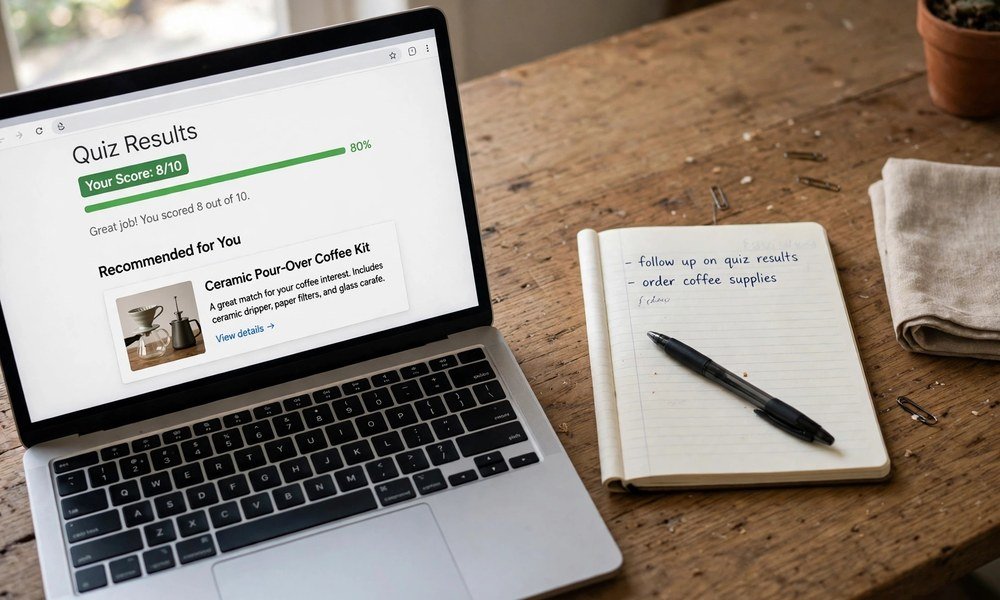
Personality quizzes sort visitors into types. A travel company might sort visitors into four traveller styles, and a coffee roaster might sort visitors into flavour profiles. Personality quizzes work when the brand has a strong voice and the result feels like a small piece of self knowledge. They are the most shared kind of quiz, because visitors like to tell friends about a result that sounds like them. The risk is a result that feels generic, when too few questions sort every visitor into the same type.
Knowledge quizzes test what the visitor knows, and give a score at the end. A training company can test readiness before a course, and a safety consultant can test whether a team knows the basics. Knowledge quizzes work when the score means something and the result explains what to do next. A score with a short plan, such as a reading list or a next course, turns a test into a useful tool. Knowledge quizzes need careful questions, because a wrong or unfair question damages trust fast.
Product finder quizzes ask about needs, budget, and taste, and then recommend one product or service. A mattress shop asks about sleep position, firmness, and budget. A plant shop asks about light, watering habits, and pets. Product finders are the most direct kind of quiz for sales, because the result is a buying recommendation. They work best when the catalogue is large enough that visitors genuinely struggle to choose. The best quiz maker software covers tools that handle all three kinds, with scoring and results pages built in.
Some quizzes mix the kinds. A fitness coach might run a quiz that tests knowledge and then recommends a program based on the score and the stated goals. Mixing works when the quiz still has one clear job.
How a quiz differs from a survey and a poll
A quiz, a survey, and a poll all ask questions on a website, and they are often confused with each other. The difference sits in what the visitor gets back, and in what the business does with the answers. A quiz gives the visitor a personal result. A survey gives the visitor nothing back, and the business keeps the answers for research. A poll asks one quick question, usually for fun or for a fast opinion, and shows the crowd result at once.
A survey is a research tool. It asks structured questions to collect opinions, and the answers are grouped and studied later. A survey can be long, because the respondent has agreed to help. The visitor answers to help the business, not to learn something about the visitor. The best survey software for small business covers the tools for this kind of research, which are built for analysis rather than for entertainment.
A poll is a single question with a few quick answers. A poll takes seconds, and the result is a share of votes. A poll cannot recommend a product or qualify a lead, because one question carries too little signal.
The practical test is simple. If the visitor should get a personal answer, build a quiz. If the business needs opinions from many people, run a survey. If the goal is a fast opinion on one question, run a poll. A survey dressed up as a quiz disappoints, because the visitor waits for a result that never arrives.
The caveats that matter
Quiz results feel personal, so a bad result does real damage. A visitor who answers honestly and receives a recommendation that ignores the answers will not trust the next recommendation. A quiz with biased questions pushes visitors toward the outcome the business wants to sell, not the outcome that fits.
| Detail | What is known |
|---|---|
| Core idea | Questions in, personal result out, usually a match, a score, or a type |
| Personality quiz | Sorts visitors into types, most shared, needs enough questions to sort fairly |
| Knowledge quiz | Tests what a visitor knows, needs a fair score and a clear next step |
| Product finder quiz | Recommends one product from needs, budget, and taste, best for large catalogues |
| Quiz vs survey | A quiz returns a result to the visitor, a survey keeps answers for research |
| Quiz vs poll | A quiz asks several connected questions, a poll asks one quick question |
| Main risk | Results that ignore the answers, or too many outcomes for too few questions |
| Data duty | Quiz answers are personal data, so the page needs a clear privacy note |
Privacy is the second caveat. Quiz answers reveal taste, budget, health habits, or money worries, depending on the business, and that information is personal data. The page needs a short privacy note, and the answers should go only to the tools the business uses. A quiz should never ask for a phone number, a home address, or a full date of birth before showing a result.
Checklist: judging a website quiz honestly
- The quiz returns a result that fits the answers, not a generic label.
- The questions are fair, plain, and free of jargon, with no answer that forces a wrong outcome.
- The kind of quiz matches the job: personality for identity, knowledge for testing, product finder for choice.
- The result names the outcome, explains the fit, and gives one clear next step.
- The quiz is not a survey or a poll in disguise, and the visitor knows what to expect before starting.
- Quiz data is handled with care, with a privacy note and no fields the result does not need.
Frequently asked questions
What is a business website quiz in simple terms?
A business website quiz is a short set of questions on a company website that gives each visitor a personal result. The visitor answers questions about needs, taste, or knowledge, and the website replies with a product match, a score, or a type. The whole exchange takes a minute or two.
What kinds of quiz can a small business run?
Most small businesses run one of three kinds. A personality quiz sorts visitors into types, such as traveller styles or flavour profiles. A knowledge quiz tests what a visitor knows and gives a score. A product finder quiz asks about needs and budget, then recommends one product or service. Some quizzes mix two kinds.
How is a quiz different from a survey?
A quiz gives the visitor a personal result at the end, while a survey collects opinions and gives nothing back. A quiz is built to help the visitor decide, and a survey is built to help the business learn.
How is a quiz different from a poll?
A poll asks one quick question and shows the crowd result, while a quiz asks several connected questions with scoring and gives a personal result. A poll suits a fast opinion. A quiz suits a recommendation, a score, or a match.
What should a small business do with quiz results?
Use the result to recommend the right product, to send a follow up that fits the outcome, and to learn what visitors want. A product finder result should point to one product, and a knowledge score should point to a next step. The answers in aggregate show which problems visitors bring to the site.
Do website quizzes work for service businesses?
Yes. A bookkeeping firm can sort visitors by readiness. A coaching business can match visitors to a program. A trades business can qualify a job by size, timing, and budget before a call. The questions change with the business, but the shape stays the same.
The bottom line
A business website quiz is a short conversation on a page. It asks a few fair questions, and it answers with a result that helps the visitor decide. The three kinds cover most needs: personality for identity, knowledge for testing, and product finder for choice. The difference from a survey and a poll is the result the visitor receives, and that difference is the whole point.
A small business that runs a quiz should keep the promise small and honest. Ask only what the result needs, and score the answers fairly. A quiz built that way earns attention, earns trust, and keeps working long after it goes live.
Note: Quiz formats, tools, and plan limits change often, so check the current details of any tool before buying, and test the full quiz flow before sending visitors to the page.