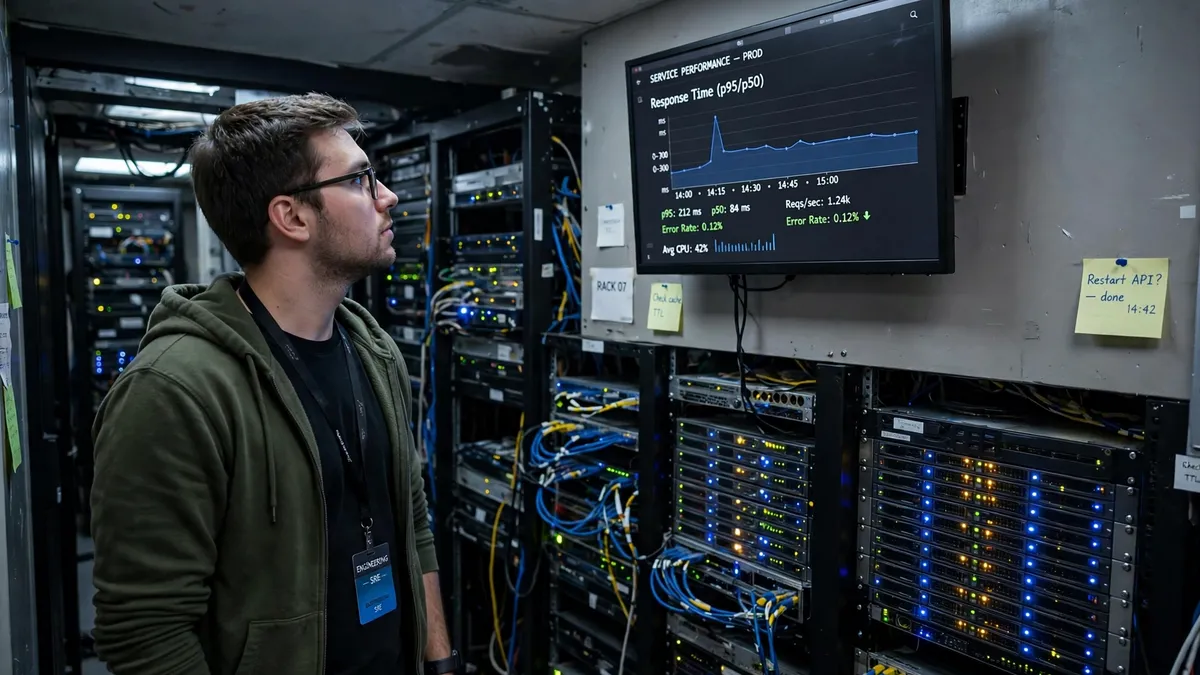
What Is an AI Inference Engine?
When you ask a chatbot a question and get an answer in seconds, a lot of invisible work happens between the question and the reply. The model was trained months earlier on enormous amounts of data, but training is only half the story. The other half is inference: the moment a trained model is used to produce an answer. An AI inference engine is the software that makes that moment happen, quickly and reliably.
The term sounds technical, but the idea is simple. A trained AI model is like a recipe book: full of knowledge, but useless until someone opens it and cooks. The inference engine is the kitchen: it loads the model onto hardware, runs the calculations, and returns results. Without it, even the best model would sit idle.
In 2027, inference engines matter more than ever because AI has left the research lab. Models now run in customer service chats, photo apps, cars, factories, and phones, and each needs answers in milliseconds, not minutes. This article explains what an AI inference engine is, how it works, the main types, and where you are likely to meet one.
Key takeaways
- An AI inference engine runs a trained model to produce answers, predictions, or decisions — the “using” half of AI, as opposed to training.
- Its main job is speed and efficiency: getting the most answers per second out of the available hardware.
- Inference engines run in the cloud, on company servers, and increasingly on devices like phones and cars.
- The same model can behave very differently depending on the engine running it.
- Choosing an engine means balancing latency, cost, accuracy, and privacy.
What an AI inference engine actually is
An AI inference engine is a software system that loads a trained machine learning model and serves its predictions to users or applications. It sits between the model and whoever needs answers. When a request arrives — a question, an image, a voice clip — the engine prepares the input, runs it through the model, and sends back the output.
To see why a dedicated engine is needed, consider what happens without one. A raw trained model is a large file of numbers plus a set of operations, and running it means loading those numbers into memory, arranging the calculations efficiently, and handling many requests at once. Doing that by hand for every application would be slow and error-prone, so inference engines package the whole job into a reusable system.
It helps to separate inference from training, because the two are often confused. Training is the long, expensive process of teaching a model by showing it examples until it learns patterns — a process explained in our guide to what machine learning is. Inference is what happens afterwards, every time the trained model is used.
How an inference engine works
An inference request follows the same path whatever the model is doing. First, the engine receives the request and checks it: is it the right format, is it within the size limits, and is the user allowed to make it? Then it prepares the input, converting text, images, or audio into the numerical form the model expects. This step, called preprocessing, can take a noticeable share of the total time.
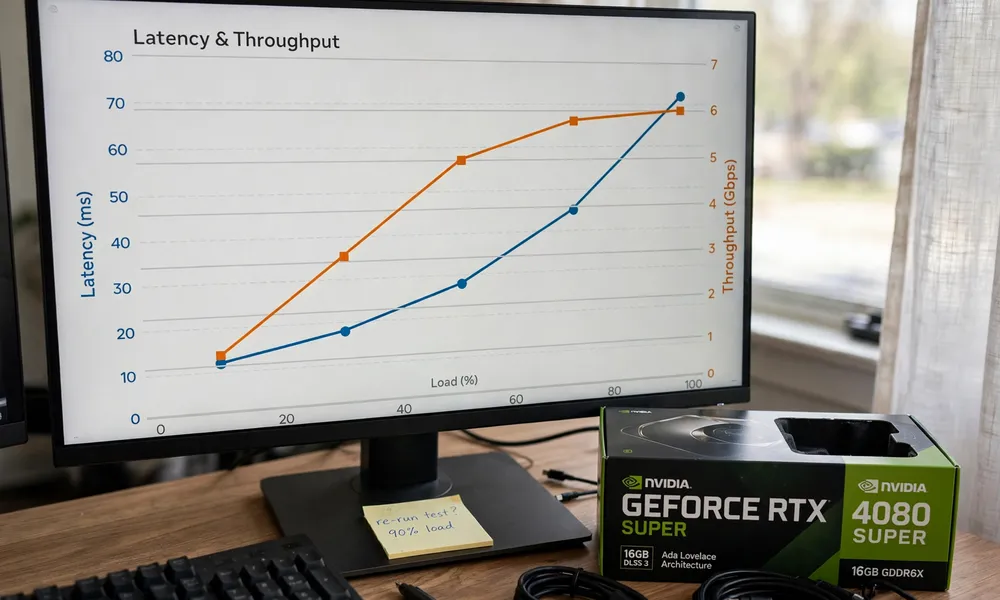
Next comes the core step: running the model. The engine feeds the prepared input through the model’s layers of calculations, usually on a graphics processing unit, which can do many calculations at once. The engine decides how to split the work across the hardware, how to group requests into a batch, and how much memory to reserve. A good engine earns its keep here: the same model can answer twice as fast on a well-tuned engine.
Finally, the engine converts the model’s raw output back into something useful — words, a label, a score — and sends it to whoever asked. It also records how long each request took, so operators can spot slowdowns. The whole round trip is measured in milliseconds for most everyday uses, and users notice quickly when it stretches into seconds.
Types of inference engines
Cloud inference engines run on remote servers, often in large data centres. They suit unpredictable traffic, because capacity can be added or removed as demand changes, and very large models that would not fit on a single device. Most chatbots and web-based AI tools you use in 2027 run on them.
On-premises engines run on servers a company owns and controls, inside its own buildings. They are common in finance, healthcare, and government, where data cannot leave the organisation, and in factories with unreliable network connections. They cost more to set up, but they give the owner full control over the hardware, the data, and the system.
Edge and on-device engines run directly on the device itself — a phone, a car, a camera, or a piece of industrial equipment. They are used where answers must be instant, where there is no network connection, or where sending data to the cloud would raise privacy concerns. Voice assistants that work offline and driver-assistance systems all rely on on-device inference, though the trade-off is that device engines run smaller, simpler models than cloud engines can.
Benefits and risks
The clearest benefit of a good inference engine is speed. By grouping requests, reusing calculations, and keeping the model loaded in memory, an engine can answer many more requests per second than a naive setup, and at a lower cost per answer. For a company serving millions of users, that decides whether the service is affordable.
The risks are real too. An engine tuned purely for speed can quietly reduce accuracy, for example by rounding numbers or skipping steps, and the change may not be obvious until users complain about worse answers. Engines also add complexity: more moving parts means more places something can go wrong. And because inference engines often run on shared cloud hardware, there are privacy questions about where data travels. There is also a cost risk — a feature that is cheap in testing can become expensive at scale.
Real-world uses
You meet inference engines constantly without noticing them. When a chatbot answers you, an inference engine is running the language model behind it — the kind of system described in our explainer on what generative AI is. When your phone transcribes a voice message or sorts your photos, an on-device inference engine is doing the work locally. When a streaming service recommends a film, an inference engine scored thousands of candidates in milliseconds.
In business, inference engines power fraud detection that scores transactions as they happen, support systems that draft replies for agents, and cameras that spot defects on a production line. In healthcare, they flag suspicious scans for radiologists to review. In vehicles, they run the models that read road signs and warn drivers of hazards — all in real time, where a delay of a second would matter.
Developers meet inference engines more directly. When a team ships an AI feature, someone has to choose an engine, configure it, and keep it running, which is why inference has become a core part of modern software work. Because most inference still runs on rented infrastructure, the choice of engine is closely tied to the choice of computing platform — see our guide to what cloud computing is for the basics.
AI inference engines at a glance
| Detail | What to know |
|---|---|
| What it does | Runs a trained model to produce answers on demand |
| Opposite of | Training, the process of teaching the model |
| Where it runs | In the cloud, on company servers, or on the device itself |
| Main goal | Fast, cheap, reliable answers |
| Key measures | Latency, throughput, cost per answer, and accuracy |
| Common hardware | Graphics processing units and AI chips |
| Typical uses | Chatbots, photo sorting, voice transcription, recommendations |
| Main trade-off | Speed and cost versus accuracy, privacy, and control |
How inference engines compare
Compare inference engines along a few clear dimensions, not one speed score. Latency is how long one request takes, and it matters most for interactive uses such as chat, where users feel every extra tenth of a second. Throughput is how many requests the engine handles per second, and it matters most for batch work such as processing a backlog of documents overnight.
Cost per answer is the figure that decides budgets: two engines can serve the same model at very different prices. Accuracy is the dimension most often forgotten — an engine that answers quickly but slightly wrongly is not a bargain. Ease of use matters too: an engine that only a specialist can operate becomes a bottleneck.
How to choose an inference engine
Use this checklist before committing to an engine for a real product.
- It runs your model well, not just the models in the vendor’s demo.
- It meets your latency target for your slowest realistic request.
- Its cost per answer stays affordable at your expected traffic.
- It keeps accuracy within the range your users will accept.
- It handles your privacy requirements, including where data is processed.
- It lets you monitor performance and update the model without downtime.
If you are building a small feature, start with a managed cloud engine and measure real usage before investing in anything more complex. If privacy rules force the model onto the device, accept the smaller model and design the feature around what it can do.
Frequently asked questions
What is the difference between AI training and AI inference?
Training is teaching a model by showing it examples until it learns patterns; it is slow, expensive, and usually done once. Inference is using the trained model to answer new questions; it is fast and repeated millions of times, and is what an inference engine handles.
Is an inference engine the same as a model?
No. The model is the trained set of numbers and rules that knows how to answer. The inference engine is the software that loads the model, runs it efficiently, and serves its answers. The same model can run on different engines and perform very differently.
Where do inference engines run?
In the cloud on rented servers, on servers a company owns, or directly on devices such as phones and cars. Cloud engines suit large models and changing traffic; on-device engines suit instant answers and offline use.
Why does inference speed matter so much?
Because users feel it directly. A chatbot that answers in half a second feels helpful; one that takes five seconds feels broken. Speed also controls cost: a faster engine serves more users on the same hardware.
Can inference engines run on a phone?
Yes, and many already do. Phones run smaller, efficient models for voice transcription, photo sorting, and predictive text, using on-device inference engines. Large models still need cloud hardware, but the gap narrows every year.
How do I know if an inference engine is accurate enough?
Measure it on your own data, not on the vendor’s benchmark. Run a sample of real requests through the engine, compare the answers with the unoptimised model’s results, and check whether the difference matters for your users. If accuracy drops noticeably, the speed gain is not worth it.
The bottom line
An AI inference engine is the part of AI you never see but always feel. It takes a trained model and turns it into a service: fast enough to use, cheap enough to run at scale, and reliable enough to trust. As AI spreads into more products in 2027, the engine behind a feature matters as much as the model itself.
For anyone building with AI, the practical lesson is simple: do not judge a model in isolation. Ask how it will be served, where it will run, what each answer will cost, and how you will know if it gets slower or less accurate. Answer those questions early.