An LLM is an AI model that learns patterns from text and uses them to generate new language. You may meet one when an app answers a question, drafts a note, or shortens a long report. These tools can save time, especially when you need a quick first pass through information.
A token is a unit of text, such as a word, part of a word, or character, that a model processes. The term can sound technical, but the basic idea is simple: the model handles text in small pieces. You can use the result as help, while keeping your own judgment in charge.
This explanation covers what the technology does, how it learns, and where it can fall short. It will help you read an answer with care, whether you use an app for school, work, or daily tasks. The system can produce fluent words without thinking like a person.
Treat a generated answer as a useful starting point, not automatic proof that its claims are right.
Key Takeaways
- An LLM learns patterns from text and generates language.
- Tokens are small units of text the model processes.
- An app and the model behind it are different things.
- LLMs can help with writing, coding, translation, and summaries.
- Check important facts before acting on a response.
What Is a Large Language Model?
An LLM is a text-trained AI model that generates language by using patterns learned across a very large collection of text. It predicts how words and other text units are likely to fit together. Large refers to scale, though scale has more than one meaning.
Training text can include billions or trillions of words from books, articles, websites, and code. After training, a model has learned internal variables called parameters. Some LLMs have billions or trillions of parameters, but those numbers do not count the training words.

Training text and parameters describe different parts of a model. The text is material used during learning; parameters are learned values that shape how the model handles a prompt. GPT-3, released in 2020, had 175 billion parameters, a historical example rather than a current performance measure.
For a plain-language definition, a large language model in AI is a text-trained AI model that predicts language patterns. It does not store each book or page as a neat set of facts. It learns relationships that help it produce likely responses.
That distinction helps explain why an answer may sound certain but still contain a mistake. A model can form a response from patterns, even when it lacks a reliable fact about a specific event.
“Large” describes the scale of the text and learned parameters, not a guarantee of capability.
The beginner’s guide to LLMs in AI also explains how model size differs from what a tool can do. More parameters alone do not show whether a model will work well for your task.
How Is ChatGPT Related to GPT, LLMs, and AI?
ChatGPT is a user-facing app built on OpenAI GPT models, while GPT names the underlying model family. App and model are different terms. ChatGPT is not the name of one model.
OpenAI launched ChatGPT in December 2022. GPT refers to a family of models, and different versions can power an app over time. An app is the tool you interact with; a model is the language system working behind it.

LLMs are one type of AI, focused on language tasks. AI is the wider field of systems that perform tasks linked with human abilities, such as learning or making decisions. The difference between AI and machine learning helps place LLMs within that wider field.
Generative AI is another broad term. It includes systems that create new content, such as text, images, audio, or video. LLMs generate language, while other generative AI models can produce different kinds of output.
This means one app may offer access to more than one model or feature. A product name can stay familiar even as its underlying models change. The reverse is also true: one model family may appear in several apps.
When you hear a model name, check whether it refers to the app, the model family, or a particular model version.
How Does an LLM Generate Text?
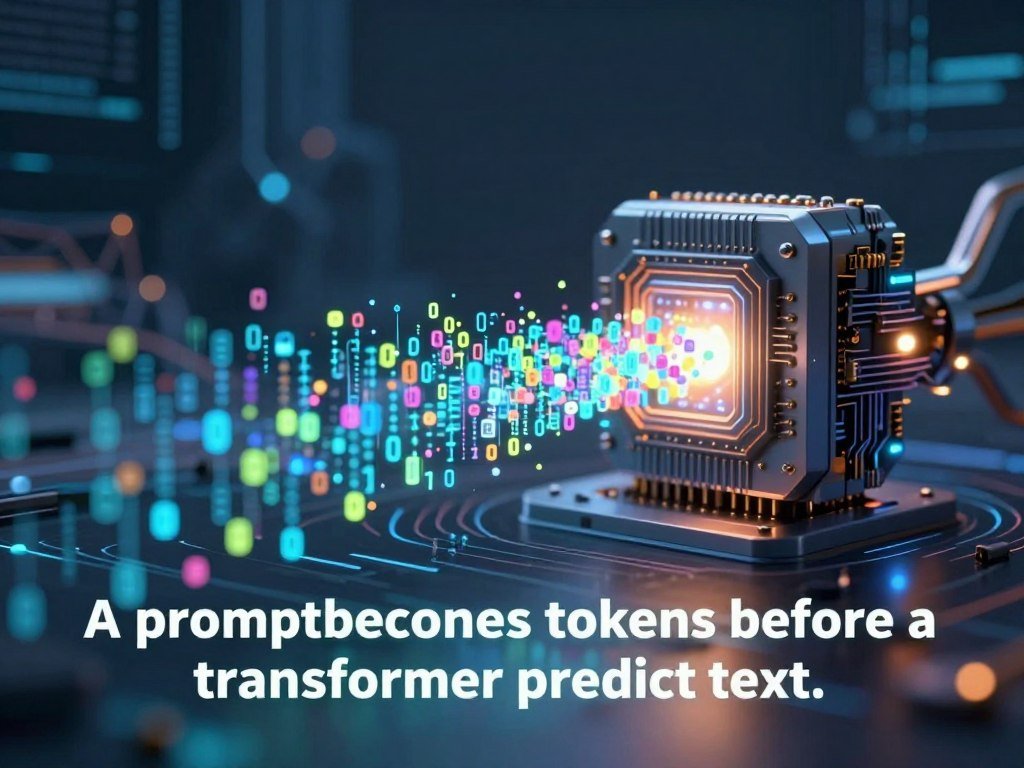
When you submit a prompt, the model processes its text and starts calculating which token is likely to come next. Each token is turned into numbers the model can work with. The model then builds a response a piece at a time.
A token may be a whole word, part of a word, or a character-sized unit. A short word may fit in one token, while a longer or less common word may split into several. The exact split depends on the model’s text system.
What tokens and parameters represent
Numbers represent each token in a form the model can process. Parameters are learned internal variables that guide how those representations affect predictions. Together, they help the model weigh text from the prompt and its growing response.
Think of parameters as many small settings inside a large language model. They shape how the model responds to patterns it has learned. They are not a tidy list of facts or instructions that a person can read like a manual.
Most modern LLMs use a transformer architecture. Researchers introduced transformers in 2017, offering a new way to handle relationships among text units. The original paper, “Attention Is All You Need”, describes this architecture.
How self-attention supports next-token generation
Self-attention helps a transformer weigh how tokens relate to one another. It can connect words that sit far apart in a passage, not just words beside each other. That context can change which next token seems likely.
For example, “the bank raised its rates” could refer to a financial institution. Nearby words guide that reading; a river might point toward a different meaning of “bank.” The model weighs those clues while processing the sentence.
Next, it predicts a likely token, adds that token to the text, and repeats the calculation. Each new token becomes part of the context for the next prediction. The app may also apply settings that shape how predictable or varied the answer sounds.
The answer is produced one token at a time, not retrieved as a complete prewritten response.
How Are LLMs Trained and Fine-Tuned?
Pretraining gives an LLM broad language patterns, while fine-tuning can adapt its behavior to a more specific task. Pretraining comes first, and it usually uses a large amount of text. Fine-tuning shapes an existing model rather than rebuilding it from scratch.
In pretraining, an LLM learns from unlabeled data through self-supervised learning. The model uses text itself to learn patterns and relationships, such as which words often appear together. The data does not need a person to label every sentence with its meaning.

Pretraining learns broad patterns
Pretraining teaches a model broad language patterns across many kinds of text. It can help the model form useful answers across topics, but it does not ensure that every answer is true. A model’s training can shape its responses without giving it perfect knowledge.
Pretraining also takes substantial computing resources. Starting over means repeating the large training process, which is costly in time and computing power. It is usually unnecessary when the goal is to adapt an existing model to a narrower task.
Fine-tuning adapts a model to tasks
Fine-tuning uses additional examples to adjust how a pretrained model handles a particular job. A team might adapt a model for summarization, classification, or customer support. For customer support, examples could show the style and steps expected in replies.
Fine-tuning generally uses fewer resources than training from scratch. It can make a model more suited to a task, but it does not automatically add current facts or remove every error. It changes the model’s behavior through more targeted examples.
Feedback can also shape how a model responds, depending on the techniques used. The details vary across systems, but the basic distinction remains: broad learning happens first, and task adaptation follows. Fine-tuning changes how a model handles a task without requiring the full training process to start again.
What Do Large Language Models Do Best?
LLMs are most useful for language-heavy tasks such as drafting, summarizing, translating, and organizing information. They can take a first pass at work that begins with words or documents. They are helpers, not a replacement for checking the result.
Writing tasks include drafting a note, editing a paragraph, or changing the tone for a different audience. LLMs can also answer questions about supplied material and turn a long document into a brief. GPT and BERT are named model families used for language tasks.
Writing and information work
Summaries can help you scan a report before reading the parts that matter most. A model can also pull key details from a document, such as dates or names. Classification sorts text into set groups, such as billing, delivery, or account support.
Here are six examples of prompts and useful outputs:
- Prompt: “Turn this long report into a short brief.” Output: a compact summary.
- Prompt: “Rewrite this email for a new audience.” Output: a revised email.
- Prompt: “Translate this passage into Spanish.” Output: a translated passage.
- Prompt: “Classify these support requests.” Output: a category for each request.
- Prompt: “Extract dates and names from this document.” Output: a list of details.
- Prompt: “Draft a test for this function.” Output: a possible code test.
Code, translation, and structured tasks
LLMs can translate text, generate code, or help debug a code snippet. They can also turn a set of documents into structured information, such as a table of dates and names. Clear instructions and a small example can help define the format you need.
Code generation can speed up a first draft, but a convincing answer is not proof that the code works. A test may miss edge cases, and a suggested fix may cause a new bug. Run and test generated code before relying on it in a working application.
The working paper on generative AI and developer work studied how GitHub Copilot changed developers’ work activities. Such tools can shift time toward coding, but they do not remove the need to review code.
Which Large Language Models Can You Use?
Claude is an LLM-powered assistant, just as ChatGPT and Gemini are familiar ways to interact with language models. These names do not all mean the same thing: some name an assistant, and others name a model family. An app can use several versions from one model family.
ChatGPT, Claude, Gemini, and Grok are chatbot examples built around LLMs. Qwen and DeepSeek also offer LLM-powered tools and models. What you can do with each product depends on its features and the model version it provides.
Familiar assistants and their underlying models
The table separates familiar names from the models they refer to. Claude is the assistant and product name; Claude models are the underlying language systems. The same distinction helps when you compare ChatGPT with other tools.
| Assistant or model name | What the name refers to | Associated organization |
|---|---|---|
| ChatGPT | Assistant built on OpenAI GPT | OpenAI |
| Claude | Assistant using Claude models | Anthropic |
| Gemini | Assistant using Gemini models | |
| Llama | Family of Llama models | Meta |
| DeepSeek | Assistant and DeepSeek models | DeepSeek |
Model families and release names
A model family can include several versions, each with different strengths, costs, or access rules. An app may offer one version for quick replies and another for harder tasks. Release names can change, so check the full model name when comparing results.
There is no single AI replacing ChatGPT. Claude, Gemini, and other assistants are alternatives, and one may suit a task better than another. Grok, Qwen, and DeepSeek offer further options for people who want different tools or features.
A model list is most useful when it separates the model families from individual products and versions. For a clear comparison, note both the assistant you use and the named model behind it.
How Should You Compare LLM Performance?
A model can lead one benchmark and rank lower on another because each test measures a different slice of performance. A benchmark is a test built around defined tasks. Its score does not measure every real-world ability.
The Artificial Analysis Intelligence Index v5 gives 25% of its score to each of four areas: knowledge work, coding, science, and general tasks. FrontierCode 2.0 and Terminal-Bench-Science each receive 15% of the index’s total weight. Those task scores help explain what a combined score means.
What the index weights
FrontierCode 2.0 tests real-world repository tasks. It asks whether a maintainer would merge the proposed code change. Terminal-Bench-Science tests 70 research tasks in a terminal environment, where a model must complete scientific work.
The table reports Intelligence Index v5 scores for the supplied comparison. The leading model scored 58, while the highest-scoring open-weights model scored 46. Models with released weights scored 32 each.
| Comparison group | Model or models | Intelligence Index v5 score |
|---|---|---|
| Overall leader | Claude Opus 5.5 (max) | 58 |
| Next | GPT-6 Astra (max) | 57 |
| Next | GPT-6.1 Sol (max) | 55 |
| Leading open-weights model | Kimi K3.1 Pro | 46 |
| Leading released-weight models | DeepSeek V4.1 Flash 1017 (max); GLM-5.3 (max) | 32 each |
Why task-level scores can disagree
Claude Opus 5.5 (max) scored 46% on FrontierCode 2.0, ahead of GPT-6 Astra (max) at 42%. GPT-6 Astra led Terminal-Bench-Science at 63%, followed by Claude Opus 5.5 at 59%. A strong result in one area does not guarantee the top score elsewhere.
Other tests give different views. On HLE-Diamond, a set of 1,000 questions split evenly between reasoning and knowledge, Claude Opus 5.5 scored 68%, while GPT-6 Astra scored 64%. Claude Opus 5.5 also led AA-Omniscience v1.1 with a score of 48.
The Artificial Analysis Intelligence Index combines several evaluations into one score. Its results can help narrow choices, while a task-specific test can show whether a model fits your actual work.
Cost and performance tell different stories
Claude Opus 5.5 (max) cost $10.04 per task in the comparison, while GPT-6.1 Sol (max) cost $1.27 per task and scored within four points. A higher score can come with a higher task cost. Your workload may not need the top result on every test.
Benchmarks also change as models improve. SWE-bench Verified results rose from 60% to nearly 100% in one year, while AI agents’ OSWorld task success rose from 12% to about 66%. Agents still failed roughly one in three attempts on a structured benchmark.
Use a benchmark as evidence about its test, not as a promise about every prompt you may give. Compare scores for the task you need, rather than choosing by the highest number on one leaderboard.
What Can Go Wrong When You Use an LLM?
A fluent response can still be wrong because an LLM predicts likely text rather than checking every claim against reality. Plausible wording can hide a false date, invented detail, or faulty explanation. Fluency is not proof of truth.
People often call inaccurate or fabricated output a hallucination. The model can produce a confident answer even when the prompt lacks enough detail. Bias or errors in training data can also shape responses and make some views less visible.
Why plausible text can be wrong
NIST describes generative AI as models that imitate the structure and traits of input data to create synthetic text, images, video, or audio. Its 2025 Generative AI Profile is a voluntary companion to the AI Risk Management Framework. It frames risk management across the AI lifecycle.
That lifecycle view matters because risk can arise during design, use, or later review. A team may need to consider how data, users, and the setting affect a system. A polished response alone cannot show that the system handled a claim correctly.
Use this short checklist when a response could affect a decision:
- Check factual claims against primary material.
- Verify dates and names.
- Recalculate figures that matter.
- Do not treat a detector as sole proof of authorship.
Bias, incidents, and detection limits
Documented AI incidents rose to 362 in 2025, up from 233 in 2024. A count cannot explain every cause, but it shows why teams need plans for handling errors. Risks can affect people and organizations in different ways.
A 2025 study tested 1,000 academic texts: 250 written by people and 750 generated by ChatGPT 3.5, 4, and 4o. Three AI-text detectors had ROC area-under-the-curve results from 0.75 to 1.00. None reliably separated every AI-written text from human writing.
The study focused on academic texts, not every kind of writing. A detector may flag a passage, but its score cannot prove who wrote it. Ways to assess possible AI-written text include checking drafts and comparing the passage with a writer’s earlier work.
Treat an AI detector as one imperfect signal, never as sole proof that a person did or did not write a passage.
How Do You Choose and Use an LLM?
Choose an LLM by the job it must do and the information it must handle, not by its name alone. Start with the task, then consider privacy, tools, and how much context the model needs. Context size and app usage limits are separate measures.
Retrieval-augmented generation (RAG) gives a model outside information by finding relevant material and placing it in the context. RAG does not retrain the model. It can help when a response needs details from a set of documents.
Gemini Apps context windows differ by plan. A context window is the amount of information a model can handle at once, not the number of times you may use the app.
| Gemini Apps plan | Context window |
|---|---|
| No AI plan | 32k tokens |
| AI Plus | 128k tokens |
| AI Pro or AI Ultra | 1 million tokens |
Usage limits can depend on prompt complexity, model and feature choice, and chat length. Gemini Apps limits refresh every five hours until a weekly limit is reached. If you hit a cap, you may need to wait for a refresh or choose a plan with higher limits.
As of October 9, 2026, Gemini users without a Google AI subscription are limited to Flash-Lite. AI Plus users can use Flash-Lite and Flash, but not Pro. Google AI Pro subscribers are to receive Gemini Deep Think for maximum parallel reasoning starting in October 2026.
Use this checklist before choosing a tool:
- Define the task.
- Check privacy requirements.
- Confirm context and usage limits separately.
- Test the workflow with a short, representative input.
Keep a fallback workflow for tasks that cannot pause when an app reaches its usage cap.
Conclusion
LLMs are most useful when you match the tool to a clear task and stay responsible for the result. They can help you shape text, sort information, and start work faster. Their limits still matter when an answer affects a grade, a customer, or a real decision.
Pick a low-stakes task, such as rewriting a short email or summarizing a public article. Give the same prompt to two available tools, then check both results against the original. Notice which one is clearer and more accurate for your purpose.
Try one low-stakes task with the same prompt in two tools, then keep the one that best fits your needs.
FAQ
Is ChatGPT an LLM or generative AI?
ChatGPT is an app built on OpenAI GPT models, which are LLMs. Generative AI is the broader category, covering systems that create text, images, audio, or video. ChatGPT is a way to use language models through an app. Its name does not identify one fixed model version, since the app can offer different GPT models.
What is the difference between GPT and LLM?
GPT is a model family, while an LLM is a type of AI model trained for language tasks. GPT models are LLMs, but GPT is not the only LLM family. The letters GPT stand for “generative pretrained transformer.” A product may give you access to a GPT model through an app, while other tools use different model families.
What is the difference between AI and LLM?
AI is the broad field of computer systems that perform tasks linked with human abilities. An LLM is one kind of AI model, focused on processing and generating language. Other AI systems may work with images, speech, planning, or data. Calling an LLM “AI” is correct, but the wider term includes many systems beyond language models.
What are the top 5 LLM models?
The top five depend on the benchmark and task you care about. Artificial Analysis Intelligence Index v5 lists Claude Opus 5.5 (max) at 58, GPT-6 Astra (max) at 57, and GPT-6.1 Sol (max) at 55. Those are the three highest scores in the listed comparison. Other strong choices may rank higher on coding, science, cost, or another measure.
What is the smartest LLM model right now?
Claude Opus 5.5 (max) leads Intelligence Index v5 with a score of 58. That answer applies to this combined benchmark, not every task. GPT-6 Astra (max) leads Terminal-Bench-Science with 63%, so a science task can point to a different model. The best fit depends on the work you need done and the cost you can accept.
What LLMs are better than ChatGPT?
No model wins every task, so “better” depends on what you need. Claude Opus 5.5 (max) leads Intelligence Index v5, while a different model may suit a specific task or budget. Per-task cost can also change which option fits. Compare the actual output on your own kind of work, rather than relying only on a single overall ranking.
What are the best free LLMs right now?
The best free option depends on your task and the access limits in place. Starting October 9, 2026, Gemini users without a Google AI subscription are limited to Flash-Lite. Other apps may offer free access to different models or features. Check whether the free tier handles your file size, privacy needs, and expected number of prompts before building a workflow around it.
Can ChatGPT be detected?
Detectors can flag text that may be AI-generated, but they cannot prove authorship. A 2025 study of academic texts found detector ROC area-under-the-curve results from 0.75 to 1.00, and none was fully reliable. The study tested 250 human-written texts and 750 generated texts. Results may differ for other writing, so use drafts and context rather than a detector score alone.