
You can ask an AI assistant to summarize a long document in seconds, but the response comes from a system with a specific way of processing language. It can also help with writing, translation, and other tasks. Knowing what happens behind the screen can make these tools easier to use.
For beginners, learning the basics can help turn a surprising answer into useful information. It can also help you spot where a tool fits your needs and where your own judgment matters. This guide explains how these systems produce text and what you can expect from them.
You will see how the technology connects to familiar tools, from chat assistants to writing features. You will also get a simple way to try one on work you already know. Knowing the basics makes it easier to use these tools thoughtfully.
Key Takeaways
- LLM stands for large language model.
- LLMs focus on language, while generative AI covers more kinds of content.
- A model turns input into tokens and predicts text one token at a time.
- Training can shape a model’s responses, but cannot promise perfect answers.
- Benchmarks test specific abilities, not every task you may need.
What Is an LLM in AI?
An LLM is a language-focused AI model trained to recognize patterns in text and produce language in response to an input. LLM stands for large language model. The best description is a language-focused machine-learning model trained on extensive text.
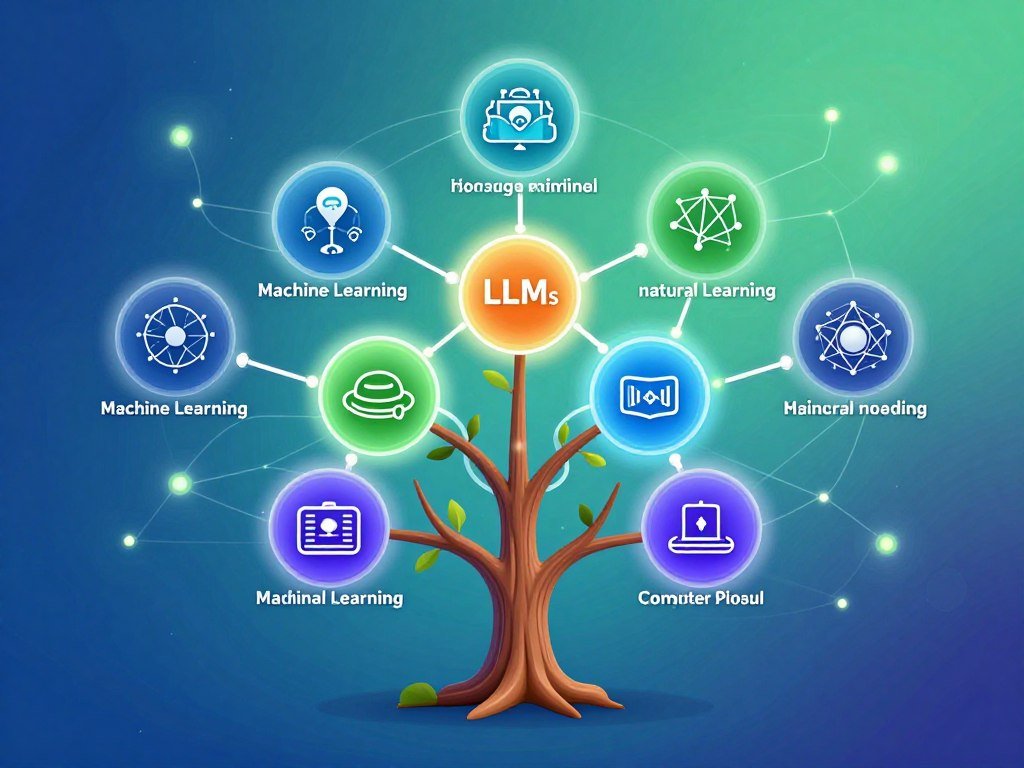
Where LLMs fit in AI
A large language model is a machine-learning model, often built as a neural network. Machine learning is one part of AI, and deep learning is one part of machine learning. Deep learning uses networks with many layers to learn patterns.
The Stanford HAI AI glossary defines LLMs as systems trained on large amounts of text to understand and generate language. The category links describe what each type of model covers.
| Category | What it covers | Relationship | Example |
|---|---|---|---|
| AI | Systems that perform tasks linked to intelligence | Broadest category | Speech recognition |
| Machine learning | Systems that learn patterns from data | Part of AI | Email spam filter |
| Deep learning | Learning with layered neural networks | Part of machine learning | Image recognition network |
| LLM | Language tasks using large amounts of text | Deep-learning model focused on language | Text summarizer |
An LLM works with language, while generative AI also includes systems that create images, code, audio, and video.
How generative AI relates to LLMs
Generative AI creates new content, including text, images, code, audio, and video. LLMs are one category within generative AI, focused on language tasks such as generating, summarizing, translating, and analyzing text.
Put plainly, an LLM is a generative AI system when it creates language, but generative AI includes many systems that are not LLMs. A GPT model is one kind of LLM, not a synonym for every LLM.
How Does an LLM Work?
A prompt first becomes a sequence of small text units that the model can process mathematically. Each unit is a token: a word, part of a word, or character-sized unit that a model processes as a single piece of text. The model uses those pieces to predict a response one token at a time.
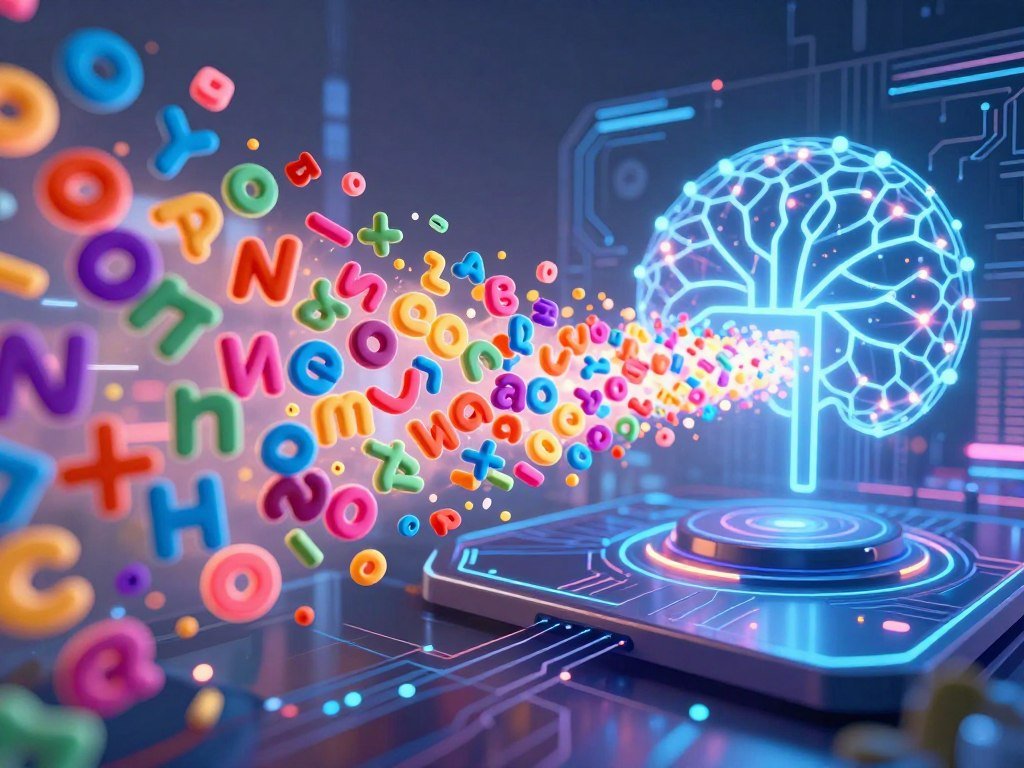
From a prompt to tokens
A token can be a whole word, a subword, or a character. The steps below show how a prompt becomes generated text.
- The model splits the input into tokens.
- It represents each token as numbers called embeddings.
- Transformer attention weighs useful context in the sequence.
- The model predicts the next token, then repeats until the response is complete.
In English, one token often represents about four characters, or roughly three-quarters of a word. That estimate helps explain why a short paragraph may contain more tokens than words.
How attention helps predict text
Attention helps a neural network connect relevant words, even when they sit far apart in a sentence. For example, a model can link a pronoun to a person named earlier. Google researchers introduced the transformer design in 2017 in “Attention Is All You Need”.
Earlier recurrent neural networks process a sequence token by token, which can make distant details harder to retain. N-grams use shorter word sequences and may miss useful context. Transformers use attention to weigh links across a longer sequence.
Token counts are only a rough guide because tokenization varies by language and text.
How Do LLMs Learn and Adapt?
Pretraining gives an LLM broad language patterns, while later training can steer how it responds to instructions. Pretraining uses text without requiring a human-labeled answer for every example. Later training adapts an existing model rather than starting from scratch.

Pretraining on text
During pretraining, models learn patterns across large collections of text. They practice predicting missing or next text, then adjust their internal settings based on the result. Those settings are called parameters.
Models trained this way are often called foundation models because they can support many later uses. Building large models takes substantial data, computing resources, and technical expertise. Parameter size alone does not tell you how useful a model will be.
Fine-tuning for useful responses
Supervised fine-tuning uses examples paired with desired answers. Instruction tuning teaches a model to respond to requests, while reinforcement learning from human feedback, or RLHF, uses human rankings to shape preferred responses.
Some open-weight models can run on your computer or in the cloud. A guide to running models locally explains how tools such as LM Studio and Ollama can load downloadable models. Your computer’s memory can affect which model will run well.
In January 2025, DeepSeek released R1 with 671 billion parameters. That count describes its size, not a guarantee of better answers. A study of pretraining and fine-tuning found that fine-tuning can improve performance on a target task while weakening some earlier skills.
A model’s training approach is one clue about its intended behavior, not a guarantee that every response will be correct.
How Do GPT Models Differ From Other LLMs?
GPT names a family of language models, while LLM describes the larger category those models belong to. GPT is a type of LLM, not another name for every language model. ChatGPT is an AI product built using GPT models, which use machine learning.
GPT models are pretrained to predict the next word or token. Many are later tuned to follow instructions and work as assistants. This approach helped make a broad language model useful in a chat product.
ChatGPT launched in November 2022 and reached 100 million users within two months. That growth made the product familiar to many people, but it does not make GPT the only kind of LLM.
Model details can be public or undisclosed. OpenAI has not disclosed GPT-4’s parameter count, and a parameter total alone cannot show how well a model performs on every task.
ChatGPT is AI, and the GPT models it uses are machine-learning models.
What Can LLMs Do in Everyday Tools?
A single LLM can help turn a rough email draft into a clearer message or condense a long document into key points. These tools work with text in personal and workplace settings. Generated content can be a starting point that you edit or verify.
Writing, summarizing and translation
Common applications of LLMs include drafting, summarization, translation, and text analysis. You might ask an assistant to shorten meeting notes, explain a complex paragraph, or translate a message before sending it.
- Draft or rewrite an email.
- Summarize a long document.
- Translate text into another language.
- Explain or debug a code snippet.
These tasks can save time on a first draft, but the result still needs a human reader. A phone feature may also turn a recording into a searchable transcript or short summary.
Coding help and conversational assistants
ChatGPT can help with content drafting, summarizing, translation, coding, and code debugging. Claude, Gemini, Grok, Qwen, and DeepSeek are other chatbot products or assistants based on LLMs. Their features and access options are not identical.
You can compare ChatGPT alternatives for different tasks by testing the same prompt in each tool. Some people also use an assistant to explain a code error or turn rough notes into a work plan.
For consequential work, review the output before relying on it.
What Are the Limits of LLMs?
A fluent answer can sound certain even when its details are wrong. This kind of plausible but false or misleading output is often called a hallucination. Biased or inaccurate training data can make an answer less reliable.
LLMs learn from information in their training data, so gaps or bias in that data can shape their responses. A clear writing style does not prove that a claim is true. Treat confidence in the wording and accuracy of the facts as separate things.
Software can add memory or tools such as web search. Retrieval-augmented generation, or RAG, adds retrieved outside information to a model’s context without retraining it. These tools can help supply useful details, but they do not make a model infallible.
Use this short checklist when an answer matters:
- Check important claims against a dependable source.
- See whether the answer uses current information.
- Take extra care with sensitive or consequential decisions.
For example, phone tools can summarize a recording, but names, dates, and decisions may need checking against the original. Treat an LLM’s response as a draft to verify when accuracy matters.
How Can You Judge an LLM’s Performance?
A benchmark score describes performance on a defined test, not every task a person might give a model. Benchmarks measure different abilities, such as reasoning, factual accuracy, alignment, and safety. A high combined score does not make one model best for every task.
What benchmarks measure
MMMU tests understanding across many subjects, GPQA tests challenging science questions, and SWE-bench measures software engineering tasks. From 2023 to 2024, gains on these benchmarks were substantial.
| Benchmark | Score increase from 2023 to 2024 | Increase in percentage points |
|---|---|---|
| MMMU | 18.8 percentage points | 18.8 |
| GPQA | 48.9 percentage points | 48.9 |
| SWE-bench | 67.3 percentage points | 67.3 |
Benchmark scores rose by these amounts across the tests, but each test measures a different skill. In 2024, 78% of organizations used AI, up from 55% in 2023. Global private investment in generative AI reached $33.9 billion in 2024.
Why scores and model rankings need context
A composite score blends several measures into one number. The blend can hide a weaker result in a skill you care about, and each lab may use a different test setup.
An October 2026 comparison scored Gemini 4 Argon at 82.93 overall and GPT-6 Sol at 79.01. Their coding scores were 73.2 and 66.3, respectively, but that ordering was only a lean because score ranges were unvalidated.
Compare models on the task, limits, and context you actually need, rather than relying on a single rank.
The comparison lists a 1-million-token context window for Gemini on Google AI Pro. It lists a 256,000-token context limit for reasoning models on ChatGPT Plus.
A context window is the maximum input a model can use at once. The comparison’s coding ranges were unvalidated, so its coding order was not settled. You can also compare tools on representative work, such as a legal research task, before choosing one.
Legal AI tool comparisons show why task fit and review controls matter in high-stakes work. Compare models on the task, limits, and context you actually need, rather than relying on a single rank.
Conclusion
An LLM is best understood as a capable language tool, not an all-knowing source of truth. It generates language from patterns learned during training, which can make it useful for many text tasks. Human judgment still matters when you use the result.
A simple next step is to ask a tool to summarize a document you already know. Compare its summary with the original, and notice which details it keeps or misses. Try it on a familiar, low-stakes task and verify the answer for yourself.
FAQ
What is the difference between GPT and LLM?
GPT is a type of LLM, while LLM is the broader category of language-focused models. GPT models are trained to predict text and may later learn to follow instructions. Other LLM families use different designs or training choices. So, every GPT model is an LLM, but not every LLM is a GPT model.
How do LLMs like ChatGPT work?
LLMs like ChatGPT process an input and use learned patterns to predict output one token at a time. A token may be a word, part of a word, or a character-sized unit. The model continues its predictions until it forms a response. The result can sound natural, but its wording alone does not confirm that every fact is correct.
What is the key difference between generative AI and large language models (LLMs)?
Generative AI includes systems that create text, images, code, audio, and video, while LLMs focus on language. An LLM may generate or analyze text, but an image model can create pictures without being an LLM. Think of generative AI as the larger group, with language models as one part of it.
Is ChatGPT AI or ML?
ChatGPT is an AI tool built using GPT models, which are machine-learning models. AI is the broad field, and machine learning is one way to build AI systems. ChatGPT is a product people use, while GPT refers to the model family behind its language abilities. The terms describe related but different things.
What is the largest LLM currently?
DeepSeek R1 had 671 billion parameters when released in January 2025, but that figure does not establish today’s largest LLM. Parameter counts alone do not show which model is biggest across all designs or versions. OpenAI has not disclosed GPT-4’s parameter count. Size also does not prove that a model will give better answers.
What AI is smarter than ChatGPT?
In an October 2026 comparison, Gemini 4 Argon scored 82.93 overall, above GPT-6 Sol’s 79.01. That comparison does not prove Gemini is smarter for every task. Coding scores were 73.2 and 66.3, but the ordering was only a lean because score ranges were unvalidated. Test setup and the task both shape the result.
What is the #1 AI right now?
Gemini 4 Argon ranked above GPT-6 Sol overall in an October 2026 comparison, with scores of 82.93 and 79.01. That does not make it the top choice for every use. Different tests reward different skills, and coding results in that comparison were not settled. Pick a model by the task and limits you need.