AI data centers are becoming harder to build, and the companies feeling the squeeze first are the neoclouds — the specialist providers that rent AI computing power to developers and enterprises. The message in late November 2026 is blunt: land, power and a finished building now matter more than a pitch deck, and companies that cannot show all three are struggling to get financed and built.
The shift was laid out on TechCrunch’s Equity podcast on 25 November 2026, where reporter Rebecca Bellan spoke with Anita Verma-Lallian, whose company Arizona Land Consulting assembles data center sites for developers, hyperscalers, AI labs and neoclouds. They discussed who carries the risk now that Nvidia has made clear it will not backstop an AI data center until the facility is nearly ready to run, and what a shakeout in 2027 might look like.
Neoclouds report construction delays and costlier debt as voters and local governments push back against new projects, utilities struggle to deliver enough power, and the gap between announced and operating capacity becomes harder to ignore. The buildout is not stopping, but the easy phase appears over.
Key takeaways
- Nvidia has made clear it will not backstop an AI data center until the facility is nearly ready to operate, raising the bar for developers who need financing before construction is complete.
- Neoclouds — specialist AI cloud providers — report construction delays and more expensive debt, leaving them exposed when projects run late.
- Voters rejected data centers in 40 of 41 local ballot measures across 10 states in the 2026 elections, according to Ballotpedia.
- Moratoriums now cover about 40 percent of planned US data center projects, per Cleanview Energy.
- Gartner says compute capacity already surpasses demand and predicts 80 percent of independent neoclouds could cease operations by 2030.
| Pressure | What the reporting shows |
|---|---|
| Financing bar | Nvidia will not backstop a data center until it is nearly ready |
| Neocloud strain | Construction delays and more expensive debt |
| Local opposition | 40 of 41 ballot measures in 10 states went against data centers |
| Moratorium reach | About 40% of planned US projects affected, per Cleanview Energy |
| Market reaction | CoreWeave and Nebius fell 16% each in a week; IREN fell 10% |
| Forecast | Gartner: 80% of independent neoclouds could close by 2030 |
What a Neocloud Is and Why It Is Exposed
A neocloud is a cloud provider built for AI workloads, renting out computing capacity — usually powered by Nvidia chips — to AI developers and enterprise customers. Unlike hyperscalers, which have many profitable businesses, a neocloud depends almost entirely on building data centers and renting out the capacity inside them.
That model works when construction runs on time and money is cheap, and turns fragile when either changes. As one adviser put it to The Daily Upside, “a moratorium hits whoever is borrowing against capacity that isn’t built yet, and that’s the neoclouds first.” Their GPU loans assume the chips earn money within months, so a 12-month delay means paying interest on idle hardware while contracts slip.
The stock market shows how investors read the risk. In the week after the 2026 midterm elections, neocloud stocks were among the hardest hit: CoreWeave and Nebius each fell 16 percent, while IREN fell 10 percent. Hyperscalers were relatively insulated, their data center spending supported by large, profitable businesses beyond AI infrastructure.
Nvidia Raises the Bar for Credible Capacity
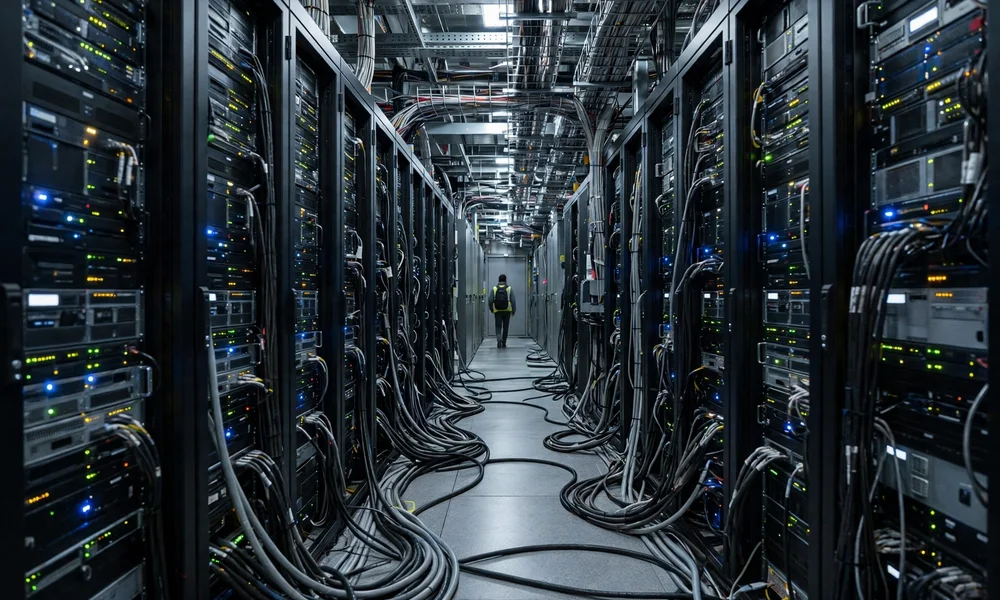
The clearest signal comes from Nvidia itself: it will not backstop an AI data center until the facility is nearly ready to operate, just as neoclouds report delays and costlier debt. In its second-quarter fiscal 2027 filing, Nvidia said land, power, a finished building shell and capital are all essential to completing AI data centers, alongside a selective, project-by-project approach to guarantees.
The message is straightforward: a power reservation or a planned campus is no longer enough. Developers need the site, the energy and a building that can run computing equipment before the industry’s most important supplier shares the risk.
That selectivity shifts risk back onto developers and lenders: the early-stage uncertainty is carried by someone else. For the best-prepared projects, that is manageable; for speculative ones, it can decide whether they break ground or stall. The debate around what Jensen Huang’s return reveals about the AI trade reflects the same tension: Nvidia’s choices now shape which projects live and which do not.
Land, Power and Shell: The New Test
The phrase that sums up the new reality is “land, power, shell” — the three ingredients a project needs before it can be taken seriously. Verma-Lallian’s company assembles data center sites for developers, hyperscalers, AI labs and neoclouds, giving her a view into who is buying and where projects run into trouble. She also partners with investor Chamath Palihapitiya, who has predicted an industry shakeout.
Land is the first hurdle, and it is getting harder to clear. Easily finding viable real estate with ready grid connectivity is already over, experts told The Daily Upside, and a project’s scope now extends far beyond the data center itself. Communities demand developers ease the burden — a little league field, or old bridges rebuilt for the concrete trucks — and most developers are starting to budget for it.
Power is the second hurdle, and often the larger one: a data center needs enormous amounts of electricity, and connecting to the grid can take years. Utilities are getting major customers such as chipmaker TSMC to help fund the infrastructure, spreading the cost across the companies that will use it.
The shell — a finished building for servers, cooling and networking — is the third hurdle, and the one Nvidia’s stance puts in the spotlight. A shell proves a project has moved from paper to reality: permits obtained, concrete poured, walls up. Where announced capacity is not delivered capacity, the shell separates a credible project from a speculative one.
Ballot Boxes and Moratoriums Add Political Risk
The physical hurdles are now joined by political ones. In the 2026 elections, there were 41 ballot measures across 10 states proposing moratoriums or restrictions on local data center construction, per Ballotpedia. Voters sided against the data centers in 40 of those votes, and in 46 out of 47 total measures so far in 2026.
An NBC News exit poll found 23 percent of voters said data centers played a “crucial” role in their vote, 33 percent more said a “major” role, and 76 percent would oppose a new one in their community. Successful candidates ran in part on data center and AI-skeptical campaigns, including Texas governor-elect Gina Hinojosa, who will run a state home to one-fifth of the planned 253-gigawatt pipeline.
The practical effect is a brake rather than a full stop. Existing and proposed moratoriums extend to around 40 percent of planned US projects, per Cleanview Energy, and most would not affect projects already in development. Hinojosa’s policy would not halt projects currently permitted or under construction — 119 in Texas — only pausing new ones until legislators pass a unified rulebook.
Even so, analysts have started to quantify the damage. Dan Ives of Wedbush estimated about 10 percent of data centers will not happen now, and the Nasdaq 100 fell more than 6 percent as investors digested a stricter regulatory regime. A national moratorium, floated by Senator Bernie Sanders, appears remote, but developers are redrawing their maps — fleeing to friendlier territories such as Florida, or abroad, or to Harwood in North Dakota, the one community that voted in favour of data centers.
What It Means for the AI Industry
The slowdown will not hit everyone equally. Hyperscalers are relatively insulated, but Meta’s Mark Zuckerberg has said the company cannot roll out Muse internationally until it increases compute supply. AI labs such as Anthropic and OpenAI sit in the middle — neither as leveraged as the neoclouds, though compute constraints could slow future models.
Consumers could feel the crunch too. When capacity is tight, AI companies ration first — waitlists, usage caps, slower rollouts — with price increases later at the premium end. Token prices have been falling for years; the likeliest effect is that they stop falling as quickly.
There is also a counter-argument: a slowdown may matter less than it seems, because the industry was building supply that surpassed demand. Gartner’s chief forecaster, John Lovelock, has said compute capacity already surpasses demand, and the firm predicts 80 percent of independent neoclouds could cease operations by 2030. One estimate put the share of announced but unstarted capacity that may never be built at 20 to 50 percent.
That points toward a shakeout: companies with land, power and finished shells are best positioned to acquire distressed projects, and AI labs and hyperscalers may increasingly build their own data centers instead of relying on neoclouds. Readers tracking the best AI tools should note the same lesson applies to the services those tools run on: the infrastructure underneath the software is now the bottleneck.
Checklist: How to Read the Data Center Shakeout
- Watch whether Nvidia supports a project before its shell is finished — a sign the bar is lowering.
- Track neocloud earnings and debt costs: rising borrowing costs plus delays break projects.
- Follow ballot measures and moratoriums, now covering about 40 percent of planned US projects.
- Compare announced capacity with delivered capacity in company reports.
- Look for acquisitions of stalled projects by hyperscalers, labs or developers with land and power.
- Check whether AI model prices keep falling or flatten — a sign of whether scarcity is reaching consumers.
Frequently Asked Questions
What is a neocloud?
A neocloud is a cloud provider built for AI workloads, renting out Nvidia-powered capacity to AI developers and enterprise customers. Unlike hyperscalers, it depends on building data centers and renting out the capacity inside.
Why are AI data centers harder to build now?
Several pressures arrived at once: Nvidia will not backstop a data center until it is nearly ready, construction is delayed and debt is costlier, power takes longer, and opposition has produced moratoriums covering about 40 percent of planned US projects.
What does “land, power, shell” mean?
It is the three-part test for a credible project: a site, enough electricity, and a finished shell for servers and cooling. Projects with all three are far more likely to be financed and completed than projects with only a plan.
How did voters react in 2026?
Voters sided against data centers in 40 of 41 local ballot measures across 10 states, per Ballotpedia, and in 46 of 47 measures overall in 2026. An NBC News exit poll found 76 percent would oppose one in their community.
Will the slowdown raise AI prices for consumers?
Probably not sharply. When capacity is tight, AI companies ration first — waitlists, usage caps, slower rollouts — and price increases come later at the premium end. Token prices have been falling for years; the likeliest effect is that they stop falling as quickly.
Could most neoclouds really disappear by 2030?
Gartner predicts 80 percent of independent neoclouds could cease operations by 2030, and one estimate suggests 20 to 50 percent of announced but unstarted capacity may never be built. Both are forecasts, not certainties.
The Bottom Line
AI data centers are becoming harder to build because every part of the job got harder at the same time: the land is contested, the power is scarce, the money is pickier and the politics have turned. Nvidia’s refusal to backstop a facility until it is nearly ready is the clearest expression of that change, and it lands hardest on the neoclouds, whose model depends on borrowing against capacity that does not exist yet.
The buildout is not ending — demand is real, capital is still available, and the best-prepared projects will get built. But the era in which a pitch deck and a power reservation were enough is over. The winners will be developers who already hold land, power and a finished shell, and companies that can buy distressed projects cheaply when the shakeout comes. For everyone else, the best AI writing tools and the models behind them will increasingly run on infrastructure that was secured the hard way.