
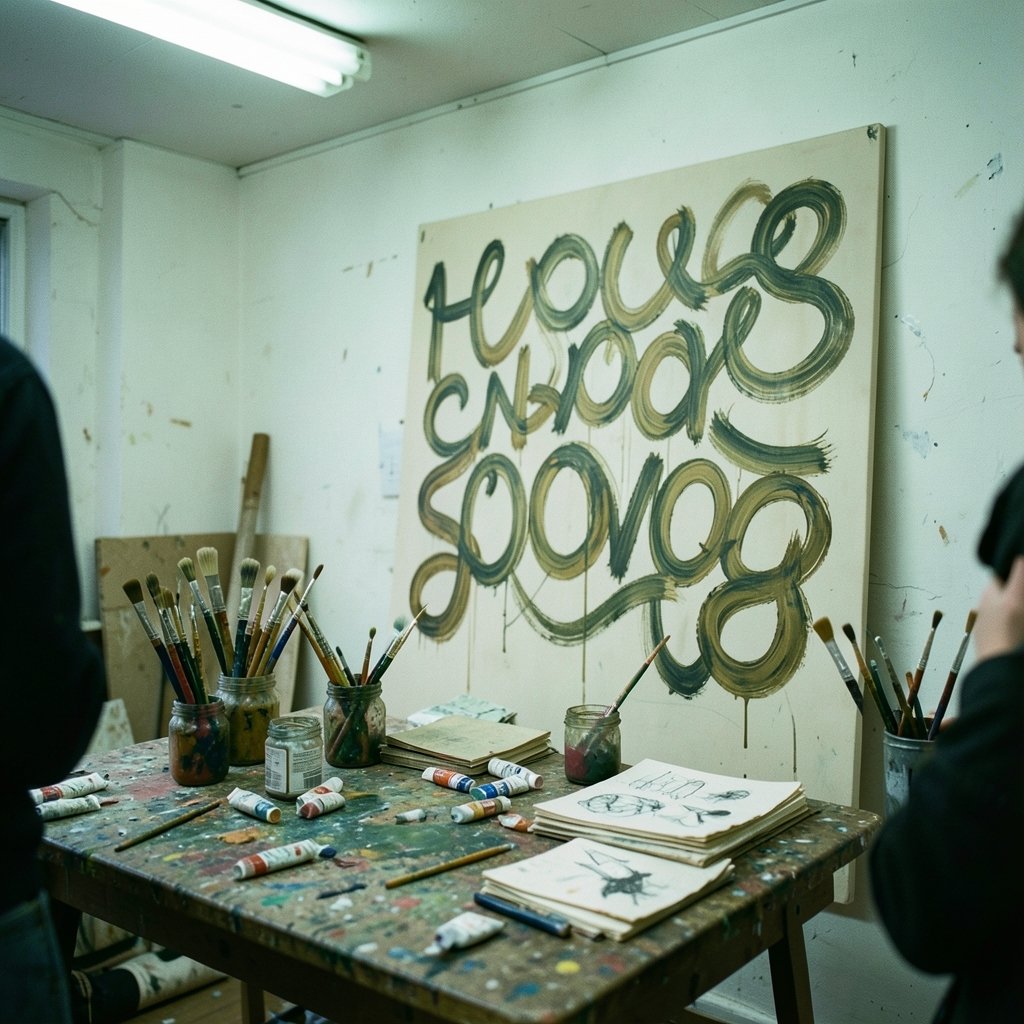
What do you picture when you hear the word “artist”? Maybe someone splashing color on a canvas, or a sculptor chipping away at marble. Alexandra Grant does neither, exactly. She paints words. Big, looping, hand-lettered words that turn language itself into the subject of the picture. Once you notice this, her whole career snaps into focus: the paintings, the drawings, the books, the collaborations, even the press coverage that made her famous for reasons that had nothing to do with paint.
This article walks through who Grant is, how she built her practice, why text sits at the center of everything she makes, and how to look at her work without getting lost in the noise around it.
Who is Alexandra Grant?
Grant is a Los Angeles–based visual artist born in 1973 in Fairfax, Virginia. She works across painting, drawing, sculpture, video, and collaborative text-based projects. That range matters, because people who only know her from a headline often assume she is a painter and nothing more. In practice, her career reads like a long conversation between the visual and the verbal, with different media picking up the thread at different points.
Her education followed a deliberate path. She earned a BA from Swarthmore College in 1995, then an MA in art history from the University of California, Los Angeles, and an MFA from the California College of the Arts in San Francisco. Notice the combination: art history alongside studio practice. That double training explains a lot about how she works. She thinks like a scholar about what images mean and like a maker about what they look like.
How language became her main material

Most artists treat words as labels: a title on a wall card, a signature in the corner. Grant treats words as pigment. Her paintings and drawings often center on handwriting, with letters scaled up until they become shapes, textures, and rhythms rather than readable sentences. The text is there, but it refuses to behave like ordinary text. You catch a word, lose it, find it again.
This is the through-line across her painting and her collaborative work. Whether she is composing a large canvas or co-authoring a book, the question stays the same: what happens when language stops being a vehicle for meaning and becomes the thing you look at?
Why handwriting instead of typed letters
Handwriting carries the body of the person who made it. A typed word is identical no matter who presses the key. A handwritten word wobbles, leans, and breathes. By building paintings out of her own hand-lettering, Grant keeps a human presence inside work that could otherwise read as cool and conceptual. The letters are monumental in scale but intimate in origin. That tension is the engine of the whole practice.
The word as a shared object
There is a practical lesson here for anyone trying to understand contemporary art that uses text. Don’t hunt for the hidden message. Ask instead what the word does to you before you decode it. Does it feel warm, ominous, tender, insistent? Grant’s large text-based paintings, including a series often described as Ode to the Feminist and works built around the word SHADOWS, work on the viewer at that pre-reading level first. Meaning arrives second.
The books: The Artists’ Prison and X Artists’ Books
Grant’s collaborative projects deserve their own spotlight, because they show an artist who treats publishing as a creative medium rather than a side activity.
With artist Eve Wood, she co-authored The Artists’ Prison, a book of text and drawings that imagines a prison built for artists. The premise is dark and funny at once, and it fits her interest in language as a space people inhabit. A prison made of words is still a prison.
She also co-founded X Artists’ Books (XAB), an independent art-book press, with actor Keanu Reeves. The press exists to make books that function as artworks in their own right, not catalogs of exhibitions. For an artist whose entire practice revolves around the printed and written word, founding a press is the logical next step. It is the difference between making sentences and building the room where sentences live.
Collaboration with Keanu Reeves
Grant and Reeves have collaborated on book projects, including Ode to Happiness (2011) and Shadows (2016). These are artist’s books in the truest sense: text and image working together, neither one illustrating the other. Their relationship became widely covered in the press around 2019, and that coverage introduced millions of people to her name.
Here is where a practical caution is worth stating plainly. When a famous person’s partner is an artist, the internet tends to file the artist under the famous person. That framing is lazy and it misses the work. Grant had a two-decade exhibition and publishing record before the tabloid era, and the books she made with Reeves are collaborative art objects, not celebrity merchandise. If you want to understand her, start with the paintings and the press she founded. The relationship is a footnote, not the chapter.
Exhibitions and where her work has appeared
Her work has been shown in solo and group exhibitions at venues including the Los Angeles County Museum of Art (LACMA), as well as galleries in the United States and Europe. Exact show titles and dates vary, and exhibition chronologies shift as records are updated, so the most reliable approach is to check current listings directly with the institutions and galleries involved rather than trusting a decade-old summary.
That advice applies to any living artist, by the way. Gallery representation changes. Shows get rescheduled. A biography written in 2018 may list a representative the artist left in 2021. Treat any single source as a snapshot, not a permanent record.
How to actually look at a text-based painting
This is the part most viewers get wrong, and it is worth slowing down for. People stand in front of a painting full of words and try to read it like a page. When they can’t, they decide the work is difficult or pretentious. There is a better way.
- Step back first. Take in the whole composition before your eyes try to parse letters. Notice where the dark masses sit, where the light breaks through, how the eye travels.
- Let the words arrive in fragments. Don’t force full sentences. Catch a word, let it go, catch another. The partial reading is the intended experience, not a failure.
- Watch your own reaction. Notice whether a word lands emotionally before you know what it says. That gut response is data.
- Move closer last. Up close, look at the surface: the drag of the brush, the edges of the letters, the places where the hand sped up or slowed down.
- Skip the biography. For a first encounter, ignore who the artist is dating. Let the work stand on its own legs.
Common mistakes viewers make
The biggest one is treating text-based art as a puzzle with a solution hidden in the letters. It isn’t a riddle. The second mistake is assuming that because the words are legible, the work must be simple. Legibility and simplicity are not the same thing. A single handwritten word the size of a door can hold more weight than a hundred typed paragraphs.
A third mistake, specific to Grant, is arriving through celebrity gossip and then judging the art as if it were a hobby. That is backwards. The body of work came first, and it is substantial.
Where her practice fits in contemporary art
Text in art is not new. Conceptual artists have used language as material for decades, and the tradition of blending words with images runs deep through modern art history. What Grant adds is warmth. Her work keeps the hand visible, which pushes back against the cool, industrial feel of a lot of conceptual work. The letters are big, but they are also personal.
That combination, conceptual rigor plus human touch, is why her work reads well to people who usually bounce off contemporary art. You don’t need a theory seminar to feel something in front of a wall of handwritten words. You just need to look.
If you are the kind of reader who likes practical, plain-spoken breakdowns of confusing topics, from art to money to home technology, the same instinct applies here: start with what you can see, then build outward. A good example of that approach is how a clear explainer on grants, scholarships, and which financial aid is actually free money separates what sounds generous from what actually pays out. Art writing works the same way. Separate the noise from the substance. (Homekit vs google home vs alexa compatibility privacy cost)
Practical tips for following a living artist’s career
If Grant’s work has caught your attention and you want to follow it properly, a few habits will serve you well.
- Check primary sources first. An artist’s own portfolio and the press or publisher’s catalog are more current than any encyclopedia entry.
- Track the books alongside the canvases. For Grant specifically, the publishing side is central. Her collaborative books are part of the art, not marketing for it.
- Expect change. Representation, series names, and exhibition dates shift. A fact that was true three years ago may not be true now.
- Read the wall text. Museum labels written by curators often explain the conceptual frame better than any secondary summary.
- Ignore the gossip cycle. Celebrity coverage spikes and fades. The work stays.
That last point connects to a broader pattern in how people research anything online. Sensational angles travel faster than accurate ones. The same dynamic shows up in consumer topics, where a flashy claim about free grant money bills and who actually qualifies outruns the duller, correct answer. The fix is identical: go to the source, read carefully, and be suspicious of anything that sounds too tidy.
What makes her work worth your time
Grant’s art asks a question most of us never consider: what would happen if we stopped reading words and started seeing them? Every text message, every street sign, every label in your kitchen is a small visual object you have trained yourself to look through. Her paintings make you look at the object instead.
That is a genuinely useful shift in attention, and it is why her work rewards patience. The paintings don’t hand you a message. They hand you an experience of language as a physical, human, slightly messy thing. In a world that treats text as pure utility, that is a small act of resistance.
Conclusion
Alexandra Grant is a Los Angeles artist with a Swarthmore BA, a UCLA art history MA, and a California College of the Arts MFA, and she has spent her career turning language into visual material. Her paintings and drawings build images out of handwriting. Her books, including The Artists’ Prison with Eve Wood, extend that interest into publishing, and X Artists’ Books, which she co-founded with Keanu Reeves, gives the printed word a permanent home. Her collaborations with Reeves, including Ode to Happiness and Shadows, are art objects in their own right, and her work has appeared in solo and group shows at venues including LACMA and galleries across the U.S. and Europe.
The takeaway is simple. Approach her work as painting first and text second. Step back, let the words arrive in pieces, and notice how your body reacts before your brain starts decoding. Do that, and the celebrity headlines fade into the background where they belong, leaving the actual work in the foreground: big, handwritten, quietly insistent, and very much worth your attention.
Frequently Asked Questions
Who is Alexandra Grant?
Alexandra Grant is a Los Angeles–based visual artist born in 1973 in Fairfax, Virginia. She works in painting, drawing, sculpture, video, and collaborative text-based projects, and her practice centers on the relationship between language and image. She holds a BA from Swarthmore College, an MA in art history from UCLA, and an MFA from the California College of the Arts.
What kind of art does Alexandra Grant make?
She makes paintings, drawings, sculptures, videos, and books, with handwriting and words as her core material. Her large-scale text-based paintings, including series often described as Ode to the Feminist and works built around the word SHADOWS, treat letters as visual form rather than ordinary reading matter.
What is The Artists’ Prison?
The Artists’ Prison is a book of text and drawings that Grant co-authored with artist Eve Wood. It imagines a prison built for artists, using the premise to explore how language and institutions shape creative life. It is one of several projects that show her treating publishing as a creative medium.
What is X Artists’ Books?
X Artists’ Books, or XAB, is an independent art-book press that Grant co-founded with actor Keanu Reeves. The press publishes books that function as artworks in their own right rather than as exhibition catalogs, extending Grant’s long-standing interest in the printed and written word.
How is Alexandra Grant connected to Keanu Reeves?
They have collaborated on book projects, including Ode to Happiness (2011) and Shadows (2016), and their relationship became widely covered in the press around 2019. The books are collaborative art objects, and Grant’s own exhibition and publishing record predates that press attention by roughly two decades.
Where has Alexandra Grant’s work been exhibited?
Her work has appeared in solo and group exhibitions at venues including the Los Angeles County Museum of Art (LACMA), as well as galleries in the United States and Europe. Specific show titles and dates change over time, so checking current institutional and gallery listings is the most reliable way to confirm what is on view.



