

Have you ever watched a cartoon character peel a banknote off a fat stack, only to see that same stack grow back two seconds later? It is a tiny gag, but it says something odd about how people think about money. On screen, cash can fly, multiply, and burst into confetti. In real life, it does none of that. The gap between the two is where animated money gets interesting.
This article looks at animated money from several angles: how it works in film and games, how studios build it, what it costs, and where it crosses into fraud. It also explains a related idea from economics, money illusion, which is what happens when people treat the number on a note as if it were the value itself. Along the way, there are practical tips for anyone who wants to animate money without it looking cheap.
What Counts as Animated Money?
The phrase covers a lot of ground. In its simplest form, animated money means any moving depiction of currency: a spinning coin, a fluttering banknote, a slot machine payout, a cartoon vault bursting open. That includes hand-drawn animation, 3D renders, motion graphics, and the physics-driven particle effects used in modern games.
There is a second meaning too. Economists sometimes describe money as “animated” when it changes in real terms while its face value stays the same. A paycheck that looks identical year after year is not really identical if prices have risen. That is money illusion, a term named and analysed by Irving Fisher in his 1928 book The Money Illusion. Fisher argued that people routinely judge money by its nominal number rather than its purchasing power, and that this mistake has real consequences for wages, contracts, and savings.
Both meanings matter here. The visual one is about craft. The economic one is about perception. And the two overlap more than you might expect, because animation is unusually good at showing value that shifts.
Why Money Is Such a Popular Animation Subject
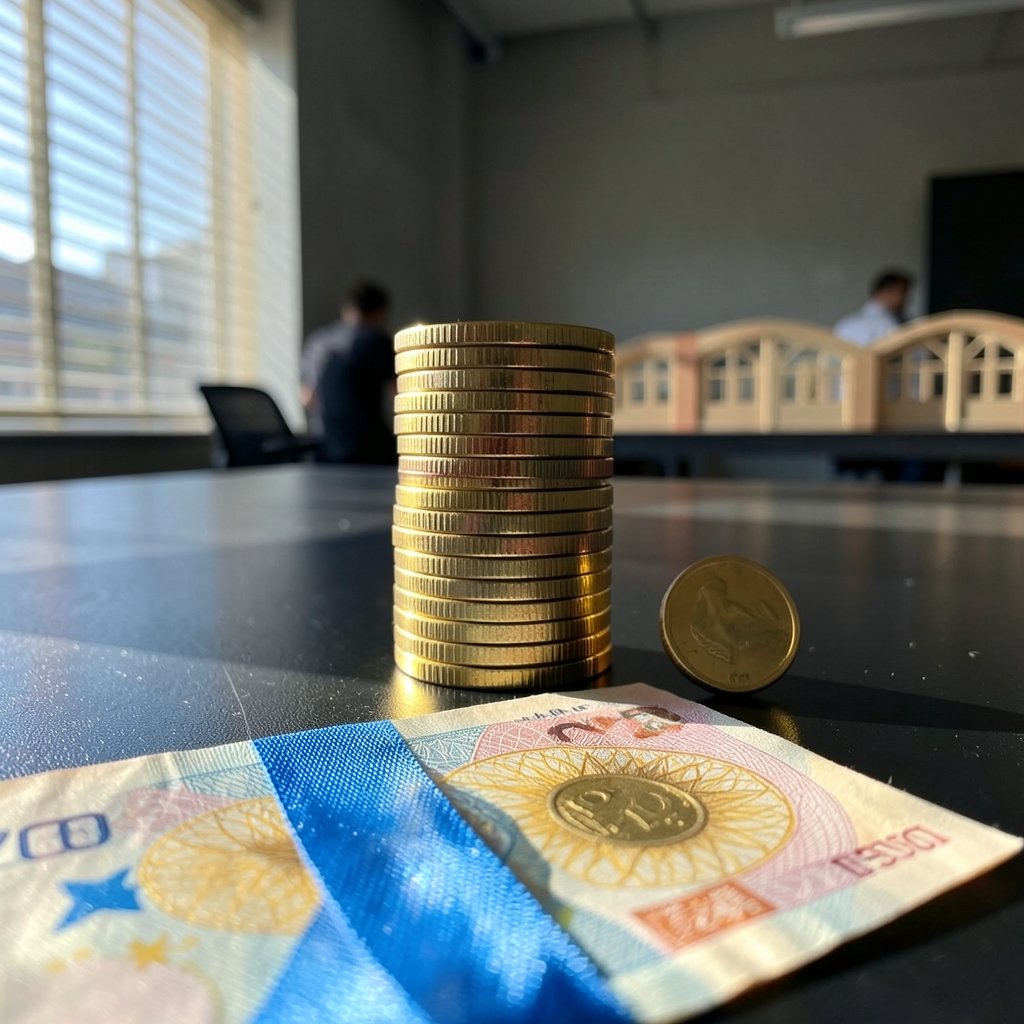
Money is a gift to animators. It is instantly recognisable, emotionally loaded, and easy to stylise. A pile of gold coins tells an audience “wealth” faster than any line of dialogue. A single coin rolling down a street creates suspense without a word.
There is also a practical reason. Currency designs are full of fine detail: guilloche patterns, portraits, security threads, microprinting. Animating those details convincingly is a challenge, and challenges attract skilled artists. The U.S. government’s own currency education site explains how features like the blue 3-D security ribbon on the current $100 note work, and that ribbon is a natural fit for motion design because it appears to move as the note is tilted.
Not every currency leans on portraits, either. The euro, which entered circulation as cash on 1 January 2002, uses bridges, windows, and gateways instead of people. That gives animators a different set of shapes to work with, and it is a useful reminder that “money” on screen is a design choice, not a fixed template.
The Craft: How Studios Actually Animate Cash
Good animated money is harder than it looks. A banknote is thin, flexible, and covered in tiny marks that flicker badly if you get the timing wrong. Here is the workflow that tends to work in practice.
- Start with a real reference. Photograph actual notes and coins under controlled light. Do not animate from memory. Memory produces generic rectangles.
- Build the note as a layered asset. Separate the base, the portrait or motif, the serial number, and the security features so each can move independently.
- Animate the bend, not the whole object. Real paper flexes along a curve. Rigging a simple spine down the middle of the note and bending that spine reads as paper; rotating a flat plane reads as cardboard.
- Add secondary motion. Corners lag behind the centre. Edges flutter after the main movement stops. This one step separates amateur work from professional work.
- Match the light. Currency has a slight sheen. A soft specular highlight that travels across the surface as the note turns sells the material.
- Keep the flicker under control. Fine line work needs anti-aliasing and, in 3D, texture filtering. Otherwise the note shimmers like static.
Common Mistakes
The most frequent error is over-animation. Beginners make every coin spin, every note flip, and every stack bounce. The result looks like a slot machine and distracts from whatever the money is supposed to communicate. Restraint works better: one clear movement, well timed.
The second mistake is ignoring scale. A coin the size of a dinner plate next to a character destroys the illusion instantly. Keep a physical reference object in the scene while you work.
The third is forgetting the sound. Money has a distinctive rustle and clink. Silent animated cash feels dead, even when the motion is perfect.
Animated Money in Games and Interfaces
Video games are where animated money gets the most screen time. Coin pickups, floating score numbers, and chest-opening sequences are all small pieces of motion design that carry a lot of psychological weight. A well-tuned coin sound and a brief sparkle give players a hit of satisfaction that keeps them playing.
The same principles apply in financial apps and dashboards. Animated counters that tick upward, progress bars that fill, and coins that drop into a piggy bank are all used to make abstract numbers feel concrete. This is where the craft meets a caution: motion can make a number feel bigger or more real than it is. If a savings app animates a balance climbing with confetti, the user may overestimate progress.
That is not a hypothetical worry. The same instinct that makes animated money persuasive also makes it exploitable. Scams frequently use polished motion graphics, fake transaction screens, and animated balance confirmations to convince victims that money has moved when it has not. Gift card fraud is a good example: victims are shown convincing confirmations and rarely recover the funds, as this breakdown of why gift card scam victims rarely get their money back explains. Animated money, in the wrong hands, is a trust tool.
The Money Illusion: When Numbers Move but Value Doesn’t
Step back from the screen and the economic meaning of animated money becomes clearer. Money illusion is the tendency to think in nominal terms. If a salary rises 3 percent while prices rise 5 percent, the worker has less purchasing power, but the bigger number feels like a win.
Fisher’s 1928 book laid out the idea in detail, and it has held up well. Modern behavioural economics has tested it experimentally. The finding that keeps coming back is that people do not fully adjust for inflation when they judge wages, prices, and fairness. A pay cut in nominal terms feels like an insult even when real pay is unchanged; a nominal raise feels generous even when real pay falls.
This matters for anyone designing or interpreting animated money. A chart that animates a rising balance without adjusting for inflation is technically accurate and quietly misleading. The same goes for a game that shows a player’s gold pile growing while the cost of items grows faster. The number animates; the value does not.
Central banks have had to think about this too. When a currency changes form, as the euro did when it moved from an abstract accounting unit to physical cash, the public’s sense of what money “is” shifts. The European Central Bank’s account of the euro’s introduction documents how the cash changeover made the currency feel real to ordinary people after three years as a number on a page. That is money becoming animated in the economic sense: same unit, different lived reality.
What Animated Money Costs
Budget questions come up constantly, and the honest answer is that it depends heavily on style and length. A short 2D loop of a coin spinning might take an afternoon. A photoreal 3D banknote with accurate security features can take days.
| Type of animated money | Typical effort | Best used for |
|---|---|---|
| Simple 2D coin spin or note flip | A few hours | Icons, small UI elements |
| Stylised cartoon cash | One to three days | Explainer videos, games |
| 3D photoreal banknotes | Several days to a week | Advertising, film inserts |
| Particle-based coin explosions | One to two days | Game rewards, celebrations |
| Full animated sequence with characters | Weeks | Short films, trailers |
The hidden cost is usually iteration, not the first pass. Clients change the colour of the notes, the number of coins, the timing. Budget for two or three rounds and the project stays sane.
There is a wider cost story too. Security and fraud prevention around money are expensive, and the spending is often invisible until something goes wrong. If you want a sense of how budgets get allocated in that world, this analysis of where identity threat detection money actually goes is a useful reality check on how security spending is distributed.
Practical Tips for Getting Animated Money Right
Whether you are making a game, a finance explainer, or a title sequence, a few habits make a real difference.
- Decide what the money is for. Is it a reward, a threat, a joke, or a neutral data point? The motion should serve that job and nothing else.
- Use real currency as reference, then simplify. Audiences recognise the idea of a banknote, not its serial number. Strip detail until the shape still reads.
- Time it to the beat. Money animations land harder when they hit on a musical or editorial beat. A coin that lands one frame late feels wrong.
- Test at small size. Most animated money is viewed on a phone. If the motion does not read at thumbnail size, it is too subtle.
- Check the legal side. Reproducing currency artwork has rules in many countries. When in doubt, design a fictional note.
- Be honest with numbers. If the animation implies growth, make sure the underlying data supports it.
For anyone building a business around this kind of content, the economics of creative work are worth understanding. This guide to how to make money with AI covers the practical side of turning creative and technical skills into income, which is relevant if animation is part of your plan. And if you are weighing up tools, this roundup of AI logo animation tools for animated branding shows how far automated motion design has come. (Animation)
Where Animated Money Is Heading
Two trends are pulling in opposite directions. On one side, tools are getting cheaper and faster. Automated rigging, physics simulation, and AI-assisted in-betweening mean a solo artist can now produce work that needed a small team a decade ago. On the other, audiences are getting better at spotting fakery. Convincing animated money is now a security concern as much as an artistic one.
The likely result is more animated money everywhere, and more scrutiny of it. Games will keep using it for reward loops. Finance apps will keep using it to make numbers feel real. Fraudsters will keep using it to make lies feel true. The difference between the three is intent, not technique.
That is why the economic idea of money illusion is worth keeping in mind. Animation makes money move. It does not change what money is worth. The moment those two things get confused, whether on a screen or in a payslip, someone ends up worse off.
Conclusion
Animated money is one of those topics that looks narrow and turns out to be wide. It is a craft discipline with real technical demands: layered assets, believable bending, secondary motion, and sound. It is a design language that games and apps use to make abstract numbers feel physical. It is also a perception problem, because moving numbers are persuasive in ways that static ones are not, and that persuasiveness can be used to inform or to deceive.
The practical takeaway is simple. If you are making animated money, start from a real reference, animate less than you think you should, and check that the motion serves the message. If you are consuming animated money, whether in a game, an app, or a message from a stranger, remember that the movement is designed. The value behind it is a separate question, and it is always worth asking.
Frequently Asked Questions
What is animated money?
Animated money is any moving depiction of currency, such as spinning coins, fluttering banknotes, or particle effects in games and videos. The term can also describe the economic idea of money whose real value shifts while its face value stays the same, a concept known as money illusion.
Why does animated money look fake in some videos?
Usually because the animation ignores physics. Flat notes that rotate without bending, coins that spin at unrealistic speeds, and missing sound all break the illusion. Adding a bend curve, secondary motion on the corners, and a soft highlight that travels across the surface fixes most of it.
How long does it take to animate a banknote?
A simple 2D note flip takes a few hours. A stylised cartoon version takes one to three days. A photoreal 3D banknote with accurate security features can take several days to a week, and most of that time goes into revisions rather than the first pass.
Is it legal to animate real currency designs?
Rules vary by country. Many places restrict reproducing currency artwork in ways that could be mistaken for real notes, especially at or near actual size. The safest approach is to design a fictional currency, or to check the specific rules published by the relevant central bank before publishing.
What is money illusion in simple terms?
Money illusion is judging money by its number instead of its buying power. If your pay rises 3 percent while prices rise 5 percent, you have less real income even though the figure on your payslip went up. People consistently react to the number rather than the value behind it.
Why do games use animated money so much?
Because it works. A coin pickup with a bright sound and a short sparkle gives players quick feedback and a small sense of reward, which keeps them engaged. The motion turns an abstract score into something that feels earned, which is exactly what good game design aims for.



