

What does it actually take to become human? Not in a philosophical sense, but in the literal, fossil-and-DNA sense. The answer is stranger and messier than most people expect. There was no single moment when a ape-like ancestor crossed a line and became a person. Instead, there was a long, uneven sequence of changes, and some of them happened in a surprising order.
Understanding that order matters, because it corrects a story most of us absorbed in school: that big brains came first and made everything else possible. The evidence says otherwise. Walking came first. Brains came much later. Culture and symbols arrived later still, and even then, patchily. Here is what the research actually supports, where the arguments still rage, and what the honest limits of the evidence are.
The First Step Was Standing Up, Not Thinking Harder
The oldest clear evidence of upright walking comes from the Laetoli footprints in Tanzania, dated to about 3.66 million years ago. The prints show a gait that looks strikingly modern: heel strike, weight rolling forward, toes pushing off. Whoever made them had a foot built for walking on two legs, not for grasping branches.
That date matters enormously. The Laetoli footprints predate major brain expansion by well over a million years. Bipedalism is generally treated as the earliest defining hominin trait, and it appeared while brains were still small. Whatever pushed our ancestors onto two legs, it was not a sudden leap in intelligence.
Why stand up at all? The hypotheses are still argued over. Freeing the hands for carrying, seeing over tall grass, and thermoregulation in open savanna heat all have supporters. No single explanation has won. What is settled is the timing: walking came early.
The genus Homo is generally dated to roughly 2.8 million years ago, based on a jaw from Ledi-Geraru in Ethiopia published in 2015. But the boundary between Australopithecus and early Homo remains debated, and reasonable researchers draw it in different places. Anyone who tells you the line is sharp is overselling.
The Brain Grew, But Not on a Neat Schedule
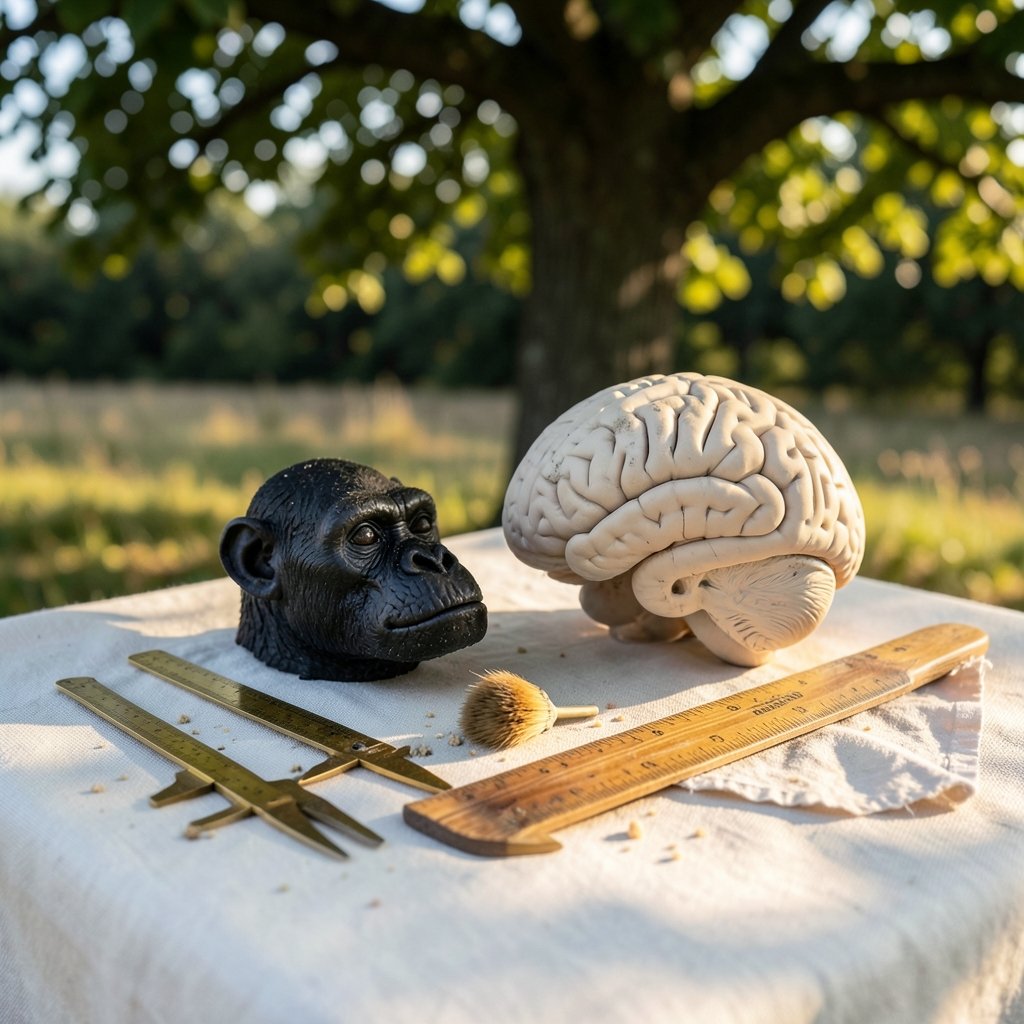
Modern human brains average roughly 1,300 to 1,400 cubic centimeters. Chimpanzee brains run about 400 to 500. That gap is real, and it accumulated over the Pleistocene rather than arriving all at once.
Here is the trap people fall into: assuming brain growth drove every other change in a straight line. In practice, the record is a mosaic. Some hominins had larger bodies before larger brains. Some had sophisticated stone tools with modest brains by modern standards. The traits did not switch on together.
Exact brain-size averages also vary by study and sample, so treat any single number as an approximation rather than a fact carved in stone. The direction is clear. The precise figures are not.
The Chimpanzee Comparison
Humans and chimpanzees share a common ancestor. Molecular estimates put the split at roughly 6 to 7 million years ago, and the chimpanzee genome paper published in 2005 remains a standard reference point. That comparison is useful because it shows how much can change in a relatively short evolutionary window, and how much did not change at all. We share a great deal of basic biology with chimps. The differences are concentrated in specific places: brain development, social cognition, and the machinery for language.
We Interbred, and That Changed the Story
One of the biggest corrections to the old “single family tree” picture is interbreeding. Genome studies, including the 2010 Neanderthal draft genome work, showed that non-African modern humans carry roughly 1 to 2 percent Neanderthal ancestry. Denisovan ancestry appears in some Oceanian and Asian populations.
This is not a footnote. It means the human story is a braided river, not a single trunk. Populations split, met, mixed, and split again. Some of that inherited DNA appears to affect immune function and other traits, though the percentages vary by population and by method, so precise figures should be read with caution.
The practical takeaway: “becoming human” was never a solo project. It was a group process, and the group was more diverse than the old diagrams suggested.
Symbolic Thought Arrived in Fits and Starts
Blombos Cave in South Africa has produced engraved ochre and shell beads, both dated to roughly 75,000 years ago. These are often cited as early evidence of symbolic behavior: the use of signs to mean something beyond themselves.
But interpretation is contested. Some researchers see clear evidence of symbolic thought. Others argue the same objects could have decorative or practical functions. The honest position is that the earliest unambiguous symbolism is hard to pin down, and the debate is genuinely open.
What is not contested is that symbolic capacity eventually became central to human life. Art, ritual, and notation all rest on it. The argument is about when it crossed from occasional to routine.
Language Remains the Hardest Problem
Language is where the science gets most cautious, and rightly so. The FOXP2 gene is associated with speech and language disorders in humans. That association is real. But the popular claim that FOXP2 is “the language gene” is widely criticized as oversimplified. Language is not one gene, and it is not one brain region.
The evolution of language remains unresolved. There is no fossil record of speech. Brain structures leave only indirect traces. Comparative work with other primates offers clues but not proof. Anyone claiming a settled date for the origin of language is going beyond the evidence.
That caution is worth applying more broadly. When a headline promises a definitive answer about human origins, the underlying paper usually says something narrower.
Culture and Cooperation as the Engine
Two related frameworks dominate current thinking. The social brain hypothesis links human cognition to social complexity: bigger social groups demand more cognitive horsepower. The cultural brain hypothesis extends this to the transmission of knowledge. Cumulative cultural evolution, associated with researchers such as Boyd and Richerson, argues that humans accumulate knowledge across generations in ways other species do not.
These are hypotheses, not settled findings. But they explain something the fossil record alone cannot: why human cognition is so heavily tuned for cooperation, teaching, and shared attention. The same logic shows up in applied settings. When organizations weigh automation against human judgment, the deciding factor is usually exactly this accumulated, socially transmitted expertise, which is why a careful AI business strategy should separate automation from human judgment rather than treating them as interchangeable. (Robot vacuum long human hair actually works)
Born Helpless, Raised Human
Human infants are born highly altricial, meaning extremely dependent. A newborn human cannot walk, feed itself, or regulate much of anything. Extended childhood and cooperative breeding, where care is shared beyond the mother, are often proposed as key to human cognitive development.
The causal direction is debated. Did extended childhood enable big brains, or did big brains require extended childhood? Probably both, in a feedback loop. What is clear is that human cognition develops inside a social environment, not in isolation. Take away the caregivers and the culture, and the brain does not develop normally.
Anyone who has watched a toddler learn a word from an adult’s glance understands the mechanism intuitively. The child does more than absorb data; the child takes part in a shared practice.
What “Becoming Human” Does Not Mean
It is worth saying plainly: “becoming human” is not a single event. It is shorthand for a long, mosaic process involving anatomy, cognition, culture, and genetics, with no agreed single threshold.
| Claim | What the evidence supports | What remains uncertain |
|---|---|---|
| Bipedalism came first | Strong: Laetoli footprints at ~3.66 million years | Why it evolved; exact selection pressures |
| Big brains drove everything | Weak as a single cause | Relative weight of diet, sociality, ecology |
| Humans evolved in one line | Weak: interbreeding is documented | Exact admixture percentages by population |
| Symbolism appeared suddenly | Contested | Timing and interpretation of early artifacts |
| One gene explains language | Weak: FOXP2 is oversimplified | Origin and evolution of language entirely |
That table is the honest summary. The left column is what the record shows. The right column is where the arguments live.
Practical Lessons From the Evidence
For readers trying to make sense of human-origins claims, a few habits help.
- Check the date before the interpretation. A find’s age often settles more than its headline meaning.
- Ask whether a trait appeared together with others. Mosaic evolution is the rule, not the exception.
- Treat single-gene stories with suspicion. Complex traits rarely reduce to one gene.
- Look for the sample size and the method. Averages for brain size, admixture, and dates all shift with the sample.
- Separate “earliest known” from “first.” A new find pushes the date back; it rarely proves the behavior started there.
These habits transfer. The same discipline applies when evaluating claims about machine intelligence, which is why the parallel between AI infrastructure hype and the 2000 telecom bust keeps resurfacing in serious analysis. Enthusiasm outruns evidence in both fields, and the correction is always the same: follow the record, not the narrative.
Why the Question Still Matters
The story of becoming human is a story about accumulation. Small advantages compounded over immense stretches of time: a foot that pushed off instead of grasping, a childhood that stretched longer, a group that shared what it learned. None of those changes was dramatic on its own. Together they produced something that could ask the question in the first place.
That has a practical edge. When people try to replicate human capacities in machines or organizations, the failures usually trace back to the same missing pieces: no accumulated culture, no cooperative teaching, no long dependent childhood. The gap is not raw processing power. It is the social and developmental scaffolding that took millions of years to build.
Conclusion
Becoming human was not a threshold crossed in a single leap. It was a mosaic process: upright walking around 3.66 million years ago, brain expansion spread across the Pleistocene, interbreeding with Neanderthals and Denisovans, symbolic behavior appearing in fits and starts, and language still resisting a clean explanation. The evidence supports a braided, uneven, deeply social story rather than a tidy ladder.
The most useful thing to take away is intellectual honesty about what the record can and cannot show. Dates and fossils are strong. Interpretations are contested. Anyone who presents human origins as a solved puzzle is skipping the part where the science actually lives. The question of what made us human is still open, and that is precisely what makes it worth asking.
FAQ
What does “becoming human” actually mean in evolutionary terms?
It refers to the long, mosaic process by which hominin anatomy, cognition, culture, and genetics changed over millions of years. There is no agreed single threshold or moment when a species “became human.” Researchers treat it as shorthand for a gradual accumulation of traits rather than a discrete event.
Did big brains come before or after walking upright?
After, by a wide margin. The Laetoli footprints in Tanzania, dated to about 3.66 million years ago, show upright walking well before major brain expansion. Bipedalism is generally treated as the earliest defining hominin trait, which reverses the popular assumption that intelligence came first.
How much Neanderthal DNA do modern humans carry?
Non-African modern humans carry roughly 1 to 2 percent Neanderthal ancestry, based on genome studies including the 2010 Neanderthal draft genome. Denisovan ancestry appears in some Oceanian and Asian populations. These percentages vary by population and by analytical method, so they should be read as approximations.
Is FOXP2 really the language gene?
No, and that framing is widely criticized as oversimplified. FOXP2 is associated with speech and language disorders in humans, and that association is real. But language involves many genes and brain systems, and its evolution remains unresolved. Calling FOXP2 “the language gene” goes well beyond the evidence.
When did humans and chimpanzees split from a common ancestor?
Molecular estimates place the split at roughly 6 to 7 million years ago. The chimpanzee genome paper published in 2005 remains a standard reference. The exact timing is an estimate rather than a fixed date, and different methods produce somewhat different ranges.
What is the earliest evidence of symbolic behavior?
Engraved ochre and shell beads from Blombos Cave in South Africa, dated to roughly 75,000 years ago, are often cited as early evidence of symbolic thought. The interpretation is contested, however, since some researchers argue the objects could have decorative or practical functions rather than strictly symbolic ones.



