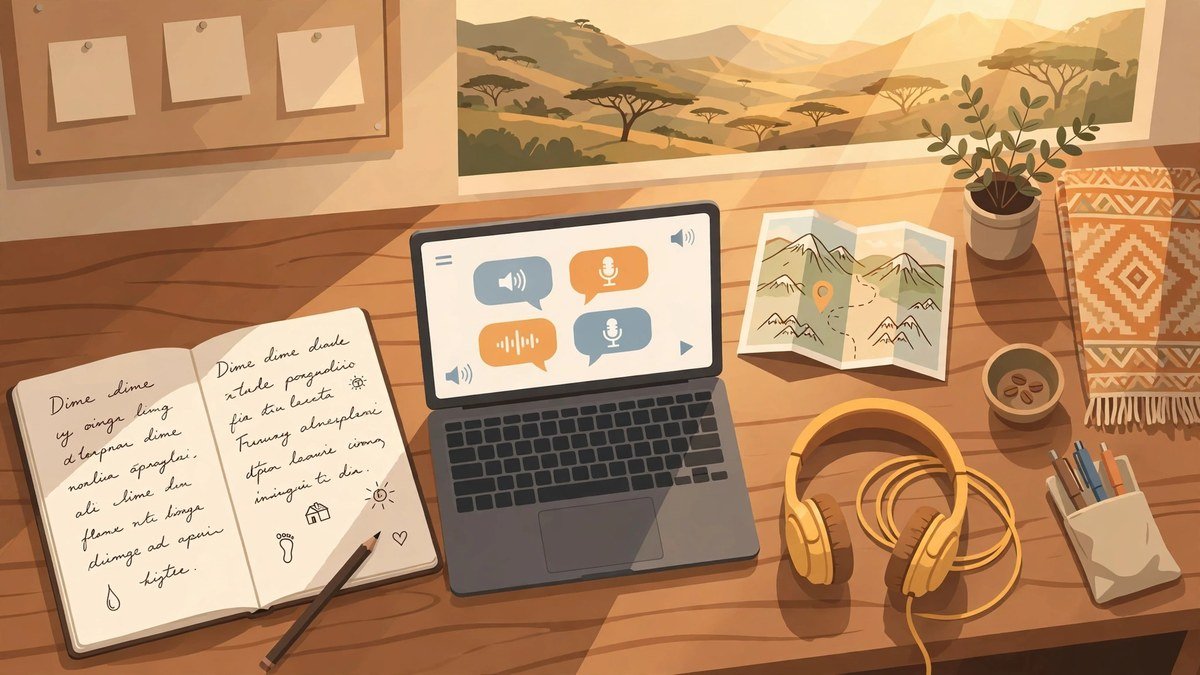
Dime, also written Dimé, is a distinct Omotic language spoken in southern Ethiopia, in the highlands around the Dime mountains and the Omo River basin. It belongs to the Omotic branch of the Afroasiatic family, but it is its own language with its own sounds, grammar, and vocabulary — not a dialect of any neighbour. That distinction matters, because Dime is often confused with the other Omotic languages spoken nearby, and learning material for one of them will not teach you Dime. Gofa, Gamo, Konta, Malo, Oyda, Zayse, Dawro, Wolaytta, Yemsa, Kafa, Bench, Sheko, and Basketo are all sibling Omotic languages, each with its own speakers and its own identity, and none of them is a substitute for Dime.
That is the hard part of learning Dime in 2027: no major app offers a ready-made Dime course. There is no Dime tree on Duolingo, no Dime path on Babbel, and no Dime phrasebook inside Rosetta Stone. What the best AI tools offer instead is a set of flexible systems — speech recognition, spaced repetition, AI conversation partners, and custom flashcard decks — that a determined learner can load with Dime material and turn into a working study routine.
This guide reviews eight real AI language-learning tools and judges each one on the same four questions: can it hold Dime content at all, does it help with speaking and listening, what does it cost, and how much setup does it demand before your first useful lesson. The shortlist runs from Duolingo, the easiest place to build a daily habit, through Memrise and LingQ for vocabulary and reading, to Pimsleur for audio-only practice. No single app covers everything, so the guide ends with a combination that works for a low-resource language like Dime.
Key takeaways
- Duolingo is the best overall starting point for a Dime learner, because its free tier, streak system, and custom practice habits make daily study easy even though it has no Dime course.
- Memrise and LingQ are the strongest tools for building a personal Dime vocabulary, since both accept custom word lists and audio you record yourself.
- Pimsleur is the best audio-only option, and its listen-and-repeat method transfers well to Dime pronunciation once you supply your own phrases.
- No app in this guide teaches Dime directly, so expect to spend your first week gathering Dime words and recordings before the tools do their best work.
- The smartest setup pairs one habit app with one vocabulary tool and one conversation tool, rather than paying for three subscriptions at once.
At a glance: the shortlist
| Product | Best for | Starting price | Standout limit |
|---|---|---|---|
| Duolingo | Daily habit and beginners | Free; Super from around $6.99 a month | No Dime course; needs custom practice |
| Babbel | Structured grammar lessons | From around $13.95 a month | No Dime content; English-based lessons only |
| Rosetta Stone | Pronunciation and immersion | From around $11.99 a month | No Dime course; image-based method only |
| Memrise | Vocabulary with custom decks | Free; Pro from around $8.99 a month | Community Dime content is thin or absent |
| Mondly | Conversation practice | Free; Premium from around $9.99 a month | No Dime course; chatbot is generic |
| Pimsleur | Audio-only learning | From around $14.95 a month | No Dime audio; you supply the phrases |
| LingQ | Reading and listening | Free; Premium from around $12.99 a month | Needs imported Dime text and audio |
| uTalk | Phrasebook basics | From around $9.99 a month | No Dime language pack available |
Duolingo — Best overall
Duolingo is the most useful starting point for a Dime learner, not because it teaches Dime — it does not — but because it solves the first problem every low-resource language learner faces: showing up every day. Its short lessons, streaks, and reminders turn study into a habit, and a habit is worth more than a perfect textbook you never open. Use Duolingo as the scaffolding of a routine: do a short session in Amharic to train your ear for Ethiopian sounds, then move to your own Dime practice in the same daily slot.
Duolingo’s AI features add a second layer. Its adaptive practice repeats the words you miss most often, and its conversation exercises let you practise forming sentences under light pressure. For Dime, treat Duolingo as your warm-up and habit keeper, then pair it with a vocabulary tool where your real Dime words live. The free tier is generous enough for this role, and the paid Super tier mainly removes ads and adds offline lessons. The same habit-first pattern works for sibling languages, as the best AI tools for learning Gofa show for another Omotic language.
Pros: Free tier is genuinely usable; streaks and reminders build a lasting daily habit; speech and listening drills train your ear; works well on phone and desktop.
Cons: No Dime course and no way to add one; Amharic is the closest available language and is not a substitute; ads on the free tier interrupt longer sessions.
Babbel — Best for structured grammar
Babbel is built around short, structured lessons that explain grammar in plain language instead of leaving you to guess it from examples. Each lesson takes ten to fifteen minutes and focuses on a real situation — ordering food, asking directions, introducing yourself — which is exactly the kind of functional language a Dime learner needs first. The catch is the same as everywhere else in this guide: Babbel has no Dime course, so you cannot learn Dime directly inside it. Use it instead to learn the study method, and to build grammar awareness you can apply to Dime sentences later.
For a Dime learner, Babbel works best as a second app rather than the main one. Use it to understand how verb tenses, word order, and question forms are taught, then apply that framework to the Dime sentences you collect from speakers and written sources. Its speech recognition gives useful feedback on pronunciation in the languages it does support, and its review sessions use spaced repetition to bring back words just before you would forget them. Babbel’s subscription costs more than Duolingo’s free tier, so treat it as a short-term investment: a few months to learn how to learn, then cancel once your Dime routine runs on its own.
Pros: Clear grammar explanations in short lessons; speech recognition with useful feedback; review sessions use spaced repetition effectively.
Cons: No Dime course; subscription is pricier than most rivals; lesson topics assume a language Babbel actually teaches.
Rosetta Stone — Best for pronunciation
Rosetta Stone’s method is immersion without translation: you match pictures to spoken words and repeat them until the sounds feel natural. Its TruAccent speech recognition listens to your pronunciation and scores it, which is genuinely useful for a language like Dime, where tone, stress, and unfamiliar consonants can change meaning. The problem is content: there is no Dime course, so you cannot practise Dime sounds inside the app. Use its method on a language it does offer, and its pronunciation training to sharpen your ear before you practise Dime with a native speaker.
The honest verdict is that Rosetta Stone is a supporting tool, not a core one. Its strength is building confidence in speaking aloud, and many learners of low-resource languages stall because they never say the words out loud. If you already own a subscription, use it for twenty minutes a day to train your mouth and ear, then spend your main study time on Dime material elsewhere. Do not buy it expecting Dime lessons.
Pros: Excellent speech recognition and pronunciation feedback; immersion method builds speaking confidence; offline lessons work without a connection.
Cons: No Dime course at all; image-based method is slow for vocabulary building; lifetime pricing is expensive for a supporting tool.
Memrise — Best for vocabulary
Memrise is the strongest vocabulary tool in this guide, because it is built around user-created courses and community decks. Where Duolingo and Babbel lock you into their own curriculums, Memrise lets you build your own: type in Dime words, add English meanings, record or upload audio, and let its spaced-repetition system schedule reviews. That flexibility is exactly what a low-resource language needs. Start with the fifty most useful Dime words — greetings, numbers, family terms, food, and directions — and grow the deck as you learn more.
Memrise also uses short video clips of native speakers in its main courses. There are no Dime clips, but the same effect comes from recording a Dime speaker saying each word and attaching the audio to your deck. The free tier covers deck creation and basic review, while Pro adds offline mode. The main risk is quality control: a deck you build yourself is only as good as the words you put in it, so check every entry with a speaker before you memorise it.
Pros: Custom decks let you study real Dime vocabulary; spaced repetition schedules reviews well; audio can be attached to every word; free tier covers the essentials.
Cons: No ready-made Dime course; deck quality depends entirely on your own entries; community content for rare languages is thin.
Mondly — Best for conversation practice
Mondly’s main selling point is its AI chatbot, which holds simple conversations and corrects your answers in real time. The chatbot will not speak Dime, but the pattern it teaches — short exchanges, quick replies, and gentle correction — is the pattern you need when you finally practise with a real speaker. Mondly also uses speech recognition and daily lessons that keep practice varied, and its lessons are short enough to fit into a lunch break. Used as a conversation trainer in a language it does support, it builds the reflex of answering quickly instead of translating slowly in your head.
The practical way to use Mondly for Dime is indirect: run its conversation exercises to build speaking confidence, then carry that confidence into Dime practice with a speaker or an AI chat tool prompted with Dime phrases. The free tier gives you one daily lesson, while Premium unlocks the full library. Do not pay for Premium hoping a Dime course will appear; buy it, if at all, for the conversation habit.
Pros: AI chatbot gives low-pressure conversation practice; speech recognition checks pronunciation; daily lessons are short and varied.
Cons: No Dime course and the chatbot cannot speak Dime; free tier is limited to one lesson a day; Premium is poor value if you only want Dime.
Pimsleur — Best for audio-only learning
Pimsleur is the only tool in this guide designed entirely around listening and speaking, with no reading, no typing, and no screen required. Each thirty-minute lesson plays a conversation, breaks it into pieces, and asks you to answer out loud, spacing repetitions so each phrase returns just before you forget it. That method transfers well to Dime, because Dime is primarily a spoken language for most learners, and the skill you need first is hearing it and saying it, not reading it. The gap is that Pimsleur has no Dime course, so there are no ready-made Dime lessons to play.
The workaround is to borrow the method rather than the material. Study how Pimsleur structures a lesson — new phrase, repetition, variation, recall — then build your own audio drills the same way from recordings of a Dime speaker. A Pimsleur subscription in a language it does teach, such as Amharic, also trains your ear for Ethiopian speech sounds. Pimsleur is expensive for a tool you must adapt this heavily, so try the free trial first.
Pros: Best audio-only method in this guide; spaced repetition is built into every lesson; hands-free learning fits commutes and chores.
Cons: No Dime audio lessons; subscription is among the priciest here; no reading or writing practice at all.
LingQ — Best for reading and listening
LingQ is built for learners who want to read and listen to real content, and it is the most flexible tool in this guide for a language with no commercial course. You import text and audio — a story, a song, a recorded conversation — and LingQ turns it into an interactive lesson, letting you click any word to save it, hear it, and review it later. For Dime, that means any material you can find or create becomes a lesson: a short text written by a speaker, a recording with a transcript, or a list of sentences you collected.
The trade-off is effort. LingQ gives you a powerful system and almost no content for Dime, so your first weeks are spent gathering and importing material rather than studying. That is time well spent: the library you build becomes your personal course, and every word you save is a word you actually need. The free tier limits saved words, so Premium is worth it once your library grows. Its AI features can generate example sentences, though you should always check the AI’s guesses against a speaker.
Pros: Imports your own Dime text and audio as lessons; click-to-save vocabulary with spaced review; AI sentence help for unfamiliar words.
Cons: No ready-made Dime content; free tier limits saved words; setup takes real time before study begins.
uTalk — Best for phrasebook basics
uTalk is a phrasebook app with a simple idea: learn the words and phrases a traveller or beginner actually needs, spoken by native speakers, with games to drill them. Its courses cover everyday topics — greetings, numbers, food, directions, emergencies — and each phrase comes with audio you can repeat and record yourself saying. For a Dime learner, uTalk’s value is its structure: it shows you which sixty or so phrases matter most in the first month, and gives you a proven way to drill them until they stick.
The limitation is familiar: uTalk has no Dime language pack, so you cannot open it and start learning Dime phrases. Use its phrase lists as a checklist instead. Take its topic list, gather the Dime equivalent of each phrase from a speaker, and drill them with the same game-style repetition. On its own, uTalk is a template for Dime study rather than a Dime course.
Pros: Clear phrasebook structure for beginners; native-speaker audio in the languages it covers; games make drilling less dull; one subscription covers many languages.
Cons: No Dime language pack; phrasebook depth is shallow; weak on grammar and longer conversations.
How to choose
Start with the problem you actually have. If you never study, pick Duolingo and build the habit first. If your vocabulary never sticks, pick Memrise and build a Dime deck. If you can read Dime words but cannot say them, use Pimsleur’s method and practise out loud every day. If you have Dime recordings and texts, pick LingQ and turn them into lessons. Most learners need two tools: a habit app and a vocabulary app, plus a way to speak. Start free, find the pair that fits, and only then pay for the one you use every day.
A free tool you use daily beats a paid tool you open once a week, and the most expensive mistake here is buying a subscription for a language the app does not teach. Check before you pay: search the app for Dime, and if it is not there, assume you will adapt the tool with your own material. That adaptation is normal for a low-resource language. The best AI tools for learning Gamo use the same two-tool rule for another southern Ethiopian language.
Checklist: before you pay
- Confirm the app has no Dime course, so you are paying for a system you will adapt, not for Dime lessons.
- Gather your first fifty Dime words and a few recordings from a speaker before you buy anything.
- Try the free tier for two weeks and check whether you actually open the app every day.
- Check the renewal price, not just the first-month offer, and set a reminder before it renews.
- Make sure you can export your word lists and notes, so your Dime work survives if you cancel.
- Pick one habit app and one vocabulary tool, and do not pay for a third until both are part of your daily routine.
Frequently asked questions
Is Dime the same as Gofa, Gamo, or Wolaytta?
No. Dime is a distinct Omotic language of southern Ethiopia, different from its sibling Omotic languages Gofa, Gamo, Konta, Malo, Oyda, Zayse, Dawro, Wolaytta, Yemsa, Kafa, Bench, Sheko, and Basketo. These languages are related through the Omotic branch, but each has its own vocabulary, grammar, and speakers, so material for one will not teach you another. Always check that your study material is labelled Dime or Dimé before you memorise it.
Does any app offer a complete Dime course?
No major app offers a complete Dime course in 2027. Duolingo, Babbel, Rosetta Stone, Memrise, Mondly, Pimsleur, LingQ, and uTalk all lack Dime content, so the tools in this guide work by letting you load your own Dime words, recordings, and texts into their systems. That is the reality of learning a low-resource language.
Which tool is best for learning Dime vocabulary?
Memrise is the best choice for vocabulary, because its custom decks accept Dime words and audio you provide, and its spaced repetition schedules reviews well. LingQ is the best second choice, especially if you have Dime texts and recordings to import.
How can I practise speaking Dime with no native speakers nearby?
Record yourself saying Dime phrases and compare them with a speaker’s audio, use Pimsleur’s listen-and-repeat method with your own phrases, and practise conversation with an AI chat tool prompted with Dime sentences. None of these replaces a real speaker, so look for Dime speakers online or through language exchange platforms whenever you can.
How long does it take to hold a basic conversation in Dime?
With thirty minutes of daily study, most learners can manage greetings, introductions, numbers, and simple requests within three to six months. Progress depends on how much Dime material you can gather and how often you speak aloud. Learners who only read about Dime will progress far more slowly than learners who speak it every day, even for a few minutes. The best AI tools for learning Wolaytta follow the same timeline for a related Omotic language.
Should I learn Amharic first and then Dime?
Learning Amharic first can help, since Amharic is widely spoken in Ethiopia and several apps teach it, but it is not a shortcut to Dime. Amharic is a Semitic language, while Dime is Omotic, so Amharic will not teach you Dime grammar or vocabulary. Learn Amharic if you need it for travel in Ethiopia, and learn Dime directly with the tools in this guide.
The bottom line
Duolingo is the best starting point for a Dime learner, because it builds the daily habit that everything else depends on. Pair it with Memrise for vocabulary, and add LingQ once you have Dime texts and recordings to import. If you learn best by listening, use Pimsleur’s method with your own audio instead. That combination — one habit app, one vocabulary tool, and one way to speak — covers the whole job, and it works for a language no app teaches directly.
Start this week, not next month. Gather fifty Dime words, record them with a speaker if you can, load them into Memrise, and open Duolingo every morning. The tools will not do the work for you, but they will make the work you do count twice. Check current pricing before you subscribe, since plans change.
Note: Prices and plans change. Check the product’s current plan details before buying — no link is provided here by design, all links in this article go to other occcy.com guides.