
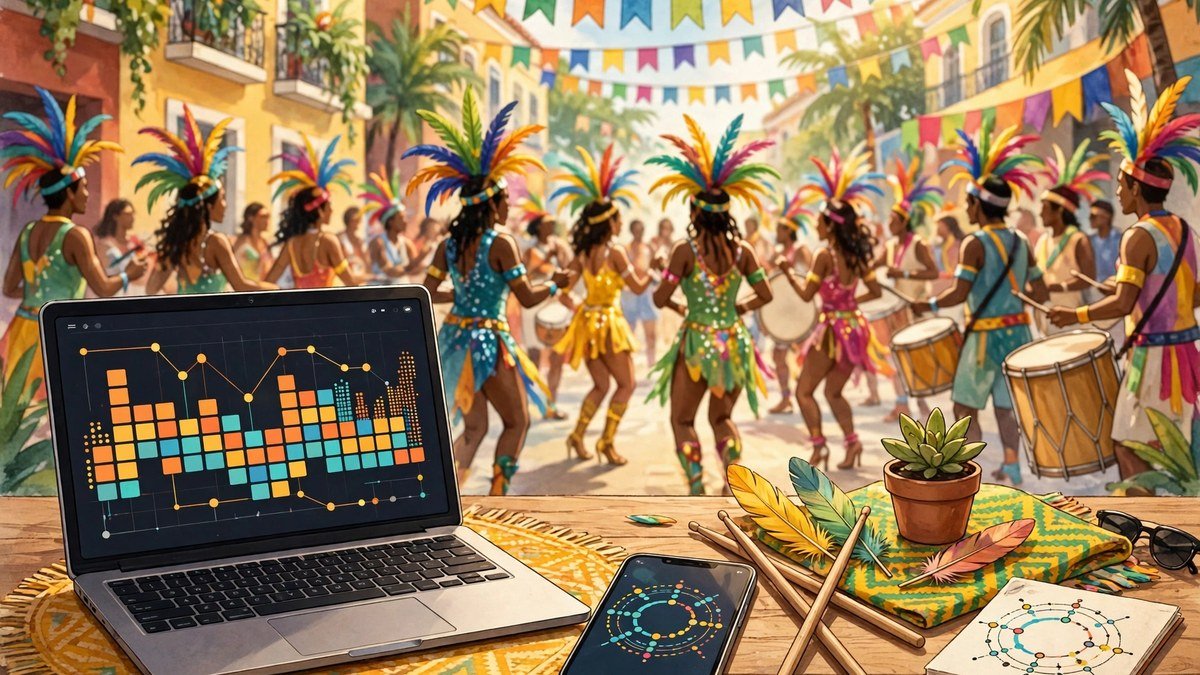
Samba looks simple from the sidelines, yet the bounce, hip movement, syncopated rhythm and coordination with a partner or a bateria all have to land at the same time. For most beginners, the hardest part is not enthusiasm. It is knowing what to practise, in what order, and whether the timing is right when nobody is watching.
That is where AI tools for learning samba earn their place in 2027. The best listen to your clapping or drumming, watch your steps through a phone camera, slow a pattern down without changing its feel, and build a practice plan around the bar where you keep slipping. They do not replace a teacher or a live roda, but they make the hours between lessons far more useful, especially for learners who do not live near a Brazilian dance school.
We tested the field for rhythm accuracy, step feedback, Portuguese lyric support, percussion training, price and beginner-friendliness. The eight tools below are the strongest picks for 2027, from a polished all-rounder to a free rhythm trainer worth your time.
Key takeaways
- SambaFlow AI is the best overall pick, combining step tracking, rhythm scoring and structured courses in one app.
- Ritmo Coach is the best choice for complete beginners, with slow, clear breakdowns and no jargon.
- Batucada Beat Lab is the best tool for percussion and timing, with precise feedback on surdo, tamborim and agogo patterns.
- Most learners should start with a free trial, check the renewal price, and practise in short daily sessions of 15 to 20 minutes.
- No app can fully judge style, musicality or partner connection, so combine an AI tool with live classes or social dancing when you can.
At a glance: the shortlist
| Product | Best for | Starting price | Standout limit |
|---|---|---|---|
| SambaFlow AI | Best overall | From $12 per month | Advanced feedback needs a clear camera view |
| Ritmo Coach | Beginners | From $8 per month | Smaller song library than rivals |
| Batucada Beat Lab | Rhythm and percussion | From $10 per month | Focused on drumming, not dance steps |
| Carnaval Step Studio | Dance moves | From $14 per month | Higher price for full access |
| Portuguese Samba Tutor | Lyrics and language | From $9 per month | Less step-by-step dance coaching |
| DrumSync AI | Percussion practice | From $7 per month | No partner-dance mode |
| SambaFit Motion | Fitness and movement | From $11 per month | Music selection is workout-led |
| GrooveMentor | Budget and free tier | Free, premium from $5 per month | Free plan limits daily lessons |
SambaFlow AI — Best overall
SambaFlow AI is the most complete package here, treating samba as three skills at once: rhythm, steps and musical understanding. A typical lesson starts with a short listening exercise, moves into a step breakdown filmed from two angles, and ends with a practice round where the app scores your timing. Many apps teach steps in isolation; SambaFlow keeps the music in the room from the first minute, which is how samba is actually learned in Brazil.
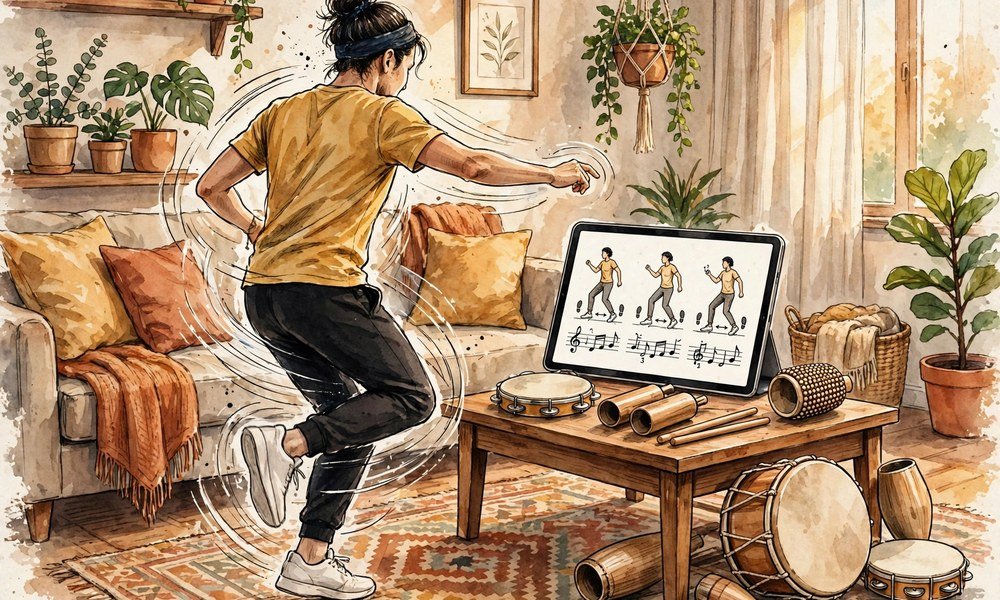
The camera feedback is the standout feature. Dance a basic step and the app highlights whether your bounce lands on the beat, whether your weight transfer is late, and whether your hips move with the step rather than after it. The feedback is specific, so you can fix one thing at a time. It works best with a tripod or a phone propped at waist height, in good light.
The library covers samba de gafieira, samba no pe and carnival parade steps, plus surdo and tamborim rhythm modules. Lessons run five to ten minutes, in a weekly plan set by a short opening assessment. Pricing starts from $12 per month on an annual plan, with a free trial and offline downloads on paid plans.
Pros: Complete dance, rhythm and music courses; specific camera feedback on timing and weight transfer; short lessons with a personalised weekly plan; offline downloads on paid plans.
Cons: Camera feedback needs good light and space; monthly billing is noticeably more expensive than the annual plan; some advanced carnival routines are locked behind the top tier.
Ritmo Coach — Best for beginners
Ritmo Coach is the tool to choose if you have never danced samba and want it explained plainly. It builds a gentle path through the basic step, the bounce, the side step and the first turns, each taught at half speed with a clear count. There is no jargon in the early lessons, and no pressure to keep up with a fast backing track before you are ready.
The rhythm trainer isolates the pulse, then adds one instrument at a time: first the surdo, then the tamborim, then the shaker. You tap along, the app tells you whether you are early or late, and it only moves on when your timing is steady. Many beginners fail not because they cannot move, but because they cannot hear where the beat sits inside a busy rhythm. Ritmo Coach fixes the listening first, and the dancing gets easier as a result.
Lessons are short and encouraging, with a streak system that rewards daily practice. The song library is smaller than SambaFlow AI, focused on classic samba and pagode, but each track is available at several speeds, with the count shown visually and audibly. Pricing starts from $8 per month, and the free trial covers the full beginner course. The trade-off is depth: once you want advanced turns or partner work, you will outgrow it, but for the first three to six months it is the friendliest way to start.
Pros: Clear, jargon-free beginner lessons; excellent step-by-step rhythm trainer; affordable starting price; works well on older phones.
Cons: Smaller song library than rivals; limited advanced and partner-dance content; no dedicated percussion courses.
Batucada Beat Lab — Best for rhythm and percussion
To understand and play the rhythms behind samba, Batucada Beat Lab is the specialist tool to beat. It is built around the bateria, the percussion ensemble at the heart of samba, and it teaches each instrument properly: surdo, tamborim, repique, agogo, shaker and caixa. For each one, you get a clear pattern, a slow demonstration, a loop you can play along with, and AI feedback that listens to your playing and marks each hit as on time, early or late.
That feedback is unusually precise. The app separates the low thump of a surdo from the sharp crack of a tamborim, so it can tell you which hand is rushing. It shows your timing on a simple visual timeline, and you can slow any pattern to half speed, loop a single tricky bar, and gradually raise the tempo as accuracy improves.
The library includes classic samba-reggae, samba-enredo and pagode grooves, plus call-and-response, breaks and transitions, and an ensemble mode where the app plays the other instruments while you hold one part. Dancers benefit too: understanding the surdo pattern makes the step feel obvious. Pricing starts from $10 per month, with a free tier for the basic surdo and tamborim patterns. The trade-off is focus: this is a rhythm tool first, so if you only want steps, a broader app will serve you better.
Pros: Precise listening feedback for each instrument; slow-down and looping tools; ensemble mode for group practice; strong library of classic grooves.
Cons: Focused on drumming, not dance steps; assumes some percussion comfort; full library requires a paid plan.
Carnaval Step Studio — Best for dance moves
Carnaval Step Studio is the showiest tool in this list. It focuses on the dance itself: samba no pe, parade choreography, turns, travelling steps and the expressive arm and hip styling that makes samba look like samba rather than a fitness routine. Lessons are filmed with professional dancers, shot from the front and the back, and broken into counts so you can learn a move in pieces before putting it together at full speed.
The AI mirror mode is the core feature. Your phone camera tracks your body and overlays your silhouette against the instructor, so you can see whether your arms are too low, your steps are too wide or your bounce is missing. The app also scores each run and saves a clip of your best attempt.
Choreography packs are organised by carnival theme, song and difficulty, so you can learn a complete routine for a performance rather than disconnected steps. The app includes samba-specific warm-ups and cool-downs for ankles, hips and lower back. Pricing starts from $14 per month, the highest here, and the best packs sit on the top tier. If you are preparing for a carnival or a showcase, it is the most dance-focused and polished tool here.
Pros: Excellent filmed choreography and mirror mode; clear front and back views; themed routine packs; samba-specific warm-ups.
Cons: Highest starting price here; best packs need the top tier; social feedback quality varies.
Portuguese Samba Tutor — Best for lyrics and language
Samba is inseparable from Portuguese. The songs tell stories, the calls in a roda are in Portuguese, and the names of steps and instruments make far more sense once you know what the words mean. Portuguese Samba Tutor teaches the language through samba lyrics, breaking songs line by line, explaining vocabulary and pronunciation, and using the song itself as the listening exercise.
Each song lesson starts with the full lyric, a translation, and a slow spoken reading. Then the app plays the song in sections, highlighting each line as it is sung, and asks you to repeat, fill in missing words, or match the phrase to its meaning. Speech recognition is tuned for singing, and gives feedback on vowel sounds and stress. Over time you build the vocabulary that actually appears in samba: saudade, alegria, roda, bateria, ginga and dozens more.
Dance support is lighter here: basic step videos and rhythm counts, but not full choreography. Its strength is cultural and linguistic: you finish a lesson understanding what you are dancing to, able to sing along, and better equipped to follow a Brazilian teacher or join a roda. Pricing starts from $9 per month, with a free tier for a handful of classic songs. The music-creation side is covered in our guide to the best AI tools for music creation.
Pros: Teaches Portuguese through real samba lyrics; speech feedback tuned for singing; strong classic song library; affordable price.
Cons: Less step-by-step dance coaching; limited choreography; library leans towards classic rather than new songs.
DrumSync AI — Best for percussion practice
DrumSync AI is a focused percussion trainer that does one job very well: it listens to you play and tells you, beat by beat, how accurate you are. Pick an instrument, pick a pattern, pick a tempo, and play. The app shows a scrolling pattern, highlights each hit as it passes, and gives you a score at the end of the round, with a breakdown of your weakest bars.
The pattern library is deep for its price, covering the core samba instruments, plus exercises for hand independence and dynamics. There is a metronome mode with a samba feel, more useful than a plain click, because samba timing swings slightly rather than sitting rigidly on the grid. You can also import a song, detect its tempo, and practise the matching pattern alongside it.
Sessions are short, usually ten minutes, and the app builds a daily routine from your recent scores. If your tamborim pattern is shaky, it keeps serving it until it stabilises, rather than moving on. Pricing starts from $7 per month, the cheapest paid tool here, with a free trial for the basic patterns. The limitation is scope: no partner-dance mode, choreography or lyric support. For samba percussion, though, it is excellent value and the most direct route to steady timing.
Pros: Clear beat-by-beat accuracy scoring; deep pattern library; adaptive daily practice; cheapest paid option here.
Cons: No partner-dance mode; no choreography or lyric lessons; microphone accuracy drops in noisy rooms.
SambaFit Motion — Best for fitness and movement
SambaFit Motion sits at the meeting point of dance and fitness. It teaches samba steps through follow-along workouts, where the goal is to keep moving, raise your heart rate and build stamina, while also learning real footwork. Lessons are structured like a class: warm-up, step practice, a full routine, and a cool-down, with the AI tracking your movement and estimating effort and consistency over time.
The motion tracking is the main draw. Using your phone camera, the app checks whether you are completing the full range of a step, whether your knees are bending enough for the bounce, and whether you are staying on the beat as the tempo rises. It is less precise than a dedicated dance coach on fine details, but very good at the big picture: are you moving, are you in time, and is your stamina improving?
The music is workout-led: energetic samba and samba-funk tracks chosen for tempo and drive, with fewer slow, traditional songs. The app also includes strength and mobility routines for ankles, calves and hips. Pricing starts from $11 per month, with a free trial, a family plan, and fitness tracker sync. The trade-off is depth: it teaches steps well, but goes less far into partner work, styling or percussion than the specialist tools.
Pros: Follow-along dance workouts; motion tracking for range and timing; fitness tracker sync; dancer-specific strength and mobility routines.
Cons: Music selection is workout-led; less partner and styling depth; motion feedback is broad rather than fine-grained.
GrooveMentor — Best budget and free tier
GrooveMentor proves that a useful samba tool does not have to cost much. Its free tier includes a basic step course, a rhythm trainer and a small library of songs, with no card required to start. The lessons are simple and well filmed, and the free plan is genuinely usable for a first month rather than a teaser that stops after two lessons.
The rhythm trainer is the best part of the free tier, covering the basic samba pulse, the surdo pattern and a simple tamborim pattern, with tap-along feedback and a visual count. The step course covers the basic step, side step and a first turn, each taught slowly and repeated at increasing speeds. It is not as polished as SambaFlow AI or as deep as Batucada Beat Lab, but the core teaching is sound.
Premium, from $5 per month, removes the daily lesson limit, unlocks the full song library and adds camera feedback for steps. Start free, practise for a few weeks, and only pay if you are still dancing. The limits are real: the free plan caps daily lessons, the song library is smaller than paid rivals, and camera feedback is basic. Even so, it is the best place to start if budget matters.
Pros: Genuinely useful free tier; premium from only $5 per month; clear beginner steps and rhythm trainer; no card needed to start.
Cons: Free plan limits daily lessons; smaller song library; basic camera feedback compared with premium rivals.
How to choose
Start with your goal, not the app store ranking. To dance, choose a tool with camera feedback and filmed steps, such as SambaFlow AI or Carnaval Step Studio. To play, choose a percussion specialist such as Batucada Beat Lab or DrumSync AI. To understand the songs, choose Portuguese Samba Tutor. If you are not sure yet, start with GrooveMentor for free and see which part of samba pulls you in first.
Next, test the feedback in your real practice space. Camera tools need light and room, microphone tools need a reasonably quiet space, and both need a phone position you can repeat daily. Use the free trial in the exact spot where you will practise, and check the renewal price and cancellation terms. Rhythm is the foundation of samba, so a tool that teaches you to hear the instruments, not just copy steps, will serve you longer. Our guide to the best AI tools for sound design is a useful next read on rhythm and timing.
Checklist: before you pay
- Use the free trial in your actual practice space, with your real phone position and lighting.
- Check the renewal price, not just the first-month price, and confirm how cancellation works.
- Confirm the tool covers your goal: dance steps, percussion, lyrics or fitness, not just one of them.
- Test the feedback: does it tell you exactly what was early, late or incomplete?
- Check the song library for variety, tempo options and the styles you want to learn.
- Confirm you can export or keep your progress, and that offline downloads are included if you need them.
Frequently asked questions
Can AI tools really teach me samba?
Yes, for the foundations: rhythm, timing, step breakdowns and repetition. They are weaker at style, musicality and partner connection, best learned from a teacher or in a social setting. Use an app for daily practice and a live class for the parts an app cannot judge.
How long does it take to learn the basic samba step?
Most beginners can dance a recognisable basic step within two to four weeks of short daily practice, usually 15 to 20 minutes a day. Dancing it smoothly, in time, with the right bounce takes longer, often two to three months. Timing feedback speeds this up by catching small errors early.
Do I need a drum to learn samba percussion?
No. You can start on a practice pad, a tabletop or even your knees, and the AI feedback will still work. A real surdo or tamborim gives a cleaner sound and a better feel, and it is worth buying once you are sure you want to continue, but it is not required to learn the patterns or build timing.
Is samba hard for complete beginners?
Samba is fast and syncopated, so it feels hard at first. Slow it down: learn the pulse first, then the step at half speed, then add the music. Tools such as Ritmo Coach are built for this approach, and they make the first month far less frustrating.
Which AI tool is best for learning samba on a budget?
GrooveMentor is the best budget pick, with a genuinely useful free tier and premium from $5 per month. DrumSync AI is also excellent value at $7 per month if your focus is percussion. Start free, practise for a few weeks, and only pay for a tool once you know which part of samba you want to focus on.
Should I learn samba dance or percussion first?
Either works, and each helps the other. Dancers who understand the drum patterns find the step easier, and drummers who understand the step feel the groove more naturally. Pick the one that excites you most, because excitement keeps you practising. Our guide to the best AI tools for learning Ngemba shows the same structured, step-by-step approach for any new skill.
The bottom line
For most learners, SambaFlow AI is the best overall choice, covering dance, rhythm and music in one structured course. Beginners should start with Ritmo Coach, drummers should choose Batucada Beat Lab or DrumSync AI, and anyone on a budget should start free with GrooveMentor. Carnaval Step Studio is the pick for performance, Portuguese Samba Tutor for lyrics, and SambaFit Motion for fitness and dance together.
Whichever tool you choose, practise little and often, use the trial before you pay, and get into a live class or a social dance when you can. An app can teach the step and the beat, but samba is social music, and it comes alive when you dance it with other people. Start with the basics, trust the count, and let the rhythm do the rest.
Note: Prices and plans change. Check the product’s current plan details before buying — no link is provided here by design, all links in this article go to other occcy.com guides.



