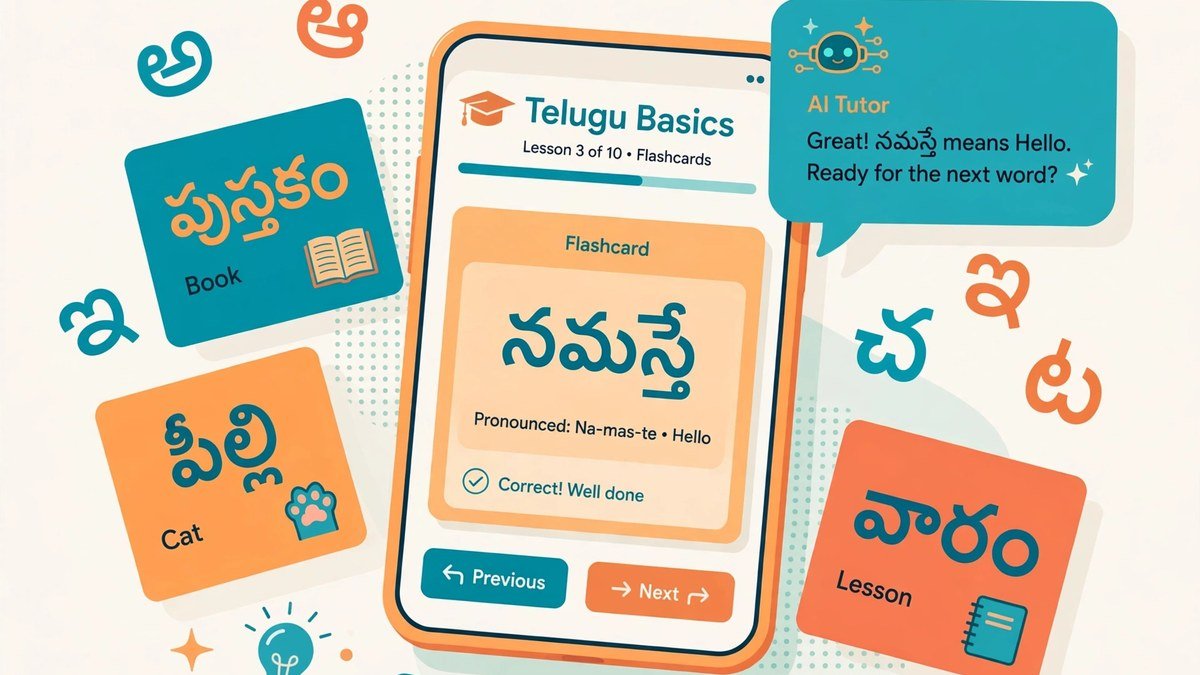
Telugu is spoken by roughly 96 million people, making it one of the largest languages in India and the official language of Andhra Pradesh and Telangana. For years, learners had to rely on a handful of textbooks, scattered YouTube channels, and patient friends. In 2027, that has changed. AI-powered apps can now hear your Telugu pronunciation, correct it in real time, generate conversations on any topic, and teach the script step by step — all from a phone.
The change is not just about having more apps. Speech recognition for Telugu has improved sharply, transliteration tools let beginners read Telugu words in Latin letters while they learn the script, and AI tutors can hold a conversation at exactly your level, switching between Telugu and English whenever you get stuck. The best tools combine these strengths instead of doing one thing well and ignoring the rest.
This guide tests the field and ranks eight tools for 2027. Duolingo leads overall for its structured Telugu course, Ling is the strongest dedicated Telugu app, and Talkpal AI is the best AI conversation partner. Drops wins for vocabulary, Memrise for video-based listening, Mondly for daily habit building, ChatGPT for a free, flexible AI tutor, and HelloTalk for real conversations with native speakers.
Key takeaways
- Duolingo is the best overall starting point, with a full Telugu course, speech exercises, and a free tier that covers the basics well.
- Ling is the best dedicated Telugu app, with lessons built specifically around Telugu script, sounds, and everyday phrases.
- Talkpal AI is the best AI conversation partner, letting you practise realistic spoken Telugu without the pressure of a real person.
- Most learners should pair one structured course with one speaking tool, rather than paying for three apps that do the same thing.
- Free tiers are genuinely useful for Telugu, but speech feedback and offline lessons usually sit behind a paid plan.
At a glance: the shortlist
| Product | Best for | Starting price | Standout limit |
|---|---|---|---|
| Duolingo | Overall beginners | Free; Super from about $7 per month | Advanced conversation is limited |
| Ling | Dedicated Telugu lessons | Free trial; Pro from about $8 per month | Smaller community than big apps |
| Talkpal AI | AI speaking practice | Free tier; Premium from about $10 per month | Needs a decent internet connection |
| Drops | Vocabulary building | Free; Premium from about $8 per month | Five-minute daily limit on free plan |
| Memrise | Listening and video | Free; Pro from about $9 per month | Telugu content is thinner than major languages |
| Mondly | Daily habit building | Free; Premium from about $10 per month | Less depth at intermediate level |
| ChatGPT | Free flexible AI tutor | Free; Plus from about $20 per month | No structured curriculum of its own |
| HelloTalk | Real native speakers | Free; VIP from about $7 per month | Quality depends on your partners |
Duolingo — Best overall
Duolingo remains the easiest place to start learning Telugu in 2027, and that is exactly why it leads this list. Its Telugu course walks you through the script one character at a time, pairs each new letter with audio from native speakers, and then builds short sentences from the words you already know. The bite-sized lessons fit into five or ten minutes, and the streak system is genuinely effective at keeping beginners coming back every day.
The AI features are what keep Duolingo ahead of a simple flashcard app. Speech recognition checks your pronunciation on speaking exercises, the app adapts lesson difficulty based on your mistakes, and the newer AI conversation features let you practise short exchanges instead of only tapping multiple-choice answers.
Duolingo’s approach to South Asian languages follows the same pattern across its courses, and our guide to the best AI tools for learning Tamil shows how the same strengths and limits play out in a closely related language. The free tier is usable for a long time, with ads and a limited number of mistakes before you need to wait or pay. Super removes ads, adds unlimited hearts, and unlocks offline lessons, which matters if you study on the move.
Pros: Full Telugu course with script teaching, strong speech recognition, excellent free tier, proven daily habit design.
Cons: Limited advanced conversation practice, some sentences feel unnatural, ads on the free plan.
Ling — Best for dedicated Telugu lessons
Ling is built specifically for less commonly taught languages, and that focus shows in its Telugu course. Where the biggest apps sometimes treat Telugu as a smaller course, Ling gives it a full curriculum: alphabet lessons with stroke-order guidance, vocabulary grouped by real situations such as eating out or visiting family, and mini-dialogues recorded by native speakers. The app teaches the Telugu script from day one rather than hiding it behind transliteration, which pays off quickly.

The AI chatbot inside Ling is the standout feature for intermediate learners. You can practise ordering food, asking directions, or introducing yourself, and the bot responds in Telugu at a level matched to your progress, correcting mistakes as you go. Pronunciation feedback on individual words is clear and forgiving, which helps with Telugu’s retroflex sounds that English speakers often struggle with.
Ling’s weak spot is its smaller community, so there are fewer user-made extras and less discussion around the Telugu course than you will find for Spanish or French. The free version gives you a real taste, but the full course needs a Pro subscription. For learners who want an app that treats Telugu as a first-class language rather than an afterthought, it is the best dedicated option in 2027.
Pros: Telugu-first curriculum, script teaching with stroke order, AI chatbot for realistic dialogues, native-speaker audio.
Cons: Smaller community, full course needs a paid plan, fewer advanced reading materials.
Talkpal AI — Best AI conversation partner
Talkpal AI is the closest thing to a private Telugu tutor that you can carry in your pocket. It is an AI language tutor built on large language models, and you can talk to it by voice or text about anything: your day, a film you watched, a trip to Hyderabad, or a job interview. It responds in Telugu, corrects your errors, explains the correction in English when you ask, and remembers the vocabulary you struggle with so it can bring those words back later.
The voice mode is the reason Talkpal earns its place here. Speaking Telugu out loud to an AI that never gets impatient is the fastest way most learners build confidence, and Talkpal’s speech recognition handles Telugu reasonably well in 2027, including common code-switching with English. You can set the difficulty, choose a scenario such as a market or a family gathering, and practise the exact phrases you need. Role-play modes simulate real situations, and the app tracks your fluency, vocabulary range, and grammar over time.
Talkpal works best as a second tool alongside a structured course, because it does not teach the Telugu script or grammar systematically on its own. Absolute beginners may find open conversation intimidating before they know a few hundred words.
Pros: Realistic AI voice conversation, personalised corrections, role-play scenarios, progress tracking.
Cons: Not a complete course on its own, needs internet, premium plan needed for unlimited voice chats.
Drops — Best for vocabulary
Drops takes a deliberately narrow approach: it teaches vocabulary and almost nothing else, and it does that one job extremely well. Each session lasts five minutes, and you learn Telugu words through fast, visual word-matching games with clear audio and beautiful illustrations. The Telugu word bank covers everyday topics thoroughly, from food and family to travel and work, and the script is shown alongside transliteration so you start recognising characters naturally.
The five-minute limit sounds like a drawback, but it is the point. Drops is designed for the moments other apps waste: a bus ride, a queue, the minutes before bed. For learners who already have a main course and need a painless way to grow their word count, Drops is the best supplement on this list.
The free plan really does cap you at five minutes a day, which is enough for vocabulary but frustrating if you want longer sessions. Premium removes the limit and adds offline access and word lists. Drops will not teach you grammar or conversation, and it does not pretend to. Used for what it is, it is one of the most efficient Telugu vocabulary tools available in 2027.
Pros: Fast, visual vocabulary learning, excellent Telugu word bank, smart spaced repetition, genuinely fun in short bursts.
Cons: Five-minute daily limit on free plan, no grammar or conversation, premium needed for unlimited use.
Memrise — Best for listening and video
Memrise’s strength is that it teaches Telugu the way it is actually spoken, through short video clips of native speakers. Instead of learning a word from a robotic voice and then being surprised by real speech, you hear dozens of different people saying the same phrases, with different accents, speeds, and intonations. That exposure makes a real difference to listening comprehension, which is where many app learners stall.
The AI features in Memrise have grown steadily. Its conversation practice tool lets you respond to video prompts as if you were talking to the person on screen, and speech recognition scores your pronunciation. The spaced repetition system is solid, and the app mixes video learning with classic flashcard review so new words actually stick. Telugu content is thinner than the library for French or Spanish, but what exists is well made and focused on phrases you will genuinely use.
Memrise is at its best as a listening companion to a structured course such as Duolingo or Ling. For learners who understand written Telugu but freeze when someone speaks to them, it is the best fix in this roundup.
Pros: Native-speaker video clips, strong listening practice, AI conversation prompts, good spaced repetition.
Cons: Smaller Telugu library than major languages, not a complete course alone, Pro needed for full features.
Mondly — Best for daily habit building
Mondly’s Telugu course is built around short daily lessons that combine vocabulary, phrases, and simple conversations in a single flow. Each lesson takes about ten minutes and ends with a short dialogue you can practise with speech recognition, so you are speaking from the very first day rather than only reading. The app’s clean design and daily reminders make it one of the easiest tools to stick with, and consistency matters more than intensity for a language like Telugu.
The standout feature is Mondly’s augmented reality and chatbot modes, which turn practice into something closer to a game. The chatbot holds simple conversations in Telugu and corrects you gently, while the AR feature places virtual objects in your room and teaches you their Telugu names.
Mondly’s depth is its limit. Once you pass the beginner stage, the lessons become repetitive and the Telugu content runs thinner than the dedicated courses. It is an excellent first app for someone who has never studied a language before and needs momentum, and it pairs well with Talkpal AI later, when you are ready for open conversation. The free tier covers the basics, with the full course behind a premium subscription.
Pros: Very easy daily habit, speech practice from day one, fun chatbot and AR modes, clean design.
Cons: Thin at intermediate level, repetitive after a few months, full course needs a paid plan.
ChatGPT — Best free AI tutor
ChatGPT is the most flexible tool on this list, and for many learners it is also the best value, because the free tier is genuinely powerful. You can ask it to explain Telugu grammar in plain English, generate example sentences with any word, translate a paragraph and explain every choice it made, quiz you on vocabulary, or role-play a conversation at a level you choose. No other single tool covers that range, and you can shape every session around exactly what you need that day.
The voice mode turns ChatGPT into a Telugu conversation partner. You can talk to it, have it correct your pronunciation indirectly by responding naturally to what you said, and ask it to slow down or repeat itself in simpler Telugu. It can also read Telugu text aloud, help you write messages to Telugu-speaking friends or family, and create personalised study plans. The quality of its Telugu has improved markedly, and in 2027 it handles everyday conversation, grammar explanations, and transliteration reliably.
The catch is that ChatGPT is not a course. It will not plan your learning path unless you ask it to, it will not remind you to study, and it can occasionally produce an unnatural phrase without flagging it. The Plus plan adds faster responses and better voice quality, but the free tier is enough to start.
Pros: Free tier is powerful, unlimited custom lessons and explanations, good voice conversation, handles transliteration well.
Cons: No built-in curriculum or reminders, occasional unnatural phrasing, no systematic progress tracking.
HelloTalk — Best for real native speakers
HelloTalk is where AI-assisted learning meets real people. It is a language exchange app that connects you with native Telugu speakers who want to learn your language, and its built-in tools make the exchange work: instant translation, transliteration, pronunciation playback, and AI-powered grammar correction on your messages. You can text, send voice notes, or call, and the app corrects your Telugu as you write, which turns every chat into a lesson.
The reason HelloTalk belongs on an AI tools list is that its AI features remove the friction that used to make language exchange intimidating. You can look up any word mid-conversation without leaving the chat, have your sentences corrected before you send them, and practise with Moments posts — short public updates in Telugu that native speakers correct for you. For learners who already know the basics and need real conversation, there is no substitute for talking to actual people.
The experience depends on your partners, so it takes a little patience to find reliable exchange friends, and you should expect to help them with your language in return. HelloTalk is not the right first app for a complete beginner with no Telugu at all, but once you can introduce yourself and ask simple questions, it is the best way to turn textbook knowledge into real fluency.
Pros: Real conversations with native speakers, built-in translation and correction, voice notes and calls, free messaging tier.
Cons: Partner quality varies, not suitable for absolute beginners, exchange takes time and patience.
How to choose
Start with your level. If you know no Telugu at all, pick Duolingo or Ling and commit to one of them for at least a month — switching apps every week is the most common reason beginners stall. If you already know the script and a few hundred words, skip ahead to Talkpal AI or HelloTalk, because speaking practice is what you need most. If your listening is the weak point, add Memrise; if your vocabulary is thin, add Drops for five minutes a day.
Budget matters less than it looks, because every tool here has a free tier that teaches real Telugu. Pay only when you hit a wall on the free plan that actually slows you down, such as needing offline lessons or unlimited speaking practice. Before paying for two apps, check whether they overlap: Duolingo and Mondly cover similar ground, so owning both rarely helps. If you are also learning a second Indian language, our guide to the best AI tools for learning Punjabi compares many of the same apps side by side, which makes it easier to see which ones are worth paying for twice.
Finally, think about how you actually study. If you learn in five-minute gaps, Drops and Duolingo fit your life; if you prefer one focused half-hour session, Ling plus Talkpal AI is a stronger combination. The best tool is the one you will open tomorrow, so try the free tiers for a week before deciding.
Checklist: before you pay
- Use the free tier for at least a week to confirm the Telugu content is deep enough for your level.
- Check whether the paid plan adds speech feedback or offline lessons, or only removes ads.
- Compare the monthly price with the annual plan — most of these apps discount yearly billing heavily.
- Test the speech recognition with your own voice before paying, since accuracy varies by accent.
- Confirm you can cancel in the app store or on the website without contacting support.
- Make sure the app teaches the Telugu script, not only transliteration, if reading is one of your goals.
Frequently asked questions
Can I learn Telugu using only AI tools?
Yes, up to a strong intermediate level. A structured app such as Duolingo or Ling can teach you the script, grammar, and core vocabulary, while an AI tutor such as Talkpal AI or ChatGPT gives you speaking practice. Most learners eventually benefit from real conversation, which is where HelloTalk comes in, but you can go a long way before that point.
How long does it take to learn Telugu with an app?
With 20 to 30 minutes a day, most learners can hold a basic conversation within six to nine months and read simple Telugu within three to four months. Progress depends heavily on consistency, so a daily habit matters far more than occasional long sessions.
Is Telugu hard for English speakers?
Telugu is moderately challenging. The script has around 60 characters, which takes real effort, and the sounds include retroflex consonants that English does not have. On the other hand, Telugu pronunciation is very regular once you learn the rules, and its grammar is logical. AI speech feedback helps a lot with the sounds that feel unfamiliar at first.
Which app is best for learning the Telugu script?
Ling is the best dedicated option, because it teaches stroke order and builds reading practice into every lesson. Duolingo also teaches the script well for beginners. Drops helps you recognise characters through repetition, but it is a supplement rather than a full reading course.
Should I learn Telugu in script or transliteration?
Learn the script. Transliteration is a useful crutch in the first weeks, but it slows you down later, and most good Telugu content is written in the script. Our guide to the best AI tools for learning Urdu explains how speech recognition handles a different script system, which is a useful contrast if you are weighing script-first against transliteration-first learning.
Can I learn Telugu and another Indian language at the same time?
You can, but it is easier if the two languages are quite different, or if you are already comfortable in one of them. Telugu and Tamil share some sounds and structure, so learners sometimes mix them up early on.
The bottom line
For most learners, the best setup in 2027 is Duolingo or Ling as the main course, Talkpal AI for speaking practice, and Drops for vocabulary. That combination covers the script, grammar, listening, speaking, and word count you need, and the free tiers will carry you through the first months before you need to pay for anything. ChatGPT is the best free addition to any setup, and HelloTalk is the step to take when you are ready for real conversations.
The tools have never been better, but they still reward the same thing they always have: showing up every day. Pick one main app today, do the first lesson, and let the AI handle the corrections while you build the habit.
Note: Prices and plans change. Check the product’s current plan details before buying — no link is provided here by design, all links in this article go to other occcy.com guides.