
Risk teams in 2027 face a problem that spreadsheets cannot solve: threats arrive faster, from more directions, and with more data attached than any manual process can absorb. The best AI tools for risk analysis change that equation by scanning transactions, contracts, market signals and internal controls continuously, then ranking what actually matters so a small team can act before a small exposure becomes a large loss.
What separates a useful risk platform from an expensive dashboard is action. A good tool does not only score risk; it explains the score, traces it to the underlying evidence, routes the case to the right owner, and records every step for audit. The weakest tools in this category produce impressive charts and leave the follow-up entirely to the reader.
This guide compares eight platforms that serve different corners of risk work, from enterprise governance and credit risk to operational and third-party risk: IBM OpenPages, MetricStream, LogicGate Risk Cloud, Resolver, Moody’s CreditLens, SAS Risk Management, Riskonnect and RSA Archer.
Key takeaways
- IBM OpenPages is the best overall choice for large enterprises that need governance, risk and compliance in one governed system.
- LogicGate Risk Cloud is the best fit for mid-sized teams that want a working risk register in weeks rather than months.
- Moody’s CreditLens is the strongest pick for credit risk, with deep financial spreading and rating models.
- Expect custom pricing on most enterprise platforms; only LogicGate and Resolver publish approachable starting points.
- No tool removes human judgement: every AI risk score still needs an owner, a threshold and a documented decision.
At a glance: the shortlist
| Product | Best for | Starting price | Standout limit |
|---|---|---|---|
| IBM OpenPages | Enterprise GRC | Custom pricing | Needs IBM services for setup |
| MetricStream | Regulated industries | Custom pricing | Long implementation cycles |
| LogicGate Risk Cloud | Mid-sized teams | From around $2,500 per month | Advanced analytics cost extra |
| Resolver | Incident and risk workflows | From around $1,500 per month | Reporting needs configuration |
| Moody’s CreditLens | Credit risk | Custom pricing | Credit focus only |
| SAS Risk Management | Model-heavy risk teams | Custom pricing | Steep learning curve |
| Riskonnect | Insurance and claims risk | Custom pricing | Best with existing RMIS data |
| RSA Archer | Large compliance programs | Custom pricing | Interface feels dated |
IBM OpenPages — Best overall
IBM OpenPages is the most complete risk platform on this list, and that is why it leads it. It brings operational risk, IT risk, third-party risk and compliance into one system with a shared data model. Its AI features prioritise risk events, flag control gaps and suggest remediation steps based on patterns across the organisation.
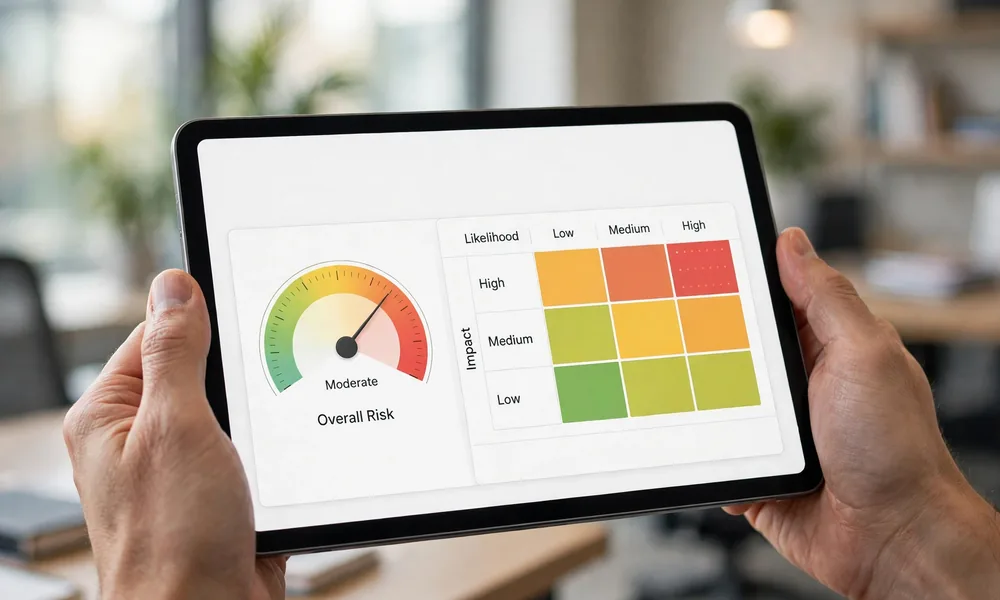
The platform suits banks, insurers and other large regulated firms that need audit trails that satisfy examiners. Implementation is a project, not a purchase: expect months of configuration and training. For a team of five, it is far more than needed, but for a team of five hundred, nothing else here matches its depth. Readers comparing analytics options should also look at our guide to the best AI tools for predictive analytics, which covers the forecasting side of the same problem.
Pros: unified risk data model, strong audit trails, mature AI prioritisation, deep regulatory content.
Cons: custom pricing only, long deployment, heavyweight for small teams.
MetricStream — Best for regulated industries
MetricStream has spent years building content libraries for banking, healthcare and energy regulation, and that shows in daily use. Its AI scans regulatory updates, maps them to controls and flags where a new rule creates a gap, which saves compliance teams the slow work of reading every update by hand. Risk assessments, control testing and issue tracking all run in the same workflow.
The trade-off is speed of adoption. Implementations commonly run for several months, and the platform rewards organisations that already have defined risk processes. Teams that want a quick pilot should trial a narrower module first.
Pros: deep regulatory content, strong control testing, proven in large banks.
Cons: custom pricing, slow implementation, complex administration.
LogicGate Risk Cloud — Best for mid-sized teams
LogicGate Risk Cloud takes the opposite approach to the enterprise suites: it gives a mid-sized team a working risk register, assessment workflows and dashboards within weeks. Its no-code builder lets risk managers design their own forms and approval chains without waiting for developers, and its AI features summarise risk data and highlight the assessments that have drifted furthest from their last review.
Pricing starts from around $2,500 per month, one of the few figures here a buyer can plan around; check current pricing before budgeting, since plans change. The limit is depth: very large banks will outgrow its analytics, but for a risk team of three to thirty people, it is the fastest path to a credible programme.
Pros: fast deployment, no-code workflows, clear starting price, good dashboards.
Cons: advanced analytics are add-ons, less suited to very large banks.
Resolver — Best for incident and risk workflows
Resolver is built around the daily work of risk teams: incidents come in, get triaged, investigated and closed with a full record. Its AI triage suggests severity and routes cases to the right team, which matters when a single incident queue serves security, safety and compliance at once. The risk register links each incident back to the risk it belongs to, so trends are visible instead of buried.
Pricing starts from around $1,500 per month, with final cost depending on modules and users; check current pricing before deciding. Reporting is capable but needs configuration to match an executive pack, so budget time for dashboard setup in the first month.
Pros: strong incident workflows, good AI triage, sensible starting price.
Cons: reporting needs setup, modules add cost quickly.
Moody’s CreditLens — Best for credit risk
Moody’s CreditLens is a specialist, and specialists win their own category. It spreads financial statements, applies rating models and produces probability-of-default estimates that credit committees can defend, drawing on Moody’s own data and research. For a lender, that depth matters more than any general-purpose dashboard.
The obvious limit is scope: CreditLens does credit risk and little else. A bank will pair it with a broader GRC platform rather than using it alone, and pricing is custom, agreed with Moody’s directly. Teams that only need credit decisions should not pay for a full enterprise suite when this does the core job better. Our roundup of the best AI tools for financial analysis covers more options for the wider finance workflow.
Pros: deep credit models, trusted data, defensible outputs.
Cons: credit only, custom pricing, needs a GRC partner for the rest.
SAS Risk Management — Best for model-heavy teams
SAS Risk Management is the choice for organisations whose risk work is genuinely quantitative: stress testing, capital modelling and scenario analysis at scale. Its modelling environment is the most powerful here, and its AI tooling supports model validation, challenger models and the documentation regulators expect. Banks with dedicated model-risk teams will feel at home.
The cost of that power is a steep learning curve and custom pricing that only large institutions can justify. Smaller teams should look at LogicGate or Resolver instead.
Pros: best-in-class modelling, strong validation tooling, proven at scale.
Cons: custom pricing, steep learning curve, overkill for small teams.
Riskonnect — Best for insurance and claims risk
Riskonnect grew out of risk management information systems, so it understands claims, policies and exposures in a way general GRC tools do not. Its AI flags claim patterns, predicts reserve movements and highlights the policies driving losses, which gives risk managers a direct line from data to action. Insurers and large self-insured employers are its natural buyers.
The platform works best when an organisation already has clean claims and policy data feeding it. Pricing is custom, so expect a sales-led process rather than a self-serve trial.
Pros: deep insurance data model, strong claims analytics, good loss forecasting.
Cons: custom pricing, needs clean source data, narrow outside insurance.
RSA Archer — Best for large compliance programs
RSA Archer has been the default GRC platform in large enterprises for years, and its installed base is its strength: auditors know it, consultants know it and most large firms already have staff who have used it. Its AI capabilities now help prioritise assessments and surface control gaps across a large programme, and its use-case library covers most compliance frameworks out of the box.
The weakness is the experience. The interface feels dated next to LogicGate or Resolver, and configuration still needs specialist knowledge. It remains a solid choice for a large compliance programme that values stability over novelty. Fraud signals often feed the same risk register, so teams handling payment risk should also read our guide to the best AI tools for fraud detection.
Pros: huge use-case library, familiar to auditors, stable at scale.
Cons: dated interface, custom pricing, needs specialist configuration.
How to choose
Start with the risk you actually manage. A lender needs credit models first, an insurer needs claims analytics, and a mid-sized company needs a working register before it needs advanced modelling. Buying the largest platform first is the most common mistake in this category.
Next, test the AI rather than the marketing. Ask each vendor to score a sample of your own incidents or credit files and explain the top five scores. If the explanation is vague, the model will be vague in production too. Prices are approximate starting prices throughout this guide; check current pricing with each vendor before budgeting, since plans and list prices change.
Checklist: before you pay
- Run a pilot on your own incident or credit data, not the vendor demo set.
- Confirm the renewal price in writing, not just the first-year discount.
- Check how the tool exports risk data if you cancel.
- Ask who owns model updates and how often scores are retrained.
- Confirm audit-trail coverage for every score change and override.
- Verify support hours and response times match your operating hours.
Frequently asked questions
What is the best AI tool for risk analysis overall?
IBM OpenPages is the strongest overall choice for large enterprises because it unifies governance, risk and compliance in one governed system with mature AI prioritisation. Mid-sized teams will usually get more value from LogicGate Risk Cloud, which deploys faster and costs less.
Can AI tools replace a risk analyst?
No. AI tools rank, summarise and flag risks far faster than a person can, but every score still needs an owner who understands the business context, sets thresholds and documents the decision.
How much do AI risk analysis tools cost?
Most enterprise platforms use custom pricing, so a buyer should expect a sales process and a quote based on users and modules. LogicGate starts from around $2,500 per month and Resolver from around $1,500 per month.
Do these tools work for small businesses?
Yes, but only the lighter platforms. LogicGate and Resolver fit small and mid-sized teams well, while IBM OpenPages, MetricStream and SAS are designed for large institutions and will be too expensive and complex for a small business.
How long does implementation take?
LogicGate and Resolver can be running in weeks. Enterprise platforms such as IBM OpenPages and MetricStream commonly take several months, including data migration, configuration and training. Budget for that time in the project plan.
What data do AI risk tools need?
They need incident records, control assessments, financial statements or claims data, depending on the risk type. Clean, consistent historical data produces far better scores than a large volume of messy records.
The bottom line
For most large enterprises, IBM OpenPages is the right anchor for an AI risk programme, with Moody’s CreditLens added for credit decisions and SAS for heavy modelling. For mid-sized teams, LogicGate Risk Cloud delivers the most value the fastest, with Resolver as the stronger choice when incident workflows dominate the workload.
Whichever platform you choose, judge it on a pilot with your own data and a clear owner for every score it produces. A risk tool earns its place by making decisions faster and more defensible, and the eight tools above are the strongest ways to get there in 2027.