

The global market for true wireless earbuds passed 300 million units a year, and the fastest-growing slice is the cheap end. That matters because the gap between a $30 pair and a $150 pair has never been smaller. Bluetooth chipsets that cost a few dollars now handle multipoint pairing, low-latency modes, and active noise cancellation that would have been flagship-only features five years ago.
But the budget shelf is also where bad products hide. So here is what actually separates a smart buy from a waste of money in 2026, plus where to look for the models worth your cash.
Why 2026 Is the Best Year Yet for Cheap Earbuds
Three things changed. First, Bluetooth 5.4 and LE Audio spread down to entry-level chips, which means better battery efficiency and more stable connections. Second, active noise cancellation (ANC) moved into the sub-$50 bracket, though quality varies wildly. Third, phone makers stopped shipping chargers and started shipping earbuds, which flooded the market with competition.
The result: you can now expect six to eight hours of playback per charge, a pocketable case with two to three extra charges, and USB-C fast charging on almost anything decent. What you still cannot expect at this price is premium build materials, class-leading microphones, or app support that lasts more than two years.
If you want to see how the budget tier stacks up against the mid-range, our roundup of the best wireless earbuds under 200 is the natural next step up.
What “Budget” Actually Means in 2026
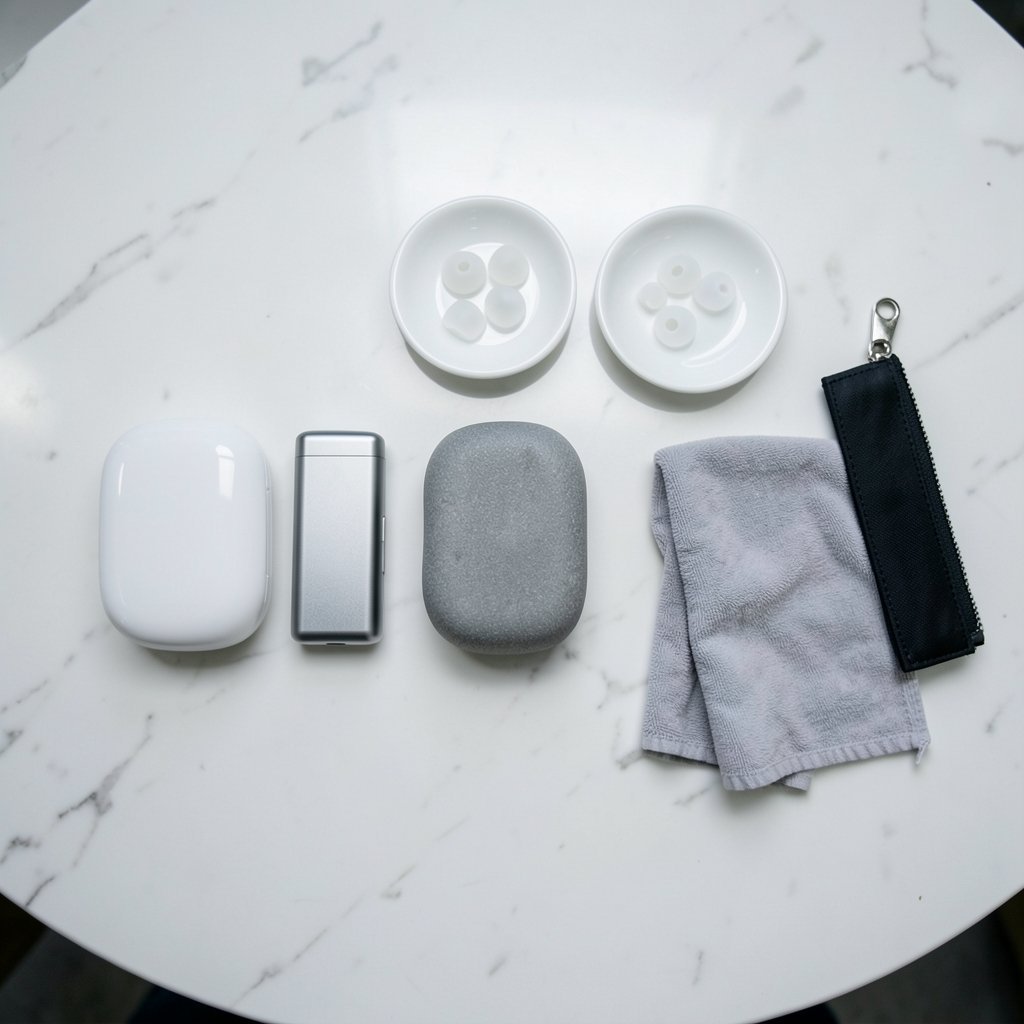
Prices have drifted. A “budget” pair now spans roughly $20 to $60. Below $20 you are in disposable territory, and above $60 you are competing with discounted mid-range models from last season, which is often the smarter buy.
| Price band | What you get | What you give up |
|---|---|---|
| Under $25 | Basic Bluetooth 5.3, 4–5 hrs battery, no ANC | Mic quality, app support, fit options |
| $25–$40 | ANC (basic), 6–7 hrs, IPX4 water resistance | Premium codecs, wireless charging |
| $40–$60 | Multipoint, better mics, IPX5, EQ app | Brand-name build quality |
| $60+ | Previous-gen flagship features | Nothing, but you are no longer “budget” |
The sweet spot is $30 to $45. That is where manufacturers still compete on features rather than cutting corners on the battery cell.
The Features That Actually Matter (and the Ones That Don’t)
Marketing copy on budget earbuds is a minefield. Here is the honest breakdown.
Worth paying for
- Multipoint pairing. Connecting to a laptop and phone at once is genuinely useful and still not universal at this price.
- IPX4 or better. Sweat and rain resistance is the difference between a two-year pair and a two-month pair.
- USB-C charging with a 10-minute quick charge. A short top-up that buys two hours is more valuable than a bigger case.
- Replaceable ear tips. Silicone tips wear out. If you cannot buy spares, the earbuds have a hidden expiry date.
- A real app with EQ. Even a basic five-band equalizer lets you fix the tuning to your taste.
Mostly marketing
- “Hi-Res Audio” badges. On budget hardware the codec support is often there but the driver and tuning are not.
- “AI noise reduction” on calls. Almost every brand claims it. Almost none of them perform well in wind.
- Huge driver numbers. A 13mm driver is not automatically better than a 10mm one. Tuning matters more than diameter.
- “Gaming mode” latency figures. Real-world latency is usually double the claimed number.
A useful rule: if a spec sheet brags about a number you cannot verify with your own ears, treat it as decoration.
Sound Quality: What $35 Really Buys
Budget earbuds have a characteristic sound signature: boosted bass, recessed mids, and a sharp treble peak that makes cymbals sound like static. It is not accidental. Bass sells in a demo, and a V-shaped tuning hides cheap drivers.
The good news is that a handful of brands have figured out that a neutral-ish tuning wins repeat buyers. Look for reviews that mention “balanced,” “mids forward,” or “no sibilance.” Avoid anything described as “bass-heavy” unless that is genuinely what you want for the gym.
Fit matters more than the driver. A $30 pair with the right tip seal will outperform a $100 pair with a bad seal, because bass response collapses when the seal breaks. Spend five minutes trying all three tip sizes. It is the single highest-return adjustment you can make. (Headphones)
Battery Life: Read the Fine Print
Manufacturers quote playback without ANC. Turn ANC on and expect 25 to 40 percent less. Turn on a high-bitrate codec and lose a bit more.
Realistic 2026 expectations:
- Without ANC: 6 to 8 hours per charge, 20 to 28 hours total with the case.
- With ANC: 4 to 5 hours per charge, 14 to 18 hours total.
- Degradation: lithium cells lose roughly 20 percent capacity after 300 to 500 full cycles, so a daily user will notice a drop in about 18 months.
That last point is the real budget consideration. A $35 pair that lasts two years costs about $1.50 a month. A $150 pair that lasts three years costs more than four times that. Cheap earbuds are not always false economy.
Call Quality and Connectivity
Microphones are where budget models stumble hardest. The physics is unforgiving: good beamforming needs multiple mics spaced apart, and small earbuds cannot fit them.
What works in practice: single-mic setups are fine in a quiet room and poor on a busy street. If calls matter, prioritize models with a visible stem design, which puts the mic closer to your mouth. That single design choice often beats a higher price tag.
On connectivity, Bluetooth 5.3 or newer is the baseline. Older 5.0 chips drop out when you put your phone in a back pocket. If you carry two devices, multipoint is worth more than any other feature at this price.
Fit, Comfort, and the Ear Tip Problem
Budget earbuds often ship with three tip sizes of mediocre silicone. Two fixes cost almost nothing:
- Buy aftermarket foam or hybrid tips. A $10 set of foam tips can transform isolation and bass on a $30 pair.
- Test the seal with a simple hum. If the sound changes dramatically when you open your mouth, the seal is broken.
For running, look for a wing or fin on the housing. Smooth, round buds work loose during exercise no matter how good the IP rating is.
Common Mistakes Budget Buyers Make
- Buying on day-one reviews. Firmware updates in the first three months often fix connection bugs and re-tune the sound. Wait for long-term impressions.
- Ignoring the app. Many budget brands abandon their app after a year. Check the last update date in the app store before buying.
- Chasing ANC at $20. Cheap ANC often adds a faint hiss and pressure sensation that is worse than no ANC at all.
- Skipping the return window test. Use the full return period. Wear them for a commute, a call, and a workout before deciding.
- Assuming one brand fits all ears. Ear canal shape varies enormously. A model that fits one reviewer perfectly may fall out of your ear.
The pattern here is that testing beats spec-sheet reading every time.
Where Budget Earbuds Fit in a Bigger Tech Budget
It helps to think of earbuds as one line item. If you are refreshing your whole kit this year, our guide to the best laptops 2026 top picks for every budget today covers the bigger purchase, and the best phone to buy 2026 expert picks for every budget explains which handsets pair best with modern Bluetooth codecs. Spending less on earbuds frees up real money for the device that actually runs your day.
For a narrower shortlist, the best budget earbuds under 50 roundup focuses purely on that price ceiling.
How to Test Earbuds Before the Return Window Closes
A structured 48-hour test catches almost every problem:
- Commute test. Wear them on a noisy street. Can you hear your podcast at 50 percent volume?
- Call test. Record a voice memo through the mic and play it back. Harsh? Tinny? You will hear it instantly.
- Comfort test. Wear them for 90 continuous minutes. Any ache is a dealbreaker.
- Connection test. Walk 10 meters away with a wall between you and the phone. Count the dropouts.
- Battery test. Time a full discharge with ANC on. Compare to the claim.
- App test. Update firmware, adjust EQ, and check whether the app crashes.
If a pair passes all six, it is a keeper regardless of brand.
The Verdict
The best budget earbuds in 2026 are not the ones with the longest spec sheet. They are the ones with a stable connection, a secure fit, honest battery figures, and a tuning you can live with for two years. Expect to pay $30 to $45. Expect to replace them in about 24 months. Expect to be genuinely surprised by how close they get to premium sound.
And if you are weighing a bigger purchase, the Black Friday car deals coverage is a reminder that timing a purchase around discount season is often worth more than picking the perfect model.
Frequently Asked Questions
Are cheap earbuds worth buying in 2026?
Yes, for most everyday listeners. The core technology has commoditized, so a $35 pair now handles music, podcasts, and calls competently. The trade-off is longevity and microphone quality rather than basic sound.
How much should I spend on budget earbuds?
Plan on $30 to $45. Below $25 you lose features like multipoint and decent water resistance. Above $60 you are better off waiting for a discount on last year’s mid-range model.
Do budget earbuds have good noise cancellation?
Some do, but quality is inconsistent. Basic ANC at this price reduces low-frequency rumble like bus engines and air conditioning. It rarely handles voices, and poorly tuned ANC can add a faint hiss. (Radio Frequency Safety)
How long do budget earbuds last?
Typically 18 to 30 months with daily use. The battery is the limiting factor, since small lithium cells lose capacity after a few hundred charge cycles. Water resistance and replaceable ear tips are the two biggest factors in longevity.
Can I use budget earbuds for running and the gym?
Yes, if they are rated IPX4 or higher and have a wing or fin to hold them in place. Sweat resistance matters more than the ANC feature for workouts, and open-style or finned designs stay put better than smooth round buds.
Why do my cheap earbuds sound worse than the reviews say?
Almost always a fit problem. If the ear tip does not seal, bass disappears and the treble sounds harsh. Try every included tip size, then consider aftermarket foam tips before concluding the earbuds are bad.
Conclusion
The budget earbud market in 2026 rewards patience and punishes impulse. The winners are not the flashiest listings but the models with multipoint pairing, IPX4 sealing, honest battery numbers, and a tuning that does not fatigue your ears after an hour. Buy in the $30 to $45 band, test hard inside the return window, and invest ten dollars in better ear tips. Do that, and a cheap pair will serve you well for two years without a single regret.
Final thought on brand loyalty. Budget brands rarely stay reliable forever; a model that was excellent last year may be quietly revised with cheaper internals. Buy the specific model reviewers tested, not the brand name, and check that the listing matches the reviewed version number. Firmware and hardware revisions are the quiet reason two people can own “the same” earbuds and have opposite experiences. When in doubt, favor the model with the longer, more boring track record over the exciting new release.



