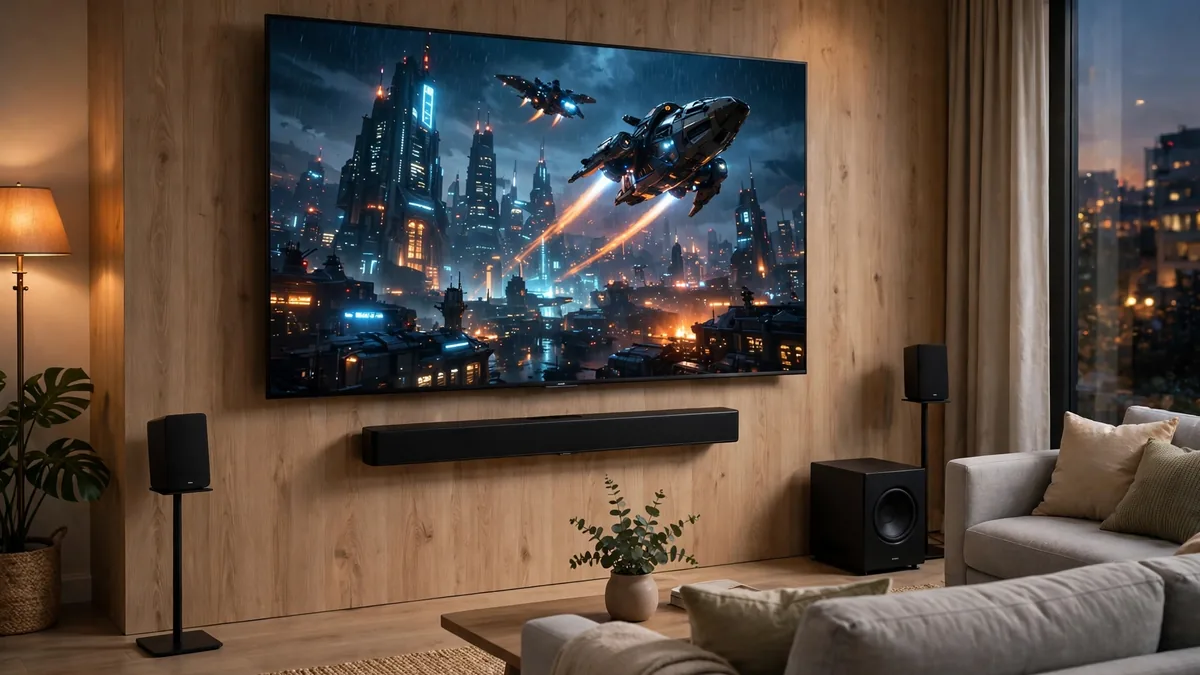
Best home theater systems in 2027 are no longer a choice between a simple soundbar and a complicated receiver-and-speakers build. The best home theater systems now include wireless Dolby Atmos soundbars with detachable rear speakers, premium multi-speaker sets from Sonos, and full 11-channel systems that rival a cinema, all of which set up in an afternoon with little more than a phone app and an HDMI cable.
The big change this year is how complete the mid-range has become. A soundbar system costing around $1,200 to $1,600 now delivers genuine surround sound with height channels, deep bass, and room calibration that tunes itself to your living room.
We compared the current 2026 and 2027 lineups from Samsung, Sonos, LG, Sony, JBL, Nakamichi, and Hisense, judging them on surround immersion, dialogue clarity, bass, ease of setup, and value. Prices are approximate starting prices, so check current pricing before you buy.
Key takeaways
- The Samsung HW-Q990D is the best home theater system overall, combining 11.1.4 channels, wireless rear speakers, and strong value.
- The Sonos Arc Ultra set is the best premium wireless option, with the easiest app and the most refined sound.
- The Hisense AX5125H is the best budget pick, delivering real 5.1.2 Dolby Atmos surround for around $500.
- Dialogue clarity matters more than raw power: Sony and Sonos lead here, and both offer voice enhancement modes.
- Check your TV’s HDMI eARC port before buying; without it, you lose the best sound formats your system supports.
At a glance: the shortlist
| System | Best for | Starting price | Standout limit |
|---|---|---|---|
| Samsung HW-Q990D | Overall | around $1,600 | 11.1.4 channels |
| Sonos Arc Ultra set | Premium wireless | around $2,700 | Requires Sonos app |
| LG S95TR | LG TV owners | around $1,500 | 9.1.5 channels |
| Sony Bravia Theatre Bar 9 | Dialogue clarity | around $1,400 | Subwoofer sold separately |
| JBL Bar 1000 | Bass lovers | around $1,200 | 7.1.4 channels |
| Nakamichi Dragon 11.4.6 | Movie purists | around $3,500 | Large room needed |
| Hisense AX5125H | Budget | around $500 | 5.1.2 channels |
Samsung HW-Q990D — Best overall
The Samsung HW-Q990D is the home theater system to beat in 2027. It packs 11.1.4 channels into a single soundbar, a wireless subwoofer, and two wireless rear speakers with up-firing drivers, and it supports Dolby Atmos and DTS:X.

Samsung’s SpaceFit Sound Pro calibration measures your room and tunes the system automatically, and Q-Symphony lets the soundbar work together with a compatible Samsung TV’s speakers rather than replacing them. For movie nights, nothing at this price comes close. If you are still choosing the screen to go with it, our guide to the best smart TVs covers the best matches.
Pros: True 11.1.4 surround; wireless rears and sub; automatic room calibration; excellent value for the channel count.
Cons: Music performance is merely good; large soundbar needs a wide TV stand; no built-in voice assistant.
Sonos Arc Ultra set — Best premium wireless
The Sonos Arc Ultra, paired with the Sub 4 and a pair of Era 300 rear speakers, is the most refined wireless home theater you can buy. The Arc Ultra’s new Sound Motion woofer delivers deeper bass from a slim bar than any rival, and the Era 300s add genuine height channels for Dolby Atmos.
What sets Sonos apart is the experience around the sound. Trueplay tuning adapts the system to your room in minutes, the app is the best in the business, and the system expands easily: add speakers room by room, or group the theater with the rest of your home. If you want the most polished wireless setup and you value music as much as movies, this is it.
Pros: Superb sound for films and music; best-in-class app and multi-room; easy to expand; elegant design.
Cons: Around $2,700 for the full set; app-dependent setup; no DTS:X support.
LG S95TR — Best for LG TV owners
The LG S95TR is a 9.1.5-channel system built to pair with LG’s OLED televisions, and the combination is superb. Its soundbar, wireless subwoofer, and rear speakers include a centre up-firing channel that lifts dialogue and effects above the screen, and LG’s WOW Orchestra feature lets the TV’s speakers join the soundbar for a fuller front stage.
Setup is simple, calibration is automatic, and the system supports Dolby Atmos, DTS:X, and IMAX Enhanced. For LG households, though, it is the natural choice. Our comparison of OLED versus QLED TVs explains why LG’s OLED panels pair so well with a system like this.
Pros: Excellent match for LG OLED TVs; centre height channel aids dialogue; IMAX Enhanced support; automatic calibration.
Cons: Best value only with an LG TV; slightly less bass impact than Samsung; premium price.
Sony Bravia Theatre Bar 9 — Best dialogue clarity
Sony’s Bravia Theatre Bar 9 is the pick for anyone who struggles to hear dialogue. Its Acoustic Center Sync feature uses a compatible Sony TV as the centre channel, anchoring voices to the actors on screen, and its Voice Zoom 3 mode uses AI to lift speech out of busy soundtracks without making everything else louder.
The Bar 9 alone is a 13-speaker soundbar with Dolby Atmos and DTS:X, and adding Sony’s optional subwoofer and rear speakers turns it into a full surround system. The catch is cost: the bar starts around $1,400, and the subwoofer and rears are sold separately, pushing a full system well past $2,000.
Pros: Best-in-class dialogue clarity; AI voice enhancement; superb spatial sound; pairs perfectly with Sony TVs.
Cons: Subwoofer and rears cost extra; full system is expensive; setup app is fiddly.
JBL Bar 1000 — Best for bass lovers
The JBL Bar 1000 is the most fun system in this roundup. Its detachable, battery-powered rear speakers are its party trick: they sit on the ends of the soundbar to charge, then lift off and sit behind your sofa as wireless surrounds, with no cables and no extra boxes. When the film ends, they dock back and the system becomes a single bar again.
Sound is big and bold, with a 10-inch wireless subwoofer that delivers the deepest bass of any soundbar system here. Explosions hit hard, music has real weight, and the 7.1.4-channel Dolby Atmos layout creates a convincing sense of height. For action films and music, though, it is a thrill.
Pros: Detachable wireless rear speakers; huge bass from the 10-inch sub; flexible one-bar or full-surround modes; strong value.
Cons: Rear speakers need recharging; dialogue can get lost in loud scenes; less refined than premium rivals.
Nakamichi Dragon 11.4.6 — Best for movie purists
The Nakamichi Dragon is the most ambitious home theater system you can buy without a receiver. Its 11.4.6-channel layout uses four subwoofers, a soundbar with 31 drivers, and two wireless rear speakers, and it produces a scale of sound that makes other soundbars feel small. This is the system for a dedicated media room and a viewer who wants the cinema experience at home.
The Dragon’s quad subwoofers deliver bass you feel in your chest, and its surround processing places effects with remarkable precision. But for a big room and a serious film collection, nothing else in this list comes close. For the speakers behind the screen, our guide to Sonos versus Bose speakers is a useful companion read.
Pros: Cinema-scale sound; four subwoofers; widest format support; superb for large rooms.
Cons: Around $3,500; very large; needs a big room to justify it.
Hisense AX5125H — Best budget
The Hisense AX5125H proves that real surround sound no longer costs a fortune. For around $500, this 5.1.2-channel system includes a soundbar with up-firing height drivers, a wireless subwoofer, and two wired rear speakers, with Dolby Atmos and DTS:X support. It is the cheapest system here by a wide margin, and it sounds far better than its price suggests.
Dialogue is clear, effects move convincingly around the room, and the subwoofer adds genuine weight to action scenes. Setup is straightforward, though the rear speakers are wired to the subwoofer, so you will need to plan cable runs behind the sofa. But if you want true surround sound on a tight budget, this is the one to buy.
Pros: Real 5.1.2 surround for around $500; clear dialogue; good bass for the price; simple setup.
Cons: Rear speakers are wired; no automatic room calibration; budget build quality.
How to choose
Start with your room. A small flat suits a single soundbar or a compact 5.1.2 system, while a large living room or media room justifies the Samsung Q990D or the Nakamichi Dragon. Measure your TV stand too: flagship soundbars are wide, and a bar that overhangs the stand looks wrong and blocks the TV’s lower edge.
Next, check your TV’s connections. Your television needs an HDMI eARC port to pass Dolby Atmos and DTS:X to the soundbar; without it, you lose the best formats. Finally, think about wires: fully wireless rears cost more but save you from running cables, while budget systems such as the Hisense still use wired rears.
Checklist: before you pay
- Confirm your TV has an HDMI eARC port and that it supports Dolby Atmos passthrough.
- Measure the soundbar against your TV stand and check it will not block the screen.
- Decide whether wireless rear speakers matter or whether wired rears are acceptable.
- Check that the system’s streaming and voice features match your household.
- Plan subwoofer placement: a corner boosts bass, but a central spot is more accurate.
- Budget for an HDMI cable and, for wired rears, cable covers or trunking.
Frequently asked questions
Is a soundbar enough for a home theater?
For most living rooms, yes. A good Dolby Atmos soundbar with a subwoofer and rear speakers delivers convincing surround sound. A receiver-and-speakers system still wins on upgradeability and ultimate quality, but it costs more and takes far longer to set up.
What is the difference between 5.1.2 and 11.1.4?
The numbers describe channels: the first is standard surround speakers, the second is subwoofers, and the third is height speakers. A 5.1.2 system has five surround speakers, one subwoofer, and two height channels.
Do I need eARC on my TV?
For the best sound, yes. HDMI eARC carries uncompressed Dolby Atmos and DTS:X from the TV to the soundbar. With older ARC, you get compressed audio only, which is still good but not the full quality your system supports.
Are wireless rear speakers really wireless?
Mostly. They connect to the soundbar wirelessly, but each speaker still needs mains power, and some budget systems wire the rears to the subwoofer. Check the fine print before you buy.
How important is room calibration?
Very. Automatic calibration measures your room’s shape and furnishings and tunes the system to suit. It is one of the biggest reasons modern soundbars sound so good with so little setup, and it is worth choosing a system that includes it.
Can I add speakers to a soundbar system later?
It depends on the brand. Sonos systems expand easily with more speakers, and Samsung and Sony sell matching rears and subwoofers. Budget systems usually cannot be expanded, so buy the configuration you want from the start.
The bottom line
For most homes, the Samsung HW-Q990D is the best home theater system in 2027: it delivers full 11.1.4 surround, wireless rears, and automatic calibration at a price that undercuts the premium rivals. If you want the most refined sound and the best music performance, the Sonos Arc Ultra set is worth the extra money.
On a budget, the Hisense AX5125H brings real Dolby Atmos surround for around $500, which would have been unthinkable a few years ago.