
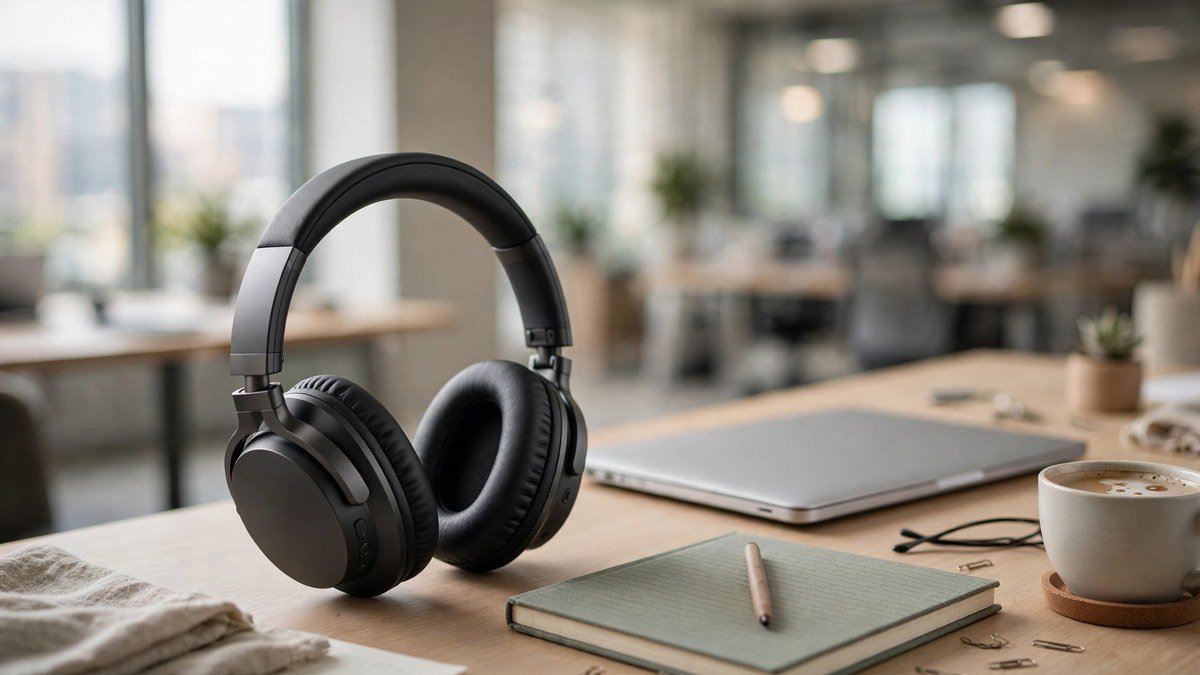
Open-plan offices, shared workspaces and back-to-back video calls have made noise-cancelling headphones a genuine work tool rather than a luxury. The right pair does three jobs at once: it silences the room around you, it makes your voice clear on calls, and it stays comfortable through a full working day. The wrong pair does none of those well, however good it sounds with music.
Work headphones are judged differently from everyday listening headphones. Battery life matters because a dead pair at 3pm ends your focus. Multipoint Bluetooth matters because you switch between a laptop and a phone all day. Microphone quality matters because your colleagues hear you through it, not through the drivers. And comfort matters more than sound quality, because a pair that hurts after two hours will sit in a drawer no matter how good its bass is.
This guide compares eight of the strongest options for work in 2027, from flagship over-ears to a genuinely capable budget pick. Every model here was assessed on the same work-first criteria: noise cancellation strength, call quality, comfort over long sessions, battery life, multipoint support and the practical details, like whether the microphone works well in a noisy room and whether the headphones can be used wired when the battery runs out.
Key takeaways
- The Sony WH-1000XM6 is the best overall work headphone, with the strongest noise cancellation, excellent microphones and 30-hour battery life.
- The Bose QuietComfort Ultra is the most comfortable flagship for all-day wear, with superb call quality and a lighter clamp than its rivals.
- Apple users who live in the Mac and iPhone ecosystem will get the smoothest experience from the AirPods Max, despite its higher price and weight.
- Business-focused models like the Jabra Evolve2 85 and Poly Voyager Focus 2 trade some music polish for certified call platforms and boom microphones.
- The Anker Soundcore Space Q45 proves you do not need to spend flagship money: it delivers strong noise cancellation and 50-hour battery life from around $149.
At a glance: the shortlist
| Product | Best for | Starting price | Standout limit |
|---|---|---|---|
| Sony WH-1000XM6 | Best overall | From around $449 | No IP water resistance rating |
| Bose QuietComfort Ultra | All-day comfort | From around $429 | 24-hour battery, shorter than rivals |
| Apple AirPods Max | Apple ecosystem | From around $549 | Heavy at 385 grams, no 3.5mm cable included |
| Sennheiser Momentum 4 | Sound quality | From around $349 | Call quality lags behind Sony and Bose |
| Bowers & Wilkins Px7 S3 | Premium build and detail | From around $449 | Ear cups run warm on long calls |
| Jabra Evolve2 85 | Certified business calls | From around $449 | Music sound is tuned for speech, not bass |
| Poly Voyager Focus 2 | Office and call centres | From around $299 | Bulky design, average music quality |
| Anker Soundcore Space Q45 | Budget pick | From around $149 | Microphones struggle in very noisy rooms |
Sony WH-1000XM6 — Best overall
The Sony WH-1000XM6 is the benchmark work headphone in 2027, and it earns that position by being excellent at everything rather than outstanding at one thing. Its noise cancellation is the strongest in this roundup, driven by two processors and a six-microphone array that adapts to your surroundings hundreds of times per second. In a busy office it removes the low hum of air conditioning, the clatter of keyboards and most nearby conversation, leaving a quiet space you can actually think in.

Call quality is a genuine strength, not an afterthought. Six beamforming microphones isolate your voice and suppress background noise, so colleagues hear you clearly even when the office is loud. Multipoint Bluetooth connects to your laptop and phone at the same time, and switching between them is automatic. Battery life is 30 hours with noise cancellation on, and a three-minute charge adds around three hours of playback, which covers the dreaded dead-battery-before-a-call scenario. The headphones also fold flat, work wired over USB-C or a 3.5mm cable, and support the LDAC codec for higher-quality audio on Android devices.
The trade-offs are minor but worth knowing. There is no official water or dust resistance rating, so they are not the pick for sweaty commutes in the rain. The touch controls can be fiddly when you are trying to mute quickly mid-call, although the physical controls in the companion app help. For a closer look at how Sony’s flagship compares with Apple’s, our comparison of the Sony WH-1000XM6 vs AirPods Max breaks down sound, comfort and call performance side by side.
Pros: Strongest noise cancellation here; excellent call microphones; 30-hour battery with fast charging; multipoint and wired options; folds for travel.
Cons: No IP rating; touch controls take practice; premium price.
Bose QuietComfort Ultra — Best for all-day comfort
If you wear headphones for eight hours straight, comfort becomes the deciding factor, and that is where the Bose QuietComfort Ultra wins. The clamping force is lighter than the Sony, the ear cushions are softer, and the weight is distributed so evenly that most people forget they are wearing them by mid-morning. Bose’s noise cancellation is a fraction behind Sony’s on paper, but in practice the difference is small: the Ultra still erases office chatter, traffic and the drone of a plane cabin with ease.
Where Bose pulls ahead is the immersive audio mode, which widens the soundstage and makes music and video feel more spacious, and a call experience that is consistently clear. The microphone array handles wind and background noise well, and the sidetone option lets you hear your own voice naturally on calls, which reduces the urge to shout. Battery life is 24 hours with noise cancellation on, which is shorter than Sony or Sennheiser, but still covers two full working days for most people. A 15-minute charge adds around two and a half hours.
The Ultra also has one of the best transparency modes in this group, which matters at work: you can hear a colleague’s question without taking the headphones off. The downsides are the shorter battery life, a case that is bulkier than Sony’s, and a price that sits firmly in flagship territory. For pure comfort over a long working day, though, nothing here beats it.
Pros: Most comfortable flagship; excellent transparency mode; strong call quality; immersive audio for music and video.
Cons: 24-hour battery is the shortest among flagships; bulky case; no LDAC support.
Apple AirPods Max — Best for the Apple ecosystem
The AirPods Max are the most expensive headphones in this guide, and the hardest to recommend outside the Apple ecosystem, but for Mac and iPhone users they offer an integration no other pair can match. Pairing is instant, switching between a MacBook, iPhone and iPad is automatic, and spatial audio with head tracking makes video calls and films feel unusually natural. The build is also a step above everything else here: aluminium ear cups, a stainless steel frame and a mesh headband that spreads the weight well.
Noise cancellation is excellent, close to Sony and Bose, and the transparency mode remains the best available, sounding so natural that it is easy to forget the headphones are on. Call quality is good, with microphones that handle quiet offices well, though they are not as strong as Sony’s in a noisy open-plan space. Battery life is 20 hours, the shortest in this roundup, and the headphones do not fold, so the included case is more of a sleeve than real protection.
The weight is the real caveat: at 385 grams, the AirPods Max are noticeably heavier than every rival here, and some people feel neck strain after several hours. There is also no 3.5mm cable in the box, and the USB-C port handles wired listening only with a separate cable. If your working day is spent entirely inside Apple devices and you value seamless switching above all else, they are worth it. If you use Windows or Android, the Sony or Bose are better value.
Pros: Best-in-class build; superb transparency mode; seamless Apple device switching; excellent spatial audio.
Cons: Heavy at 385 grams; 20-hour battery; highest price here; no folding design.
Sennheiser Momentum 4 — Best sound quality
The Sennheiser Momentum 4 is the audiophile’s work headphone. Its sound is detailed, balanced and spacious, with a clarity in voices and acoustic instruments that the other flagships do not quite match. If your working day involves long stretches of music between meetings, the Momentum 4 makes those stretches genuinely enjoyable rather than merely tolerable.
Noise cancellation is strong, though a step behind Sony and Bose in very loud environments, and battery life is the best in this group at 60 hours with noise cancellation on. That is a full working week without charging for most people, and it removes battery anxiety entirely. The headphones are comfortable, with deep ear cups and soft padding, and multipoint Bluetooth works reliably across a laptop and phone.
The weakness is call quality. The microphones are fine in a quiet home office but pick up more background noise than Sony, Bose or Jabra in a busy room, so colleagues may hear your surroundings. The design is also plainer than the price suggests, with a mostly plastic build. If music quality and battery life matter more to you than call performance, the Momentum 4 is an excellent choice; if calls dominate your day, look at the Sony or the Jabra instead.
Pros: Best sound quality in this group; 60-hour battery life; comfortable deep ear cups; reliable multipoint.
Cons: Call microphones lag behind rivals; plain plastic design; noise cancellation a step behind Sony.
Bowers & Wilkins Px7 S3 — Best premium build and detail
The Bowers & Wilkins Px7 S3 is the most beautifully made headphone in this roundup, with a design that looks and feels like a luxury product rather than a piece of office equipment. The sound matches the looks: detailed, refined and precise, with a treble clarity that makes voices on calls and podcasts unusually easy to follow. For people who care about how their headphones look on a video call and how they sound during focus time, the Px7 S3 is a compelling pick.
Noise cancellation is good rather than class-leading, handling steady background noise well but letting more conversation through than the Sony or Bose. Call quality is solid, with clear voice pickup in quiet and moderately noisy rooms, and battery life is 30 hours, which is respectable for a flagship. Multipoint is supported, and the headphones work wired over USB-C with high-resolution audio support.
The main drawback is comfort on very long days: the ear cups can run warm during hours of continuous wear, and the clamp is firmer than the Bose. The price also sits at flagship level without matching Sony’s noise cancellation. Choose the Px7 S3 if build quality and sound detail are your priorities; choose the Sony if raw noise cancellation matters more.
Pros: Outstanding build quality; detailed, refined sound; clear voice reproduction; 30-hour battery.
Cons: Ear cups run warm on long sessions; noise cancellation behind Sony and Bose; flagship price.
Jabra Evolve2 85 — Best for certified business calls
The Jabra Evolve2 85 is built for work first and music second, and that focus shows in every design decision. It carries Microsoft Teams and Zoom certifications, which means call platforms recognise it properly, mute status syncs, and the busy light on the ear cup tells colleagues you are on a call. The boom microphone is the best call microphone in this group: your voice comes through clearly in a noisy office, a crowded airport or a shared workspace.
Noise cancellation is strong for an office headset, and the 37-hour battery life comfortably covers several working days. The included charging stand is a genuinely useful desk accessory, keeping the headphones charged and visible, and the USB dongle provides a rock-solid wireless connection to a laptop that Bluetooth alone sometimes cannot match. Multipoint works across the dongle and a phone simultaneously.
The compromise is music. The sound is tuned for speech clarity, so music sounds thinner and less full than on the Sony or Sennheiser, and the design is bulkier and more obviously a work headset. If your day is dominated by calls and you need colleagues to hear you perfectly, the Evolve2 85 is the most reliable tool here. If music matters as much as calls, the Sony is the better all-rounder.
Pros: Best call microphone here; Teams and Zoom certified; busy light; 37-hour battery; charging stand included.
Cons: Music sound is tuned for speech; bulky design; expensive for a work headset.
Poly Voyager Focus 2 — Best for office and call-centre work
The Poly Voyager Focus 2 is the workhorse of this group: a dedicated office headset designed for people who spend most of their day on the phone. Its acoustic fence technology uses multiple microphones to block background noise from your voice, so callers hear you and not your colleagues. In a loud open-plan office, that focus makes a real difference to how professional you sound.
The headset is comfortable for long shifts, with plush ear cushions and a design that sits securely without pressing hard. Battery life is 19 hours of talk time, which covers a full working day of calls, and the included charging stand keeps it topped up between shifts. It connects via Bluetooth or a USB dongle, works with the major call platforms, and has on-ear controls for answering, muting and volume.
Music quality is average at best, and the design is unmistakably a call-centre headset rather than something you would wear on a commute. Noise cancellation for the listener is also weaker than the consumer flagships, so it is less useful for deep focus work in a noisy room. For pure call work, though, it is a proven and reliable choice at a lower price than the Jabra.
Pros: Excellent voice isolation on calls; comfortable for long shifts; charging stand included; reliable USB dongle connection.
Cons: Average music quality; weaker noise cancellation for the listener; bulky office design.
Anker Soundcore Space Q45 — Best budget pick
The Anker Soundcore Space Q45 is the surprise of this roundup: a pair of headphones that costs roughly a third of the flagships yet delivers most of what matters for work. Noise cancellation is genuinely strong, cutting office chatter and low-frequency hum far better than its price suggests, and the 50-hour battery life with noise cancellation on beats every flagship except the Sennheiser.
Sound quality is good, with a warm, bass-friendly tuning that suits music and podcasts, and the companion app offers a useful equaliser plus customisable noise cancellation levels. Multipoint Bluetooth is supported, the headphones fold for travel, and they work wired when the battery runs out. For a home office or a quieter workplace, the Q45 covers the essentials with money to spare.
The limits show up in the noisiest environments. The microphones struggle more than the Sony or Jabra in a loud open-plan office, and the plastic build feels cheaper than the flagships, which is fair at this price. Comfort is good for the price, though the ear cushions are shallower than the Bose. If your budget is tight or you want a second pair for the office, the Space Q45 is the best value in this guide by a wide margin.
Pros: Outstanding value; strong noise cancellation for the price; 50-hour battery; multipoint and wired options.
Cons: Microphones struggle in very noisy rooms; plastic build; shallower ear cushions.
How to choose
Start with how you actually spend your working day. If most of your hours are video calls, prioritise microphone quality and platform certification over sound quality: the Jabra Evolve2 85 or the Sony WH-1000XM6 will serve you better than a music-first pair. If your day is mostly silent focus work in a noisy room, prioritise noise cancellation and comfort, which points to the Sony or the Bose. And if you split your time between a home office and a shared workspace, the right setup changes with the room: our guide to the best headphones for working from home covers the quieter home-office case in more detail.
Next, check the practical details that cause daily friction. Multipoint Bluetooth is essential if you take calls on a laptop and a phone; without it, you will be re-pairing constantly. Battery life matters less than it seems if you charge nightly, but a pair with 30 hours or more removes the worry entirely. Wired listening is worth having as a backup, because a dead battery should not end your working day. And if you wear glasses, try the clamp force before committing: a firm seal improves noise cancellation, but it can press frames into your head over hours.
Finally, think about your device ecosystem. Apple users get the most from the AirPods Max, Android users get the most from the Sony with LDAC, and Windows users should check that their chosen pair works well with Teams or Zoom, ideally with certification. Price is the last filter, not the first: the difference between a $149 pair and a $449 pair is real, but only in the areas that matter to your specific working day.
Checklist: before you pay
Run through these checks before buying any work headphone.
- Test the microphones in a noisy room, not a quiet one: call quality in silence tells you almost nothing.
- Confirm multipoint Bluetooth works with your exact laptop and phone combination.
- Wear the headphones for at least an hour before the return window closes: comfort problems appear slowly.
- Check whether your call platform is certified for the model, especially Teams or Zoom.
- Confirm the battery life figure is with noise cancellation on, not off: the two numbers differ widely.
- Check the return policy and warranty: a work tool that fails in month eleven should be replaceable, not disposable.
Frequently asked questions
Are noise-cancelling headphones good for work calls?
Yes, provided the microphones are good. Noise cancellation helps you hear the call; it is the microphone array that determines how well others hear you. The Sony WH-1000XM6, Bose QuietComfort Ultra and Jabra Evolve2 85 all have strong call microphones, while cheaper models can struggle in noisy rooms.
Which noise-cancelling headphones have the best microphones for calls?
The Jabra Evolve2 85 leads this group thanks to its boom microphone, followed closely by the Sony WH-1000XM6 and the Poly Voyager Focus 2. If calls are your main use, a business headset with a boom microphone is usually the safer choice.
Can I wear noise-cancelling headphones all day?
Most people can, but comfort varies. The Bose QuietComfort Ultra is the most comfortable flagship for eight-hour wear, and taking short breaks every hour or two helps regardless of model. If you feel pressure or warmth, try a lighter clamp or looser-fitting ear cushions.
Do I need multipoint Bluetooth for work?
If you take calls on both a laptop and a phone, yes. Multipoint keeps both connected so you can switch without re-pairing. All eight models in this guide support it except some older business headsets, so check the specification before buying.
Are expensive noise-cancelling headphones worth it for work?
It depends on your environment. In a noisy open-plan office, the stronger noise cancellation and better microphones of a flagship are worth the price. In a quiet home office, a budget pair like the Anker Soundcore Space Q45 covers the essentials well. For the broader picture, our roundup of the best noise cancelling headphones compares these models on sound and comfort as well as work use.
How long do work headphones last?
A good pair typically lasts three to five years with daily use. Battery capacity fades gradually, and ear cushions wear out first: both are replaceable on most flagship models, which is worth checking before you buy.
The bottom line
For most people working in 2027, the Sony WH-1000XM6 is the right answer: the strongest noise cancellation, excellent call microphones, 30-hour battery life and reliable multipoint cover every part of the working day. If comfort matters most, buy the Bose QuietComfort Ultra. If your day is dominated by calls, buy the Jabra Evolve2 85. And if your budget is tight, the Anker Soundcore Space Q45 delivers most of the experience for roughly a third of the price.
Whichever you choose, treat the purchase as a work tool, not an accessory: test the microphones in a real room, wear them for a full day inside the return window, and check the battery and multipoint details before you commit. Prices change often, so confirm the current price and any bundled accessories before buying.
Note: Prices and plans change. Check the product’s current plan details before buying — no link is provided here by design, all links in this article go to other occcy.com guides.



