

Best performance management software for small business in 2027 helps a small team run reviews, goals and feedback without turning the process into a second job. The right tool replaces the spreadsheet, the shared document and the annual review form with one place where managers can set goals, record check-ins, run a review cycle and see who needs support before a small problem becomes a resignation.
Small businesses need something different from the platforms built for companies with thousands of employees. A team of ten or forty cannot afford a six-week implementation, a dedicated administrator or a review process that takes a manager a full day per employee. The tools in this guide are judged on that reality: how quickly a small team can start, how clear the review workflow is, and how much it costs per person.
The shortlist below covers eight products, from all-in-one HR platforms with performance built in to focused review tools that do one job well. BambooHR leads for small businesses that want HR and performance together, Lattice leads for structured reviews and goals, and 15Five leads for teams that prefer continuous feedback over a single annual event. Prices change often, so treat every starting price here as a guide and check current pricing before you buy.
Key takeaways
- BambooHR is the best overall choice for a small business that wants HR records and performance reviews in one system.
- Lattice is the best pick for structured review cycles, goals and one-to-ones that run on a clear schedule.
- 15Five is the best option for continuous feedback, weekly check-ins and recognition between formal reviews.
- Most small teams should budget roughly $5 to $15 per person per month, and check current pricing before committing.
- Avoid tools that need a dedicated administrator; the best small-business options can be running within a week.
At a glance: the shortlist
| Product | Best for | Starting price | Standout limit |
|---|---|---|---|
| BambooHR | Small businesses wanting HR and performance together | Custom pricing; check current pricing | Performance features are an add-on in some plans |
| Lattice | Structured reviews, goals and one-to-ones | From around $11 per person per month | Full value needs the performance and engagement bundles |
| 15Five | Continuous feedback and weekly check-ins | From around $10 per person per month | Deeper reviews sit in higher-priced plans |
| Leapsome | Reviews, goals and learning in one place | From around $8 per person per month | Smaller teams may not use the learning tools |
| PerformYard | Simple, flexible review cycles | From around $5 per person per month | Reporting is lighter than larger platforms |
| Trakstar | Small teams wanting a light, focused setup | Custom pricing; check current pricing | Fewer engagement and learning features |
| Engagedly | Engagement, recognition and performance together | Check current pricing | Can feel broad for a very small team |
| Culture Amp | Feedback and people analytics as you grow | Custom pricing; check current pricing | Priced for growing teams, not the smallest ones |
BambooHR — Best overall
BambooHR is the strongest overall choice for a small business that wants performance management inside the same system that already holds employee records, time off and onboarding. That matters more than it sounds. When a review lives next to the employee’s role, start date, manager and time-off history, a manager does not have to chase three systems to prepare for a conversation, and nothing important gets lost between a spreadsheet and a shared drive.
Its performance tools cover the basics a small team actually needs: goal setting, review cycles, self-assessments and manager assessments, plus one-to-one notes and feedback. The interface is deliberately plain, and BambooHR keeps the steps in the same order every cycle so the second review is faster than the first.
The trade-off is that performance is not BambooHR’s only focus, so a team that wants deep 360-degree feedback or advanced calibration may find it lighter than a specialist tool. Pricing is also quoted rather than published as a single flat rate, so a small business should ask for a quote for its exact headcount and check current pricing before deciding. For most small teams, though, the combination of HR and performance in one calm, well-organised system is the practical winner, and it pairs naturally with the wider HR choices covered in our guide to HR software for agencies, which explains how small service teams structure the same people processes.
Pros: HR and performance in one system; clear, consistent review workflow; easy for occasional users to pick up.
Cons: Performance is an add-on in some plans; pricing is quoted, not a flat published rate; lighter on advanced 360-degree feedback.
Lattice — Best for structured reviews and goals
Lattice is built for teams that want performance management to run on a schedule rather than on memory. Reviews, goals, one-to-ones and feedback each have a clear home, and the platform walks a manager through a cycle step by step: set the timeline, send the self-assessment, collect peer feedback, hold the calibration conversation, then share the result. For a small business that has outgrown informal reviews, that structure is the point.
Goals in Lattice connect to the wider company objectives, so an employee can see how their quarterly work supports the team’s priorities. One-to-one agendas, updates and praise sit alongside the formal review, which means the annual conversation stops being a surprise, and managers get a clear view of who has finished each step.
The cost is the main thing to weigh. Lattice starts from around $11 per person per month for its performance tools, and the full value often needs the engagement bundle as well, so the real monthly figure can climb for a team that wants everything. Check current pricing for the exact combination you need. Even so, for a small business that wants reviews done properly and on time, Lattice is the most disciplined option in this guide.
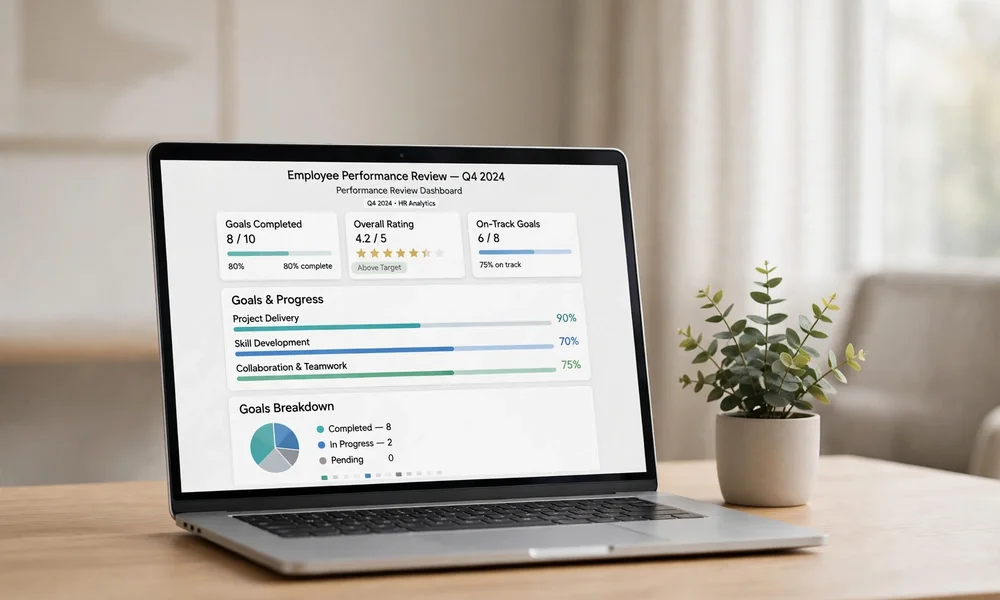
Pros: Clear, scheduled review cycles; goals linked to company objectives; strong one-to-one and feedback tools.
Cons: Full value often needs more than one bundle; per-person cost adds up as the team grows; setup takes more thought than the simplest tools.
15Five — Best for continuous feedback and check-ins
15Five takes a different approach from the annual-review tools: it assumes performance is managed week by week, not once a year. Its weekly check-in asks each employee a short set of questions about priorities, progress and blockers, and managers reply in the same place. Over a quarter, that creates a written record of what actually happened, which makes the formal review far easier to write and far harder to argue with.
The platform also covers recognition, one-to-ones, goals and structured reviews, so the weekly habit feeds directly into the bigger cycle. Managers can spot a struggling employee from two or three flat check-ins rather than discovering the problem at review time.
Pricing starts from around $10 per person per month, with deeper review and analytics features in higher-priced plans, so check current pricing for the plan that matches your review ambitions. The weekly rhythm is also a commitment: a team that will not answer a short check-in each week will get less from 15Five than from a simpler review-only tool. For teams that will keep the habit, it is the best continuous-feedback option here.
Pros: Weekly check-ins build a real performance record; recognition and one-to-ones included; reviews become easier and fairer.
Cons: Needs a weekly habit to pay off; deeper reviews cost more; some teams find the check-in cadence too frequent.
Leapsome — Best for reviews, goals and learning in one place
Leapsome combines performance reviews, goals, feedback and learning in a single platform, which suits a small business that wants to tie a review outcome to a concrete next step. When a review identifies a skill gap, the same system can suggest or assign learning content, and the next review can check whether that learning actually happened. That closed loop is rare at this price.
Its review builder is flexible without being confusing. A small team can run a simple annual review, add peer feedback, or build a 360-degree cycle with custom questions, and the goals module supports both individual targets and team objectives.
Leapsome starts from around $8 per person per month per module, so a team that wants reviews, goals and learning together should price the full combination and check current pricing before buying. The learning library is a genuine advantage, but a very small team may not use it enough to justify it. For a growing small business that wants performance and development in one place, Leapsome is a strong, well-priced choice.
Pros: Reviews, goals and learning in one system; flexible review builder with 360-degree options; good value per module.
Cons: Full platform means pricing per module; learning tools may go unused in very small teams; setup benefits from a clear plan.
PerformYard — Best for simple, flexible reviews
PerformYard is the pick for a small business that wants a proper review cycle without a platform that tries to do everything. It focuses on the core job: building a review form, running it on a schedule, collecting self-assessments and manager assessments, and keeping a clean record of the result. There is very little to learn, and a first review cycle can be running within days rather than weeks.
The flexibility is the selling point. A team can run different review forms for different roles, set its own cadence, and adjust the questions without calling in a consultant. Goals and continuous feedback are available too, but they stay secondary to the review itself, which keeps the interface uncluttered for managers who only open the tool a few times a year.
Pricing starts from around $5 per person per month, which makes PerformYard one of the most affordable options in this guide, though the exact figure depends on the plan and headcount, so check current pricing. Reporting is lighter than the analytics-heavy platforms, and there is no built-in learning library. For a small team that wants reviews done well and simply, that is a fair trade.
Pros: Simple, focused review workflow; flexible forms and cadence; one of the lowest starting prices here.
Cons: Lighter reporting than larger platforms; no built-in learning library; fewer engagement features.
Trakstar — Best for small teams wanting a light setup
Trakstar, formerly known for its performance tools under the same name, is designed for small and mid-sized teams that want reviews, goals and feedback without enterprise weight. The review cycle is straightforward: set the schedule, send the forms, track completion, and keep the signed-off record in one place. Managers can see at a glance who has finished and who still needs a nudge.
Its goal tracking keeps individual and team targets visible between reviews, and the feedback tools let employees and managers exchange notes without waiting for the formal cycle. The interface is plain and practical, which suits a small business where the person running reviews is also running something else. There is no long implementation project and no need for a specialist administrator.
Pricing is quoted rather than published as a single flat rate, so a small business should request a quote and check current pricing for its team size. Trakstar has fewer engagement and learning features than the broader platforms in this guide, and its reporting is solid rather than spectacular. For a small team that wants a light, focused performance tool at a sensible cost, it does the job well.
Pros: Light, practical setup with no long implementation; clear completion tracking; goals and feedback included.
Cons: Pricing is quoted, not flat; fewer engagement and learning features; reporting is solid rather than deep.
Engagedly — Best for engagement, recognition and performance together
Engagedly brings engagement and performance into the same system, which fits a small business that worries about retention as much as about reviews. Recognition, surveys, goals, feedback and structured reviews share one employee view, so a manager can see both how someone is performing and how they are feeling about the work. That combination helps a small team catch disengagement early, when it is still fixable.
The review tools cover self-assessments, manager assessments and 360-degree feedback, and the goals module supports individual and team targets with regular check-ins. Recognition features let colleagues praise good work publicly, which matters in a small team where a quiet thank-you can be as motivating as a formal rating. Engagement surveys add a regular temperature check between review cycles.
Pricing is not published as a single flat rate, so check current pricing for your headcount and the modules you need. The breadth is also the risk: a very small team may find Engagedly wider than it needs, and it takes a little more setup than the simplest review-only tools. For a small business that wants performance and engagement managed together, it is a capable all-rounder.
Pros: Engagement, recognition and performance in one place; 360-degree feedback included; surveys catch problems between reviews.
Cons: Pricing is quoted; broader than a very small team may need; setup takes more time than the simplest tools.
Culture Amp — Best for feedback and people analytics as you grow
Culture Amp is the most analytics-minded option in this guide, and it suits a small business that is growing fast and wants to understand its people, not just review them. Its employee surveys, feedback tools and performance reviews feed into reporting that shows patterns across teams: where engagement is slipping, which managers need support, and which parts of the review process employees actually trust.
The performance module covers goals, reviews, one-to-ones and feedback, while the survey tools run engagement and lifecycle surveys that a smaller tool would not attempt. For a team of fifty or a hundred people, that evidence is genuinely useful when deciding where to invest in training or management support.
Culture Amp is priced by quote, so check current pricing, and it is priced for growing teams rather than the smallest ones. A team of ten will pay for depth it does not yet need, and the setup rewards a clear plan. For a small business that expects to double in size and wants its people data to keep up, Culture Amp is the forward-looking choice in this list.
Pros: Strong surveys and people analytics; clear manager guidance; scales well as the team grows.
Cons: Priced by quote and aimed at growing teams; more depth than a very small team needs; setup rewards careful planning.
How to choose
Start with the size and shape of your team, not with the feature list. A team of ten that sits in one office needs a simple review cycle and a shared record; a team of sixty spread across time zones needs goals, check-ins and completion tracking that work without constant chasing. The best tool is the one your managers will actually open, so favour a clear workflow over a long feature list, and trial the review cycle with two or three real employees before you roll it out to everyone.
Next, decide how often you want feedback to happen. If you want a formal review twice a year and little in between, a focused tool such as PerformYard or Trakstar is enough. If you want weekly check-ins and continuous feedback, 15Five is built for that rhythm. If you want reviews, goals and learning tied together, Leapsome or Lattice will serve you better. And if your team is remote or hybrid, the review tool has to work alongside the way you already manage distributed work — our guide to remote team management tools covers the wider setup that makes remote reviews fair and consistent.
Finally, check the practical details before you pay: the price per person at your exact headcount, whether performance features are included or an add-on, how data exports work if you ever leave, and what support looks like when a review cycle goes wrong. A free trial that covers a full review cycle tells you more than any feature page.
Checklist: before you pay
- Run a trial review cycle with real employees before you commit to a full year.
- Confirm the per-person price at your exact headcount, including any performance add-ons.
- Check that review forms, goals and notes can be exported if you switch tools later.
- Make sure the review workflow is simple enough for a manager who only uses it twice a year.
- Ask how the tool handles peer feedback, calibration and sign-off for your team size.
- Confirm what support is included, and how quickly you get help during a live review cycle.
Frequently asked questions
What is performance management software?
Performance management software is a tool that helps a business run employee reviews, set and track goals, collect feedback and keep a record of performance conversations. For a small business, it usually replaces spreadsheets and shared documents with one system where managers and employees can see goals, check-ins and review history in the same place.
How much does performance management software cost for a small business?
Most small-business options in this guide start from around $5 to $15 per person per month, with some platforms priced by quote. The total depends on headcount, the modules you choose and whether performance features are included or an add-on. Always check current pricing for your exact team size before you buy.
Do small businesses really need performance management software?
A team of five can manage with a document and a calendar reminder, but once a business reaches ten or twenty people, reviews, goals and feedback become hard to track fairly without a system. Software helps small teams run reviews on time, keep a consistent record and give employees clearer feedback, which matters most when a team is growing quickly.
Is BambooHR or Lattice better for a small business?
BambooHR is better if you want HR records and performance in one system and a calm, simple workflow. Lattice is better if you want structured review cycles, goals and one-to-ones run on a clear schedule. The right choice depends on whether your bigger need is a combined HR system or a disciplined review process, and both are strong options for small teams.
Can performance management software help with remote teams?
Yes, and it often helps more for remote teams than for office teams, because goals, check-ins and review records replace the informal conversations that happen naturally in an office. A shared system keeps remote reviews fair and documented, and it works best alongside the wider practices in our guide to HR software for restaurants, which covers people management for teams that rarely sit in the same room.
How long does it take to set up performance management software?
A focused tool such as PerformYard or Trakstar can be running a first review cycle within a few days. A broader platform such as Lattice, Leapsome or Culture Amp usually takes one to three weeks to set up properly, including review forms, goals and manager training. Plan a trial cycle with a small group first, then roll it out to the whole team.
The bottom line
For most small businesses, BambooHR is the best starting point because it combines HR and performance in one system that managers can use without training. If reviews are your main problem, Lattice is the strongest structured option, and if you want feedback to happen every week rather than once a year, 15Five is the best fit. PerformYard is the best value choice for a team that wants a simple, affordable review cycle, and Leapsome is the best option for tying reviews to learning and development.
Whichever tool you choose, the software is only half the job. Set a clear review calendar, keep goals short and visible, and give feedback when the work happens, not months later. Do that, and any of the tools in this guide will make performance management simpler, fairer and easier to keep up with as your team grows.



